Types of Nail Guns Explained: Which One Do You Actually Need?
Gauge numbering runs backwards: the higher the number, the thinner the nail. Here is the whole range of nail gun types in gauge order, and why most DIYers only ever need one of them.

- Category
- Nailers & Fastening
- Tools tested
- 6
- Read time
- 13 min
- Updated
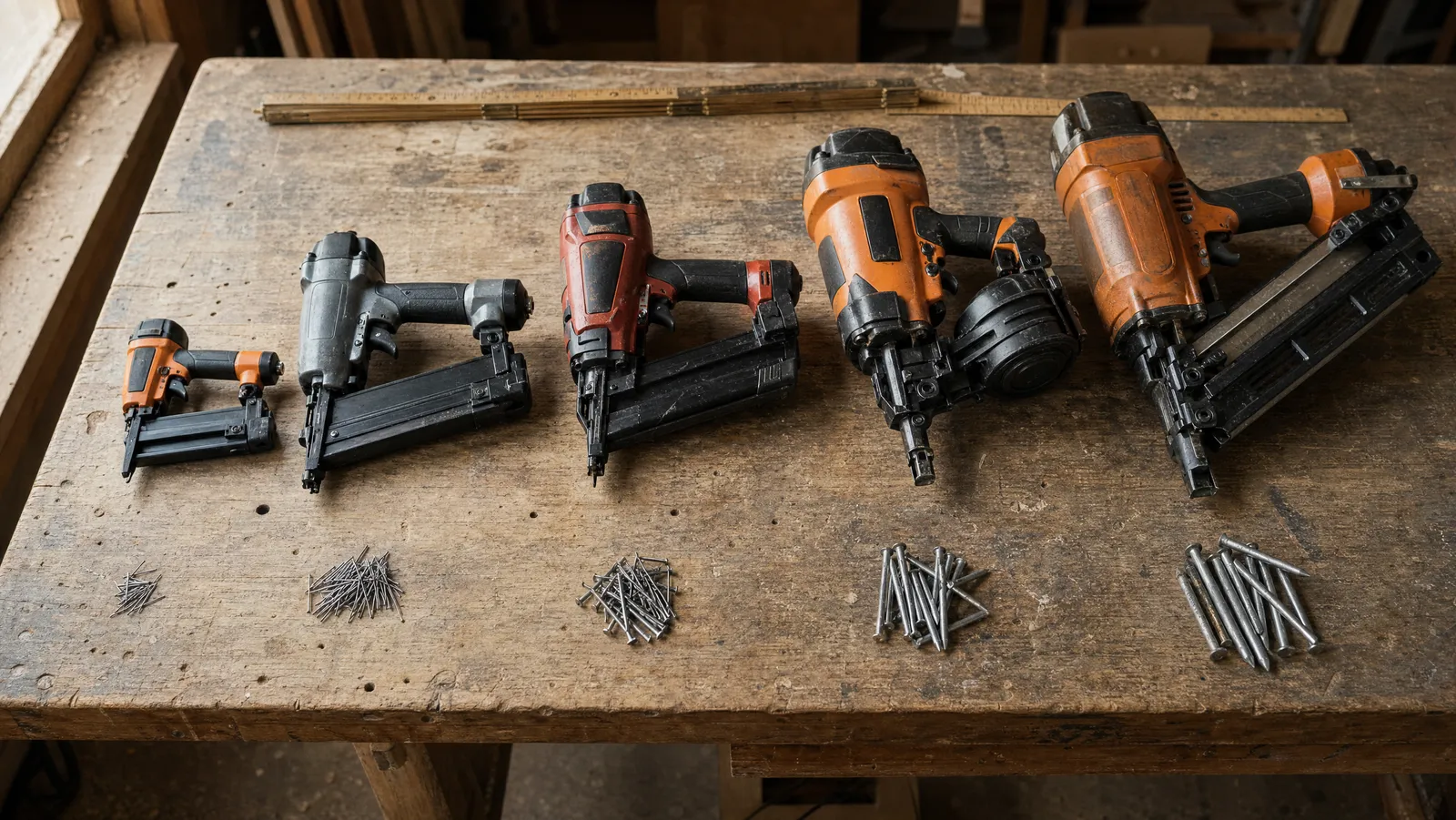
Most DIYers need exactly one nail gun: an 18-gauge brad nailer. It covers trim, molding, small assemblies and most repairs around a house. The other five families on this page exist for jobs you will probably never do — which is why our best nail gun for DIY guide is built around one tool, not six.
Below is the full range in gauge order, one representative tool per family. If you are still assembling the basics, start with essential DIY tools instead — a nailer is a second-wave purchase.
The short answer
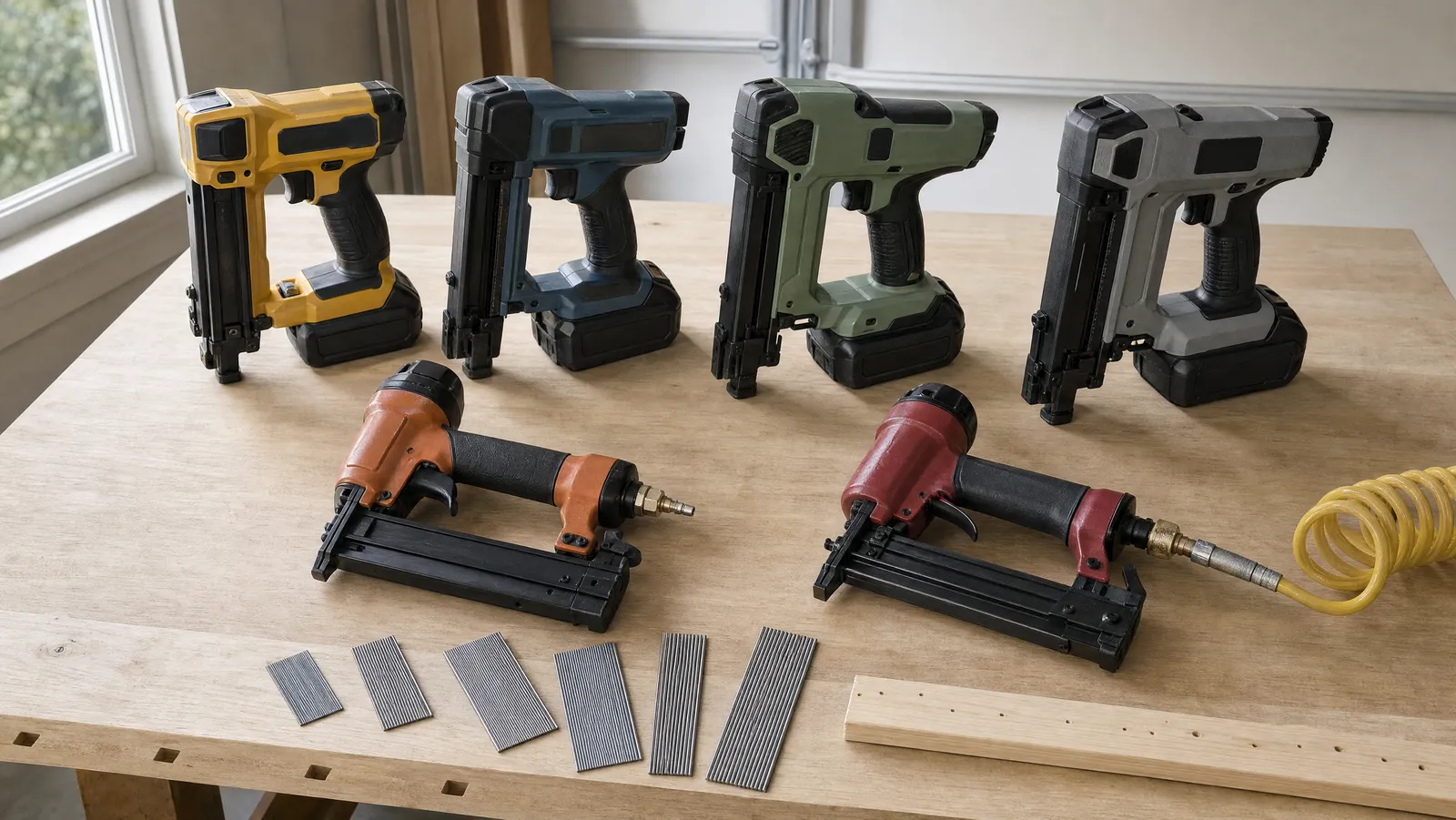
Six tool families, six jobs. 23-gauge pin nailers hold parts while glue dries. 18-gauge brad nailers handle almost all DIY trim. 16- and 15-gauge finish nailers drive the heavier trim that has to stay put. Framing nailers build structure. Staple guns are not nail guns at all, and one is here purely as the contrast case.
The price spread is the first clue that these are not substitutes. Running the numbers on the six tools below, the dearest costs about 8.6 times the cheapest — $169.00 against $19.63, as of November 2026 — and even across the five actual nail guns it is roughly 3.1 times ($169.00 against $54.97).
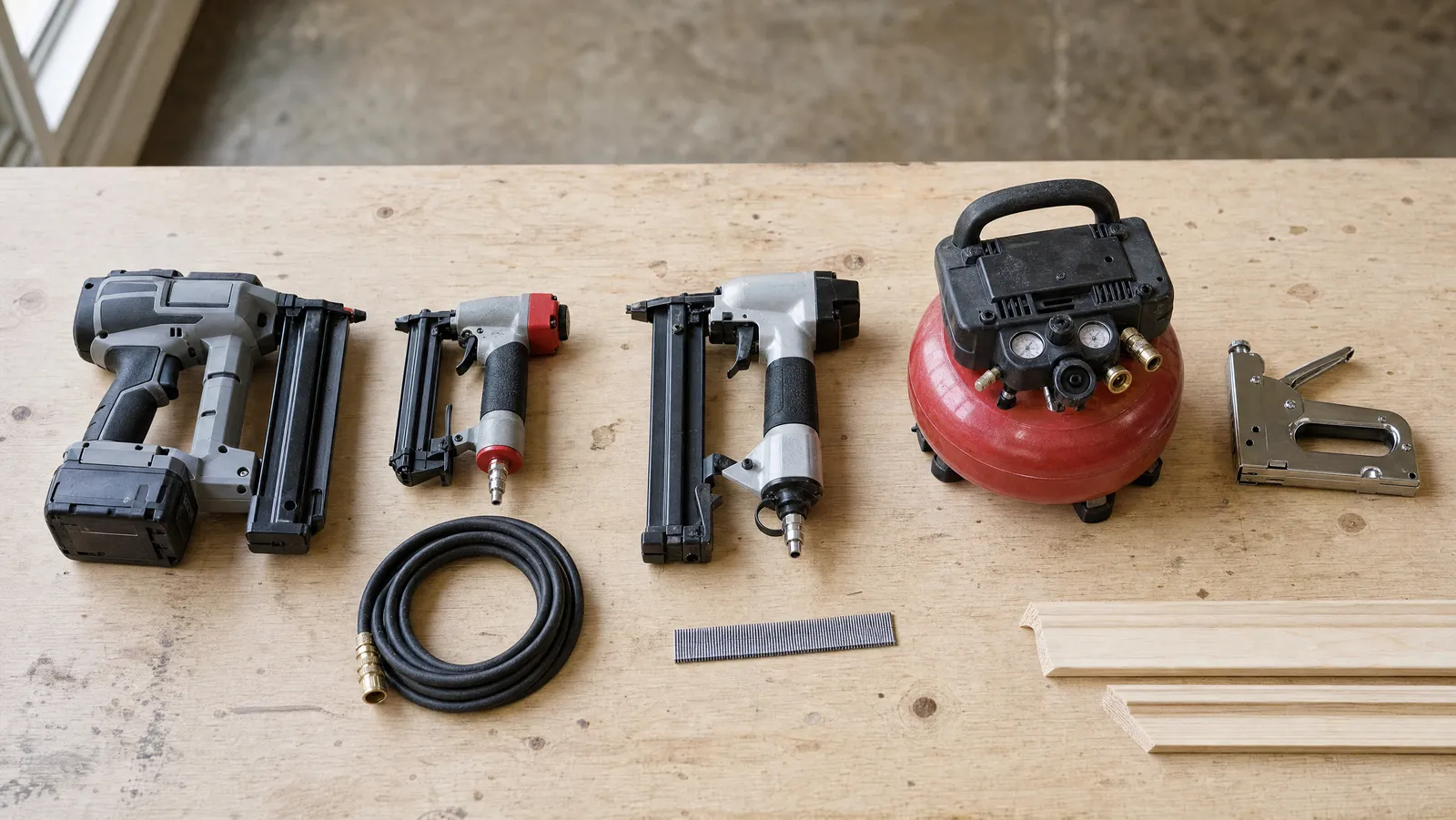
One more practical split: four of these six tools are pneumatic, one is cordless and one is hand-powered. If you do not already own a compressor, settle whether you need an air compressor for a nail gun before you pick a family, because the tank and hose can cost more than the gun.
Drag to compare all 5 →
Gauge runs backwards: the one fact that makes this simple
Here is the fact that unlocks every nailer spec sheet: gauge numbering is inverse. According to Senco, "the lower the gauge, the thicker the nail, and the higher the gauge, the thinner the nail." So a 23-gauge pin is the thinnest fastener on this page, and a framing nail the thickest.
The numbers behind it are small and specific. Grabber's spec sheet for brads, pins and finish nails lists wire diameters of 0.025 in. at 23 gauge, 0.048 in. at 18 gauge, 0.063 in. at 16 gauge and 0.072 in. at 15 gauge. Divide it out and a 15-gauge finish nail is 2.9 times the diameter of a 23-gauge pin — close to three times the wire diameter, from a gauge number that only moved eight points.
Everything else follows from that. Senco notes that higher-gauge, thinner nails "provide less holding power" but leave "smaller nail holes that can be almost invisible," while lower-gauge nails "create bigger holes that requires touch up." Grabber's own guidance says the same thing in plainer terms: higher gauges, 23 to 18, for more delicate work; lower gauges, 16 to 15, for thicker materials or stronger holds.
Brads are a standardised fastener, not a brand's invention: according to Engineers Edge, they are specified as "Brad Nails, Type I, Style 1 per ASTM F 1667."
23-gauge pin nailers: for holding, not fastening
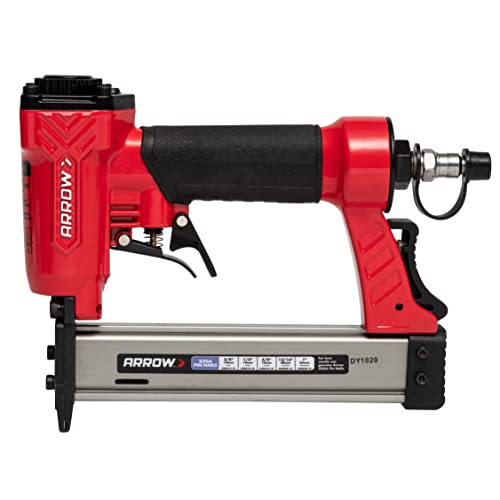
Arrow PT23G
A headless-pin gun for trim, molding and craft work, where the point is a hole you can barely find afterwards.
Pros
- Headless pins leave a hole that is close to invisible
- Oil-free, so there is no daily oiling routine
- Its listing gives the full pin range: 3/8 in. to 1 in.
- Cheapest pneumatic gun in this article at $54.97
Cons
- A 1 in. ceiling on pin length — this is a holding tool for glue-ups, not a fastening tool
- Headless pins have very little grip on their own
- Pneumatic, so it needs a compressor
- Its Amazon listing publishes no weight figure
A pin nailer is a clamp you can fire. According to Woodsmith, the glue does the real work and "the pins simply act as clamps while the glue dries"; it rates the holding power of a headless pin as "pretty fair but not great." The payoff is cosmetic — Woodsmith describes the result as a "tiny, nearly unnoticeable hole in the surface of the wood," so filling is often unnecessary.
The Arrow PT23G is the cheapest pneumatic gun here at $54.97 as of November 2026, and its listing covers pins from 3/8 in. up to 1 in. That 1 in. ceiling is the whole story: this is a holding tool, not a fastening tool. Its listing also calls it oil-free, which is a genuine convenience — just not a market exclusive, since other brands market oil-free pneumatic nailers too.
One honest caveat about consumables. The listing enumerates pin lengths of 3/8, 1/2, 5/8, 13/16 and 1 in., and says the tool works best with Arrow 23G pin nails. A 13/16 in. size appears in very few ranges, and a fastener list that leans on one brand is a real consideration when you will be buying pins for a decade.
18-gauge brad nailers: the one to buy first

WEN 20512
The family most DIYers should buy first: 18-gauge brads, cordless, and complete in the box.
Pros
- No compressor and no hose
- Arrives complete: battery, charger and 400 brads
- 18-gauge is the best all-round DIY gauge for trim and small assemblies
- 100-nail magazine
Cons
- Brads stop at 2 in.
- Its Amazon listing publishes no weight figure
- Its minimum brad is 3/4 in., longer than some pneumatic 18-gauge guns reach
This is the family we would buy if we could only own one. 18-gauge sits in the middle of the ladder: thin enough that the hole takes nothing more than a dab of filler, thick enough to actually hold trim, and at 0.048 in. on Grabber's chart, under twice the diameter of a pin.
The WEN 20512 is $108.00 as of November 2026 and shoots brads from 3/4 in. to 2 in. It is the only cordless tool in this article — 20V Max, with a 2.0Ah battery, a charger and 400 brads in the box, a 100-nail magazine, and an LED that reports battery state, magazine fill and tool temperature. No compressor, no hose dragged down a hallway. That is the same argument that makes must-have cordless power tools the sensible default for homeowners.
Two honest limits. Its brads stop at 2 in., and its 3/4 in. minimum is longer than some pneumatic 18-gauge guns reach, so very thin stock is out. For the rest of the field, see our picks for the best brad nailers for DIY.
16-gauge finish nailers: when the trim has to stay put

Metabo HPT NT65M2S
A 3.7 lb straight-magazine finish nailer covering the 1 in. to 2-1/2 in. range that baseboard and casing actually want.
Pros
- Reaches 2-1/2 in. — long enough to get through trim and drywall into framing
- 3.7 lbs, one of only three tools in this article whose listing publishes a weight
- Starts at 1 in., so it still handles lighter stock
- 5-year warranty
Cons
- Pneumatic — a compressor is required and is not included
- 16-gauge leaves a bigger hole than an 18-gauge brad
- A straight magazine is harder to get into an inside corner than an angled one
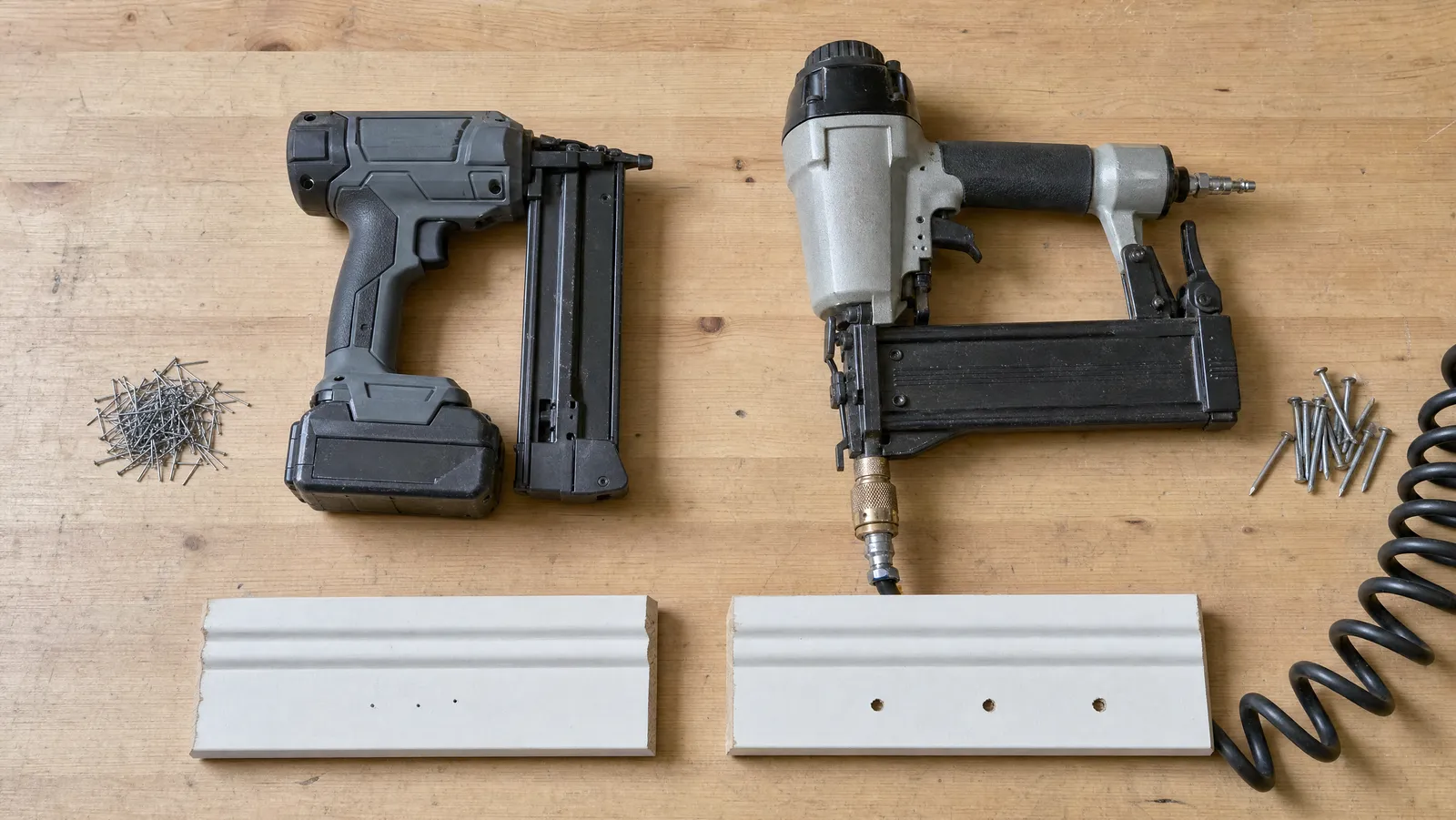
Step down to 16 gauge and the nail gets meaningfully thicker — 0.063 in. against 0.048 in. on Grabber's chart. That is exactly the trade readers are weighing when they ask about the difference between a brad nailer and a finish nailer: you gain grip and you lose invisibility.
The Metabo HPT NT65M2S is $109.00 as of November 2026 — a single dollar more than the cordless brad nailer — and it drives 16-gauge nails from 1 in. to 2-1/2 in. Its listing publishes a weight of 3.7 lbs, making it one of only three tools in this article that publishes one at all. It adds a selective actuation switch for bump or sequential firing, tool-free depth of drive, a no-mar tip, a 360-degree adjustable exhaust and an air duster button, under Metabo HPT's 5-year tool warranty.
The costs are a compressor, which is not included, and a straight magazine, which is harder to work into an inside corner than an angled one.
15-gauge angled finish nailers: reaching the corner

Metabo HPT NT65MA4
The heavier trim gauge, on an angled magazine built to reach into corners a straight gun cannot.
Pros
- Angled magazine reaches inside corners and tight returns
- 15-gauge holds harder than 16-gauge in the same length
- 4.2 lbs — the middle of the three tools here whose listings publish a weight
- Same 2-1/2 in. ceiling as the 16-gauge gun
Cons
- Its minimum nail is 1-1/4 in., not 1 in. — it is less useful on thin stock
- 15-gauge leaves the largest hole of any trim gauge here
- Pneumatic, and uses DA-style angled nails rather than straight strips
15 gauge is the thickest trim gauge at 0.072 in. per Grabber's chart, and on the NT65MA4 the angled magazine is the entire point: its listing describes the angle as being "for easier placement and operation in tight corners." At $136.80 as of November 2026 it is the dearest of the three trim guns here, and at 4.2 lbs it sits in the middle of the three tools whose listings publish a weight.
It drives angled DA nails from 1-1/4 in. to 2-1/2 in. — the same ceiling as the 16-gauge gun, but a minimum a quarter-inch longer, which quietly rules out thin stock. If heavy trim is the actual job, our guide to the best finish nailers for trim weighs 15 against 16 gauge properly.
Framing nailers: the structural end of the range

Metabo HPT NR90AES1
The structural end of the range: 2 in. to 3-1/2 in. nails for framing, sheathing and decking, and the one family most homeowners never need.
Pros
- Drives structural nails from 2 in. to 3-1/2 in.
- Selective actuation switch for sequential or contact firing
- 5-year warranty
- The right tool for framing, decking and sheathing
Cons
- 7.5 lbs — the heaviest of the three tools here that publish a weight, and a two-hand proposition overhead
- Needs a compressor with real sustained air delivery, not a small hobby unit
- Wildly oversized for trim: it cannot do what a brad nailer does
- Its Amazon listing does not state whether it drives full-round-head or clipped-head nails
Framing is a different trade. The Metabo HPT NR90AES1 is $169.00 as of November 2026 and drives 21-degree plastic collated nails from 2 in. to 3-1/2 in., for the applications its listing names: framing, truss and window build-up, sub-flooring, roof decking, wall sheathing and housing construction. At 7.5 lbs it is the heaviest of the three tools here that publish a weight, and overhead that is a two-hand proposition.
Two things to know before buying one. It wants a compressor with real sustained air delivery rather than a small hobby unit. And its Amazon listing never states the nail head type — full round head or clipped head — which is the spec that decides whether a given nail is accepted on a particular jobsite.
That matters less than the internet suggests. According to the Journal of Light Construction, model codes specify "nails by length and by shank diameter, not by the type of nail head," and there is "no evidence that round-head nails provide greater shear strength or withdrawal resistance than clipped-head nails" — though it notes some inspectors ask for round heads on exterior sheathing anyway. Senco adds the practical angle: because clipped-head nails are collated at a steeper angle, a clipped-head strip "allows for a greater quantity of nails in a collated strip meaning fewer reloads" — so full round heads cost you nails per stick. Where a jurisdiction does legislate head type, most sources suggest it is clipped heads that get restricted rather than round ones, which makes a full round-head gun the conservative buy.
Staple guns are not nail guns

Arrow T50
Not a nail gun at all, and worth saying so: staples hold sheet goods and fabric, where a nail would pull straight through.
Pros
- $19.63 — the cheapest tool in this article by a wide margin
- No compressor, no battery, nothing to charge
- A staple's two legs and crown hold thin material a nail would tear through
- Staple-viewing window shows when to reload
Cons
- Hand power only — it will tire you out over a big job
- Staples are visible; this is not a trim tool
- Staples sold separately
- Maximum 9/16 in. leg length per its listing
The Arrow T50 is in this article precisely because it is not a nail gun. A staple has two legs and a crown; a nail has one shank and a small head. That crown is why staples suit insulation, upholstery, wood, general repairs and crafts — the applications its listing names — where a nail would pull straight through thin material.
It is hand-powered and $19.63 as of November 2026, the cheapest tool here by a wide margin. It takes Arrow T50 staples from 1/4 in. to 9/16 in., sold separately, in a chromed-steel body with a staple-viewing window so you can see when to reload. The limits are obvious: 9/16 in. is the longest leg per its listing, staples stay visible, and squeezing a handle a thousand times will wear your hand out.
Roofing, siding and flooring nailers, briefly
Three more families exist, and each is single-purpose. Roofing nailers are built around short, wide-head nails for asphalt shingles. Siding nailers are generally set up for corrosion-resistant nails driven through lap or fiber-cement siding into the studs behind it. Flooring nailers are typically struck with a mallet and fire at an angle through the tongue of a hardwood board, so the next course hides the fastener.
We have no product data for these three, so take no numbers from us on them. The point for a DIYer is simpler: each one is a rental, not a purchase, unless the job is your trade.
Why the minimum nail length matters more than the maximum
Buyers read the maximum. The minimum is what actually stops a gun doing work.
Line the five nail guns up by their shortest fastener and the pattern is exact: 3/8 in. for the 23-gauge pin nailer, 3/4 in. for the 18-gauge brad nailer, 1 in. for the 16-gauge finish nailer, 1-1/4 in. for the 15-gauge angled gun, 2 in. for the framing nailer. The minimum rises at every single step as the fastener gets thicker — another way of saying that the heavier the gun, the less delicate work it can do.
Then look at where the ranges meet. The pin nailer and the brad nailer share only 3/4 in. to 1 in. Both finish nailers stop at 2-1/2 in. while the framing nailer starts at 2 in., so structural and trim territory overlap by just half an inch. And 2 in. is the single length four of these five guns can all drive: the brad nailer at its ceiling, both finish nailers mid-range, and the framing nailer at its floor. Below 3/4 in. only the pin nailer plays; above 2-1/2 in. only the framing nailer does.
Grabber offers a rule of thumb for choosing inside those ranges: "multiply the length of the material being fastened by three, or the closest shorter length" — which most sources read as three times the thickness of the stock you are fastening. On 1/2 in. stock that lands you at 1-1/2 in., which is inside the brad nailer's range and inside both finish nailers'. It is also the point where technique starts to matter more than the tool, which is the real subject of how to use a nail gun.
Frequently asked questions
What is the difference between a brad nailer and a finish nailer?
Gauge. A brad nailer fires 18-gauge brads; a finish nailer fires 16- or 15-gauge nails, which Senco describes as thicker wire with more holding power and a bigger hole to fill. On the tools above, that is 0.048 in. against 0.063 in. and 0.072 in. per Grabber's spec sheet.
Is a higher-gauge nail stronger?
No — the opposite. According to Senco, "the higher the gauge, the thinner the nail," and higher-gauge nails "provide less holding power." The 23-gauge pin is the weakest fastener in this guide and the framing nail the strongest.
Do I need both a pin nailer and a brad nailer?
Most people do not. A brad nailer covers nearly all DIY trim. A pin nailer earns its place only if you build small glued assemblies, which is exactly the job Woodsmith describes when it calls pins clamps that hold parts while the glue cures.
Can one nail gun do everything?
No. The five nail guns here span fasteners from 3/8 in. to 3-1/2 in., and no single one of them covers more than about half that range. Pick the family that matches the work you actually do.
Which one you actually need
If you are buying one nail gun, buy an 18-gauge brad nailer. It is the gauge that fits the most DIY jobs, the hole is small enough to hide, and a cordless one skips the compressor question entirely — the trade-off we unpack in cordless versus pneumatic nailers.
Buy a second gun only when a specific job demands it: a 16- or 15-gauge finish nailer when you are running real baseboard and casing, a pin nailer when you are gluing up small parts, and a framing nailer essentially never — rent it. A staple gun, at under twenty dollars, is worth owning regardless, because it does a job no nail gun does.
For the full field and our pick in each family, start with our complete nail gun guide.
About the Author
Cheryl Thompson
Cheryl Thompson is the tools editor at The DIY Tool Review. A lifelong fixer and self-confessed tool addict, she has spent years buying, borrowing and wearing out hand and power tools across home renovation, furniture building and everyday repairs. She writes hands-on, no-nonsense reviews to help fellow DIYers spend their money on the tools that actually last.