The Best Circular Saws for DIY (2026)
Blade diameter decides how deep a circular saw cuts — price barely moves it. The $44 SKIL and the $129 DEWALT are 1/8 in. apart, while the cordless pick quietly gives up 7/16 in.

- Category
- Saws & Cutting Tools
- Tools tested
- 5
- Read time
- 16 min
- Updated
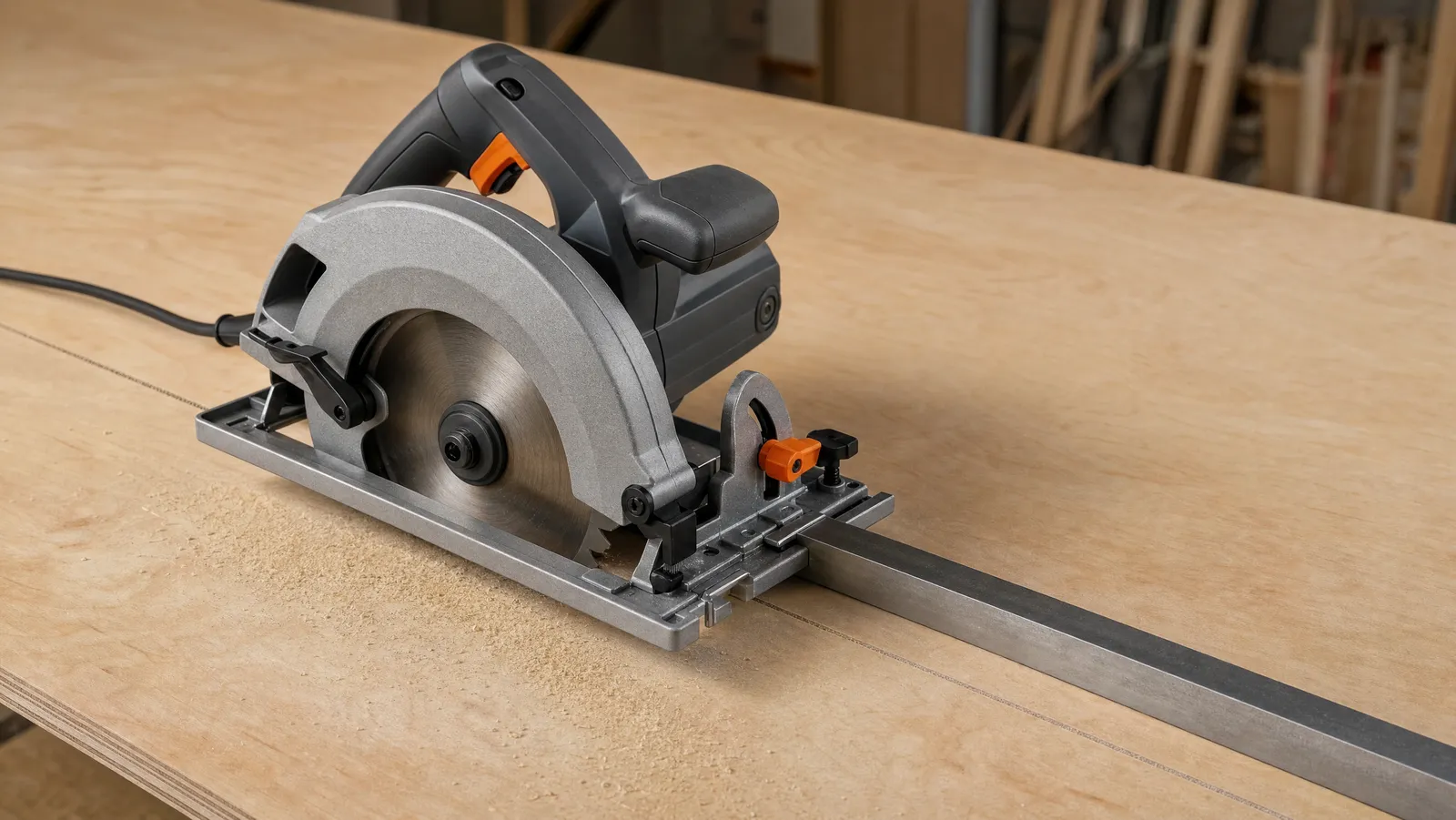
The best circular saw for DIY is the DEWALT DWE575 at $129.00 as of October 2026: 2-9/16 in. of cut depth, a 57-degree bevel, 8.8 lb. If that is more saw than your projects justify, the SKIL 5080-01 at $44.00 as of October 2026 cuts just 1/8 in. shallower for about a third of the money.
That eighth of an inch is the entire argument of this guide. Spending three times more buys you amps, an aluminum shoe, a longer warranty and — on the SB — a brake; it does not buy depth of cut. The only thing that buys depth is blade diameter, which is why the cordless DEWALT here at $99.00 as of October 2026, the saw that looks like the obvious modern choice, quietly gives up 7/16 in. to the corded pick. Most roundups never mention it. This article sits inside our wider guide to the best saw for DIY, which covers the whole category rather than just this one shape of tool.
How we picked
We have not bench-tested these five saws and we are not going to pretend otherwise. Every pick is built from published manufacturer specifications, the current Amazon listing, and arithmetic you can check against the table below.
We publish no star ratings and no review counts, because our product data source does not supply them. Where a spec appears, we say whose spec it is — DEWALT's, SKIL's, or a retailer listing's. Prices are as of October 2026 and move constantly.
Drag to compare all 5 →
What actually matters when you buy
Six things separate these saws. Only the first one is hard to change your mind about later.
Depth of cut, and why blade diameter sets it
A circular saw's maximum depth is a consequence of geometry: the blade's radius, minus however much of it the motor housing and shoe swallow. According to home-renovation writer Jon Eakes, the 7-1/4 in. blade became the standard portable size specifically "because it would easily cut through 2x4's at 90 degrees," and the depth of cut for a given diameter "is limited by the size of the motor itself" — which is why decades of motor redesign have been aimed at letting more blade hang below the housing.
Run the numbers on these five and the pattern is stark. Convert the fractions: 2-9/16 in. is 2.5625 in., 2-7/16 in. is 2.4375 in., and 2-1/8 in. is 2.125 in.
- The four 7-1/4 in. saws span 2.5625 in. down to 2.4375 in. — a spread of 0.125 in., exactly 1/8 in., across prices from $44.00 to $140.99 as of October 2026.
- The 6-1/2 in. cordless DCS391B sits at 2.125 in. Against the DWE575's 2.5625 in. that is a deficit of 0.4375 in., or 7/16 in. — three and a half times the entire spread among the bigger saws.
Here is the part worth pausing on. The cordless saw's blade is 0.75 in. smaller in diameter — 0.375 in. of radius — yet it loses 0.4375 in. of depth. The extra 1/16 in. disappears into shoe and guard geometry, so a smaller blade costs slightly more than its radius suggests.
Depth figures are the makers' or their retailers' published numbers, not our measurements. The two SKILs are both listed at 2-7/16 in.; we have not verified that they are identical in practice.
Bevel capacity
Bevel is how far the shoe tilts so the blade leans over. The two DEWALT corded saws reach 57 degrees with detents at 45 and 22.5; both SKILs reach 51 degrees with a positive stop at 45; the cordless DCS391B covers 0 to 50 degrees per its listing.
For almost all home work this is a non-issue: the stop at 45 is what you will use, and all five have it. The extra six degrees on the DEWALTs matters for roof and rake cuts and almost nowhere else. A positive stop you can feel is worth more day to day than a wider range you never visit.
Amps vs. cut quality
Amps measure how much current a motor is allowed to draw, not how neatly the saw cuts. Three of these saws are 15-amp; SKIL rates the 5080-01 at 13 amps, and the cordless DCS391B carries no amp rating at all, because it runs off a 20V MAX battery rather than a wall outlet. SKIL markets that 13-amp motor as "more power and performance than the SKIL 5380" and claims a "15% weight reduction" against the same older model — both are SKIL's own comparisons to a different saw, not a claim about this group.
What actually decides edge quality is the blade — specifically its tooth count and its kerf, the width of the slot the teeth remove. According to Fine Homebuilding, "a blade with a lower tooth count tends to cut faster than a blade with a higher tooth count, but the quality of the cut is rougher," and that the common 24-tooth framing blade "gives a pretty clean rip cut but a rougher crosscut." For sheet goods the magazine says "a 40-tooth blade works fine for most cuts through plywood," while warning that too high a tooth count "yields a slower cut that ends up burning the material."
Practical reading: buy any saw here, then buy a 40-tooth blade. That changes your results more than the jump from 13 to 15 amps.
Weight
You hold this tool out at arm's length. The spread here runs from 6.95 lb (SKIL 5080-01) to 8.8 lb (both corded DEWALTs) — 1.85 lb, which is about a quarter of the lightest saw's total weight.
The cordless DCS391B is listed at 7.0 lb as a bare tool, which is honest but incomplete: that figure excludes the 20V MAX battery, which is not in the box. Even bare it is heavier than the 6.95 lb SKIL 5080-01, and adding a battery widens that gap.
Electric brake
An electric brake stops the blade when you release the trigger instead of letting it coast. According to Pro Tool Reviews, releasing the trigger reverses the flow of electricity and throws the motor into reverse just long enough to stop the blade "in about 2 seconds," where a blade on a saw without one "can continue spinning for 10 seconds or more." SKIL's and Bosch's own circular-saw manuals warn that a lower guard "may operate sluggishly due to damaged parts, gummy deposits, or a build-up of debris" and that a saw whose guard does not close instantly should not be used — which is exactly the moment a coasting blade is dangerous.
Among the corded saws here, only the DWE575SB has one. Some retailer listings describe the cordless DCS391B as having a brake as well, but DEWALT's own feature list for that tool does not mention one, so we have not counted it. The premium over the identical un-braked DWE575 works out at $140.99 minus $129.00, or $11.99 as of October 2026. For eight seconds less spinning blade per cut, that is cheap.
Corded vs. cordless
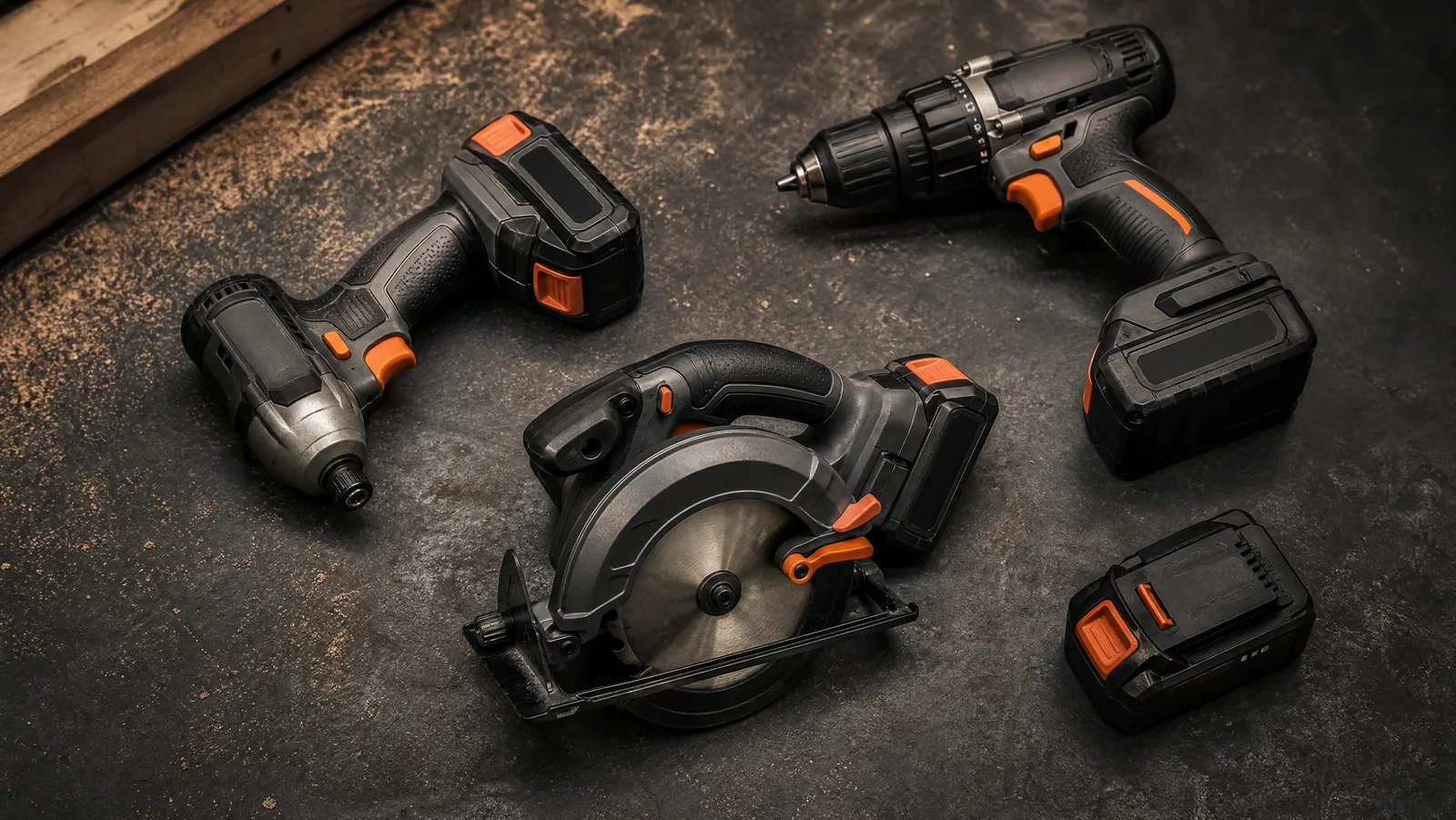
The honest trade on this list is not brand, it is 7/16 in. of depth and a battery you have to buy separately versus never managing a cord again. If you already own 20V MAX batteries, the DCS391B is a genuinely good buy; if you do not, add the cost of a battery and charger before you compare it to the SKIL 5280-01 at $69.00 as of October 2026. We work through the whole decision in corded vs cordless power tools, and the saw-specific version of it in cordless power tools for woodworking.
If this is your first serious power tool, see where a saw ranks against a drill and an impact driver in best cordless power tools for DIY before you commit to a battery platform.
The five best circular saws for home DIY
Best overall: DEWALT DWE575

DEWALT DWE575
The deepest cut in this group at 2-9/16 in. and the best-built corded saw here, currently 28 percent off list.
Pros
- Deepest cut at 90 degrees of any saw here, 2-9/16 in.
- 57-degree bevel, the widest in this group
- Anti-snag ball-bearing lower guard and a reinforced cord
Cons
- Nearly three times the price of the budget SKIL
- No electric brake — that is the DWE575SB
- Tied for the heaviest saw here at 8.8 lb
This is the saw we would buy. DEWALT's own product page lists 2-9/16 in. of depth at 90 degrees, 2 in. at 45 degrees, a 57-degree bevel capacity and 8.8 lb — the deepest cut and the widest bevel on this page. Its listing also calls out an anti-snag ball-bearing lower guard — the detail that stops the guard hanging up on a board edge — and a reinforced cord entry.
At $129.00 as of October 2026, down from a $179.00 list price — a 28 percent discount we checked at 50 dollars off 179, or 27.9 percent — it costs nearly three times the budget SKIL. Divide it out: the SKIL 5080-01 is 34 percent of this saw's price for 95 percent of its depth. The extra money buys build quality, bevel range and 1/8 in. Honest cons: no electric brake (that is the SB version below), and at 8.8 lb it is tied for heaviest here.
Best value: SKIL 5280-01
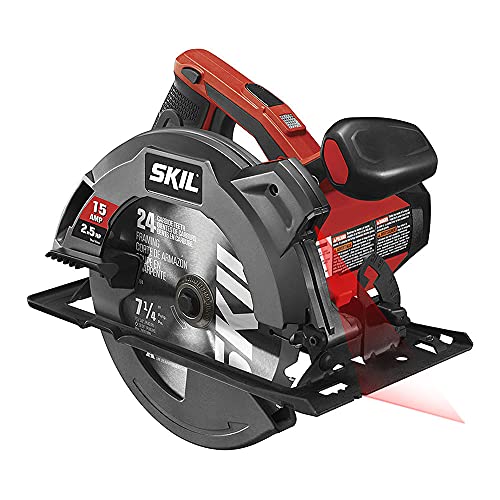
SKIL 5280-01
A full 15-amp motor, a laser guide and the same listed cut depth as the budget model, for 25 dollars more and 1.75 lb heavier.
Pros
- Full 15-amp motor at a budget price
- Laser guide and dust blower help you track a line
- Safety-lock trigger and power-on indicator
Cons
- 1.75 lb heavier than the cheaper SKIL 5080-01
- Listed to cut no deeper than the 44-dollar model
- The feature bullets never mention the laser the title sells it on
The 5280-01 is the saw most people should actually put in the cart, and the reason is boring: a full 15-amp motor, a laser guide, a dust blower to keep the line visible, and a safety-lock trigger with a power-on indicator, for $69.00 as of October 2026. SKIL's page lists 5,300 RPM, 2-7/16 in. of depth at 90 degrees, 1-15/16 in. at 45, and a 51-degree bevel with a positive stop at 45.
Two caveats we would want to know. It is 8.7 lb, 1.75 lb heavier than the cheaper 5080-01, which you will feel on a long day of cuts. And it is listed to cut no deeper than the 44-dollar model — the 25 dollars buys amps, the laser and the trigger safety, not capacity. The SKIL 5280-01 is still the best balance of price and features on this page.
Best budget circular saw: SKIL 5080-01

SKIL 5080-01
The cheapest saw here and the lightest at 6.95 lb. It is listed at exactly the same depth of cut as the SKIL that costs 57 percent more.
Pros
- Lightest saw in this group at 6.95 lb
- Listed at the same 2-7/16 in. depth as the dearer SKIL
- 51-degree bevel with a positive stop at 45
Cons
- 13-amp motor draws the least current of any saw here
- No laser guide and no electric brake
- Its two headline claims are both SKIL's comparisons to the older SKIL 5380
At $44.00 as of October 2026 this is the cheapest and the lightest saw here at 6.95 lb, and retailer and maker listings put it at the same 2-7/16 in. at 90 degrees and 1-15/16 in. at 45 as its dearer sibling, with the same 51-degree bevel and positive stop at 45. It also has a spindle lock, so blade changes need one wrench instead of two hands and a prayer.
Be clear about what you give up. SKIL rates the motor at 13 amps, the lowest current draw on this page, so it is the saw most likely to bog in wet pressure-treated stock. There is no laser and no electric brake. And its two headline marketing claims — more power, 15 percent lighter — are both SKIL's comparisons to the older 5380, not to anything on this list. For a homeowner cutting plywood and 2x4s a few weekends a year, none of that is disqualifying.
Best cordless circular saw for DIY: DEWALT DCS391B

DEWALT DCS391B
No cord and 7.0 lb as a bare tool, lighter than either corded DEWALT, but its 6-1/2 in. blade gives up 7/16 in. of cut depth and the battery is not included.
Pros
- No cord to manage or trip over
- 7.0 lb bare, lighter than either corded DEWALT
- Magnesium shoe and a 0-50 degree bevel
Cons
- Battery and charger are not included at this price
- 6-1/2 in. blade cuts 7/16 in. shallower at 90 degrees than the DWE575
- Shallowest 45-degree cut here at 1-5/8 in.
Cutting without a cord is genuinely better, and at $99.00 as of October 2026 — marked down from $159.00, a 38 percent cut we re-derived as 60 dollars off 159 — this is the cheapest serious way into it. DEWALT's spec sheet, as carried by major retailers, lists a 6-1/2 in. blade, 5,150 RPM, 2-1/8 in. of depth at 90 degrees, 1-5/8 in. at 45, a 0-50 degree bevel and 7.0 lb as a bare tool, with a magnesium shoe.
Now the part the listing does not tell you. That 6-1/2 in. blade is 7/16 in. shallower at 90 degrees than the DWE575 and 3/8 in. shallower at 45, where its 1-5/8 in. is the shallowest listed 45-degree cut on this page. And "Tool Only" means no battery and no charger — budget for a 20V MAX pack and a charger before you compare this price to anything corded. It is the right saw if you already own the batteries, and an expensive one if you do not.
Best with a brake: DEWALT DWE575SB
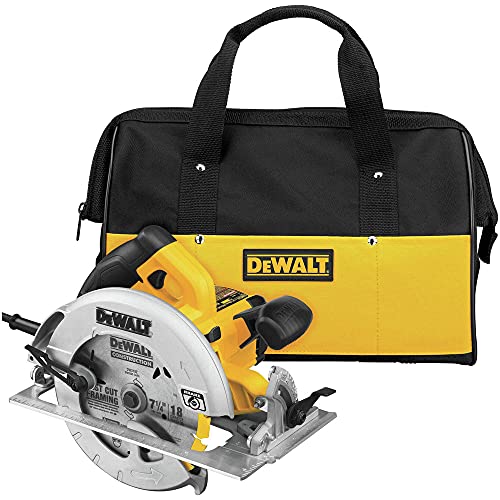
DEWALT DWE575SB
The same saw as the DWE575 plus an electric brake that stops the blade when you let go of the trigger, for about 12 dollars more.
Pros
- Electric brake stops the blade after trigger release
- Same 2-9/16 in. depth and 57-degree bevel as the DWE575
- Same 8.8 lb weight despite the added brake
Cons
- The most expensive saw in this group at $140.99 as of October 2026
- Identical to the DWE575 apart from the brake
- Still a corded saw, with a cord to manage on every cut
The SB is the DWE575 with one addition: an electric brake that stops the blade after you release the trigger. Everything else matches — 7-1/4 in. blade, 2-9/16 in. at 90 degrees, 57-degree bevel with stops at 45 and 22.5, and the same 8.8 lb despite the extra hardware.
At $140.99 as of October 2026 it is the most expensive saw in this group, and that is the whole case against it: you are paying about 12 dollars for a single feature on an otherwise identical tool. Given what Pro Tool Reviews describes about blades coasting for ten seconds or more, we think it is money well spent — and if your budget stretches, the DWE575SB is the version of our overall pick we would own.
Read the listing, not the title
Two of these five ASINs have listings that are measurably wrong or incomplete. We flag them because it is the kind of thing that quietly decides a purchase.
1. The DWE575's bevel is 57 degrees, not 53. The Amazon feature bullet for this ASIN states a "bevel capacity of 53-degree." DEWALT's own DWE575 product page says 57 degrees, and the bullets on its sibling DWE575SB listing say 57 as well. Two sources against one, including the manufacturer's: the Amazon bullet is the error. We have used 57 throughout.
2. The cordless DCS391B listing never tells you its blade size. Read the title and all four feature bullets on that ASIN and you get 5,150 RPM, a magnesium shoe, an over-molded grip and a 0-50 degree bevel. You will not find the blade diameter or the depth of cut. It is a 6-1/2 in. saw — the single most consequential difference between it and every other saw here. You have to reach DEWALT's spec sheet, or a retailer that reprints it, to learn that.
Neither defect makes either saw a bad tool. Both mean the listing is not where to do your research.
What one pass will and won't cut
Depth numbers only mean something against real lumber, and real lumber is smaller than its name. According to Roof Observations, which cites the American Softwood Lumber Standard (PS 20) published through the American Lumber Standard Committee, a nominal 2x4 actually measures 1-1/2 in. by 3-1/2 in., a 2x6 is 1-1/2 in. by 5-1/2 in., and a 4x4 is 3-1/2 in. by 3-1/2 in.
Hold that against the table:
- A 2x4 laid flat is 1-1/2 in. thick. Every saw here clears it at 90 degrees, including the 2-1/8 in. cordless. This is the cut you will make most often, and no saw on this page struggles with it.
- A 4x4 is 3-1/2 in. No saw here cuts that in a single pass — the deepest is 2-9/16 in. You flip the post and cut from two sides, and that is true of the $44.00 saw and the $140.99 saw equally.
- A 2x6 on edge is 5-1/2 in. Not even close, from any of them.
- Plywood and sheet goods mostly run 1/4 in. to 3/4 in. thick, so depth is never the constraint. Blade choice is.
So the real question is not depth. It is whether you will often stand a 4x4 on a bench — and if you will, a circular saw is not the tool for it. A circular saw is the right first buy for most people, but it is not the only option, and types of saws explained walks through the miter, jig and reciprocating saws that handle the cuts this one cannot.
Our verdict
Buy the SKIL 5280-01 at $69.00 as of October 2026 for the most saw per dollar; buy the DEWALT DWE575 at $129.00 as of October 2026, or the DWE575SB for about 12 dollars more, if you want the tool you will still own in fifteen years. Buy the SKIL 5080-01 at $44.00 as of October 2026 if the saw is for four weekends a year, and take the 6.95 lb as a bonus. Take the cordless DCS391B only if 20V MAX batteries are already in your garage.
What should not drive the decision is depth, which varies by just 1/8 in. across the four 7-1/4 in. saws here and a 97-dollar price range. It moves only when the blade does. For how a circular saw fits alongside the other saws worth owning, start with our complete saw buying guide.
Frequently asked questions
What is the best circular saw for DIY?
For most homeowners it is the DEWALT DWE575 at $129.00 as of October 2026 — the deepest cut here at 2-9/16 in., a 57-degree bevel and a well-built 8.8 lb body. If you want the same practical capability for less, the SKIL 5280-01 at $69.00 as of October 2026 is listed within 1/8 in. of it on depth and adds a laser guide.
Is a 6-1/2 in. cordless circular saw big enough?
For sheet goods and framing lumber laid flat, yes. The DCS391B is listed at 2-1/8 in. of depth at 90 degrees, and a nominal 2x4 is only 1-1/2 in. thick per the American Softwood Lumber Standard. Where it falls short is anything near its limit — it cuts 7/16 in. shallower than a 7-1/4 in. DEWALT, and just 1-5/8 in. at a 45-degree bevel.
Do I need a 15-amp saw, or is 13 amps enough?
Thirteen amps is enough for plywood, trim and dry framing lumber. Amps describe current draw, not cut quality, and a higher figure mostly buys resistance to bogging in dense or wet stock. If you are choosing between the 13-amp SKIL 5080-01 and the 15-amp 5280-01, note that both are listed at the same 2-7/16 in. depth of cut.
Is an electric brake worth paying extra for?
We think so, at this price. According to Pro Tool Reviews, an electric brake stops the blade in about 2 seconds, while a blade without one can keep spinning for 10 seconds or more. The DWE575SB costs $11.99 more than the otherwise identical DWE575 as of October 2026, which is a small premium for removing eight seconds of exposed moving blade from every cut.
About the Author
Cheryl Thompson
Cheryl Thompson is the tools editor at The DIY Tool Review. A lifelong fixer and self-confessed tool addict, she has spent years buying, borrowing and wearing out hand and power tools across home renovation, furniture building and everyday repairs. She writes hands-on, no-nonsense reviews to help fellow DIYers spend their money on the tools that actually last.