Cordless Power Tool Batteries Explained: Voltage, Amp-Hours & Platforms (2026)
Voltage, amp-hours, brushless motors and battery platforms — the confusing specs behind every cordless tool, explained in plain English so you can pick the right pack and the right brand to commit to.

- Category
- Power Tools
- Format
- How-to guide
- Read time
- 11 min
- Updated
Cordless power tool batteries are the single most confusing part of cutting the cord — a wall of voltages, amp-hour ratings and brand names that all seem designed to separate you from your money. Here is the reassuring truth: once you understand three specs and one big idea, the whole aisle makes sense.
This guide covers the essentials in plain English — voltage, amp-hours, brushless motors and, most importantly, battery platforms. The real decision you are making isn't which drill to buy; it's which battery platform to marry, because every tool you add later has to run on the same packs. When you're ready to shop the tools themselves, start with our cordless power tools buyer's guide.
Voltage: what cordless tool battery voltage really means
Voltage is the first number on the pack, and it's roughly a proxy for power and weight — not quality. A higher-voltage tool can push more current to its motor, so it drives longer screws and cuts thicker stock, but it also carries a bigger, heavier battery. What it means for you: more voltage buys muscle, at the cost of size and price.
For DIY, three tiers cover almost everything.
Here is the marketing wrinkle that trips up every beginner: "20V MAX" and "18V" describe the same class of battery. According to Pro Tool Reviews, "20V MAX" is simply the peak, no-load voltage of a freshly charged pack, while its nominal running voltage — the figure most of the world prints — is 18V. A standard pack is five lithium-ion cells wired in series, and 5 × 3.7V works out to about 18.5V nominal, briefly touching 20V straight off the charger. Same cells, same performance, bigger number on the box.
So is higher voltage better for cordless tools? Only when the job demands it. For the vast majority of DIY — drilling, driving, sanding and light cutting — an 18V/20V MAX platform is the sweet spot: enough power for real work, light enough to use all day. Reach for 36V or 40V+ only when you move outdoors to saws and mowers, and drop to 12V when you want the lightest possible tool for assembly and overhead work.
One trap to sidestep: voltage and capacity are two different things, and a big battery does not turn a small tool into a powerful one. Bolting a 6.0Ah pack onto a 12V drill gives you longer runtime, not more torque — the voltage still caps how hard the motor can push. Match the voltage to the job first, then choose your capacity.
Amp-hours (Ah): your battery's runtime
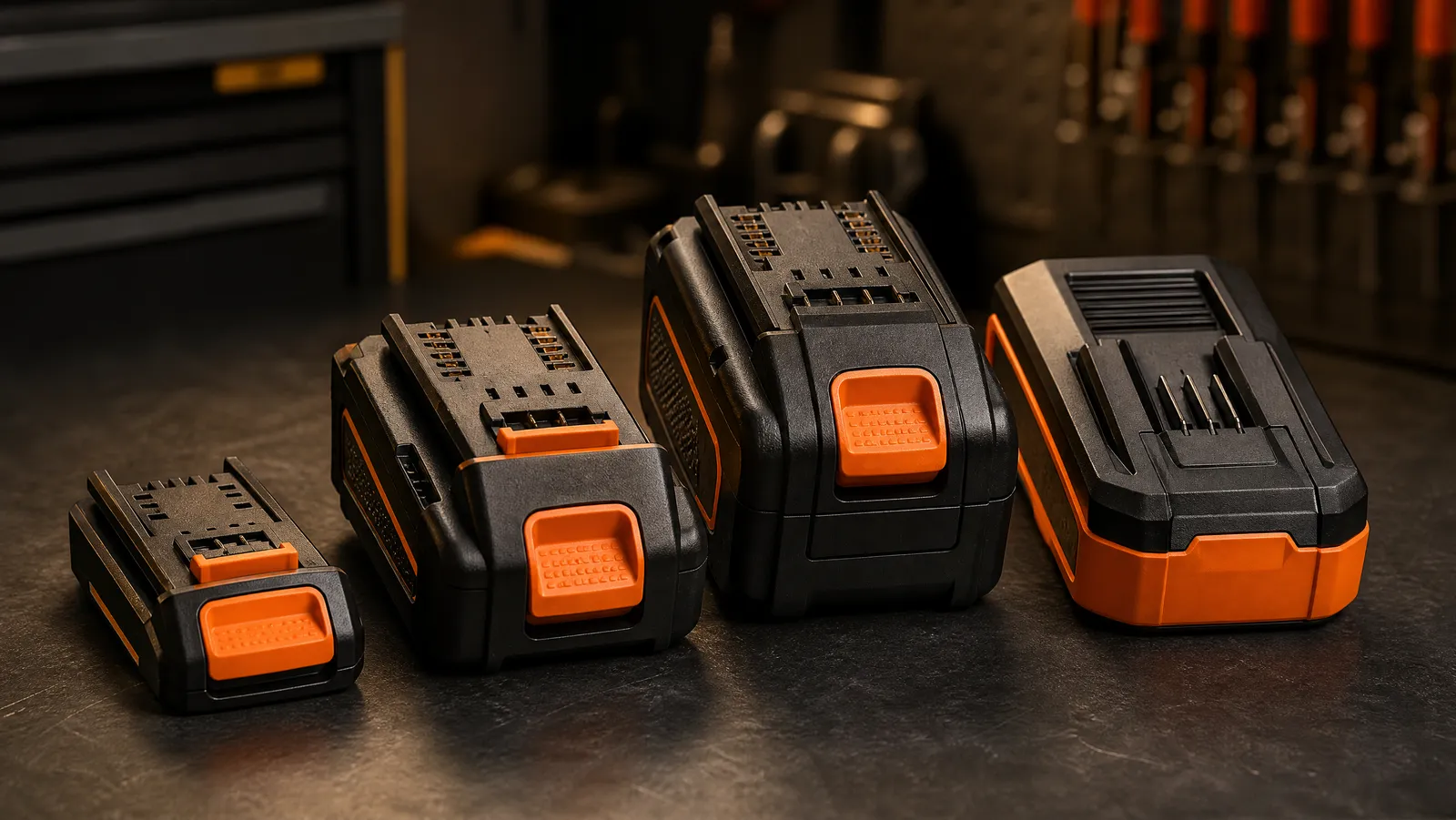
If voltage is the engine, amp-hours (Ah) are the fuel tank. They measure capacity — how much charge the pack holds — not how hard the tool hits. As ToolGuyd explains, a battery's amp-hour rating tells you how long it can supply current: a 2.0Ah pack can, in theory, deliver 2 amps for one hour. What it means for you: double the amp-hours and, at the same voltage, you roughly double how long the tool runs before a recharge — a 4.0Ah pack lasts about twice as long as a 2.0Ah pack.
Bigger isn't automatically better, though, because capacity adds weight and cost.
There are two more practical trade-offs worth knowing. Bigger packs are heavier and slower to charge — a 5.0Ah battery adds noticeable weight to the nose of a drill and takes longer to fill than a 2.0Ah pack on the same charger — and they usually cost more, since you're paying for extra cells. The happy medium for most people is to own a small pack for nimble jobs and one larger pack for anything that runs continuously.
One more term clears things up when you compare across voltages: watt-hours (volts × amp-hours). ToolGuyd points out that watt-hours are the truest measure of the total energy a pack stores, which is why a 12V 4.0Ah battery and an 18V 4.0Ah battery are not equal — the 18V pack holds far more actual energy. Within a single platform, though, amp-hours are all you need to compare runtime: a 4.0Ah beats a 2.0Ah, every time.
Brushless vs brushed motors and battery life
The motor inside the tool decides how much of that battery it wastes. A brushed motor uses carbon brushes that physically rub to transfer power, and that friction sheds energy as heat. A brushless motor replaces the brushes with electronics that feed the coils precisely, so it runs cooler and draws less current for the same work. What it means for you: brushless squeezes more out of every charge.
According to tool-industry comparisons, brushless motors run at roughly 85–90% efficiency against about 75–80% for brushed designs — a gap that can translate into 25–50% more runtime on the same battery, plus a motor with no brushes to wear out over time. If you'll use a tool weekly, brushless is worth the premium; for occasional jobs, a good brushed tool is still a smart, cheaper buy. (Our full guide to brushless versus brushed motors digs into the trade-off — for battery life, the efficiency gain above is the part that matters.)
Cordless power tool battery platforms and lock-in
Here is the one big idea that outranks every spec: a battery only fits its own brand's platform. A DeWalt 20V MAX pack will not slide into a Makita tool, and a Milwaukee M18 pack won't power a Ryobi. Each brand builds its batteries, chargers and tools around a proprietary connector, so the first platform you buy into becomes a long-term commitment — every tool you add for years afterward has to match those packs.
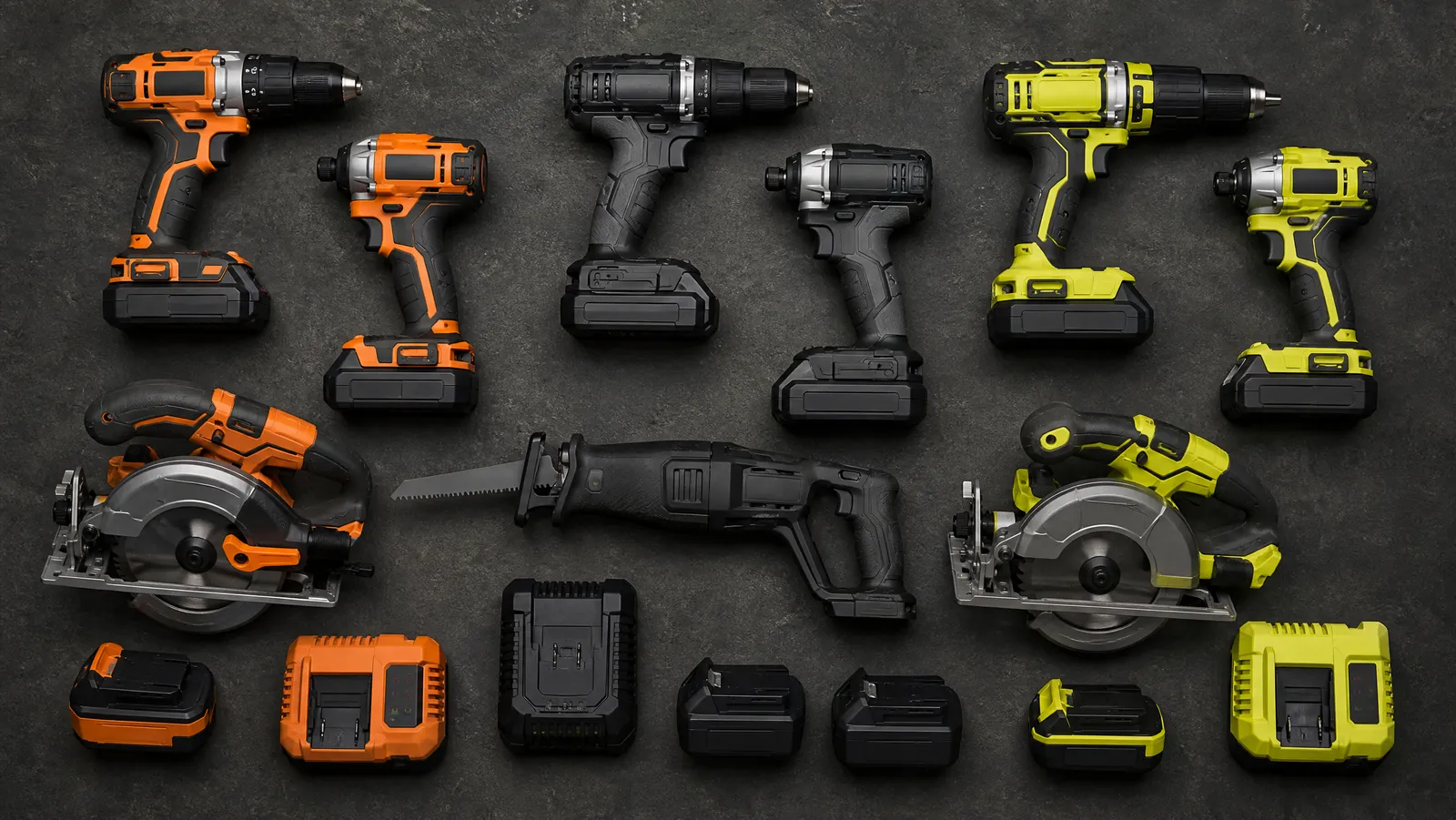
The major DIY-friendly platforms are DeWalt 20V MAX, Milwaukee M18, Makita LXT (18V), Bosch 18V and Ryobi ONE+ (18V). There's no wrong answer among them — the point is to pick one and stick with it, and our comparison of the best cordless power tool brand for DIY weighs the four biggest of them as platforms rather than as individual tools. The reason lock-in bites is money: if you build up five DeWalt tools and then decide you'd rather have Makita, you're not just re-buying tools, you're re-buying every battery and charger too. That's why the platform choice deserves more thought than the individual tool that first tempts you into the aisle.
Why the size of the ecosystem matters: the bigger the platform, the less likely you are to hit a dead end. Ryobi's ONE+ system, launched in 1996, is the largest 18V cordless platform in the world — more than 300 tools share one battery, and every ONE+ battery ever made still fits every ONE+ tool ever made. That kind of breadth means your batteries keep earning their keep as you add a sander, a blower, an inflator or a work light down the line.
This is exactly why we point beginners toward a combo kit rather than a single bare tool: you get two or three tools, a couple of batteries and a charger on one platform for less than buying the pieces separately. Our guide to the best cordless power tool combo kits for beginners walks through the smart starting bundles. And if you only ever buy one cordless tool, make it a drill/driver — see the top reasons a cordless drill earns its place and the platform it opens up.
Battery care and lifespan
Lithium-ion packs are refreshingly low-maintenance, but a few habits noticeably extend their life. The old "fully drain it to keep it healthy" advice belongs to nickel batteries — it actively harms lithium-ion.
- Store cool and dry. Lithium-ion packs are happiest at a moderate room temperature — roughly 15–25°C (59–77°F) is widely considered ideal; heat is the enemy that ages them fastest. Keep them out of a baking car, a freezing shed and direct sun.
- Store at a partial charge. For anything longer than a few weeks, leave the pack around 40–60% charged — not full, not empty — which Stihl and others recommend for long storage. Top it up before a big project.
- Don't run it flat every time. Researchers at the University of Michigan note that avoiding both temperature extremes and very high or very low states of charge slows the irreversible aging that steals capacity. Popping a pack on the charger before it's stone dead beats draining it to nothing.
- Charge before long storage, and check on stored packs every few months.
How long should a pack last? Pro Tool Reviews puts a typical lithium-ion tool battery at two to three years, or 300–500 charge cycles, whichever comes first — premium packs and gentler use stretch that further. A battery that once ran a full afternoon and now fades in minutes hasn't necessarily "died"; its cells have simply aged, and a fresh pack on the same platform brings the tool back to life. That, once again, is the payoff for choosing a big, well-supported platform up front.
The bottom line
Strip away the marketing and cordless batteries come down to four things: voltage is muscle, amp-hours are runtime, brushless wrings more work from each charge, and the platform you pick is the decision you'll live with longest. Get the platform right — a big ecosystem, genuine batteries and sensible storage — and everything else is just choosing the right pack for the job in front of you. For the tools that ride on those batteries, dig into our complete cordless power tools guide and build your kit one platform-matched tool at a time.
Frequently asked questions
Is higher voltage always better for cordless tools?
No. Higher voltage means more available power, but also a heavier, pricier battery. For most DIY — drilling, driving, sanding and light cutting — an 18V/20V MAX platform is the sweet spot. Step up to 36V/40V+ only for heavy cutting and outdoor gear like chainsaws, mowers and blowers, and drop to 12V when you want the lightest possible tool for assembly and overhead work.
How many amp-hours do I need?
For general DIY, a 2.0Ah pack keeps drills and drivers light and nimble, while a 4.0Ah pack roughly doubles runtime for saws and other high-drain tools at the cost of extra weight. Many people keep one of each — a small pack for tight, overhead work and a big one for long sessions. Just remember amp-hours only compare fairly within the same voltage.
Can I use one brand's battery in another brand's tool?
No — batteries are platform-specific. A DeWalt 20V MAX pack won't fit a Makita, Milwaukee or Ryobi tool, because each brand uses its own connector and control electronics. Third-party adapters exist, but they can bypass safety features and void warranties, so we don't recommend relying on them.
Do cordless tool batteries go bad?
Yes, gradually. Lithium-ion cells age whether you use them or not, losing capacity over roughly two to three years or a few hundred charge cycles. Storing them cool and at a partial charge slows it down, but eventually a tired pack simply needs replacing — one more reason to buy into a platform that will still sell fresh batteries years from now.
About the Author
Cheryl Thompson
Cheryl Thompson is the tools editor at The DIY Tool Review. A lifelong fixer and self-confessed tool addict, she has spent years buying, borrowing and wearing out hand and power tools across home renovation, furniture building and everyday repairs. She writes hands-on, no-nonsense reviews to help fellow DIYers spend their money on the tools that actually last.