How to Organize a Small Garage Workshop
A small garage workshop is a layout problem before it is a storage problem. Measure what the car leaves you, then build upward and on wheels.

- Category
- Workshop & Storage
- Tools tested
- 3
- Read time
- 13 min
- Updated
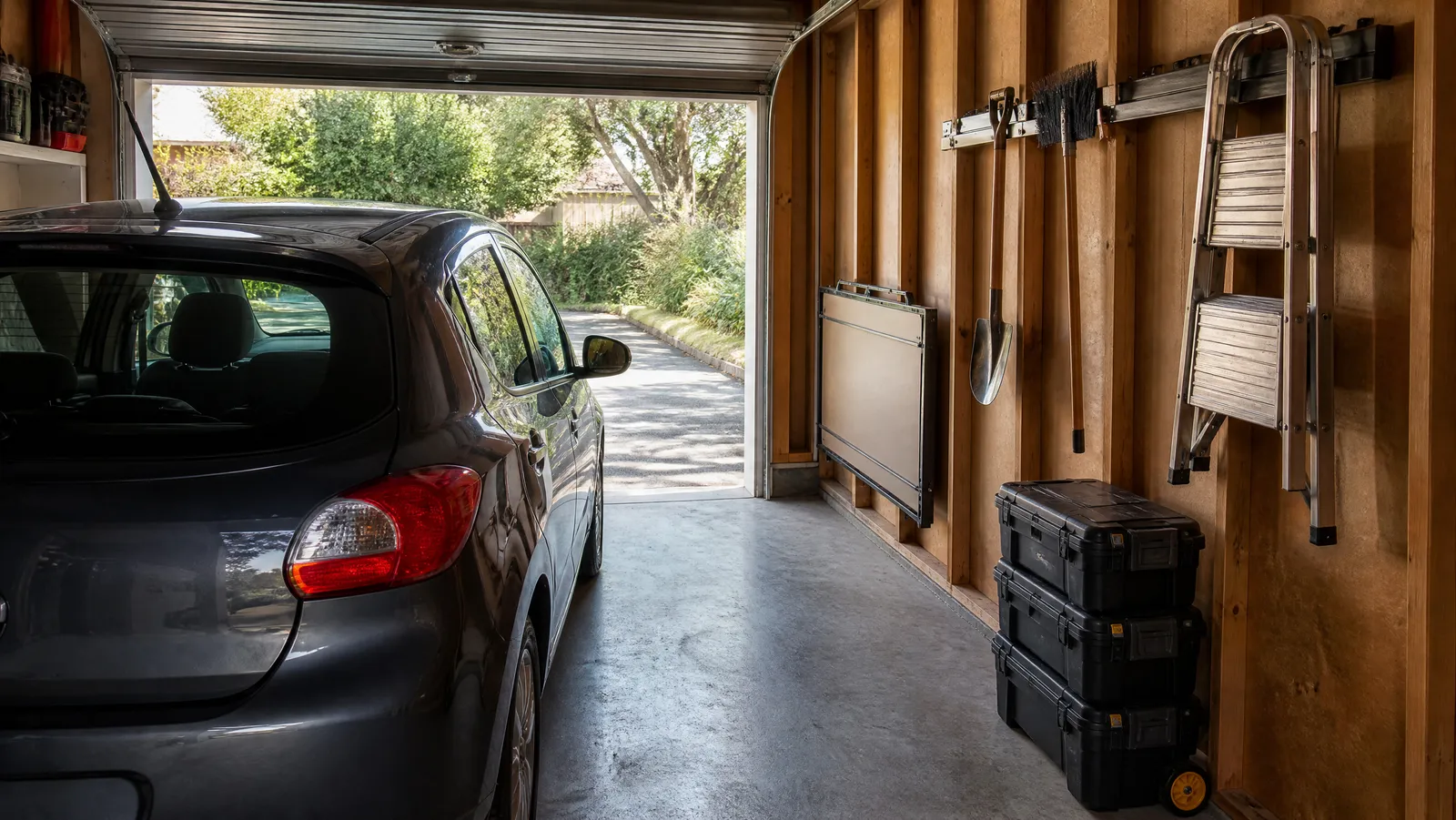
Organize a small garage workshop in five moves, in this order: measure the working envelope the car leaves you, get everything off the floor and onto the studs, make the heavy storage roll, make the bench fold, and give each job one zone. The best small workshop storage ideas all start with a tape measure rather than a shopping cart.
The order matters more than the products. Our garage tool storage guide argues for walls before cabinets in any garage; this is the version for a bay with a car in it, where every inch you take is an inch the car door needs. The car usually loses. According to a five-year UCLA Center on Everyday Lives of Families study of 32 dual-income households, reported by EurekAlert, anthropologist Jeanne Arnold found that about 75 percent of the middle-class Los Angeles homeowners studied used their garages in ways that precluded parking cars there at all.
The five moves, in order
Each takes an hour or two. Do them in sequence: each frees the space the next one needs.
- Measure the working envelope. Not the garage - the strip of floor and wall the parked car does not need.
- Everything off the floor, onto studs. Floor storage is the only kind that competes with the car.
- Make the heavy storage roll. In a single bay, storage that cannot move is in the wrong place half the time.
- Make the bench fold or roll. A fixed bench is usually the biggest thing in a small shop.
- One zone per job. Cutting, assembly, finishing and parts each get one place.
Nothing there requires buying anything; hardware comes at the end, deliberately.
Move 1: measure the envelope the car leaves you
Everyone skips this step, and it decides whether the rest works. Park the car where it normally lives, then measure from its widest point to each wall. That leftover strip is your entire shop.
Two numbers govern it. According to House Plans Helper, opening an average car door needs a minimum of 2 ft 6 in, or 76 cm, between the door and the nearest obstruction. The garage guide published by Randy Lemmon puts comfortable clearance at 30 to 36 in between a parked vehicle and the wall, 36 to 42 in between vehicles, and 42 to 48 in for a main walking route or the child-seat side - figures it is careful to call comfort targets rather than code requirements.
Now do the arithmetic on a standard bay. House Plans Helper gives 12 ft by 20 ft with a 9 ft door as the recommended minimum for a single garage, and uses a Mini at 6 ft 4 in wide as its reference car. Twelve feet is 144 in. Take away 76 in of car and 68 in is left, or 34 in a side with the car parked dead center - four inches over the minimum to open a door, and inside Randy Lemmon's 30 to 36 in comfortable band.
Now put a shelving unit against one wall. Garage shelving is commonly a foot or more deep, so that side drops to about 22 in, eight inches less than House Plans Helper says a car door needs. You have not made the garage untidy. You have made it a garage you cannot get out of.
Move 2: everything off the floor and onto the studs
In a one car garage workshop layout, the wall is not a nice-to-have. It is the only surface that is not contested. Anything standing on the floor competes with the car; anything on the wall does not.
There is a second reason to get things up. According to Stronghold Floors, many older homes have slabs poured directly onto compacted earth with no stone base acting as a capillary break, so vapor transmission through the slab is much higher. A cardboard box of fixings on that floor is the first thing to go soft.
Hang it on framing, not on wallboard. Trusscore describes 16 in. on center as the most common spacing in residential framing and the default for load-bearing walls, because it gives more attachment points and higher load capacity. That is why the useful garage rails and cleat strips are drilled at 16 in. intervals: the holes are meant to hit wood.
The gap between framing and drywall is large. Family Handyman stress-tested seven drywall anchors and published what each held: an Everbilt ribbed anchor rated at 22 lb held 80 lb, an E-Z Ancor Twist-N-Lock rated at 75 lb held 100 lb, and the best performer, a Toggler SNAPTOGGLE rated at 80 lb, held 180 lb. Respectable for a picture rail. Not numbers to hang a loaded tool wall on - and they are per anchor, in a lab, in new board.
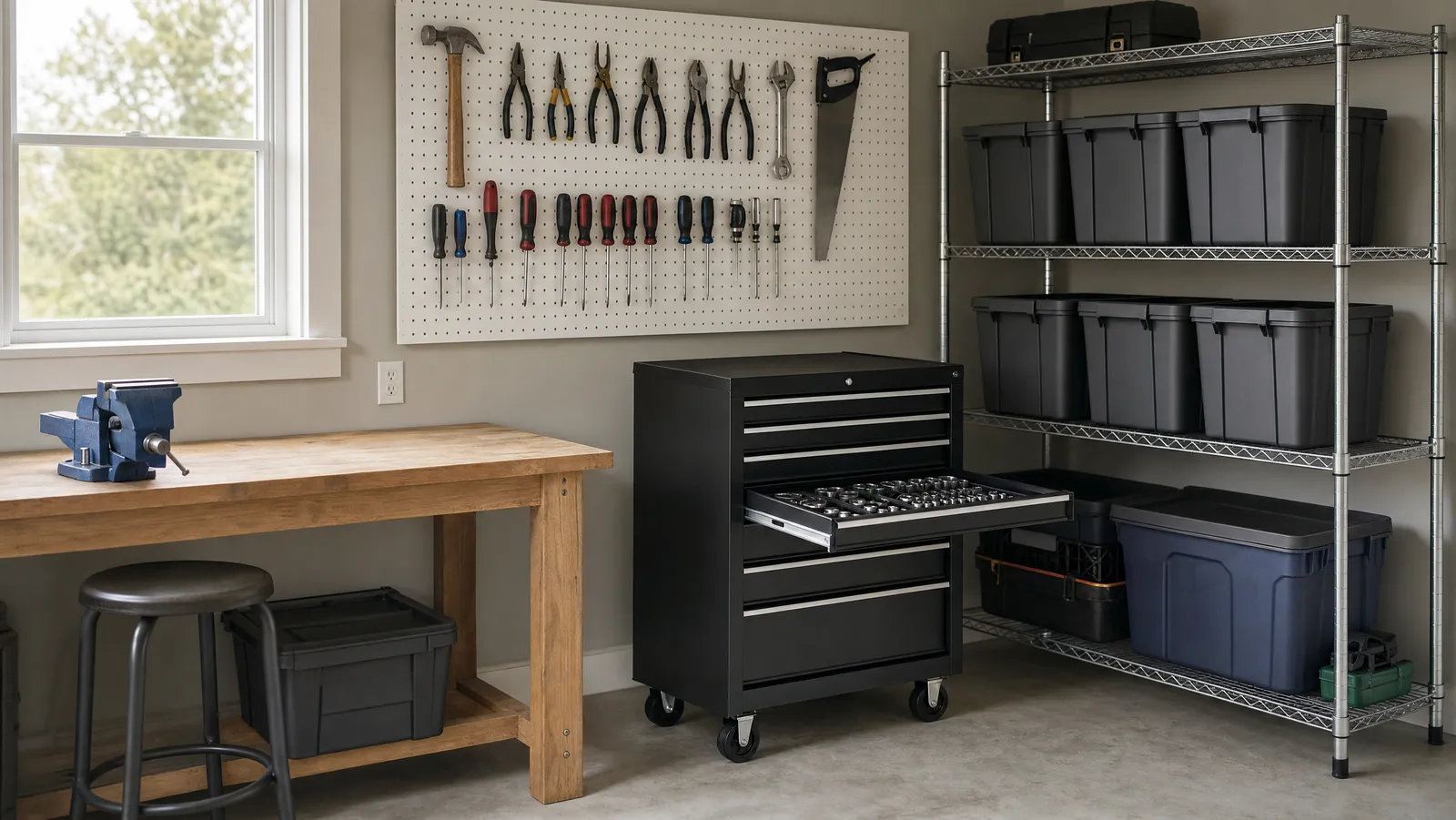
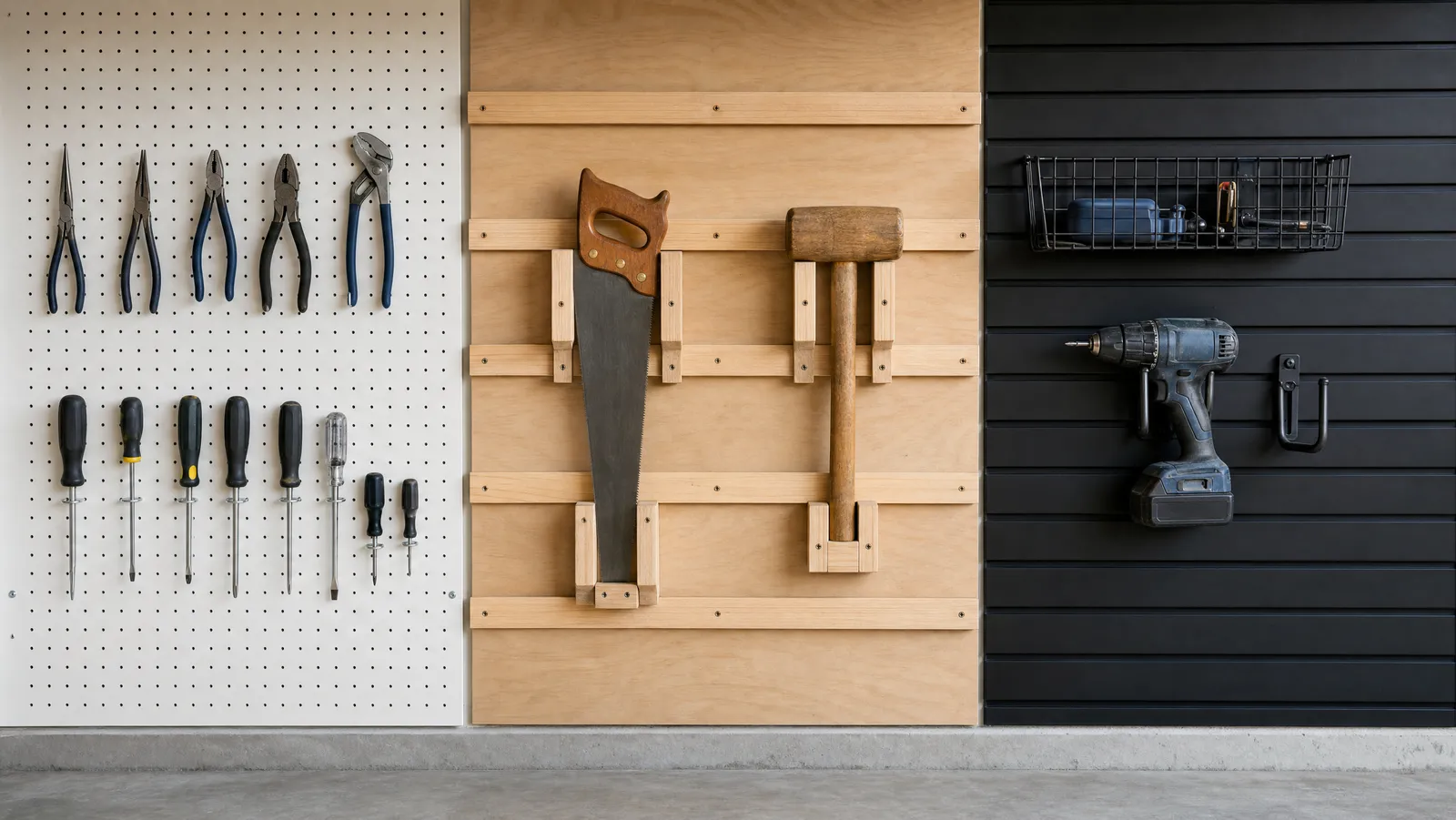
Which system goes on those studs is a separate decision, taken apart in pegboard, French cleat and slatwall compared. For a small shop the short version is that depth is the enemy: what matters is how far the panel and its hooks stand proud of the wall, because that comes straight out of your 34 in.
Move 3: make the heavy storage roll
In a garage with a car in it, no big box of tools has a good permanent home. The spot that is perfect while you work is in the way when you park.
So buy movement rather than capacity. A rolling stack that lives against the back wall, comes to the bench for an afternoon and goes back at six uses the same floor twice. A cabinet too heavy to move gets shoved against a wall on day one, and you work around it forever.
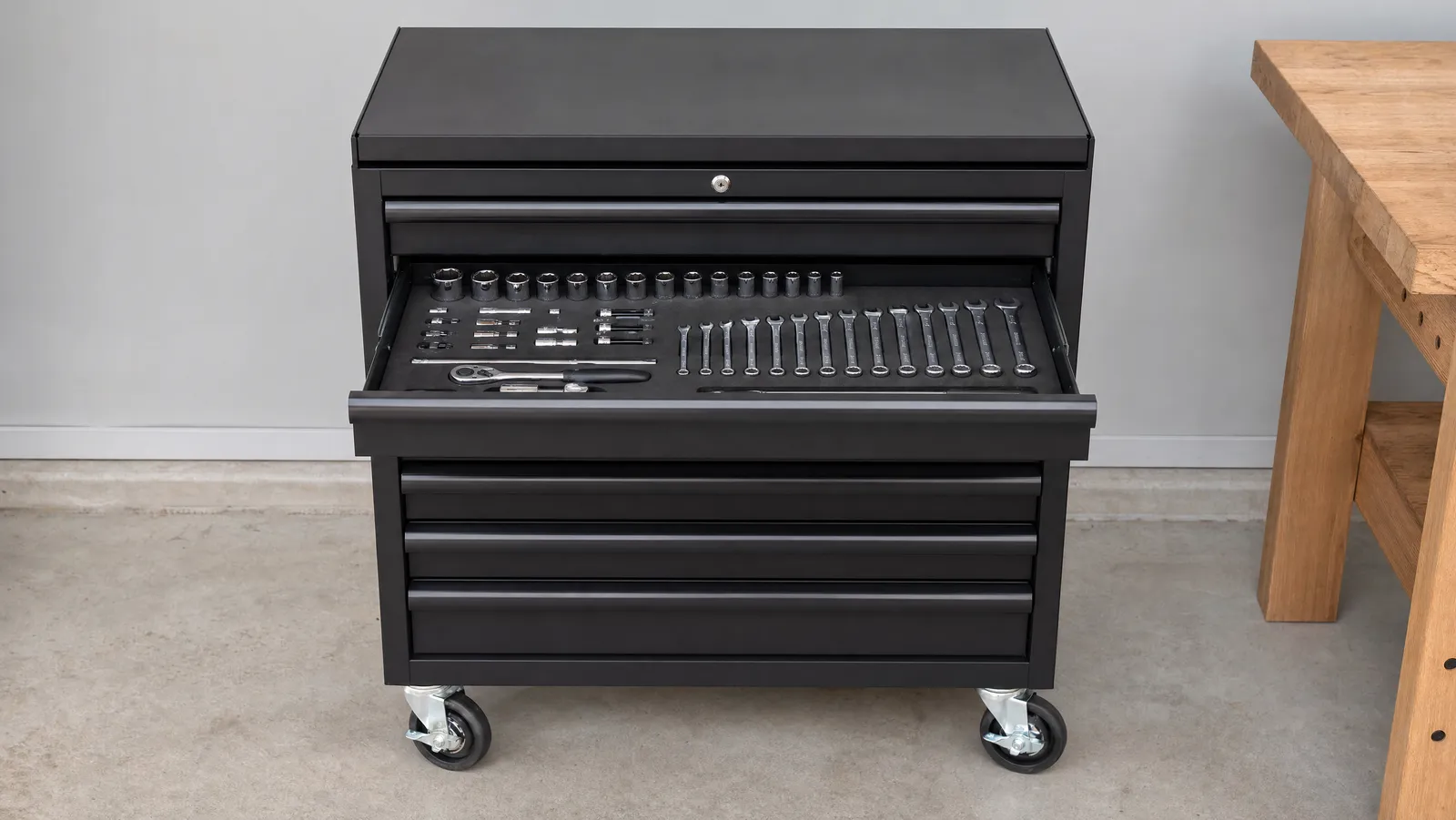
Two constraints in a real garage. Small hard casters hate a slab with expansion joints and a drain fall in it, so larger wheels win. And a stacking system only pays off if you commit to one family of boxes, which is why modular tool box systems compared is the next question to settle. If your tools genuinely need drawers, that is a different purchase - see the best tool chests for a home garage, sized against your envelope first, because a cabinet 41 in. wide takes about 3.4 ft of a 12 ft wall.
Move 4: make the bench fold
A fixed bench is usually the largest object in a small shop, and often the one used twenty minutes a week. Either it folds, it rolls, or it earns its footprint daily.
Read bench specifications closely, because capacity numbers here are not standardized - the same maker will quote two for one object. WORX publishes 300 lb as a work table and 1,000 lb as a sawhorse for its Pegasus folding table: same product, same legs, one number more than three times the other, because the two uses load it differently. WORX also publishes the figure that matters in a small garage. Folded, it lists the Pegasus at 35 in. high by 25 in. wide by 5 in. deep, weighing 30 lb.
Five inches deep is a bench you can hang on a wall. That is the test for any folding bench, and many listings do not answer it. If you want a permanent top instead, those trade-offs belong with the best workbench for a home garage rather than here.
Move 5: one zone per job
This move costs nothing. Divide the shop you measured in move 1 into zones and give each job exactly one.
- Wall zone. The hand tools you reach for weekly, at eye height on the longest uninterrupted wall.
- Bench zone. One clear surface. Nothing lives on it overnight.
- Rolling zone. The heavy and the occasional, parked clear of the car doors.
- Dirty zone. Sanding, grinding, painting - nearest the door you can open, furthest from the car.
The failure mode of a small shop is not lack of storage. It is a surface with three jobs. A bench that is also the parts shelf and where the mail lands can cost ten minutes of clearing before any work starts - enough friction to stop most jobs happening at all.
Small workshop storage ideas: the hardware, if you buy any
None of the five moves requires a purchase, but each of the middle three has a cheap piece of hardware behind it. These illustrate the moves; they are not a ranked buying guide. Every figure below is the maker's own published claim. We do not hands-on test tools, and our product data gives us no ratings or review counts.
Off the floor: a stud-spaced wall rail

ZICANYCO 49.5 in. rail
A 49.5 in. steel panel with 10 hooks that attach anywhere along it. ZICANYCO lists thickened solid carbon steel with a water- and corrosion-resistant coating, PVC-wrapped hooks, a 400 lb capacity, and 16 in. screw spacing so the fixings land on standard studs. That 16 in. spacing is the specification that matters here. The 400 lb figure is the brand own claim and the listing names no third-party test behind it.
Pros
- 16 in. screw spacing lines up with standard 16 in. on-center framing
- 10 hooks that move anywhere along the panel rather than fixed positions
- PVC-wrapped hooks, per ZICANYCO, so tool finishes are not sitting on bare steel
- Wall-hung, so nothing stands on the floor where the car has to go
Cons
- The 400 lb capacity is ZICANYCO own claim with no third-party test named
- Drywall screws are in the box, and a 400 lb claim has no business in drywall
- At 49.5 in. it covers just over a third of a 12 ft wall, so budget for more than one
- Open hooks only - nothing here closes, locks or keeps dust off
The specification to read here is not the capacity. It is the 16 in. screw spacing, which lets a 49.5 in. panel land on two or three studs in a wall framed to the spacing Trusscore calls standard. Find your studs and confirm they are at 16 in. centers before buying any rail drilled for them.
ZICANYCO lists thickened solid carbon steel with a water- and corrosion-resistant coating, PVC-wrapped hooks and a 400 lb capacity, at $29.99 as of September 2026 against a $36.99 list. Treat the 400 lb as what it is: the brand's own number, no third-party test named. One panel covers just over a third of a 12 ft wall, so plan on more than one.
Make it roll: a modular stack instead of a cabinet

Keter Stack-N-Roll 3-piece
Three interlocking pieces - a wheeled cart, a toolbox and a small parts organizer - that stack and move as one unit. Keter lists a metal telescopic handle, 7 in. wheels, side grips, latches that close with an audible snap, and a transparent polycarbonate lid on the organizer. The Amazon listing does not give a total load capacity, and Keter own US product page for the Stack and Roll system does not publish one either.
Pros
- Rolls out of the bay on 7 in. wheels when the car comes in
- Three interlocking pieces, so one hand moves the whole stack
- Transparent organizer lid, per Keter, so small parts are visible without opening it
- The cheap way into a modular system rather than a fixed cabinet
Cons
- Neither the listing nor Keter US product page publishes a total load capacity
- Resin and metal fittings - this is a carrier, not a steel chest
- A telescopic handle and wheels still means pulling, not pushing a loaded cabinet
At $118.99 as of September 2026, this is the low-cost version of move 3: a cart, a toolbox and a small parts organizer that interlock and move as one. Keter lists a metal telescopic handle, 7 in. wheels and side grips, latches that close with an audible snap, and a transparent polycarbonate lid on the organizer. Those wheels are the relevant number on a slab, where small casters stop at every expansion joint.
On capacity, we checked before saying anything. The Amazon listing gives no total load figure, and Keter's own US product page for the Stack and Roll system does not publish one either - dimensions, weight, materials and a warranty, but no load rating. Keter's South African site, for the same-named Stack n Roll system, does quote a 45 kg overall loading capacity, roughly 99 lb, alongside per-piece figures of 35 kg for the cart, 20 kg for the toolbox and 10 kg for the organizer. Those add up to 65 kg, more than the 45 kg overall figure on the same page. We cannot reconcile that, so we would not plan a load around either number.
Make the bench fold: a resin folding workbench

Keter folding workbench
A folding bench that Keter says is ready to work in 30 seconds with no assembly required. Keter lists a work surface that supports up to 1,000 lbs, 12 in. clamps that install horizontally or vertically, and weather-resistant polypropylene and heavy-duty resin with aluminium legs. The listing does not publish folded dimensions, which is the one number a single-bay garage most needs.
Pros
- Folds away, so the bench is not a permanent claim on the floor
- Keter says 30 seconds to working, with no assembly required
- 12 in. clamps included, mountable horizontally or vertically
- Work surface supports up to 1,000 lbs, per Keter
Cons
- The listing does not publish folded dimensions
- The 1,000 lb figure is Keter own claim, and rival makers quote that number for a different use case
- Anything left on the top has to come off every time you fold it
At $109.99 as of September 2026, Keter says this one is ready to work in 30 seconds with no assembly, with a work surface supporting up to 1,000 lbs, 12 in. clamps that install horizontally or vertically, and weather-resistant polypropylene and heavy-duty resin with aluminium legs.
Put that claim next to the WORX figures and you can see how little these numbers are standardized. WORX rates the Pegasus at 300 lb as a table and 1,000 lb as a sawhorse; Keter publishes 1,000 lb for a work surface. The two are almost certainly not measuring the same thing, and neither publishes the test behind it, so read them as a rough class indicator rather than a load you are entitled to.
The number we would most like and do not have is folded depth. The listing does not publish folded dimensions, and in a bay with 34 in. to play with, folded depth is the whole reason to buy a folding bench. Measure the one in the store, or pick a bench whose maker prints the figure.
Common questions
How do I organize a garage workshop that still has to fit a car?
Measure first, then work upward. The parked car plus its door swing is fixed - per House Plans Helper, at least 2 ft 6 in from the door to the nearest obstruction. Everything else is negotiable: wall storage takes inches, rolling storage uses the same floor twice, a folding bench takes none when closed.
Are drywall anchors ever acceptable for garage tool storage?
For a broom clip or a coil of extension cord, yes. For a loaded tool wall, no. Family Handyman measured failure loads of 80 lb to 180 lb per anchor in controlled testing, and a tool rail knocked sideways by a car door is not a controlled test. Hit the framing, which Trusscore says is most commonly at 16 in. on center.
What if my studs are at 24 in. rather than 16 in?
It happens - Trusscore notes 24 in. spacing turns up in newer energy-efficient builds, where fewer studs mean less lumber and less thermal bridging. A rail drilled at 16 in. intervals then catches one stud instead of two or three. The fix is a horizontal backer board screwed across several studs, with the rail mounted to that.
Should I buy a tool chest or a wall system first?
The wall, in almost every case, and especially in a single bay: a chest is floor, and floor is what you are short of. When the tools do need drawers, our comparison of the best tool chests for a home garage covers the specification that decides it - the per-drawer weight rating, not the drawer count.
The short version
A small shop is a measuring problem. Park the car, tape its envelope on the floor, and accept that what is left is the workshop. Then take the floor back in three steps: tools onto studs at 16 in. centers, heavy storage onto wheels, the bench onto a hinge. Buy hardware afterwards, if at all - the ZICANYCO rail at $29.99, the Keter Stack-N-Roll at $118.99 and the Keter folding bench at $109.99 as of September 2026 each make one of those moves, and each arrives with claims we would treat as claims.
Do the moves in order and the car still fits. Skip move 1 and you end up, like three-quarters of the households in that UCLA study, with a very well-organized garage and a car parked on the street. The rest of the system - wall choices, chests and benches - is laid out in our garage storage guide.
About the Author
Cheryl Thompson
Cheryl Thompson is the tools editor at The DIY Tool Review. A lifelong fixer and self-confessed tool addict, she has spent years buying, borrowing and wearing out hand and power tools across home renovation, furniture building and everyday repairs. She writes hands-on, no-nonsense reviews to help fellow DIYers spend their money on the tools that actually last.