The Best Garage Tool Storage and Organization for DIY (2026)
Storage is a sequence, not a shopping list. Get tools off the floor first, put a wall up before you buy drawers, and buy the chest once — bigger than you need today.

- Category
- Workshop & Storage
- Tools tested
- 6
- Read time
- 24 min
- Updated
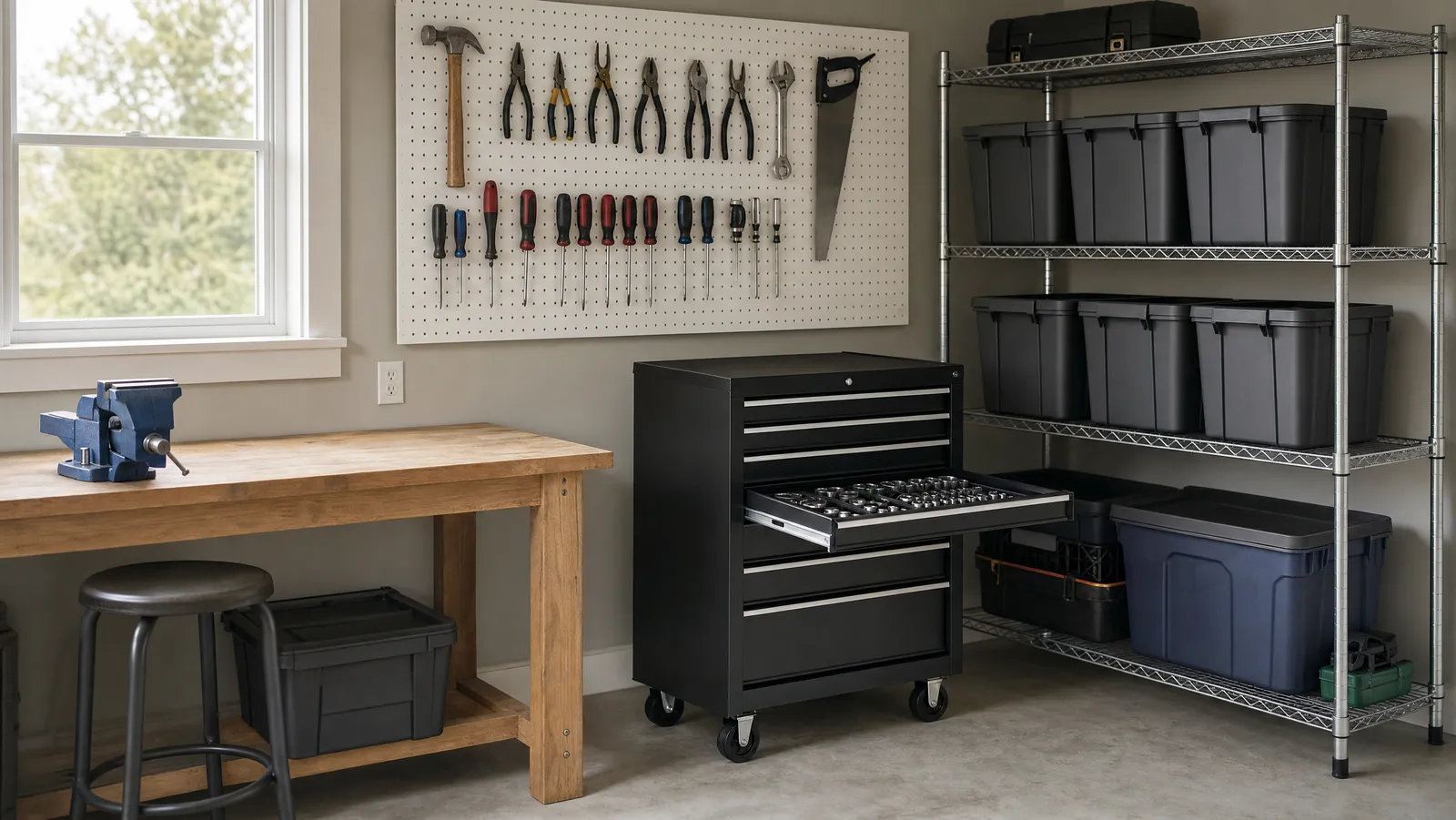
The best garage tool storage for most homeowners is a wall system first, a rolling chest second and a set of drawer trays third — in that order, and rarely the other way round. Floor space is the scarce resource in a garage that also parks a car, so the first job is getting tools off the slab, not buying drawers.
This is the hub for everything we publish about storing tools in a home garage — a complete guide on its own, pointing to the deeper articles we cover separately. One thing to settle first: storage should follow your tool collection, not lead it. If you are still working out what belongs in the garage at all, start with the tools worth owning first and come back when the pile is real.
How we picked
We do not hands-on test tools, and we are not going to pretend otherwise. Every pick here is chosen on published manufacturer specifications, current price and availability, and on how the product fits the way a home DIYer works. Where a number comes from the maker, we say whose it is. We also cannot publish star ratings or review counts, because our product data source does not supply them.
Prices are as of September 2026 and they move — treat every figure as a snapshot and check before you buy.
Workshop tool storage is not one product category but five: a wall, a chest, shelving, a portable box and the small stuff that goes inside drawers. We picked one product for each, plus a budget alternative for the chest, because those five jobs are genuinely different and buying the wrong one for a job is how people end up with a garage full of half-used storage.
The weight ratings are not comparable, and makers know it
Here is the first thing to be suspicious of. Storage makers publish load figures in at least three incompatible ways: per drawer, per shelf evenly distributed, and total unit capacity. They are not the same measurement, and a bigger number does not mean a stronger product.
Never set a per-drawer figure against a total-unit figure as though they were the same number. A 300 lb caster rating tells you what the wheels will roll; it tells you nothing about what one drawer will hold. And "evenly distributed" is doing real work in the Amazon Basics figure — a 350 lb shelf is not a shelf you put a 300 lb engine block in the middle of.
Start with the floor, not the catalogue
Most garage tool storage ideas start in the wrong place: a photograph of a finished dream shop, taken after somebody spent four thousand dollars and a summer. That picture is a result, not a plan, and copying it out of order is how people pay twice.
Storage is not a shopping problem. It is a sequence problem. Here is the order we would buy in, and it is the spine of everything below.
- Get things off the floor before you buy anything with drawers. Floor space is the scarce resource. According to Angi, standard two-car garages run from a 20 by 20 foot minimum (400 square feet) up to 30 by 30 feet, with 24 by 24 feet (576 square feet) the most common size, and Angi puts the useful garage ceiling at a minimum of eight to nine feet if you want overhead shelving — and two cars take most of that floor. Every square foot of slab you free up is worth more than a square foot of shelf.
- Wall first, then drawers. A wall system is cheaper per tool stored than a chest, and it makes the tools you reach for weekly visible from across the room. A chest is for the things you own many of — sockets, bits, fasteners — and for what you want locked.
- Buy the chest once, and buy it bigger than today's collection. Cost per drawer generally falls as chests get wider. Outgrowing a small one means buying twice.
- Portable boxes are a different job from storage. They are how tools leave the garage, not how they live in it. A stacking system that becomes your only storage is a garage where everything is in the bottom box.
- The drawer organiser is the cheapest upgrade in the whole shop, and almost nobody buys one until the drawer has already turned into a bin.
The scale of the problem is not subtle. A CRAFTSMAN survey conducted by Atomik Research among 2,004 American adults between 28 September and 5 October 2022 found that 36% of respondents said their garage was so cluttered they could no longer park vehicles inside, and that more than three in five — 62% — called the garage the most cluttered space in their home. Treat that as a motivated statistic — Craftsman sells garage storage — but the direction of it matches every garage we have ever stood in.
Wall systems: pegboard, French cleat and slatwall
This is the first purchase, and the one with the widest spread of cost and effort. A full head-to-head — pegboard, French cleat and slatwall compared on strength, flexibility and price — gets its own guide. Here is the short version.
Pegboard is a perforated board on a grid, hardboard or metal, with hooks pushed into the holes. Cheapest, fastest, excellent for hand tools, and its classic failure is hardboard blowing out around a hole under a heavy tool.
French cleat is a strip of wood ripped at 45 degrees and screwed to the wall, with matching bevels on the back of every holder you make. It is the strongest and most flexible, because every holder is custom, and the only one that costs weekends instead of money. According to Engineer Fix, a standard cleat setup in 3/4 in. stock can support roughly 110 to over 220 pounds over a short span when it is anchored into wood studs with construction screws at least 2.5 inches long that penetrate the studs by at least 1.5 inches. Figures quoted elsewhere range far wider than that, which tells you these are estimates rather than a rated product.
Slatwall is the retail-fixture system: horizontal grooved panels that take hooks, baskets and shelves anywhere along the slot. It is the tidiest-looking, generally the dearest per square foot, and it wants a full wall to make sense.
The honest comparison is cost per square foot of wall
Compare the prices these systems are advertised at and pegboard looks cheap. Work out what a square foot of usable wall actually costs and the gap gets much larger.
Wall Control lists its 4 ft. Standard Tool Storage Kit as three metal panels of 32 in. by 16 in. that cover 48 in. by 32 in. installed. That is 1,536 square inches, or 10.67 square feet. At $120.04 as of September 2026, that works out at $11.25 per square foot of wall.
A plain hardboard pegboard sheet is 4 ft. by 8 ft., which is 32 square feet. Home Depot listed a 3/16 in. hardboard pegboard panel of that size at $24.98 when we checked in September 2026; hardboard prices vary by store, grade and week, so treat that as a ballpark rather than a fixed figure. That works out at $0.78 per square foot — about one fourteenth of the metal kit.
That comparison is not quite fair, and it is worth saying so. The hardboard figure is the bare board — you still need hooks, and a working wall wants dozens. The Wall Control price includes a 9 in. shelf, a 6 in. shelf, three hanging bins, a screwdriver holder, a hammer holder and an assortment of twenty more hooks and brackets, all per Wall Control. Hooks are not free. They are also not ten dollars a square foot.
So: hardboard sheets and a box of hooks for the most wall per dollar, and a metal board for the four feet directly above the bench, where tools get knocked off and holes wear out. That is where the premium is worth paying, and nowhere else.

Wall Control 4 ft. Kit
A metal pegboard kit that ships with its own hooks and accessories. Wall Control describes its metal board as more than ten times stronger than conventional pegboard, accepting both standard 1/4 in. pegboard pegs and its own slotted tool-board pegs, and mounting directly to studs or drywall with no furring strip or framework behind it.
Pros
- Mounts flat to studs or drywall - no furring strips to build first
- Takes both conventional 1/4 in. pegs and Wall Control slotted accessories
- Metal board will not blow out around the holes the way hardboard does
- Hooks and accessories are in the box
Cons
- Costs several times what a sheet of hardboard pegboard costs
- The 10x strength figure is Wall Control own claim, not an independent test
- Fixed hole grid - heavy or odd-shaped tools still need the right hook
Wall Control describes its metal board as more than ten times stronger than conventional pegboard, taking both standard 1/4 in. pegboard pegs and its own slotted tool-board pegs, and mounting flat to studs or drywall with no furring strip or framework behind it. That last point is the one that saves an afternoon: hardboard pegboard has to stand off the wall so hooks have somewhere to go, which normally means building a frame of furring strips first.
The 10x figure is Wall Control's own claim, not an independent test, and we have not seen a published test method behind it. What we would still say is that metal will not crumble around a hole the way hardboard does after the fourth time a heavy tool comes off the hook.
Hanging hand tools
A wall earns its keep only if a tool goes back in the right place without thinking. The detail of how to store hand tools on a wall — which hook suits a plane, a clamp, a saw or a cordless drill — we cover separately, but three rules do most of the work.
- Hang by the heaviest, most rigid part. A hammer hangs by the head, not the handle. A hand saw hangs by the handle so the plate does not bend.
- One tool, one home, and outline it. Draw around the tool on the board. It sounds fussy and it is the single habit that keeps a wall tidy, because an empty outline is a visible question.
- Keep the wall to the tools you touch weekly. A wall crowded with things you never use is a wall you stop reading.
What should not go on the wall: anything heavy enough to hurt you if it falls, anything with a cord that hangs into your path, and anything that lives in a case. Cases go on shelves.
Tool chests and rolling cabinets
Now the drawers. A chest is what you buy when you own many of one thing — sockets, drivers, bits, fasteners — because a wall stores one tool per hook and a drawer stores forty.
Which chest is the best tool chest for a home garage is a question we take apart properly in its own guide. The buying rule that matters most is the boring one: buy it once, and buy it wider than you need today. Drawers are the cheapest part of a chest to add at the factory and the most expensive to add later, because adding later means buying a whole second chest.
The specification that separates cheap from expensive is the slide
Compare two chests from the same brand and the same family. Craftsman rates the 26 in. combo below at 30 lb per drawer. Craftsman rates its 41 in. cabinet at 100 lb per drawer. Same maker, same product family, more than three times the per-drawer capacity — and that difference is drawer slides and steel gauge, not badge.
Thirty pounds is not nothing — it is a full drawer of screwdrivers, or a socket set. It is also less than a couple of cast-iron hand planes, and a slide loaded past its rating sags, binds and eventually stops closing. If you know you will store heavy metal, that figure is the one to shop on.
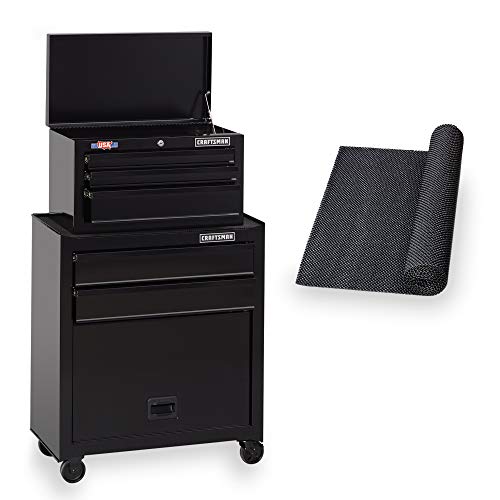
Craftsman CMST82763BK 26 in.
A chest-and-cabinet pair sold in one carton, with the chest shipped inside the cabinet. Craftsman lists 20-24 gauge steel, 30 lb full-extension ball-bearing drawer slides, a 300 lb load rating on 3 in. x 1 in. casters (two lock and swivel), and 10,227 cubic inches of storage. Made in USA with global materials.
Pros
- Chest and rolling cabinet in one purchase, so the working height is right from day one
- Full-extension ball-bearing slides rated 30 lb per drawer
- 300 lb load rating with two locking swivel casters
- 10,227 cubic inches of storage, per Craftsman
Cons
- 20-24 gauge steel is lighter than the 18-20 gauge on Craftsman own bigger chests
- 30 lb per drawer is modest if you store cast-iron hand planes or big socket sets
- At 26 in. wide it still needs real floor space
Craftsman lists 20-24 gauge steel, 30 lb full-extension ball-bearing slides, a 300 lb load rating on 3 in. by 1 in. casters with two that lock and swivel, and 10,227 cubic inches of storage. It is sold as a pair — chest and rolling cabinet in one carton, the chest shipped inside the cabinet — which is the part we would pay for. Buying the two separately usually means a top chest on the floor for a year.
The catches are honest ones. The 20-24 gauge steel is lighter than the 18-20 gauge Craftsman uses on its own bigger chests, the 30 lb per drawer is modest, and at 26 inches wide it still takes real floor space. Craftsman describes it as made in the USA with global materials; that is the company's own claim on its own listing. It is $288.00 as of September 2026, and prices move.

Granper 5-Drawer
The value route to a rolling chest. Granper lists cold-rolled steel with three layers of powder coating, five drawers over an enlarged bottom cabinet for drills and larger tools, five casters with two locking, and EVA anti-slip mats in every drawer. Ships mostly assembled - wheels and side hooks are the only fitting.
Pros
- Well under half the price of the mainstream branded combo
- Bottom cabinet swallows drills and larger tools that will not lie flat in a drawer
- EVA mats in every drawer come fitted, not sold separately
- Arrives mostly assembled
Cons
- Granper does not publish a per-drawer weight rating, so compare it on nothing but its own description
- An unfamiliar brand with no dealer network behind it
- Every figure here is the maker own
The value route. Granper lists cold-rolled steel with three layers of powder coating, five drawers over an enlarged bottom cabinet sized for drills and larger tools, five casters with two locking, and EVA anti-slip mats fitted in every drawer. It ships mostly assembled — wheels and side hooks are the only fitting — and it is $125.99 as of September 2026 against a $159.99 list price, about 44 percent of the $288.00 branded combo and so well under half its cost.
The catch is what Granper does not publish: there is no per-drawer weight rating anywhere in the listing. That means you cannot compare it to the Craftsman on the one specification that matters most, and you are buying on the description alone from a brand with no dealer network behind it. For hand tools and fasteners in a home garage, that may be a trade you are happy to make. For a drawer of impact sockets, we would want a number.
One more restraint, because it is the commonest way to waste money here: do not buy a 41 in. cabinet for eleven tools. If your collection is still at the level of a beginner's budget tool kit, a wall and a single portable box will serve you better than a chest with four empty drawers, and cost a quarter as much.
Inside the drawers
A chest does not organise anything. It gives you five rectangular boxes, and within a month each one is a layer of tools sliding about on top of another. The full method for how to organize a tool chest is a guide of its own; the summary is one job per drawer, a tray inside each, and nothing stacked two deep.

Ernst 10-Compartment Tray
The cheapest fix for a drawer that has turned into a bin. Ernst lists ten compartments in a low-profile tray that fits shallow toolbox drawers, stackable so several sit on top of each other, with rolled bottom edges to get small bits out, in high-impact plastic. Made in the USA.
Pros
- Turns one chaotic shallow drawer into ten findable compartments
- Low profile fits the 1.5-2 in. drawers most chests actually have
- Stackable, so a deep drawer can hold several trays
- Rolled bottom edges make small fasteners easy to pick out
Cons
- Fixed compartment sizes - you organize around them, not the reverse
- One tray covers one drawer, so a five-drawer chest needs several
- Plastic, not the foam-and-cutout system a machinist would want
Fifteen dollars is the cheapest meaningful upgrade in this entire article. Ernst lists ten compartments in a low-profile tray designed to fit shallow toolbox drawers, stackable so several sit on top of one another, with rolled bottom edges so small parts can be picked out rather than scraped at. It is high-impact plastic, and Ernst states it is made in the USA. It is $15.39 as of September 2026 against a $17.10 list.
The low profile is the specification that matters, because it fits the 1.5 to 2 in. drawers most chests actually have rather than the deep ones people imagine they have. The catch is arithmetic: one tray covers one drawer, so a five-drawer chest needs several, and the compartment sizes are fixed. If you want cut foam with a silhouette for every tool, this is not that — it is the ninety-percent solution at five percent of the effort.
Screws, bolts and small parts
Fasteners defeat every system built for tools, because the unit of storage is a handful rather than an object. We look at small parts and fastener organizers separately; the decision comes down to three formats.
- Compartment cases — the flat plastic boxes with movable dividers. Best for anything you carry: they stack, they travel and they close.
- Small-drawer cabinets — the many-tiny-drawers units. Best for the bench, worst for carrying, and excellent for the stuff you buy in hundreds.
- Open bins on a shelf or rail — fastest to use and worst at keeping dust out. Good for the twenty fasteners you use every week.
Two habits beat any product. Label the outside of everything, because a clear lid still needs reading from the side. And buy fasteners in the sizes you actually use rather than assortment kits, which is how most people end up with four hundred screws in two lengths they never need and none in the length they always do.
Shelving and cabinets
Shelving is the cheapest storage in the garage per cubic foot, and it is what stops the floor filling up again. We cover the best garage shelving for tools separately; the short answer is that a 4-shelf wire rack against the back wall solves more problems than anything else at the price.

Amazon Basics 4-Shelf Rack
The default garage shelf. Amazon lists chrome-finished steel, 350 pounds per shelf evenly distributed for a 1,400 pound total, shelf heights adjustable in 1 inch increments, four leveling feet, and no-tool assembly.
Pros
- 350 lb per shelf evenly distributed, per Amazon - it will take paint, fasteners and spare batteries
- Shelf height adjusts in 1 in. increments as what you store changes
- Assembles with no tools
- Leveling feet cope with a sloped garage slab
Cons
- Wire shelves drop small parts straight through unless you add bins or a board
- 350 lb is the evenly distributed figure, not a point load
- Chrome finish will spot in a damp garage
Amazon lists chrome-finished steel, 350 pounds per shelf evenly distributed for a 1,400 pound total, shelf heights adjustable in 1 inch increments, four leveling feet and no-tool assembly. At $73.73 as of September 2026 it is the default for a reason, and the leveling feet are not a throwaway feature — garage slabs are poured with a fall towards the door, so a rack without adjustable feet rocks.
Two things to plan for. The 350 lb figure is Amazon's evenly distributed rating, not a point load, so spread heavy things across the shelf rather than parking them in the middle of a span. And wire shelves drop small parts straight through, so put a cut sheet of hardboard or a row of bins on any shelf that will hold loose items.
The one thing on these shelves that deserves a genuine safety thought is batteries. Lithium-ion packs do not enjoy a garage: writing for Bob Vila, DeWalt group product manager for batteries Brad Palmatary recommends storing lithium-ion batteries between 68 and 77 degrees Fahrenheit and says to avoid storing them above 104 degrees Fahrenheit, because extreme temperatures can cause thermal decomposition of the battery components. An uninsulated garage in July or January is outside that window for weeks at a time. We go through the options — where to put the charger, what to do in an unheated space, and why the shelf above the bench is the wrong place — in our guide to cordless tool battery storage and charging.
One note on closed cabinets: an enclosed unit stores less than open shelving of the same footprint, because doors and carcass eat volume and you cannot see inside. Buy one for a specific reason — dust off abrasives, chemicals away from children — not for capacity.
Modular stacking box systems
Stacking box systems are the most fashionable thing in tool storage and the most frequently misused. They solve transport: getting a coherent set of tools across the house, or into a car, in one trip. The cross-brand detail — modular tool box systems compared on footprint, latching, wheels and price — we cover separately.

Craftsman VERSASTACK XL Tower
Three stacking VERSASTACK XL units on a wheeled base. Craftsman lists automatic stacking with a drop-and-lock mechanism and one-touch release, 7 inch wheels, a coated handle, overmold latches, an included adaptor for other VERSASTACK boxes, and a design tested and rated for dust and water resistance.
Pros
- The whole stack moves as one and splits into three boxes at the job
- Drop-and-lock stacking with a one-touch release - no straps or clips
- 7 in. wheels clear a garage threshold and gravel
- Adaptor included to connect other VERSASTACK boxes
Cons
- Commits you to one brand system - VERSASTACK boxes do not lock to rival stacks
- Craftsman states dust and water resistance here without publishing an IP number for the set
- Stacked boxes mean unstacking to reach the bottom one
Craftsman lists three stacking VERSASTACK XL units on a wheeled base with automatic drop-and-lock stacking and a one-touch release, 7 inch wheels, a coated handle, overmold latches, an adaptor to connect other VERSASTACK boxes, and a design it says is tested and rated for dust and water resistance. It is $209.00 as of September 2026.
The drop-and-lock mechanism is the feature worth paying for: systems that need straps or clips get used once and then stop being a system. Seven-inch wheels are the other detail, because the failure mode of small-wheeled boxes is a garage threshold and a gravel drive.
Three catches, and they are the reason this is not our first recommendation for a garage. It commits you to one brand — VERSASTACK boxes do not lock to a rival maker's stack, so every later purchase is decided for you. Craftsman claims dust and water resistance without publishing an IP number for the set, which is a claim we cannot check. And stacked boxes mean unstacking to reach the bottom one, which is exactly why a stack is a poor everyday home for tools you use daily.
Our rule: buy the stack when tools regularly leave the garage. Do not let it become the garage.
The workbench
Everything above assumes there is a surface to put things on. We come back to the best workbench for a home garage in its own guide; here the question is only where it goes, because the bench decides the layout of everything else.
Put it against a wall with power, and put it where you can get behind or beside it rather than in the swing of the car door. The wall above it becomes the most valuable storage real estate you own — that is where the metal pegboard earns its cost per square foot — and the space under it is the natural home for the rolling cabinet, which is why buying a chest before you know your bench height is a gamble.
If you have no bench yet, a sheet of 3/4 in. plywood on two base cabinets will do for a year, and it teaches you the height and depth you actually want before you spend real money.
Working in a small garage
A single-car garage changes the arithmetic rather than the principles. The full treatment of how to organize a small garage workshop is a guide of its own; four adjustments carry most of it.
- Go vertical earlier and higher. In a tight garage the wall is not the cheap option, it is the only option. Shelving above the car bonnet line and above the door opening is usually the last unused space in the building.
- Make the bench fold or roll. A fixed bench in a small garage is a bench you have to walk around forever. A wall-hinged top or a bench on locking castors gives the floor back every evening.
- Choose narrow and tall over wide and low. A 26 in. chest and a 14 in. deep shelving rack are far easier to live with than a 41 in. cabinet you have to edge past.
- Measure the car doors open, not closed. The usable width of a garage is the width with both doors open and a person standing in the gap. Mark that footprint on the floor with tape before you buy anything.
What to buy first
Here is the order, with rough money attached. Every price is as of September 2026 and will have moved by the time you read this.
Drag to compare all 5 →
- A wall, $25 to $120. Cheapest route: a 4 ft. by 8 ft. hardboard pegboard sheet at about $24.98 plus a box of hooks. Better route above a bench: the Wall Control 4 ft. Kit at $120.04, hooks included.
- Shelving, $73.73. The 4-shelf wire rack. Buy it second, because it is what actually clears the floor.
- Drawer trays, $15.39 each. Buy one before you buy the chest, and put it in whatever box you already own. It costs less than lunch and it is the upgrade you will notice daily.
- The chest, $125.99 or $288.00. The Granper if the budget is tight and your tools are light; the Craftsman combo if you want a published per-drawer rating and a chest-plus-cabinet pair in one go. Buy this fourth, not first.
- The portable stack, $209.00. Buy it when tools start leaving the garage regularly, and not before.
The lean version of that list — hardboard wall, shelving, one tray, Granper chest — is about $240 as of September 2026. The full version with the metal board and the Craftsman combo is about $497. Both are less than most people spend drifting into storage one panic purchase at a time.
Common questions
Should I buy pegboard or a French cleat wall?
Pegboard if you want it done this weekend and your tools are hand tools. French cleat if you enjoy the making, own heavy or awkward things, and want holders shaped to your own tools. Cost pushes the same way: hardboard pegboard worked out at about $0.78 per square foot at Home Depot prices in September 2026, while a cleat wall costs a sheet of plywood plus every weekend you spend building holders. There is no rule against both — cleats along the bench wall, pegboard above the bench.
How big a tool chest should I buy?
Bigger than your current collection, and narrower than you think you can fit. The reason is cost per drawer: chests generally get cheaper per drawer as they get wider, so the upgrade is cheapest when you buy it rather than when you replace it. The counterweight is floor space — the Craftsman combo above is 26 inches wide and that is already a real footprint in a garage that parks a car.
Can I hang a tool wall on drywall without hitting studs?
Do it into studs. The 2024 International Residential Code specifies stud spacing through Table R602.3(5), and as Jaspector's summary explains, 16 inches on centre is standard for load-bearing walls — so the studs are findable and regular. If part of a board has to land between them, use the right anchor and respect the manufacturer's stated rating rather than the numbers from pull tests, which Family Handyman measured as failure points rather than working loads.
What is the cheapest change that makes the biggest difference?
A drawer tray, at around $15. Second cheapest: drawing outlines around the tools on your pegboard, so an empty space is an obvious question. Neither is exciting, and between them they are most of what separates a tidy garage from a photogenic one.
Explore the full series
- The Best Tool Chests for a Home Garage (2026) — What a chest actually buys you over a tool bag, and the drawer-slide spec that separates the $100 boxes from the $900 ones.
- Pegboard vs French Cleat vs Slatwall: Which Tool Wall Should You Build? — Three ways to hang a tool wall, what each one costs per square foot, and which is worth building yourself.
About the Author
Cheryl Thompson
Cheryl Thompson is the tools editor at The DIY Tool Review. A lifelong fixer and self-confessed tool addict, she has spent years buying, borrowing and wearing out hand and power tools across home renovation, furniture building and everyday repairs. She writes hands-on, no-nonsense reviews to help fellow DIYers spend their money on the tools that actually last.