How to Use a Hand Saw (and Why You Still Want One)
Stop forcing the saw and the saw starts cutting straight. Here's the technique, plus why the direction a saw cuts decides how thin its blade can be — and how easily a beginner can follow a line.

- Category
- Saws & Cutting Tools
- Tools tested
- 5
- Read time
- 13 min
- Updated
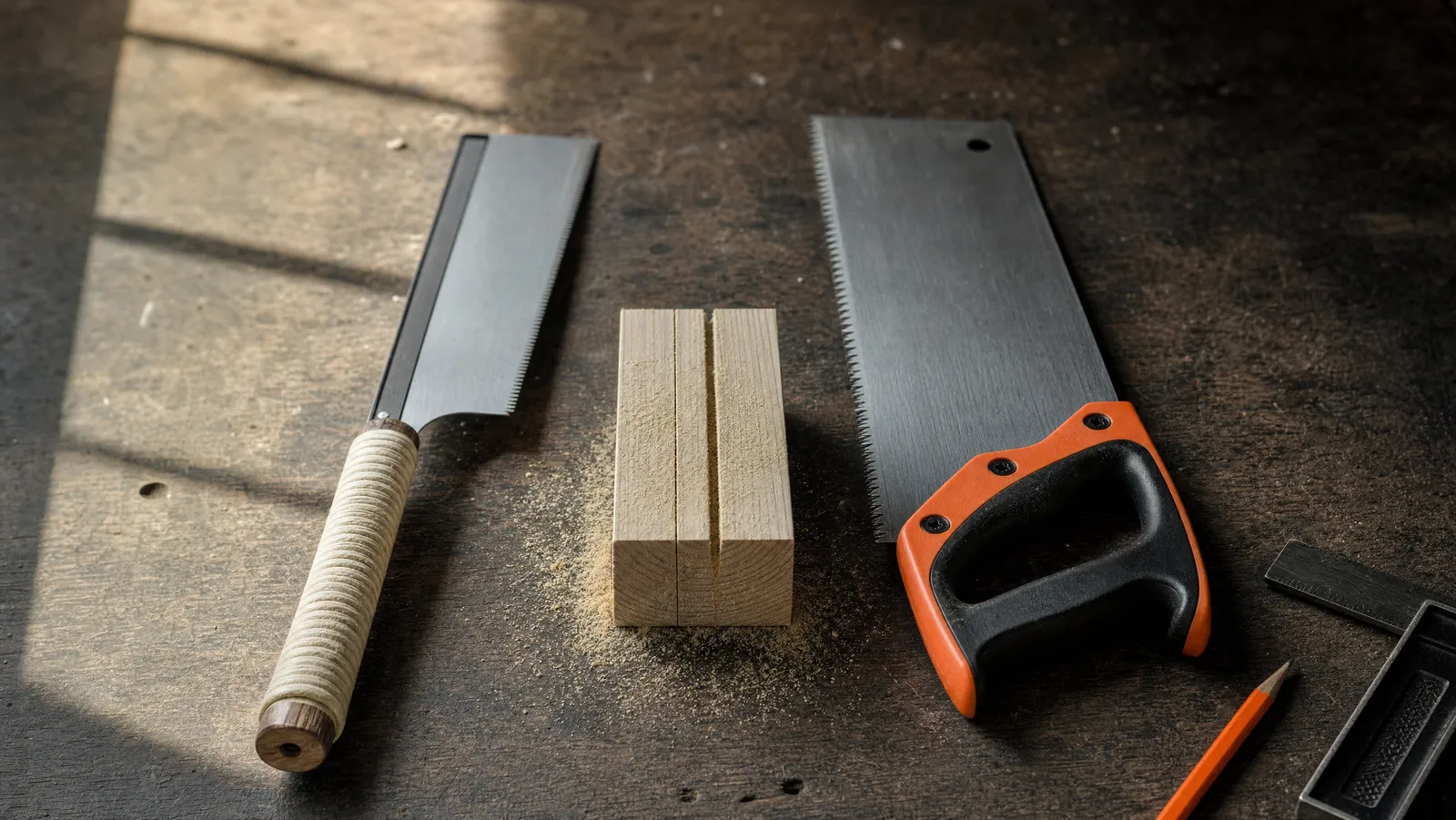
Here is how to use a hand saw: set the teeth on the waste side of your pencil line, take two or three light strokes to cut a shallow groove, then switch to long, full-length strokes with almost no downward pressure. Forcing it is what makes a blade wander. And if you are learning, a Japanese pull saw is the easiest kind to steer.
That is the whole method in one paragraph; the rest of this guide earns it. Not sure a hand saw is the right tool for the job? Start with types of saws explained, or the full DIY saw guide.
Push or pull: the choice that decides everything else
Every other difference between two hand saws follows from one thing: which direction the saw cuts.
A push saw works in compression. According to Woodbin's reference page on Japanese saws, "Push saws require a thicker blade to remain rigid," because without that thickness the blade would flex during the cut and bind.
A pull saw works in tension. Woodbin notes that pull-stroke saws "are not subject to compression tension," so their blades can be thinner and more flexible — which it links to a thinner kerf, less effort and finer control. Wikipedia's entry on Japanese saws agrees: their blades "are often thinner than traditional western saws that cut on the push stroke," and thinner blades "can leave a narrower cut width (kerf)."
The published figures here match the physics exactly. The one push saw in this guide that publishes a blade thickness, the QYQRQF 14 in., lists 0.9 mm. The two pull saws list 0.5 mm (SUIZAN Ryoba) and 0.4 mm (SUIZAN flush cut). Do the division: the push saw's blade is 1.8 times as thick as the Ryoba's, and 2.25 times as thick as the flush cut saw's.
Thicker blade, more wood per stroke, more force, harder to steer. That is why a beginner tracks a line better with a pull saw: not taste, arithmetic.
Where the numbers stop
Kerf data here is one-sided. Only the two SUIZAN saws publish a kerf: 0.03 in. (0.8 mm) for the Ryoba, 0.018 in. (0.45 mm) for the flush cut. Neither the QYQRQF nor the JORGENSEN listing gives one at all. Compare thickness to thickness and kerf to kerf, never one against the other — a set-tooth push saw's kerf is always wider than its blade, because the teeth are bent outward.
And discount the speed claims. Both the JORGENSEN and the QYQRQF listings claim their saw cuts "50% faster": unrelated makers, the same round number, and neither says faster than what. The QYQRQF listing also claims it cuts on both push and pull strokes — a vendor claim, and set teeth on a Western-pattern saw are filed to cut going forward.
How to start a cut that does not wander
The first half inch decides the rest of the cut.
Start on the far edge of the board with the blade at a low angle, and use your free hand as a fence. The 1927 Disston Tool Manual for School Shops, reproduced by the Disstonian Institute, describes placing that hand "so close that either the knuckle or the end of the thumb will bear against the saw blade and support it vertically." Keep the thumb high enough that the teeth cannot reach it.
Then take the lightest strokes you can manage. Disston's manual begins a cut by "drawing the blade slowly toward the operator two or three times" — just enough to score a groove that holds the blade on line. On a push saw those are backward draws. On a pull saw the first strokes are still pulls: SUIZAN's own beginner guide says to "pull very slowly and with extremely light pressure at first," and adds that if you find it more comfortable "pushing lightly to establish that first tiny groove, it is perfectly fine to do so."
Cutting to the waste side of the line
Your blade has width, so the slot has to come out of somewhere. Cut down the middle of your pencil line and the finished piece is short by half a kerf. Cut on the wrong side of it and you lose a full one.
Disston's manual is blunt: "Start the cut close to the line, on the waste side," and "Do not attempt to split the scribed or penciled line." This Old House agrees: set the saw on the waste, the part you plan to discard.
Stroke, pressure and angle
Use the whole blade. Disston's manual asks for strokes that "approximate the full length of the blade, so that each tooth may do a fair share of the work," and is dismissive of leaning on it: "Downward pressure through the wrist is wasted effort."
That matters most on a pull saw. A 0.5 mm blade does not care how strong you are; push hard on the return stroke and you will kink it. Let the saw's own weight be the downward force.
Angle is the one real dial you have. According to the Disston manual, the correct angle for crosscutting is about 45 degrees from the horizontal, while for ripping the saw "is held more nearly erect, at about 60 degrees." This Old House also holds the saw at about 45 degrees and adds the trade-off: drop the handle for a finer, more accurate cut, raise it for a faster one.
Clamp the board, and support the offcut so it cannot snap off under its own weight on the last few strokes.
Tracking a line on a thick board
Beginners watch the pencil line out ahead of the blade. That is the wrong place to look.
Watch where the teeth enter the wood. The entry point is the only place you can correct anything; once the blade has passed a spot, that part of the cut is finished. Small early corrections steer a saw; big late ones bind it.
On stock thicker than an inch, mark the line on the face and square it down the edge, then check the far face every few strokes. Square on top and drifting underneath is the classic hand-saw failure, and you can catch it in time if you look. If the layout line is wrong to begin with, nothing downstream saves the cut — how to use a speed square covers getting it square before the saw touches the board.
For the first inch, a square held flat against the side of the blade is a legitimate training aid. The JORGENSEN's handle has 45 and 90 degree guides moulded in for the same purpose.
Which hand saw should you own?
Four saws, one spare blade, and a real spread: $9.99 for the QYQRQF against $49.80 for the SUIZAN Ryoba as of October 2026 — just under five times the money from cheapest to dearest.
Drag to compare all 5 →
The tooth-count spread matters too: the JORGENSEN's 8 TPI against the flush cut saw's 20 TPI edge is two and a half times as many teeth per inch — fast-and-rough against slow-and-clean. Lowe's hand saw buying guide puts rip saws at roughly 4 to 7 TPI and crosscut saws at 8 to 11 TPI, the crosscut leaving a smoother edge.
Best saw to learn on — SUIZAN Ryoba 9.5 in.

SUIZAN Ryoba 9.5 in.
Two saws in one blade - a rip edge and a crosscut edge - and the easiest hand saw for a beginner to track a line with.
Pros
- Cuts on the pull stroke, which keeps the thin blade in tension so it cannot buckle
- Two edges: 9 TPI for ripping with the grain, 15 TPI for crosscutting across it
- 0.5 mm blade and 0.03 in. kerf, so it removes far less wood per stroke than a push saw
- Blade is held by a single screw and can be replaced when the teeth wear
Cons
- $49.80 is the most expensive saw here, five times the budget hardpoint
- A 0.5 mm blade will kink if you push hard on the return stroke - it demands a lighter hand
- The hand-wrapped rattan handle varies between units and may show small cracks, which SUIZAN says are not defects
This is the one we would put in a beginner's hand, for the thickness reason above. It is also two saws: a 9 TPI rip edge for cutting along the grain and a 15 TPI crosscut edge for cutting across it. Wikipedia describes exactly that arrangement for the ryoba pattern — a crosscut (yokobiki) edge on one side, a ripping (tatebiki) edge on the other. Use the edge that matches your direction; running the rip edge across the grain is how people conclude a good saw is a bad one.
At $49.80 it asks you to commit. For a first saw inside a broader starter set instead, our best diy tool kit for beginners guide builds the cheaper route.
Cheapest way in — QYQRQF 14 in.
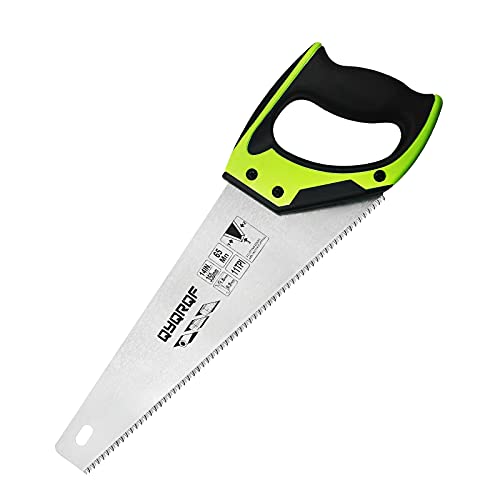
QYQRQF 14 in.
A ten-dollar hardpoint saw that will cut a 2x4 to length today. Its teeth cannot be resharpened.
Pros
- $9.99 buys a working saw, the cheapest tool in this guide
- 11 TPI is fine enough for trim and plywood as well as framing lumber
- Ships with a tooth protector, which matters more than it sounds
Cons
- Hardpoint teeth are induction-hardened and cannot be resharpened - when it dulls, it is scrap
- At 0.9 mm its blade is the thickest of the three here that publish a thickness, so it removes the most wood per stroke
- No kerf figure published anywhere in the listing
- Its 'cuts on push and pull strokes' claim is a vendor claim with nothing behind it
Ten dollars, 11 TPI, and it will cut a 2x4 to length this afternoon. The tooth protector it ships with is not a throwaway detail: a chipped tooth is permanent on a saw you cannot re-sharpen.
Western workhorse — JORGENSEN 15 in.
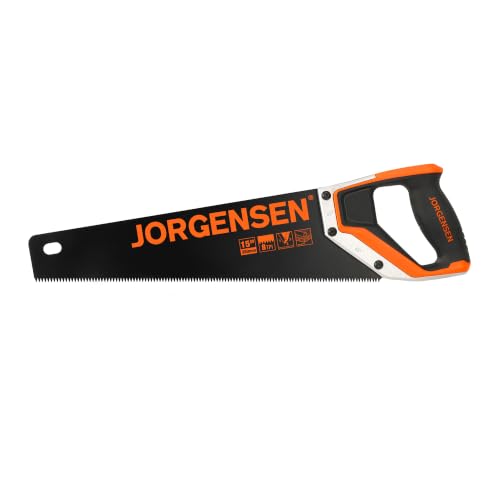
JORGENSEN 15 in.
The classic push saw: coarse, fast through softwood, and the one with layout guides in the handle.
Pros
- 8 TPI is the coarsest tooth count here, which makes it the fastest through construction lumber
- 45 and 90 degree guides moulded into the handle do real work on a job
- Teflon coating genuinely reduces binding in damp softwood
- SK5 high-carbon steel holds an edge better than generic carbon steel
Cons
- 8 TPI leaves a rough edge - too coarse for trim or plywood
- Publishes neither a blade thickness nor a kerf
- Its '50% faster' claim never says faster than what
At 8 TPI this is the coarsest and fastest saw here through construction lumber, and the trade is a rougher edge than you want on trim or plywood. Its listing publishes neither a blade thickness nor a kerf, so it cannot go on the thickness ladder above — and we will not guess a figure for it.
The specialist worth owning — SUIZAN Flush Cut 6 in.

SUIZAN Flush Cut 6 in.
Trims dowels and plugs dead flush without marking the surface around them, because its teeth have no set.
Pros
- No-set teeth and a 0.4 mm blade that flexes flat to the work - it cannot scratch the surface the way a set-tooth saw does
- Finest teeth here: 17 TPI on one edge, 20 TPI on the other, each printed on the blade
- Thinnest blade and narrowest kerf of the saws here that publish both figures
- $22.70 for a job no other saw in this guide can do cleanly
Cons
- A specialist - it cannot crosscut a board to length
- A 0.4 mm blade is easy to kink if you force it
- Held by two screws rather than one, so blade swaps are slightly slower than the Ryoba's
This does one job nothing else here does cleanly: trimming a dowel, plug or protruding tenon level with the surface without scratching the wood around it. The reason is that its teeth have no set — Wikipedia describes the kugihiki pattern as a thin, flexible flush-cut saw with unset teeth, made for trimming protrusions flush with a surface. With a 0.4 mm blade and a 0.45 mm kerf it is the thinnest and narrowest of any saw here that publishes both figures. It cannot crosscut a board to length. Both SUIZAN saws together come to $72.50.
If the real job is thirty crosscuts in framing lumber or ripping a full sheet of plywood, no hand saw is the answer and your arm will say so by cut six. That is a job for the best circular saw for diy.
Teeth you can sharpen, teeth you cannot
This is the real dividing line between the cheap saws and the expensive ones, and it maps onto price.
The QYQRQF is a hardpoint saw. According to Axminster Tools' guide to hardpoint handsaws, hardpoint blades have induction-hardened teeth and cannot be re-sharpened; once blunt they must be discarded and a new one bought. The same hardening is why they hold an edge longer than plain carbon steel. At $9.99 that is a fair bargain — it just makes the saw a consumable, not a keeper.
SUIZAN's answer is not sharpening. It is swapping the blade.

SUIZAN Ryoba blade
A fresh factory edge for the Ryoba, swapped with one screw. Price it against a whole new saw before you call it cheap.
Pros
- Restores a factory edge without learning to file saw teeth
- Identical published geometry to the original blade: 0.5 mm thick, 0.03 in. kerf, 9/15 TPI
- One screw to swap, and you keep the handle you are used to
Cons
- Costs just under half of what the complete saw costs
- Fits only the 9.5 in. standard and Assembly Version Ryoba - not the folding model
So price it honestly. The blade is $24.80 against $49.80 for the complete saw as of October 2026 — 49.8 percent, a hair under half the price of the whole thing. Choosing a fresh blade over a second complete Ryoba saves exactly $25.00 and leaves you the handle you are already used to.
Call that what it is: not cheap, and still the right call. A new blade restores the identical published geometry (0.5 mm thick, 0.03 in. kerf, 9 and 15 TPI), and it is far less work than learning to file and set saw teeth — the only other route back to a sharp edge.
Why a hand saw still earns bench space
A hand saw is the fastest tool in the shop for exactly one cut.
No cord, no battery to find charged, no blade guard to fight, no dust extraction, no setup. You pick it up, cut, and hang it back up — finished before a circular saw is plugged in. It is quiet enough to use at 9pm, and throws coarse chips rather than fine airborne dust. There is also no circular saw kickback to worry about, because a hand saw stores no energy; it only moves when your arm moves.
That is the same argument that keeps a good hammer on the wall next to the nail gun: hand tools are simpler, cheaper and never flat. We make that case in hammers are an essential diy tool, and a hand saw belongs on the same shortlist as the other essential diy tools every home should have.
Working safely
- Account for both hands. One drives the saw; the other is either clear of the work or acting as a thumb fence, raised above the teeth.
- Clamp the work. A board that shifts mid-stroke is how blades jump the kerf.
- Keep the teeth sharp. OSHA's Hand and Power Tools booklet makes the point for hand tools generally: "dull tools can cause more hazards than sharp ones." A dull saw needs force, and force is what makes it slip.
- Mind who is near you. The same booklet advises directing saw blades and knives "away from aisle areas and away from other employees working in close proximity."
- Wear the gear. OSHA notes that protective equipment such as safety goggles and gloves must be worn against hand-tool hazards.
- Guard the teeth in storage. Hardened teeth can chip, and on a saw that cannot be re-sharpened that damage is permanent.
Getting started
Buy one saw, cut ten scraps, throw them away. Mark a square line, start it on the far edge with your thumb as a fence, take two or three light strokes, then cut with the full length of the blade and no weight on it. Ten practice cuts is roughly where you stop fighting the tool and start steering it.
We would buy the SUIZAN Ryoba to learn on, because its published blade thickness says it will be easier to steer. If you would rather spend $9.99 to find out whether you enjoy hand sawing at all, that is a reasonable way in. When you are ready to weigh a hand saw against the powered options, our saw buying guide lays the category out side by side.
Frequently asked questions
What is the best hand saw for DIY?
For most DIYers we would buy the SUIZAN Ryoba at $49.80 as of October 2026: a 0.5 mm blade steers more easily than a thicker push saw, and you get a 9 TPI rip edge plus a 15 TPI crosscut edge. On a tight budget the $9.99 QYQRQF is a working saw — you just cannot resharpen it.
Which hand saw is best for hardwood?
Finer teeth and a thinner blade, because hardwood punishes anything that needs force. Of the saws here, the SUIZAN Ryoba's 15 TPI crosscut edge is what we would take into hardwood, and the flush cut saw's 17 TPI edge is the one SUIZAN labels for hardwood. The JORGENSEN's 8 TPI is built for speed in softwood.
Is a Japanese pull saw better than a Western saw?
Better for learning on, and the reason is mechanical rather than cultural. Woodbin notes that push saws need a thicker blade to stay rigid, while pull-stroke blades are not loaded in compression and can be thinner. Thinner blade, less wood per stroke, less force, easier steering. A coarse Western saw is still faster in framing lumber.
How do you use a hand saw safely?
Clamp the workpiece, keep your guide thumb clear of the teeth, and never force a cut — OSHA's hand tool guidance warns that dull tools cause more hazards than sharp ones, and force is what makes a blade slip. Wear eye protection, support the offcut so it cannot tear free, and guard the teeth for storage.
About the Author
Cheryl Thompson
Cheryl Thompson is the tools editor at The DIY Tool Review. A lifelong fixer and self-confessed tool addict, she has spent years buying, borrowing and wearing out hand and power tools across home renovation, furniture building and everyday repairs. She writes hands-on, no-nonsense reviews to help fellow DIYers spend their money on the tools that actually last.