The Best Levels for DIY: Torpedo, Box and Post Levels Compared
The right answer for most homes is two levels, not one expensive one: a 9-inch torpedo and a 24-inch. Six picks, what the accuracy specs actually mean over 24 and 48 inches, and which two of these makers publish no tolerance at all.

- Category
- Measuring & Layout
- Tools tested
- 6
- Read time
- 17 min
- Updated
The best level for DIY is not one level — it is two. A 9-inch magnetic torpedo for spot checks, and a 24-inch for anything you actually fix to a wall. Buy the Channellock 24-inch I-beam at $34.99 as of August 2026 alongside a ten-dollar torpedo and you have covered almost everything a house will ask of you.
The reason is geometry, not brand loyalty. A level only tells you the truth about the span it physically covers. Nine inches of aluminium reports on nine inches of surface; the other five feet of that shelf are guesswork. That is why the length on the box matters more than the name on it, and it is the same instinct that runs through our guide to measuring and layout tools for DIY: buy for the span and the job, not the badge.
There is a second thing nobody writing about levels says out loud. An accuracy figure is not a given. Four of the six picks below publish one, and all four land on the same professional tolerance. Two publish nothing at all, and we name them.
How we picked these levels
We have not held any of these tools and will not pretend otherwise. Our selection comes from published manufacturer specifications, current price and availability, and a view of what a homeowner actually puts a level on — a shelf, a washing machine, a fence post, a door frame.
We do not publish star ratings or review counts either. Our product data source does not supply them, so you will not find one on this page. Every performance figure below is the maker's own number, and we say whose.
Prices are as of August 2026 and they move. Levels are exactly the sort of low-margin item that gets discounted constantly, so treat every figure here as a snapshot.
Length is the spec that matters, not the brand
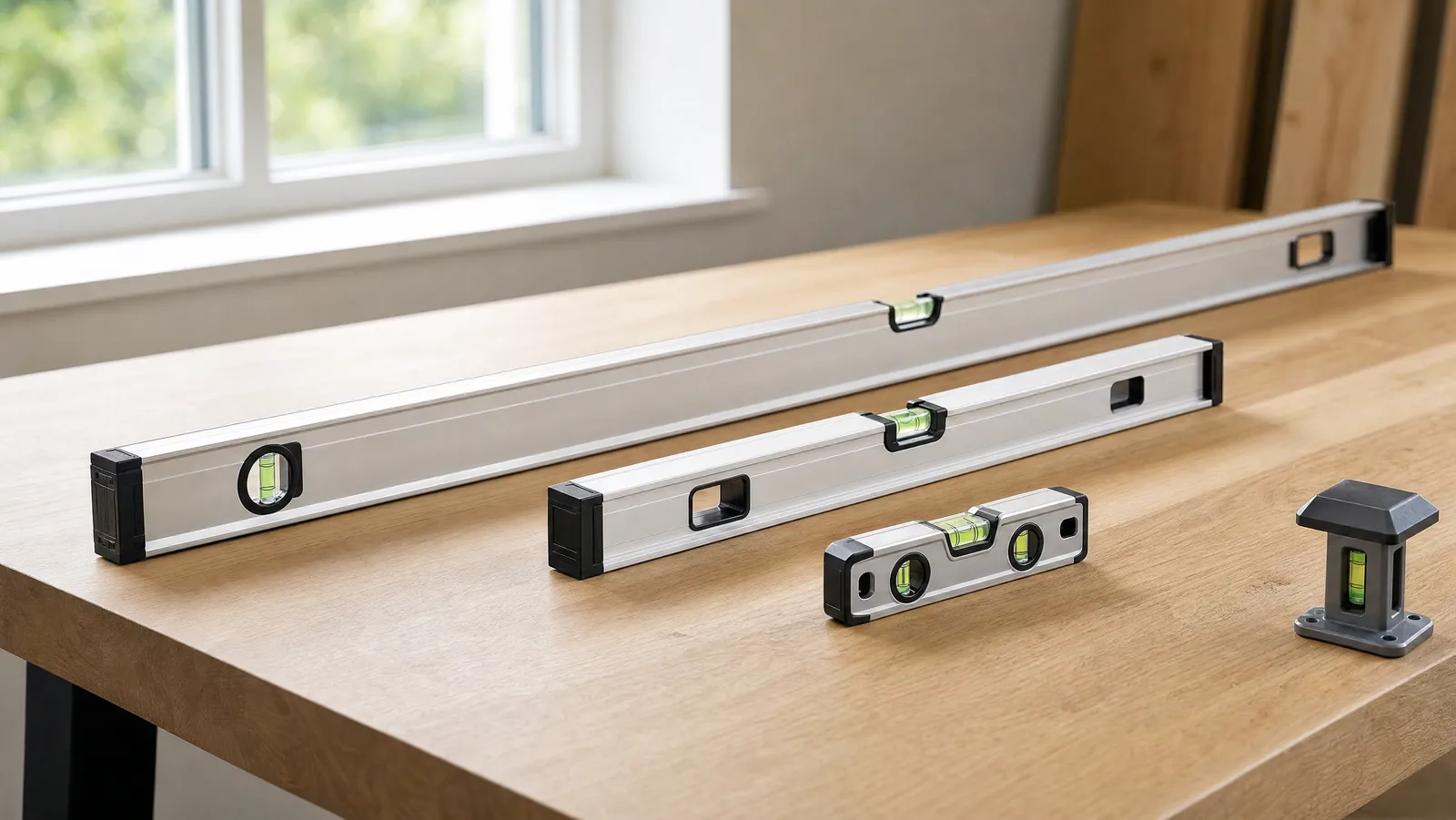
Bob Vila puts the standard sizes plainly: most torpedo levels measure about 9 inches, carpenter's levels run from 2 to 8 feet with 24-inch and 48-inch the most common, and mason's levels start at 4 feet so they can span large surfaces and reveal dips a shorter tool would miss. Bob Vila's own homeowner recommendation is the one we would give: a 9-inch torpedo plus a 24- or 48-inch level covers most household projects.
Why does length beat everything else? A level is a straightedge with a bubble on it, and it reports only on what it touches. Set a 9-inch torpedo on a bowed floorboard and it faithfully tells you about the bow. It knows nothing about the floor.
The arithmetic is worth doing once. Suppose your torpedo sits exactly at the DIY-grade tolerance of 0.001 in./in. that Kapro describes — nine thousandths of an inch of error across its own body, completely invisible in the vial. Extend that same tilt along a six-foot shelf and the far end is about 0.072 in out, roughly a fourteenth of an inch. That is the good case, where the tool is the only source of error.
Bob Vila makes the same point from the other direction: longer levels reduce the number of placements needed to check a surface, which helps minimise small measurement errors. Every time you set a level down you introduce a fresh chance to be wrong.
This Old House splits it the same way: a 24-inch spirit level is versatile for most home projects, while 4-foot levels or longer are ideal for checking large surfaces and long spans. Door openings, stud walls and floors are the cases that typically push you to four feet — a longer level judges more of the jamb or the wall in a single placement, which is Bob Vila's point about fewer placements meaning fewer chances to be wrong.
One thing no level does is tell you how long something is. That is a separate discipline, and if your shelves keep coming out level but the wrong size, the fix is in how to use a tape measure like a pro rather than in a longer level.
What the accuracy numbers actually mean
Two figures appear on the picks below: 0.0005 in./in. and 0.5 mm/m. They are the same number in different units.
According to Kapro, professional spirit levels have an accuracy tolerance of 0.5 mm/m, which is 0.0005 in./in., while the DIY market runs at 1 mm/m, or 0.001 in./in. — twice as loose. Johnson Level puts the same ceiling in degrees: the best spirit level is accurate to within plus or minus 0.5 mm/m, or 0.0005 in./in., or 0.029 degrees, with the next tier down at 0.75 mm/m, about 0.043 degrees.
Three hundredths of a degree is not a number anyone can picture, so here is the arithmetic translated into the two spans that matter in a house.
Read the top row again. A professional-grade 48-inch level is allowed to be out by twenty-four thousandths of an inch end to end. Nobody is going to notice a door that is a fortieth of an inch out of plumb. The published tolerance is almost never what ruins your shelf; the length you chose is.
That is also why the missing figures matter less than they sound. A level with no published tolerance is not necessarily inaccurate — it is unverifiable, which is a different complaint.
Which brings us to the vial itself. Hultafors defines manufacturing tolerance as the sum of all possible minor and microscopically small errors during production, and calls tolerance the divergence from sensitivity — smaller is better. Sensitivity is a separate spec: Hultafors measures it in millimetres per metre, based on how far one end of a one-metre level must be lifted for the bubble to move 2 mm, and puts the market standard at 10 mm/m, equivalent to a 200 mm vial radius. A larger radius means the bubble reacts to smaller movements.
Vial construction is the other half of it. According to Kapro, injection-moulded cylindrical vials are the most basic and are aimed at DIY work where absolute accuracy is less critical, while solid acrylic vials are usually twice as accurate, as well as stronger and more shock-resistant. Johnson Level adds that vial bodies come shaped like a barrel, like a rectangular block, or curved and banana-shaped to read a fixed pitch in fractions per foot.
The picks: the best torpedo, box and post levels
Six levels, in the order our data lists them. The editorial opinion is ours; every specification is the maker's.
Best overall torpedo: Klein Tools 935AB4V

Klein Tools 935AB4V
Klein lists a patented magnet track that stops the rare-earth magnets falling out, high-visibility vials at level, 90, 45 and 30 degrees, a V-groove for round stock and a thumb screw for clamping it to conduit while bending.
Pros
- Patented magnet track keeps the rare-earth magnets captive
- Four vial angles including 30 and 45 degrees
- V-groove and thumb screw are made for conduit and pipe
- Billet aluminium body with a tapered nose that fits a pocket
Cons
- Roughly three times the price of a basic 9-inch torpedo
- Six inches is a spot-check length, not a shelf-hanging length
- The V-groove and thumb screw are conduit features many DIYers never use
Klein lists a patented magnet track that stops the rare-earth magnets falling out, which addresses the single most tedious failure mode of a cheap magnetic torpedo — a magnet that pops loose and stays stuck to the stud. It carries high-visibility vials at level, 90, 45 and 30 degrees, a V-groove for round stock, and a thumb screw for clamping it to conduit while you bend it. Klein describes the body as billet aluminium with a tapered nose that fits a pocket.
Two honest catches, and one pleasant surprise. The surprise: Klein's own product page publishes a vial accuracy of plus or minus 0.029 degrees for the 935AB4V — exactly the professional tolerance Johnson Level quotes above, and more than most torpedo makers publish at all. The catches are that six inches is a spot-check length, not a shelf-hanging length, and that it costs roughly three times what a basic 9-inch torpedo does.
Who should skip it: anyone not bending conduit or working on round stock. The V-groove and thumb screw are the reason for the price, and if you never touch them you have paid $29.97 as of August 2026 for a very good six-inch level.
Best budget torpedo: CRAFTSMAN CMHT43191

CRAFTSMAN CMHT43191
A nine-inch magnetic torpedo for ten dollars. The Amazon listing publishes almost nothing beyond the size and country of origin, so treat it as a competent basic tool rather than a precision instrument.
Pros
- Ten dollars for a magnetic torpedo level
- Nine inches spans more than the common six-inch length
- CRAFTSMAN brand support behind a throwaway-price tool
Cons
- The listing publishes no vial accuracy figure at all
- No V-groove or thumb screw is listed
- Country of origin is Thailand, if that matters to you
Nine inches, magnetic, $9.99 as of August 2026. That is the whole pitch, and at this price it is a strong one — nine inches is the length Bob Vila points homeowners at, and this is the cheapest credible way to own it.
Set your expectations from the listing, which publishes almost nothing beyond the size and the country of origin. There is no vial accuracy figure at all, no V-groove and no thumb screw listed. Country of origin is Thailand, if that matters to you. Treat it as a competent basic tool rather than a precision instrument, and it will not disappoint you.
What you get that a no-name torpedo does not offer is CRAFTSMAN brand support behind a throwaway-price tool — a real returns path if it arrives wrong. Which is the point of the flip test above: do it the day it lands, while you can still send it back.
Best 24-inch: Channellock 5100-0024M

Channellock 5100-0024M
Channellock quotes a 0.0005 in./in. tolerance in all ten working positions, three high-contrast vials plus a top-view window, a magnetic strip and an aluminium I-beam frame with impact-resistant end caps.
Pros
- Published accuracy figure of 0.0005 in./in. in ten positions
- Magnetic strip frees a hand on steel studs and appliances
- Top-view window reads from above when the level is overhead
- Ergonomic grips work with gloves on
Cons
- An I-beam profile rather than a sealed box beam
- Twenty-four inches will not span a door opening
- Costs about the same as some 48-inch levels
If you are only buying one long level, buy this one. Channellock quotes 0.0005 in./in. in all ten working positions — a published figure, at what Kapro classifies as professional grade, on a $34.99 tool. Two of the six picks here quote nothing; this one quotes the best number available, in every orientation rather than just flat.
The practical features earn their place. A magnetic strip frees a hand on steel studs and appliance panels, which is most of what a 24-inch level does in a house. A top-view window reads the vial from above when the level is over your head — an awkward position to read a bubble in. Channellock also lists grips that work with gloves on and impact-resistant end caps.
The catches are structural rather than damning. It is an I-beam profile rather than a sealed box beam, which we unpack below. Twenty-four inches will not span a door opening. And it costs about the same as some 48-inch levels — you are paying for the tolerance figure, not the aluminium.
Best 48-inch box level: Empire 650.48

Empire 650.48
Empire lists 0.5 mm/m accuracy across five working positions, three reinforced acrylic block vials, shock-absorbing end caps, two precision-milled edges and a limited lifetime warranty on an aluminium box frame.
Pros
- Sealed box frame with two precision-milled edges
- Stated 0.5 mm/m accuracy in five working positions
- Shock-absorbing end caps survive being dropped on a slab
- Limited lifetime warranty
Cons
- Listed as 1200 mm, which is 47.2 inches rather than a true 48
- Five working positions where some rivals claim ten
- A four-foot level is awkward to store in a small flat
The framing and door-hanging tool. Empire lists 0.5 mm/m accuracy across five working positions — the same 0.0005 in./in. as the Channellock, expressed in metric — on an aluminium box frame with two precision-milled edges, shock-absorbing end caps and a limited lifetime warranty.
The vials are the detail we would pay for: three reinforced acrylic block vials. Recall Kapro's point that solid acrylic vials are usually twice as accurate as injection-moulded cylindrical ones, as well as stronger and shock-resistant. On a four-foot level that lives leaning against a wall, that is not a luxury.
Now the catch, and it is a proper one. The level is listed as 1200 mm, which is 47.2 inches, not a true 48. For hanging a door that difference is irrelevant; if you were planning to use it as a 48-inch straightedge for marking, it is not one. It also quotes five working positions where the Channellock claims ten, and a four-foot level is genuinely awkward to store in a small flat.
At $38.00 as of August 2026 it is the cheapest sensible way to own a real box level. Skip it if you hang pictures and shelves and nothing else — you will never take it off the wall hook.
Best post level: Irwin 1794482

Irwin 1794482
A moulded post level with a magnetic strip and a rubber strap, so it wraps a post, rail or pipe and reads two faces for plumb at once while both your hands stay free.
Pros
- Under six dollars at the time of writing
- Rubber strap plus magnet holds it hands-free on a post
- Reads two faces for plumb simultaneously
- Works on posts, poles, pipes and railings
Cons
- Single-purpose: useless for a shelf, a picture or a floor
- Moulded plastic frame rather than machined aluminium
- Irwin publishes no accuracy tolerance for it
This is a fence and deck tool and nothing else. A moulded post level with a magnetic strip and a rubber strap, so it wraps a post, rail or pipe and reads two faces for plumb at once while both hands stay free to brace and backfill. Setting a post single-handed with a 24-inch level — checking one face, then the other, while the post drifts — is a job this $5.99 tool simply deletes.
The catches are what you would expect at that price. It is single-purpose — useless for a shelf, a picture or a floor. The frame is moulded plastic rather than machined aluminium. And Irwin publishes no accuracy tolerance for it, which we would mind far more on a $38 box level than on a strap-on plumb indicator.
Skip it if there are no posts, poles, pipes or railings in your future. Everyone else should add it to the order with the fence lumber.
Best value set: DURATECH 3-piece

DURATECH 3-Piece Set
DURATECH supplies 8-inch, 6.25-inch and 2.5-inch levels. The maker quotes 0.0005 in/in vial accuracy, N35 rare-earth magnets holding more than 9.92 lb on the 8-inch body, a V-groove base and a thumb screw.
Pros
- Three lengths for the price of one mid-range torpedo
- Maker quotes 0.0005 in/in vial accuracy
- V-groove and thumb screw on the two larger levels
- Fluorescent vials read from front, back and top
Cons
- The longest piece is only 8 inches - no 24 or 48-inch level here
- Magnet hold and accuracy are manufacturer figures, not independent ones
- Three short levels overlap more than they complement each other
Three levels — 8-inch, 6.25-inch and 2.5-inch — for the price of one mid-range torpedo. DURATECH quotes 0.0005 in/in vial accuracy, N35 rare-earth magnets holding more than 9.92 lb on the 8-inch body, a V-groove base and a thumb screw. The vials are fluorescent and read from the front, back and top.
That is a genuinely useful published spec sheet at $29.87 as of August 2026, and the 2.5-inch piece goes places nothing else here fits. But be clear about what it is not. The longest piece is only 8 inches — there is no 24 or 48-inch level in this box, so it is an addition to the two-level kit, not a replacement. The accuracy and magnet figures are the manufacturer's, not independent. And three short levels overlap each other more than they complement each other.
Buy the set if you work in tight spaces — appliances, machinery, pipework, cabinet interiors. Buy a single 9-inch torpedo if you do not.
Box beam, I-beam or moulded plastic?
The profile is the second real specification after length. According to Kapro, box levels have four points of strength because of the square build, and a higher resistance to torsion; I-beam levels are lightweight and economical, and while Kapro says they will never reach the professional accuracy and durability of a box level, they have their place.
The underlying engineering is not controversial. Metal Pro Buildings sets it out for structural members: a box section is a closed shape that resists twisting very well, whereas an I-beam is an open shape that twists easily under torsion.
What that means on a wall: hold a level against a stud with one hand at one end and read the vial at the other, and you are applying exactly the off-centre load that twists an open section. A box frame shrugs it off. An I-beam flexes a little, and the vial goes with the flex.
Should that stop you buying the Channellock I-beam? No — its published tolerance is the best figure here, and on a 24-inch level held near its middle the twisting moment is small. But between two 48-inch levels at the same price, the box beam is the better structure. That is why our four-foot pick is one.
Moulded plastic, as on the Irwin, sits below both. Fine for a strap-on plumb indicator you hose off. Not what you want under a vial you are trusting across four feet.
Do you need a spirit level at all if you own a laser?
Yes, and the reason is contact. A laser projects a reference line into space; a spirit level sits on the thing you are trying to true. When you want to know whether this washing machine foot needs a quarter turn, you want a tool touching the object, not a line on the wall behind it.
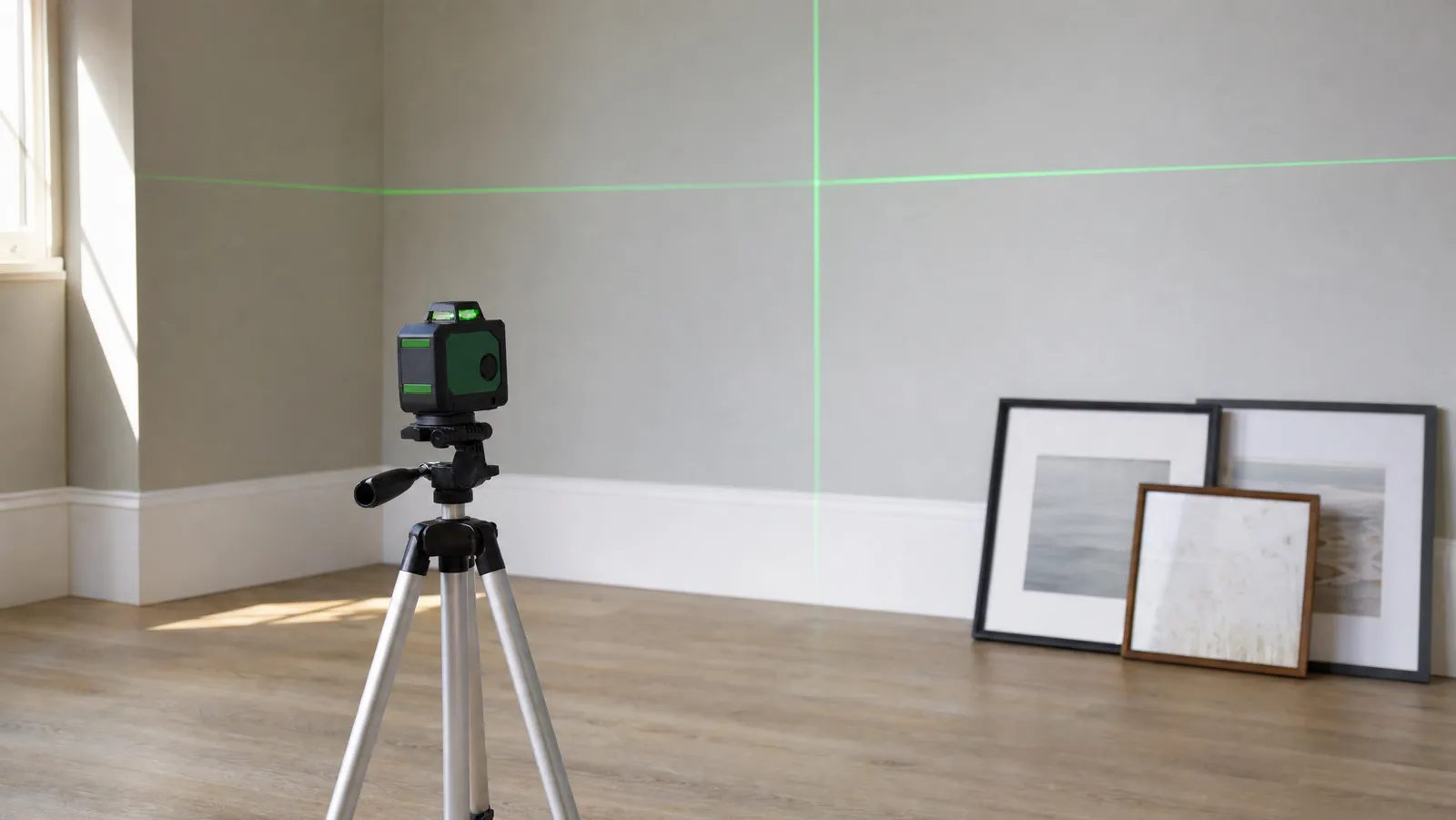
Lasers win at distance and repetition — a run of cabinets, a course of tile, a picture wall — which is why a green cross-line unit earns its place alongside a spirit level, and why we keep a separate roundup of the best laser levels for home use. Spirit levels win at contact, at anything under about two feet, anywhere without power, and on anything you need to strap to a post. We set the two head to head in laser level vs spirit level.
Two related pieces go further: one on green versus red laser beams, and one weighing a laser measure against a tape measure.
The practical answer is that a laser does not remove a single level from the two-tool kit below. It is a third purchase, not a substitute for the first two.
What to buy first: the best level for DIY is two levels
Here is the order we would buy in, and who should stop where.
First, a 9-inch magnetic torpedo. The CRAFTSMAN CMHT43191 at $9.99 as of August 2026 is the sensible default. It lives in the drawer and gets used on appliances, brackets, shelves and pictures. Spend the extra on the Klein only if conduit, pipe or round stock is part of your life.
Second, a 24-inch. The Channellock, because it is the only 24-inch here with a published tolerance in every working position. This is the level that makes shelves, worktops and cabinets look right — the single biggest upgrade most people can make to how their finished DIY looks.
Third, and only if you have doors or framing, a 48-inch box level. The Empire covers it. Never hanging a door, never building a stud wall, never levelling a floor? Skip four feet of aluminium entirely and never notice.
Separately, and only if you have posts, a post level. The Irwin 1794482 at $5.99 is not part of the general kit — it is a fence, deck and mailbox tool. Buy it when you buy the posts.
The bottom line
Levels are one of the few tool categories where the honest advice is to spend less and buy twice. Two levels totalling under $45 will serve you better than one $60 level of any length, because the failure mode is never a tool that is out by a fortieth of an inch — it is a tool too short to see the problem.
Where a maker publishes a tolerance we have quoted it: Klein at 0.029 degrees, Channellock at 0.0005 in./in. in ten positions, Empire at 0.5 mm/m in five, DURATECH at 0.0005 in/in. Where a maker publishes nothing — CRAFTSMAN and Irwin — we have said so rather than filling the gap with adjectives. Do the 180-degree flip test on whatever you buy, the week it arrives.
For where levels sit alongside tapes, squares, stud finders and lasers in a complete kit, start with our guide to the best measuring and layout tools.
About the Author
Cheryl Thompson
Cheryl Thompson is the tools editor at The DIY Tool Review. A lifelong fixer and self-confessed tool addict, she has spent years buying, borrowing and wearing out hand and power tools across home renovation, furniture building and everyday repairs. She writes hands-on, no-nonsense reviews to help fellow DIYers spend their money on the tools that actually last.