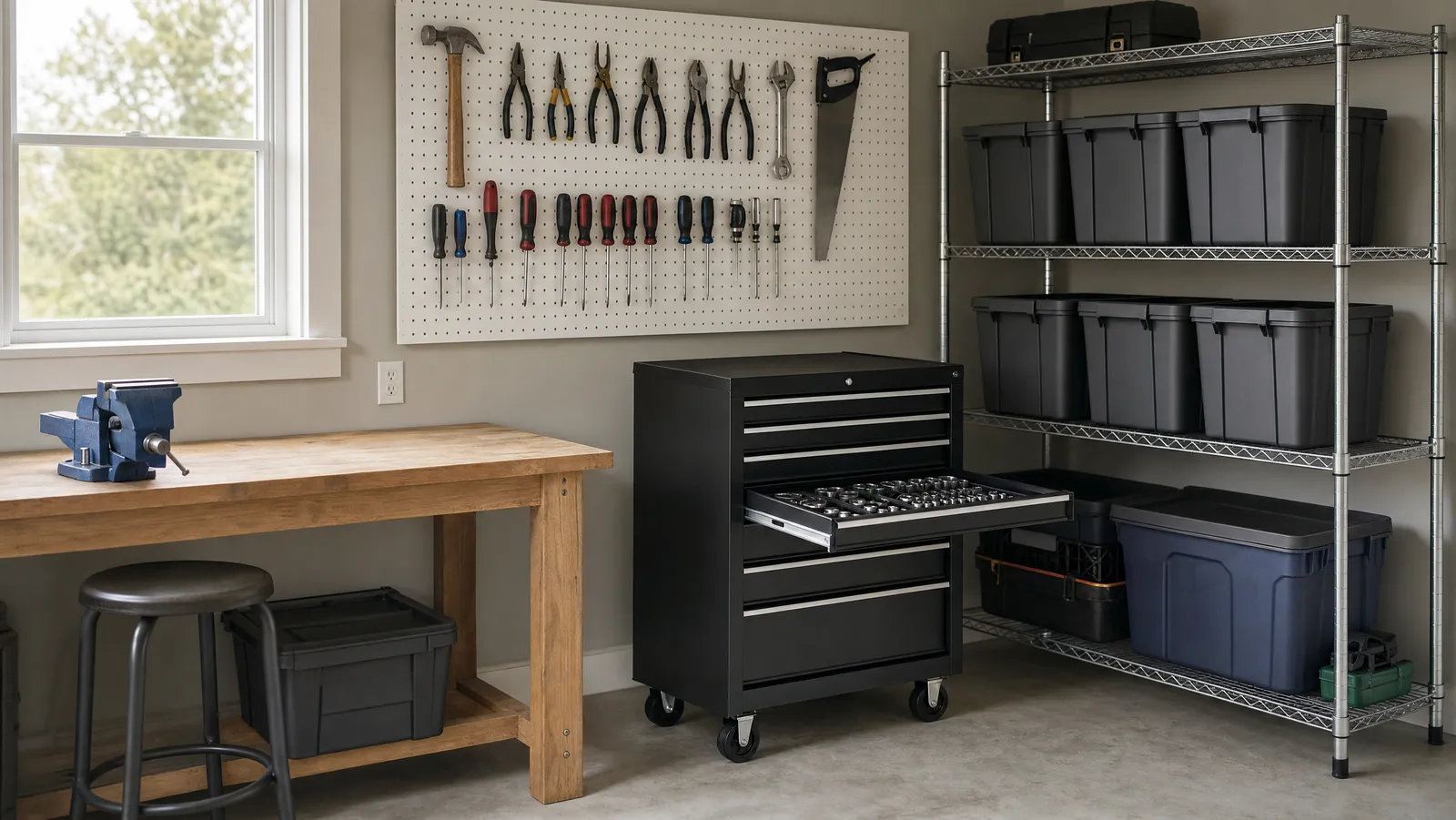
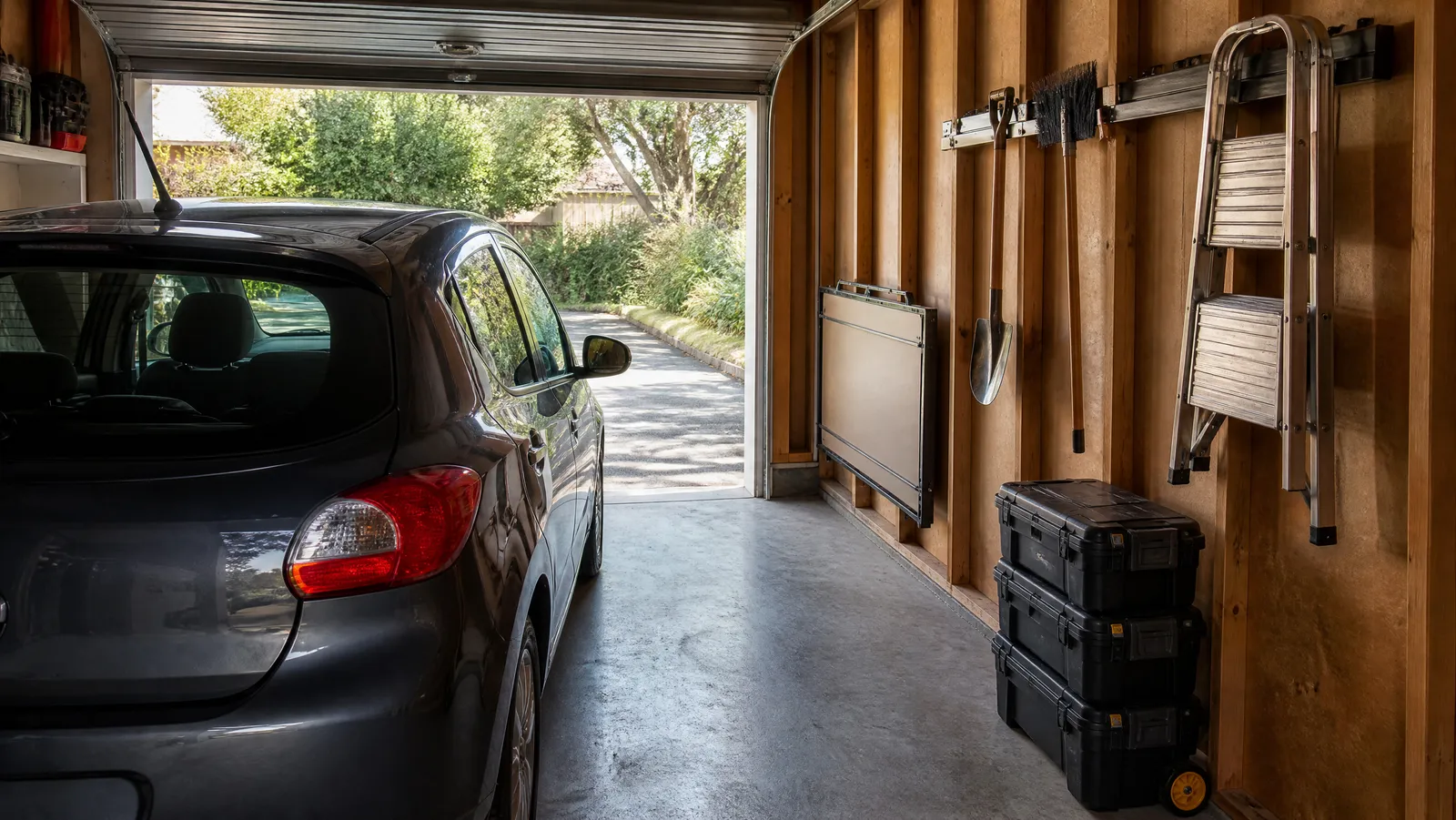
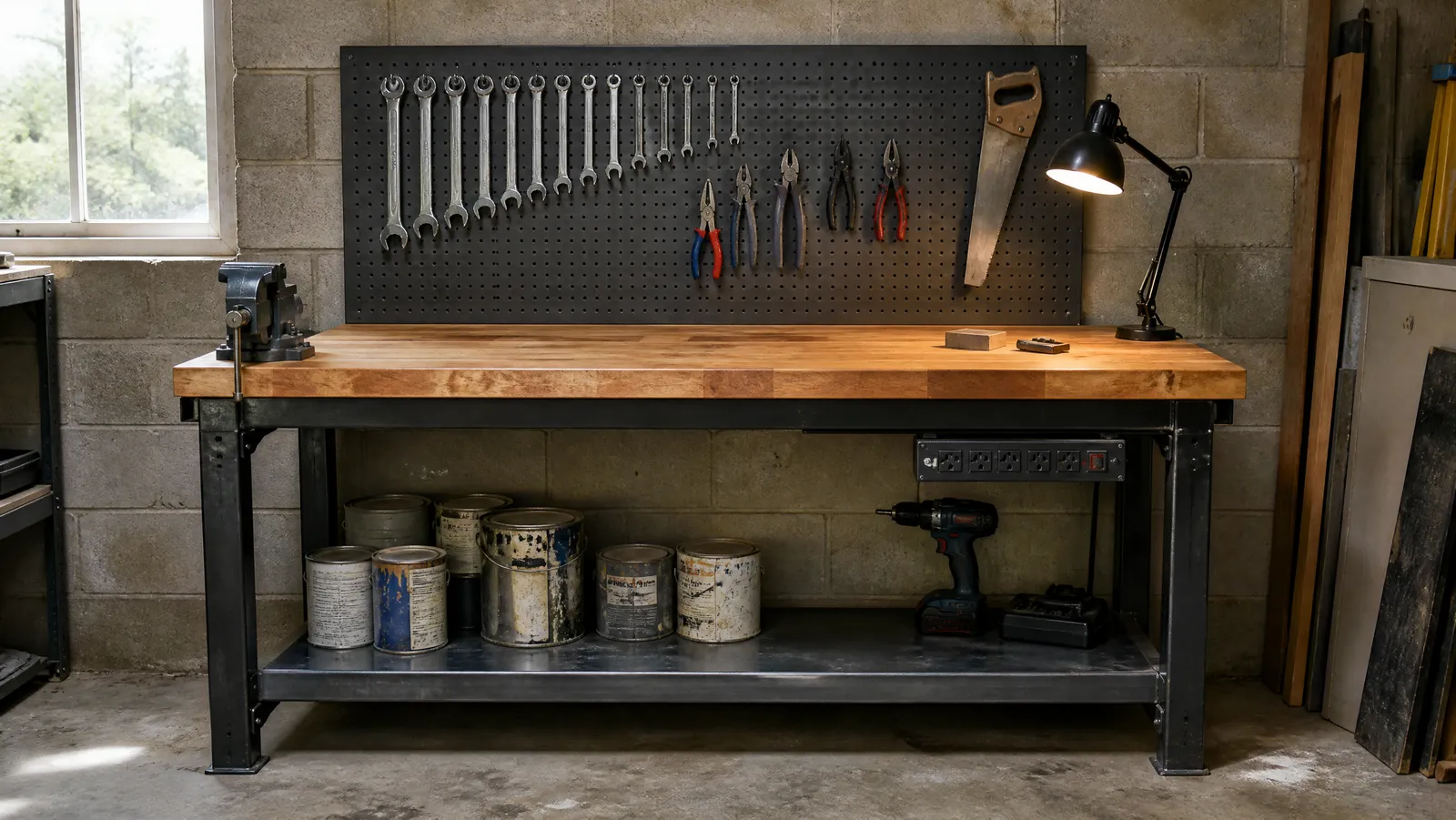
The Best Garage Shelving for Tools and Heavy Gear (2026)
Only two of these five units publish a per-shelf weight rating. The big round total in the title is the least useful number on the page, and the depth you pick matters more than the brand.

- Category
- Workshop & Storage
- Tools tested
- 5
- Read time
- 16 min
- Updated
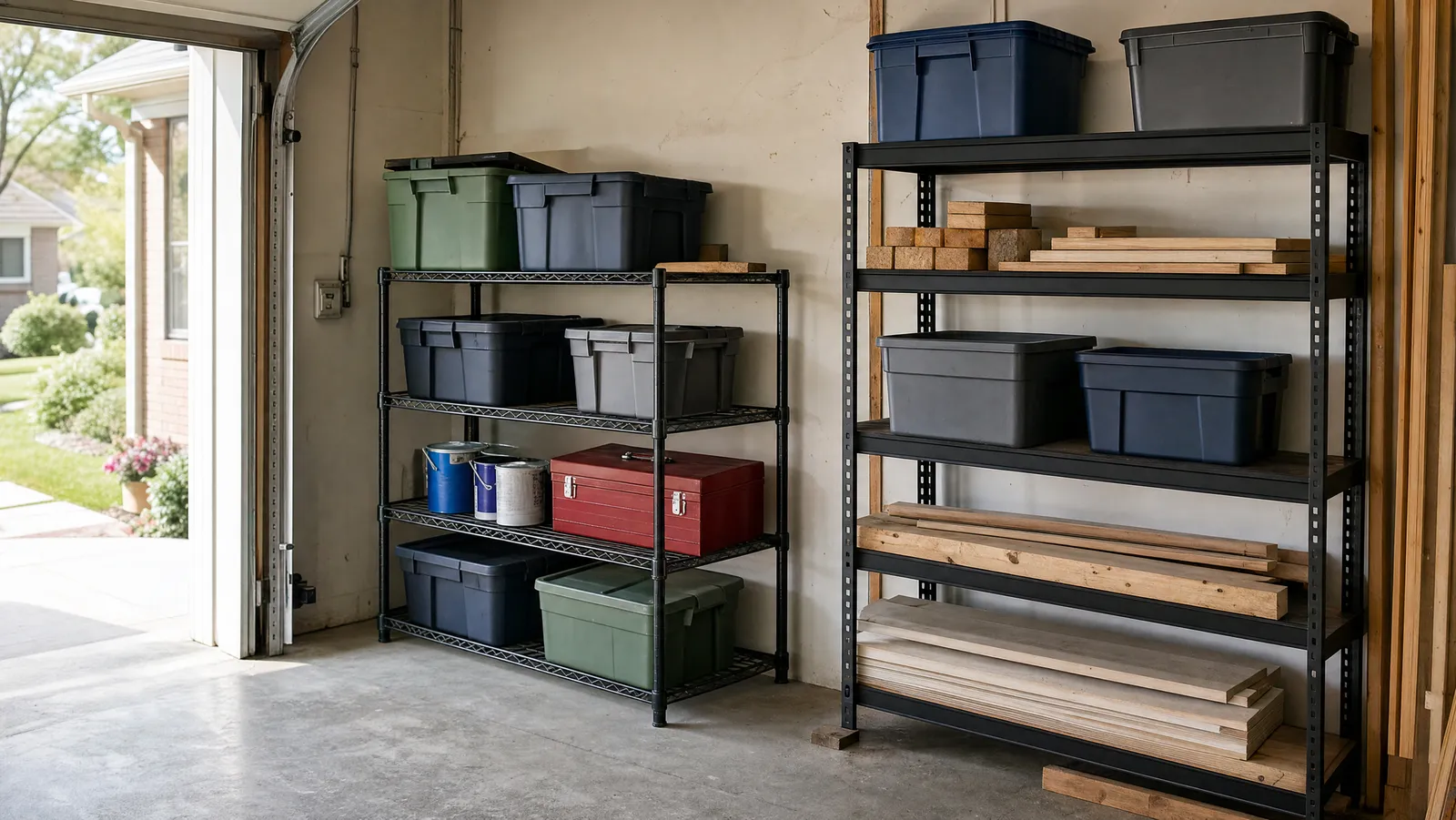
The best garage shelving for tools is the Amazon Basics 4-shelf wire rack at $74.98 as of October 2026. It is the only unit here that publishes a per-shelf rating — 350 pounds, evenly distributed — and at 14 in. deep it still leaves room for a car door to open. Buy on the per-shelf number, not the big total.
The big total is what these products are sold on, and it is close to meaningless. Garage shelving is advertised in round pounds: 1,000, 2,500, 3,000, 5,000. Only two of the five units below publish a per-shelf figure at all, and a unit total tells you nothing about the one shelf you are about to put a car battery on. The order of operations in our guide to garage tool storage and organization still holds — walls first, then shelves for what the wall cannot hold. But when you do buy shelves, two numbers decide everything: pounds per shelf, and inches of depth.
How we picked
We do not hands-on test tools, and we are not going to imply otherwise. Every figure below is the maker's own published claim or the current listing price, and we say whose. Amazon Basics and Plano are brand-owned listings, so their copy is the maker's copy; AOAORGG, SISESOL and Sakugi are marketplace brands with no manufacturer site we could find, so their numbers are attributed to the listing. We publish no star ratings or review counts — our data source does not supply them. Prices are as of October 2026 and move constantly.
Garage storage shelves: what a load rating actually rates
Here is the first thing almost nobody is told. A published shelf capacity assumes the weight is spread evenly across the whole shelf.
That is not a marketing convention; it comes out of the industrial standard. Spacesaver's published shelving tech data states that its shelf capacities are "based on independent tests performed in accordance with ANSI MH 28.1-1982 American National Standard specification for the design, testing, utilization, and application of industrial steel shelving," and heads the entire capacity chart Rated Uniform Load Capacity. Borroughs, another steel shelving manufacturer, puts it in one line: "The capacities listed are for uniformly loaded shelves," derived using ANSI MH28.1-1997 and Shelving Manufacturers Association standards.
Spacesaver adds the detail that explains why: "Loads are based on shelf deflection not to exceed L/140 (L = distance between uprights)." The rating is a bending limit measured across the span, not a strength figure for one spot.
Rack System's 2026 industrial shelving spec guide spells out the consequence: a point load is "concentrated weight in one spot," and point loads "can cause failure at far lower total weights than the UDL rating suggests."
Translate that to a garage. A shelf rated 350 lb will take 350 lb of paint cans spread end to end. It will not necessarily take a 350 lb engine block in the middle of the span. Those are different loads, and only one of them was tested.
Why a total is not a per-shelf number
The second thing nobody is told is that you cannot divide the total by the shelf count and get a per-shelf rating.
Manufacturers publish the unit figure separately because it is a separate figure. In that same Spacesaver document sits a line headed "Overall Shelving Upright Capacities: Open Upright = 2,590 lbs." The heaviest 48 in. by 24 in. shelf in its chart is rated 640 lb. Five of those shelves add to 3,200 lb — about 24 percent more than the uprights are rated to carry. Spacesaver notes those upright figures assume dynamic, mobile loads at a maximum upright height of 97 in. Either way the point stands: the shelf rating and the unit rating are two numbers, and both apply at once.
Cisco-Eagle, a material handling distributor, says of pallet rack uprights that frame capacity is "pretty much independent of what the beams can hold," and that "the more air between levels, the lower the capacity of the rack due to fewer beams, which act as horizontal ties between the uprights." The same geometry applies to a shelving unit: space the levels further apart and the frame gets weaker, even though every shelf is unchanged.
Which is why a title reading 2500LBS is not a specification. It is a headline.
Two of five. That is the column that matters, and three of these units are blank in it.
Be fair about what that means. An unrated shelf is not a dangerous shelf; it is a shelf you cannot plan with. Totes, bagged soil, empty boxes and offcuts do not need a number. A chop saw, a floor jack or a box of cast-iron clamps does, because that is a concentrated load on an unknown span.
Read the AOAORGG listing closely
On October 2, 2026, the AOAORGG listing title read "2500LBS Heavy Duty Metal Storage Shelves." On the same page, on the same day, the product's own bullet read "Reinforced thickened steel frame supports up to 3000 lbs overall load."
Two different totals, 500 lb apart, in one listing. The bullet is 20 percent higher than the title. A figure that disagrees with itself inside a single listing is not a specification. Nobody is lying to you in any interesting way — but neither figure reads like a measurement, and nothing in the listing ties either one to a test.
The listing also says a "strict load-bearing test" was carried out. It names no standard, publishes no result and gives no pass criterion. Compare the Spacesaver and Borroughs language above, which names ANSI MH28.1 and a deflection limit. Treat it as a claim, not as data.
None of which makes the AOAORGG a bad product. At $49.99 it works out at about two cents per claimed pound, which should tell you what the pound is worth.
Workshop shelving and storage: depth decides whether the garage still works
Now the dimension that matters more than any load figure. These five units run from 12.6 in. to 24 in. deep — the deepest is nearly twice the shallowest — and that one number decides whether you still have a garage afterwards.
Start with clearance. As we worked through in how to organize a small garage workshop, House Plans Helper puts the minimum space needed to open an average car door at 2 ft 6 in., or 30 in., between the door and the nearest obstruction. Hold the shelving depths against that figure.
A 24 in. shelf consumes 80 percent of the entire clearance a car door needs, before the car is in the room. A 24 in. unit and a parked car in a single bay are a choice between two things, not a combination.
The second argument has nothing to do with cars. A 24 in. shelf holds two rows of things, and you will never see the back row again. Twelve-inch totes go in two deep. The front row gets used; the back row becomes a time capsule you rediscover when you move house. A 12.6 in. shelf physically cannot do this to you, which is a feature.
So: we recommend shallow by default. Pick the shallowest unit that will hold what you own, and buy a second shallow unit before you buy one deep one. Depth buys cubic feet you cannot reach. Width buys shelf you can.
The exception is a garage deep enough, or a basement wall long enough, that nothing competes for the floor. Note that 24 in. is also the depth of a bench top — worth knowing before you hand a wall to shelving: see the best workbench for a home garage.
The one that publishes a per-shelf rating: Amazon Basics 4-shelf wire rack
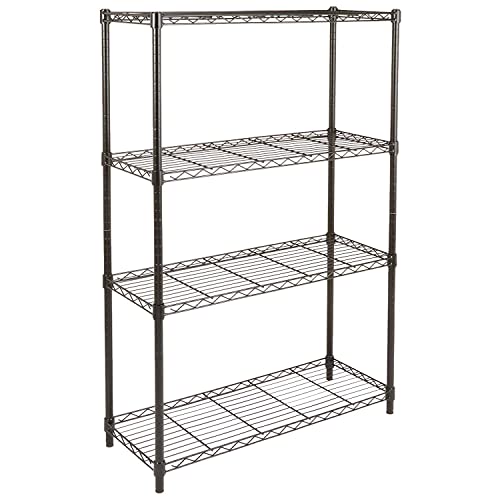
Amazon Basics 4-shelf wire rack
The only unit here whose listing gives a number you can design around. Amazon Basics states that each shelf holds up to 350 pounds, evenly distributed, with a 1,400 pound total capacity, and lists four shelves adjustable in 1-inch increments, four leveling feet and tool-free assembly. Measured 36 in. wide, 14 in. deep and 54 in. tall, it is also shallow enough to live beside a parked car.
Pros
- Publishes 350 lb per shelf and the words evenly distributed, which is what a usable rating looks like
- 14 in. deep, so it does not eat the clearance a car door needs
- Shelf heights adjustable in 1 in. increments, per Amazon Basics
- Assembles with no tools, and has four leveling feet for a sloping slab
Cons
- Its 1,400 lb total is exactly four times 350, which is the naive sum rather than a separate structural figure
- Wire shelves drop washers, drill bits and anything small straight through the grid
- At 54 in. tall it stores less per square foot of floor than the 70-72 in. units here
This is the reference product for the whole article, because of one phrase. Amazon Basics states that each shelf holds up to 350 pounds, evenly distributed, with a 1,400 pound total. That is what a usable rating looks like: a per-shelf number and the condition it applies under. Nothing else here does both.
Amazon Basics also lists four shelves adjustable in 1-inch increments, four leveling feet — useful, because garage slabs are commonly poured with a fall — and tool-free assembly. At 36 in. wide, 14 in. deep and 54 in. tall, it also sits at the depth we recommend.
One honest caveat on its own numbers. The 1,400 lb total is exactly four times 350, which is the naive sum — and as the Spacesaver and Cisco-Eagle figures above show, a unit total is rarely just the sum of its shelves. Read the 350 lb per shelf as the figure to design around and the 1,400 lb as the softer of the two. For a homeowner that is not a real constraint. The real limitation is the wire deck, which we come back to below.
The narrow one: Sakugi 5-tier

Sakugi 5-tier unit
The shallowest unit in this group at 12.6 in. deep, which is the dimension we would optimize for in a one-car garage. The listing quotes 33.0 in. by 12.6 in. by 72.0 in., 0.9 in. diameter metal tubes, a load-bearing capacity of up to 1,000 lb in total, four non-slip leveling feet and a wall fixing kit, and describes the finish as waterproof and rustproof. The 1,000 lb total is the most modest metal claim here, and no per-shelf figure is published.
Pros
- 12.6 in. deep - the easiest unit here to live with in a single bay
- Ships with a wall fixing kit, not just feet
- Five tiers over a small footprint at $54.99 as of October 2026
- A 1,000 lb total claim is restrained next to the 2,500-5,000 lb claims around it
Cons
- The listing gives only a total, so there is no per-shelf number to load against
- Nearly six times as tall as it is deep, which is tippy by geometry until it is fixed to the wall
- Waterproof and rustproof are listing adjectives with no test or standard behind them
At 12.6 in. deep this is the shallowest unit here, and in a one-car garage that is worth more than any capacity claim. The listing quotes 33.0 in. by 12.6 in. by 72.0 in., 0.9 in. metal tubes, five tiers and a total load-bearing capacity of up to 1,000 lb.
That 1,000 lb total is the most modest metal claim in this group, and the restraint deserves credit. At $54.99 as of October 2026, a listing claiming 1,000 lb next to neighbors claiming 2,500 and 5,000 lb is the one behaving most like a specification. It still gives only a total, and we are not going to invent a per-shelf figure by dividing.
The detail to act on is the hardware list: four non-slip leveling feet and a wall fixing kit. A unit 72 in. tall and 12.6 in. deep is nearly six times taller than it is deep. Shipping an anti-tip fixing in the box is the maker telling you to use it.
The honest plastic one: Plano 4-shelf

Plano 4-shelf plastic unit
The second unit here that publishes both numbers and lets them agree. Plano states a maximum of 50 lb on each of the four plastic shelves and up to 200 lb for the full unit, with each shelf taking items up to 13 in. tall. Plano gives the total dimensions as 47.5 in. tall by 23 in. long by 14 in. wide, and says multiple units interlock side by side. Fifty pounds a shelf is genuinely low, and Plano says so rather than hiding it.
Pros
- Publishes 50 lb per shelf and a 200 lb total, and the two agree
- Plastic does not care about damp, so paint and lawn chemicals are fair game
- 13 in. of clear height per shelf, which is the number that decides whether a tote fits
- Cheapest unit here at $36.17 as of October 2026, and units interlock
Cons
- 50 lb a shelf is one toolbox - this is not a shelf for tools
- The title reads 48 in. by 23 in. by 14 in., but Plano's own spec says the 48 is the rounded height
- Shortest unit here at 47.5 in., so it uses wall height poorly
Plano is the other unit that publishes both numbers, and its two numbers agree: 50 lb maximum on each of the four shelves, up to 200 lb for the full unit — exactly four times fifty.
Fifty pounds per shelf is genuinely low. That is one loaded toolbox, or two gallons of paint and a watering can. Plastic shelving is for things that are light, bulky and do not mind damp: paint, lawn and garden chemicals, camping gear, car-wash kit. It is not shelving for tools, and Plano does not pretend it is.
There is a listing-reading lesson here too. The title reads 48 in. by 23 in. by 14 in., but Plano's own specification bullet says 47.5 in. tall by 23 in. long by 14 in. wide. The 48 in the title is the rounded height — scan quickly and you could read it as a 48 in. wide unit. The figure that decides what fits is one Plano buries: 13 in. of clear height per shelf. Measure your totes. At $36.17 as of October 2026 it is the cheapest unit here.
The big number: AOAORGG 5-tier

AOAORGG 5-tier unit
A $49.99 tool-free snap-together unit with the least usable capacity claim on the page. The listing title says 2500LBS Heavy Duty Metal Storage Shelves while the listing's own bullet says the frame supports up to 3000 lbs overall load - two different totals in one listing on the same day. It also cites a strict load-bearing test without naming a standard or publishing a result. The hardware is fine: 15.7 in. by 35.4 in. by 71.2 in., five freely adjustable tiers, electrostatic powder coating and eight non-slip rubber foot pads.
Pros
- Snap-on locking assembly with no screws or bolts, per the listing
- Five freely height-adjustable tiers at 15.7 in. deep
- Eight non-slip rubber foot pads and electrostatic powder coating
- Cheapest metal unit here at $49.99 as of October 2026
Cons
- The title says 2,500 lb and the listing's own bullet says 3,000 lb - a figure that disagrees with itself is not a specification
- No per-shelf rating is published, so there is no number to load a single shelf against
- The strict load-bearing test is cited with no standard named and no result given
We have already taken the capacity claim apart, so here is the product underneath it. The listing describes 15.7 in. by 35.4 in. by 71.2 in., five freely height-adjustable tiers, tool-free snap-on locking assembly with no screws or bolts, electrostatic powder coating and eight non-slip rubber foot pads.
At $49.99 that is a lot of storage for the money, 15.7 in. is a livable depth, and snap-together assembly is genuinely quick.
What you are not buying is a number you can plan with. Store totes, bagged material, seasonal boxes and empties on it with a clear conscience. Keep the floor jack, the miter saw and the bulk fasteners somewhere whose rating you know.
The deep one: SISESOL 71.3 in. wide

SISESOL 71.3 in. wide unit
The one with real structure and the wrong depth for most garages. At 71.3 in. wide it replaces two small units, and the listing describes one-piece uprights, eight additional reinforced lateral bars to resist sway, height-adjustable shelves secured with locking pins and an anti-corrosion coating. The listing claims a total of up to 5,000 lb, does not state how many shelves the unit has, and gives no per-shelf figure. At 24 in. deep it is a basement or deep-garage unit, not a single-bay one.
Pros
- 71.3 in. wide, so one unit does the work of two
- Locking pins and eight reinforced lateral bars are structure, not adjectives
- Multiple units connect together, per the listing
Cons
- 24 in. deep is 80 percent of the clearance a car door needs, and the back row disappears
- The listing does not say how many shelves it has, so the 5,000 lb total cannot even be divided
- Most expensive unit here at $179.99 as of October 2026
- 5,000 lb is a total-only claim with no per-shelf figure behind it
This is the most substantial unit here and the one we would recommend to the fewest people. At 71.3 in. wide it does the job of two small units, and the listing's description of one-piece uprights, eight additional reinforced lateral bars to resist sway and height-adjustable shelves secured with locking pins describes structure rather than adjectives.
Two things to be clear about. The claimed 5,000 lb total is total-only and unverifiable, exactly like the AOAORGG's. And the listing does not state how many shelves the unit has — worth sitting with, because without a shelf count a total capacity cannot even be divided, let alone trusted. We are not going to guess it.
Then there is the 24 in. depth. At $179.99 as of October 2026 this is a good unit for a deep garage or a basement wall where the floor is not contested. In a single bay with a car in it, it is 80 percent of a car door's clearance and a back row you will forget about.
Wire shelves and the small-parts problem
Wire decking is the right choice in a damp garage: it does not pool water and it lets light through to the shelf below. It also has a grid in it, and washers, drill bits, cotter pins and anything smaller than the grid go through it onto the floor.
The fix is a sheet of hardboard, thin plywood or a plastic boot tray cut to size and dropped on top — a few dollars and ten minutes. Leave the other shelves open so the unit still breathes.
Small hand tools are a different problem, and shelves are a poor answer to it. Knowing how to store hand tools on a wall solves it better, because a wall shows you everything you own at once.
Anti-tip: do it on anything 70 in. tall
Three of these five units stand 70 in. or taller on a footprint 12.6 in. to 24 in. deep. That is top-heavy by geometry, and the shallower the unit the more true it is — the Sakugi is 5.7 times taller than it is deep.
This is not a hypothetical. According to the U.S. Consumer Product Safety Commission's 2022 tip-over report, shelving, shelving units and bookcases accounted for an annual average of 3,200 emergency-department-treated tip-over injuries in the United States from 2019 through 2021: 20 percent of all furniture tip-over injuries, and the second-largest furniture category after tables.
Which one, for whom
You own tools and want a number you can plan against: the Amazon Basics 4-shelf wire rack, $74.98. 350 lb per shelf evenly distributed, 14 in. deep, and a maker willing to put both facts in writing.
The garage is tight: the Sakugi 5-tier, $54.99. 12.6 in. deep is the most useful specification in this group, and the wall fixing kit is in the box.
It is paint, chemicals and camping gear: the Plano 4-shelf, $36.17. Fifty pounds a shelf, 13 in. of clear height, no pretense of being a tool shelf.
Maximum storage for minimum money, kept honest: the AOAORGG 5-tier, $49.99. Totes yes, machinery no.
A deep garage or basement wall with nothing competing for the floor: the SISESOL, $179.99. Buy it for the width and the lateral bracing, not the 5,000 lb claim.
If none of that fits, the answer may not be shelving at all — our small-garage guide works through the order to do things in a bay with a car in it, where the wall and a folding bench often beat another steel unit.
Common questions
How much weight can garage shelving hold?
Whatever the maker publishes per shelf, spread evenly across the shelf. Amazon Basics publishes 350 lb per shelf, evenly distributed; Plano publishes 50 lb. The other three listings publish only a unit total, so there is no per-shelf figure to work from. Per Rack System's spec guide, a concentrated load in one spot "can cause failure at far lower total weights than the UDL rating suggests."
Can I divide the total capacity by the number of shelves?
No. The unit figure is a separate limit, set by the uprights and the bracing rather than the shelves. Spacesaver publishes shelf capacities up to 640 lb for a 48 in. by 24 in. heavy-duty shelf and an overall open-upright capacity of 2,590 lb; five of those shelves would sum to 3,200 lb. Both limits apply at once, and the smaller one wins.
Do I really need to bolt shelving to the wall?
On anything 70 in. tall, yes. Per the CPSC's 2022 tip-over report, shelving and bookcases were linked to an annual average of 3,200 emergency-department-treated tip-over injuries from 2019 through 2021. Fix the bracket into framing, not drywall, and load the heaviest things low.
The short version
Ignore the number in the title. Find the per-shelf figure, assume it means evenly distributed, and accept that a unit without one is a tote shelf rather than a tool shelf. Then measure the garage before the gear, because depth is the decision you cannot undo: shallow by default, two narrow units before one deep one, and a bracket into the studs on anything 70 in. tall.
The Amazon Basics 4-shelf wire rack at $74.98 as of October 2026 is the one we would buy first, because Amazon Basics publishes 350 lb per shelf evenly distributed and keeps the unit to 14 in. deep. The Sakugi at $54.99 is the pick if the bay is tight. The rest are good value with no rating behind them, which is fine as long as you know it.
Shelves are only one layer of the system. The walls, the bench and the order to buy them in are in our guide to the best garage tool storage.
About the Author
Cheryl Thompson
Cheryl Thompson is the tools editor at The DIY Tool Review. A lifelong fixer and self-confessed tool addict, she has spent years buying, borrowing and wearing out hand and power tools across home renovation, furniture building and everyday repairs. She writes hands-on, no-nonsense reviews to help fellow DIYers spend their money on the tools that actually last.