Brad Nailer vs Finish Nailer: Which One Do You Need?
The difference is the fastener, not the tool. An 18-gauge brad leaves a hole you can almost ignore; a 16-gauge finish nail holds. Here's which one your trim actually needs.

- Category
- Nailers & Fastening
- Tools tested
- 3
- Read time
- 12 min
- Updated
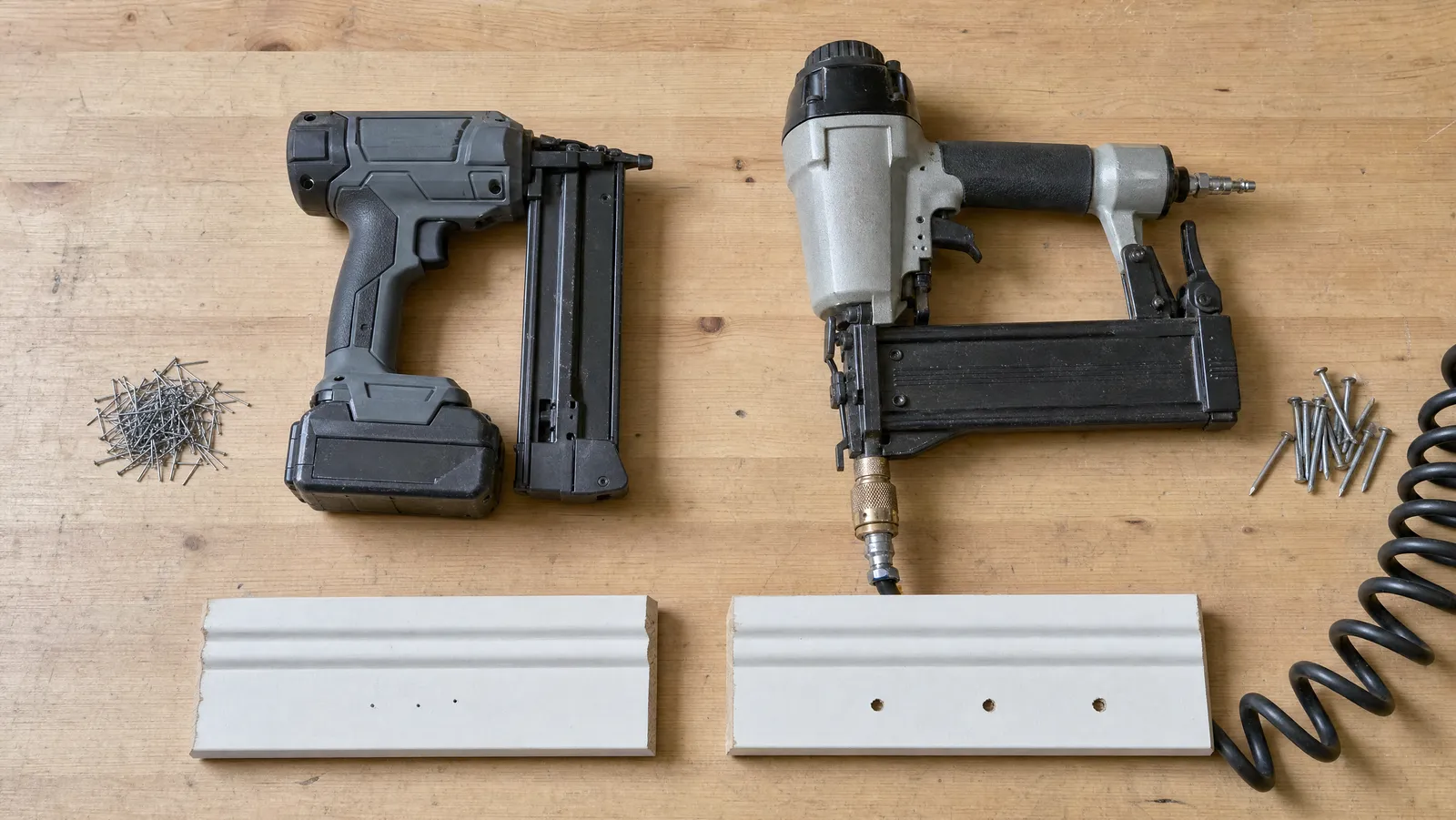
Brad nailer vs finish nailer comes down to the fastener, not the tool. A brad nailer drives thin 18-gauge brads that leave a hole you can almost ignore. A finish nailer drives heavier 16-gauge nails that hold. Buy the brad nailer for most DIY work; buy the finish nailer when the trim has to stay put.
The short answer
If you own neither, start with the 18-gauge brad nailer. It is the more forgiving tool, it covers more of the jobs a homeowner actually runs into, and the thin brad is far less likely to split a skinny piece of trim. Step up to a 16-gauge finish nailer when the thing you are fastening is heavy, long, or fighting you — baseboard, door casing, crown.
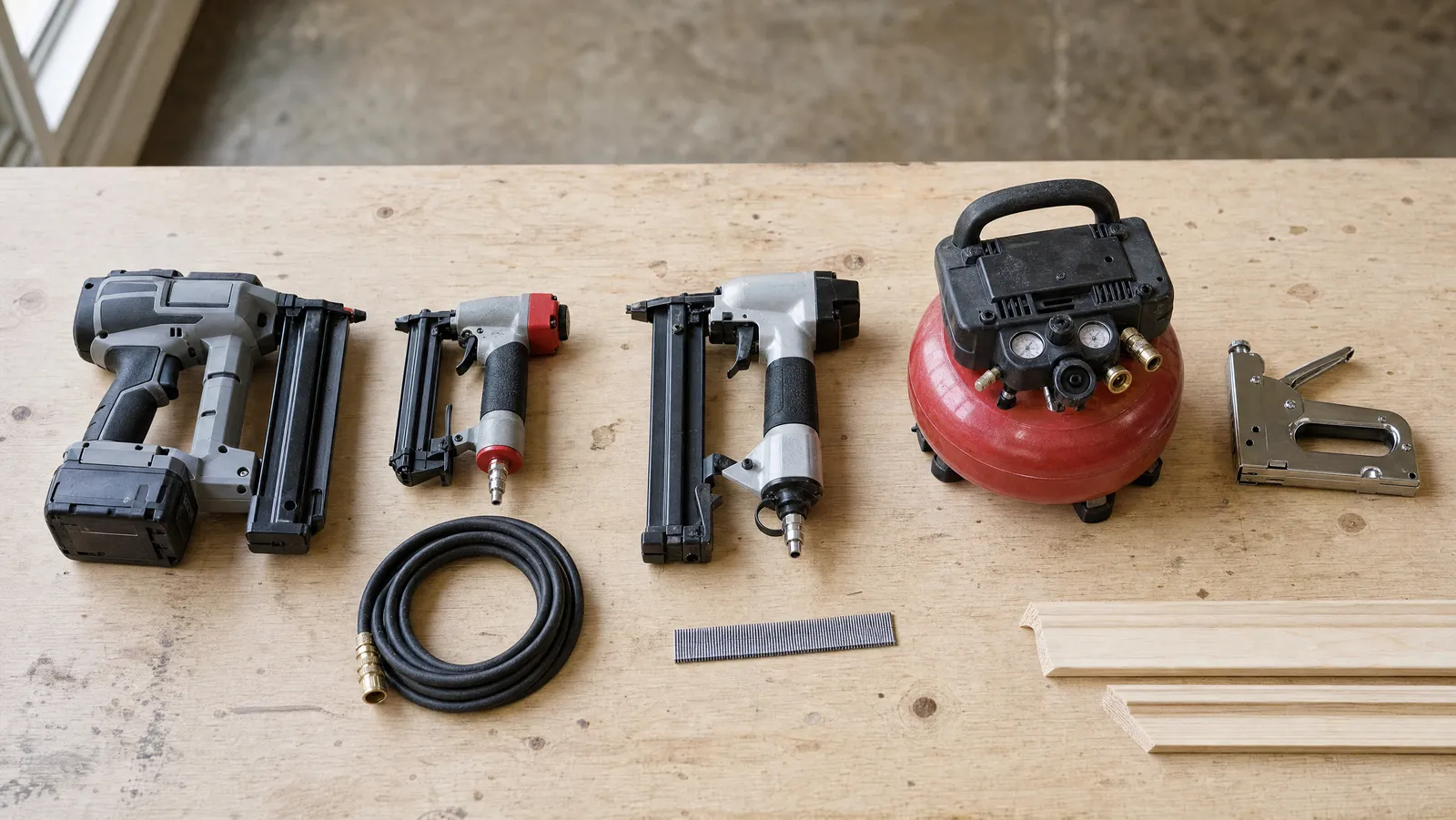
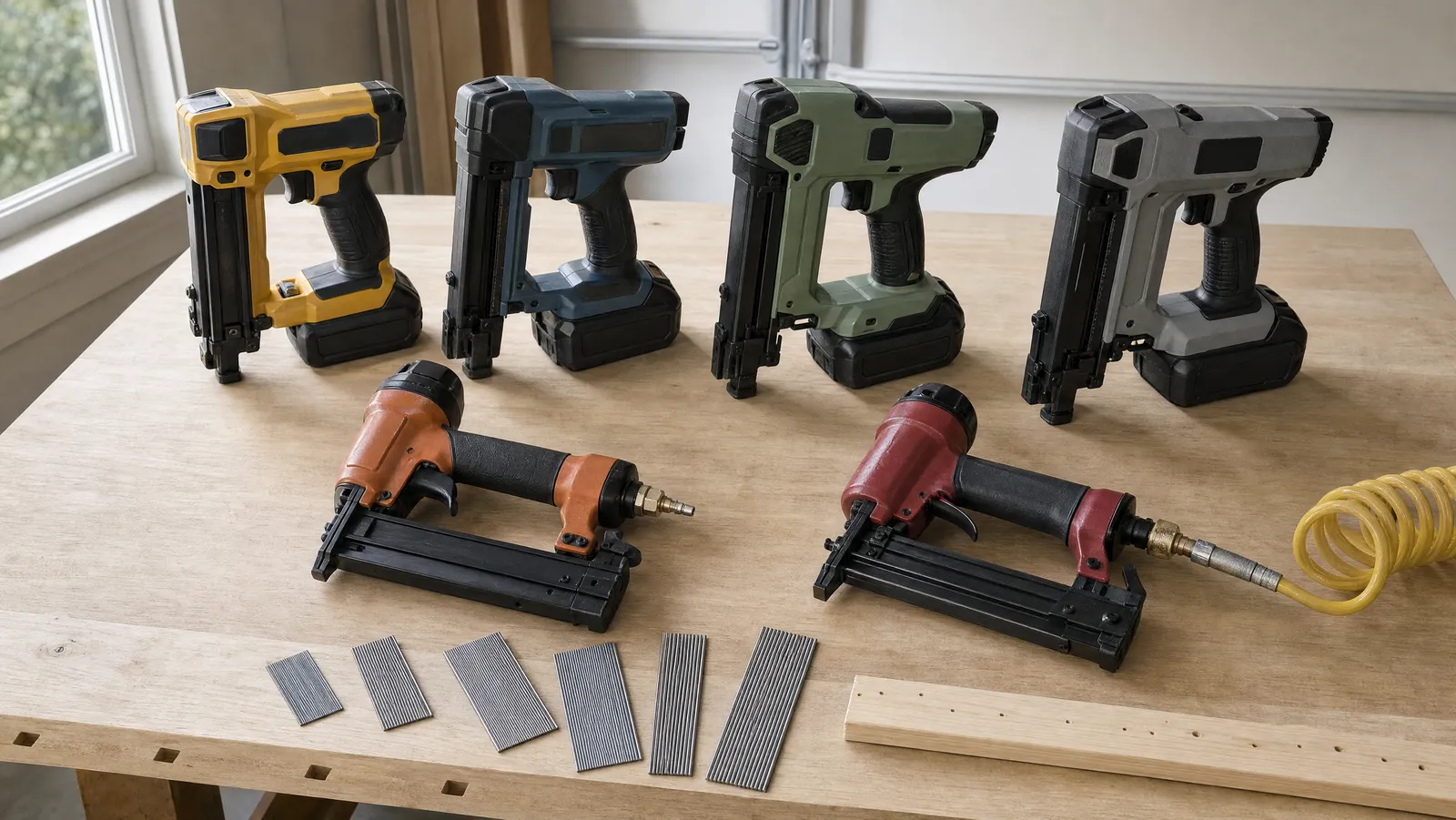
Both are trim guns, and both sit in the same family as the rest of the nail guns for DIY we cover. If you do not own the basics yet, a nailer is not the first thing to buy; our list of essential DIY tools is where to start instead.
What actually differs: the fastener
Nothing about the two guns matters as much as the wire going into them. A gauge number is a wire-diameter standard, and it reads backwards: the bigger the number, the thinner the nail.
According to the Albany County Fasteners nail size chart, an 18-gauge brad measures 0.048 in. in diameter and a 16-gauge finish nail measures 0.063 in. Do the subtraction yourself and the finish nail is 0.015 in. fatter — roughly 31% more diameter. Written down that looks like nothing. It is the entire difference between these two tools. (That is a wire-diameter comparison, not a holding-power figure; more on that below.)
Lengths overlap at the bottom and diverge at the top. According to This Old House, 18-gauge brad nailers "fire thin nails between 3/8–2 inches long, depending on the model," while 16-gauge finish nailers "typically shoot nails ranging from 3/4–2 1/2 inches long."
Most of the confusion we see is really a question about what size nails to use for trim and baseboard, and the answer starts with how much wall is sitting in front of the stud.
Holding power and when a brad is not enough
We are not going to hand you a pounds-of-force number, because we have not pulled any nails out of anything and we did not find a published withdrawal-resistance figure for these two gauges that we would stand behind. The direction, though, is not in dispute. According to Bob Vila, "the thicker a nail, the more holding power it has," and the same guide notes that a brad will not hold material of the same maximum thickness a finish nail will.
In practice, a brad is plenty when something else is also doing the holding — glue, a rabbet, a cleat, gravity, or a screw you will drive later. A brad is a clamp with a long memory.
A brad is not enough when the fastener is the only thing holding the part on, or when the stock is bowed and wants to spring back off the wall. That is where the thicker shank and bigger head of a 16-gauge nail earn their keep.
Worth remembering: none of this is compulsory. A hand-driven finish nail and a nail set still work perfectly well, which is one more reason claw hammers never leave the kit.
The hole you have to fill afterwards
This is the trade you are making. According to Bob Vila, brads "leave a very small hole," and "depending on the application of the brad nails, filling and sanding may not be required before painting." The same guide says finish nail heads are "still relatively small and easily hidden with filler."
Read that carefully, because it is the honest version of the comparison: the brad hole can sometimes be ignored, and the finish nail hole basically always gets filled.
On paint-grade work that barely matters — you are caulking and filling anyway. On stain-grade hardwood it matters a lot, because every filled hole is a colour-matching problem you created. That is the real argument for using the lightest fastener that will actually hold.
Baseboard, casing and crown: which gauge wins
The 16-gauge, and the reason is arithmetic rather than opinion. Your nail has to pass through the trim, then through the drywall, before it reaches any wood worth gripping.
Say your baseboard is 3/4 in. thick and your drywall is 1/2 in. That is 1-1/4 in. gone before the tip touches framing. A 2 in. nail has 3/4 in. of bite left. A 2-1/2 in. nail has 1-1/4 in. of bite — two-thirds more grip from half an inch of extra nail. Thicker trim eats the margin faster, which is why the long end of the 16-gauge range exists at all.
All of which assumes you hit the stud. Guessing wastes nails and leaves trim that moves, so this is exactly the job a best stud finder pays for itself on.
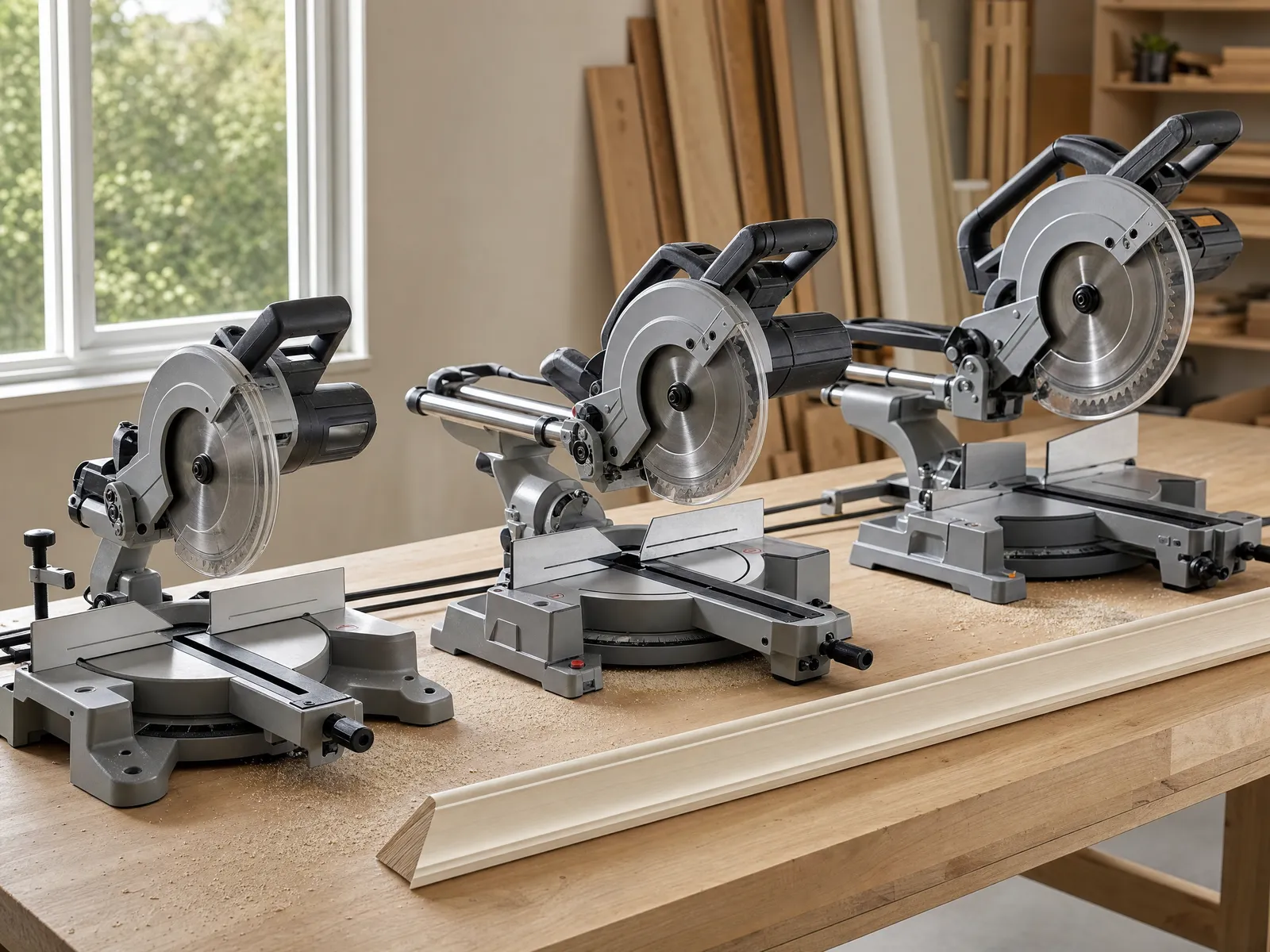
Two things a nailer cannot fix, either. A gappy miter is a saw problem, not a fastening problem — see our best miter saws for DIY guide — and if you are marking cuts by hand, how to use a speed square will save you more trim than any gun will.
If you have already decided the 16-gauge is your tool, what you are really shopping for is best finish nailers for trim, and the single spec to read first is the maximum nail length.
Where a brad nailer is the better tool
Most DIY fastening is small. Shoe molding and quarter round. Panel molding glued onto a flat cabinet door. Drawer bottoms, small boxes, picture frames, window stop, jigs, shop fixtures, and the endless tacking of thin stock where a 16-gauge nail risks splitting the piece.
The brad nailer is also the gun that stays loaded. It is lighter work, cheaper fasteners, and far less consequence when you misfire into a spot you did not mean to.
If this sounds like your project list, go straight to our roundup of the best brad nailers for DIY rather than agonizing over gauges.
What about pin nailers and 15-gauge?
Two neighbours worth knowing. A 23-gauge pin nailer drives a headless pin that the Albany County Fasteners chart lists at 0.025 in. According to JLC, pinning delicate veneer miters "accomplishes this with nearly invisible holes," and "the super-fine fasteners won't split MDF or thin wood like an 18-gauge brad will." The catch is that a pin is a clamp, not a fastener: according to This Old House, "pin nailers are often used with wood glue, acting as a temporary clamp while the adhesive sets."
At the other end, the same chart puts 15-gauge finish nails at 0.072 in. and labels them "finish nails, angled." Reviewers report that an angled magazine reaches into inside corners a straight magazine struggles with, though angled 16-gauge guns exist too, so the shape is not strictly a 15-gauge trait. What is sourced is the job list: according to This Old House, 15-gauge nailers are "best for installing large interior and exterior casing, hanging pre-hung doors" and similar heavy trim. For most homeowners it is a third gun, not a first one.
The tools: one of each, and one that claims both
Drag to compare all 3 →
Here is the hook, and then the catch inside it. The WEN brad nailer is $108.00 as of November 2026 and the Metabo HPT finish nailer is $109.00 — a difference of exactly one dollar. So sticker price is not the deciding factor; the job is.
But do not read that as "they cost the same," because all-in they are nowhere near a dollar apart. The WEN is cordless and complete. The Metabo HPT is pneumatic and needs an air compressor that is not in the box. If you do not already own one, the finish nailer is by far the more expensive half of this comparison.
The 18-gauge brad nailer — WEN 20512

WEN 20512
A cordless 18-gauge brad nailer that drives 3/4 in. to 2 in. brads and arrives complete — battery, charger and 400 brads in the box.
Pros
- Cordless 20V — no compressor and no hose
- Ships with a 2.0Ah battery, charger and 400 18-gauge brads
- 100-nail magazine
- LED indicator tracks battery status, magazine fill and tool temperature
Cons
- Brads stop at 2 in., so long baseboard fasteners are out
- Its Amazon listing does not publish a weight or a nails-per-charge figure
This is the brad side of the argument, and it is the easier tool to live with: 18-gauge brads from 3/4 in. to 2 in., a 100-nail magazine, and an LED indicator that tracks battery status, magazine fill and tool temperature. It arrives with a 2.0Ah battery, a charger and 400 brads, so there is nothing else to buy — the same logic behind most of our must-have cordless power tools picks.
Being straight about the gaps: its Amazon listing does not publish a weight or a nails-per-charge figure, so we cannot tell you either.
The 16-gauge finish nailer — Metabo HPT NT65M2S

Metabo HPT NT65M2S
A 3.7 lb pneumatic gun that drives 16-gauge finish nails from 1 in. up to 2-1/2 in. — the length range baseboard and casing actually want.
Pros
- Drives 16-gauge finish nails from 1 in. up to 2-1/2 in.
- 3.7 lbs
- Selective actuation switch — you choose bump fire or sequential fire
- Tool-free depth of drive, no-mar nose tip and a 360-degree adjustable exhaust port
- Covered by the Metabo HPT Professional 5-Year Tool Warranty
Cons
- Pneumatic — an air compressor is required and is not included
- Overkill for thin, delicate stock
The finish side. It drives 16-gauge nails from 1 in. up to 2-1/2 in., weighs 3.7 lbs per its listing, and adds the trim-carpentry niceties: tool-free depth of drive, a no-mar nose tip, a 360-degree adjustable exhaust port and an air duster button. Its listing states it was rated Pro Preferred Nailer for 12 years running, from 2014 to 2025, by Builder and Developer Magazine, and it carries the Metabo HPT Professional 5-Year Tool Warranty.
It also has a selective actuation switch, so you pick bump fire or sequential fire. We would leave it in sequential. According to CPWR, the Center for Construction Research and Training, "the contact trip trigger carries twice the risk of acute injury of the sequential trigger," and CPWR credits Duke University researchers with the finding that "using the sequential trigger cuts the injury rate from nail guns in half."
The honest caveat stays the caveat: pneumatic means a compressor, and the compressor is not included.
The one that does both — Abonnylv 3-in-1

Abonnylv 3-in-1
One cordless tool that takes 16-gauge nails, 18-gauge nails and 18-gauge narrow crown staples — with a nail-length ceiling that is the whole story.
Pros
- Takes 16-gauge nails, 18-gauge nails and 18-gauge narrow crown staples per its listing
- Runs on DEWALT 20V lithium-ion batteries (DCB200-DCB206), so no compressor
- Tool-free jam release, adjustable depth knob and a three-channel magazine
Cons
- Its listing caps BOTH nail gauges at 1-1/4 in.
- Battery is not included and is sold separately
- Its feature bullets swap the standard meanings of brad and finish nail
At $139.99 as of November 2026 this is the tempting answer — one cordless gun for both gauges plus narrow crown staples, running on DEWALT 20V batteries (DCB200-DCB206). Per its listing it takes 16-gauge at 3/4 in. to 1-1/4 in., 18-gauge at 3/4 in. to 1-1/4 in., and 18-gauge narrow crown staples at 1/2 in. to 1 in. Note that it is $31.99 more than the WEN and $30.99 more than the Metabo HPT, and that the battery is sold separately.
Why even the listings disagree about the names
If you have been confused about which tool is which, some of that is not your fault. Look at the 3-in-1 above. Its product title calls the whole tool a "Brad Nailer" while the listing advertises both 16-gauge and 18-gauge fasteners. Its feature bullets then go further: they describe the 16-gauge fasteners as "Brad nails" and the 18-gauge fastener as a "straight finish nail" — the reverse of standard trade usage, in which the brad is the thinner 18-gauge fastener and the finish nail is the heavier 16-gauge one.
To be precise about what we are claiming: we are describing the text on that listing, which is the surface we read. We are not saying the manufacturer has its own hardware wrong, and we have not adopted its vocabulary anywhere here — everywhere above, brad means 18-gauge and finish nail means 16-gauge.
What it does illustrate is why "brad nailer vs finish nailer" is a search people have to run in the first place. The names get used loosely in the market, so read the gauge number and the nail-length range, not the product title. Those two numbers tell you what a nailer is and what it can do, whatever the name on the box says.
Frequently asked questions
Can I use a brad nailer for baseboard?
Sometimes. On thin baseboard, with studs located and 2 in. brads, it will hold. Run the length math first: subtract your trim thickness and drywall thickness from the nail length and see what is left to grip with. If the answer is under about half an inch, go 16-gauge.
Is 18 gauge or 16 gauge better for trim?
Neither is better in the abstract. The 18-gauge brad leaves a smaller hole and splits less; the 16-gauge nail holds more and reaches further. Match the fastener to the weight of the trim and the thickness of the wall in front of the stud.
Can a finish nailer shoot brad nails?
No. Magazines are built for one gauge and one collation, so a 16-gauge gun takes 16-gauge nails and nothing else. If you want both from one tool you need a multi-gauge gun — and as the 3-in-1 above shows, those tend to trade away nail length to get there.
Do I need an air compressor for a finish nailer?
For a pneumatic model like the Metabo HPT NT65M2S, yes, and it is not included. Cordless 16-gauge guns are sold too, but the finish nailer in this comparison runs on air.
Which nail lengths should I buy first?
For an 18-gauge gun we would keep 1 in. and 2 in. brads on the shelf and add 1-1/4 in. if you do a lot of cabinet molding. For a 16-gauge gun, 2 in. and 2-1/2 in. cover most baseboard and casing.
Which one to buy first
If you are buying one nailer and you are not sure yet what you will use it for, buy the 18-gauge brad nailer. It is the tool you will pick up more often, the fastener is cheaper, the holes are smaller, and the mistakes are more forgiving.
If you already know the job — baseboard down a hallway, casing on six windows, crown in the dining room — buy the 16-gauge finish nailer and budget for a compressor if you do not own one. That second number is the one people forget, and it is bigger than the dollar between the two sticker prices.
And if you would rather see the whole field before you commit, our guide to the best nail gun for DIY projects lays the categories out side by side.
About the Author
Cheryl Thompson
Cheryl Thompson is the tools editor at The DIY Tool Review. A lifelong fixer and self-confessed tool addict, she has spent years buying, borrowing and wearing out hand and power tools across home renovation, furniture building and everyday repairs. She writes hands-on, no-nonsense reviews to help fellow DIYers spend their money on the tools that actually last.