How to Cut Straight With a Circular Saw (Without a Track)
Your saw is fine — freehanding is the problem. Four ways to guide a circular saw, ranked not by price but by whether the guide imposes a straight line or just copies the panel's edge.

- Category
- Saws & Cutting Tools
- Tools tested
- 4
- Read time
- 13 min
- Updated
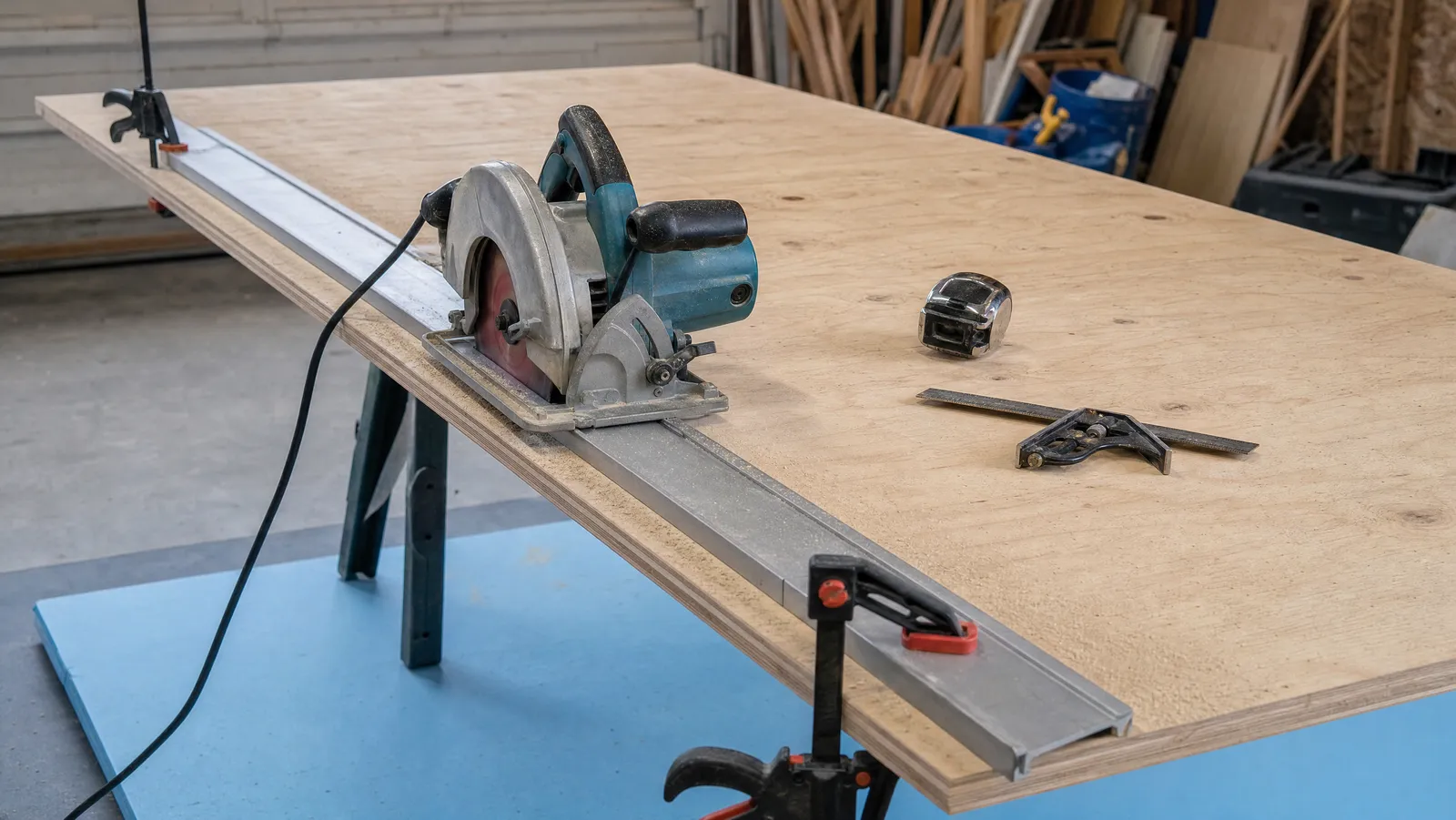
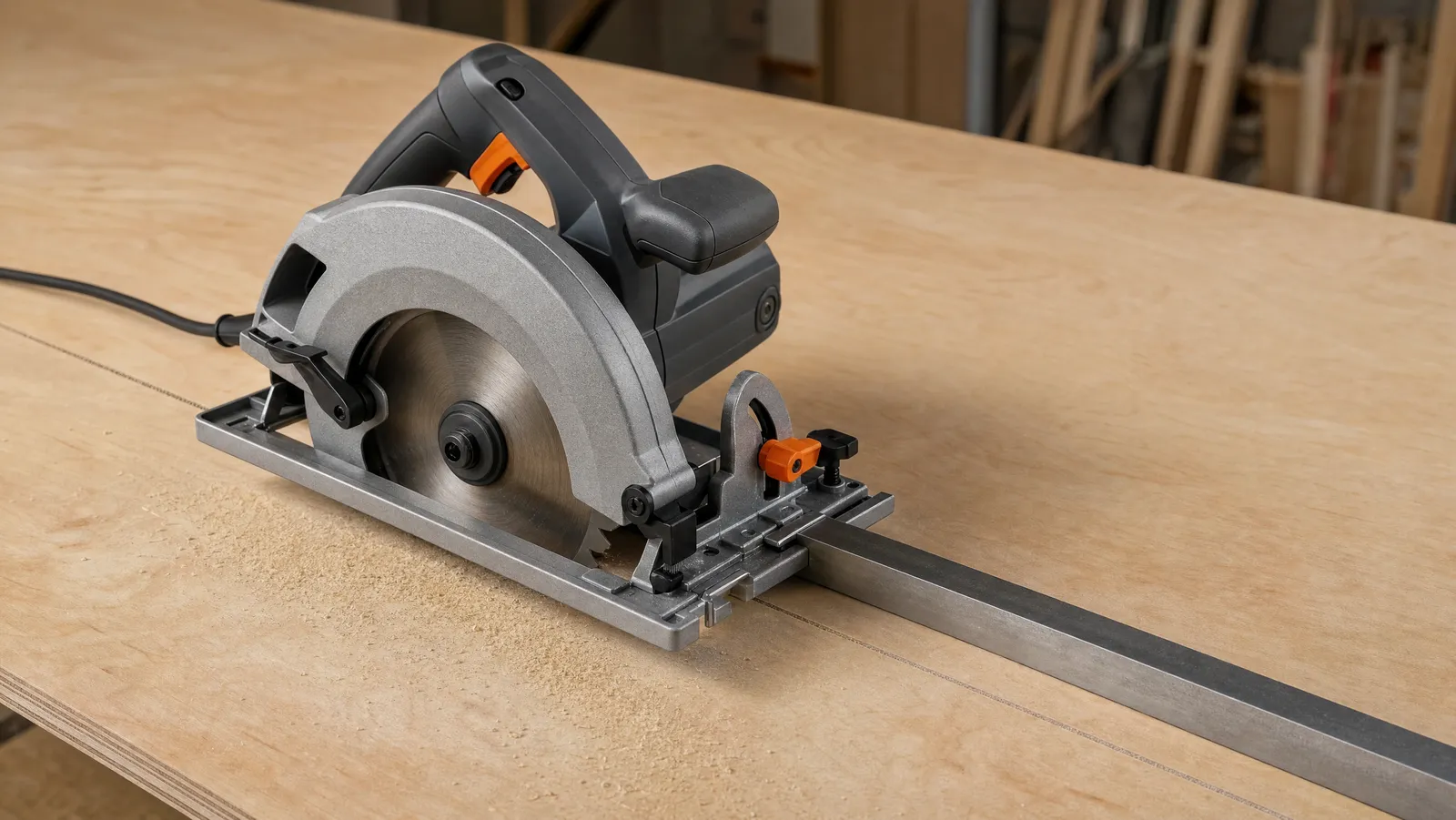
Your saw is almost certainly fine. Cuts wander because freehanding a spinning blade along a pencil line is a hand-eye job nobody wins. To cut straight with a circular saw, clamp a straightedge down, measure the distance from your own saw's shoe to its blade, and let the shoe follow the guide instead of your eye following a line.
There are four ways to do that, and they do not rank the way their prices do. This is the technique layer on top of how to use a circular saw — grip, depth and stance come first. Still working out which tool should make the cut at all? Start with picking a saw for DIY, or the whole family in types of saws explained.
Why your cuts wander
Three things go wrong, and only one of them is about skill.
You are freehanding. A saw tracks wherever the shoe points. Over 8 feet, a fraction of a degree of drift becomes a visible bow, and concentration will not fix it, because you are steering and watching a line at once.
The offcut is pinching the blade. According to Bosch's circular saw safety instructions, kickback is "a sudden reaction to a pinched, jammed or misaligned saw blade," which drives the saw back toward the operator; the same instructions say to support large panels to reduce pinching and kickback. A sagging offcut closes the kerf behind the blade, the saw fights you, and the cut moves.
You are watching the pencil line instead of the guide. Family Handyman's long-cut guide puts it plainly: with a straightedge clamped down, the job is keeping the shoe tight against it for the whole cut. Your eyes belong on the shoe-to-guide contact, not the layout line.
If the saw itself is at fault — bent shoe, warped blade, a base that will not lock square — no guide saves it, and best circular saw for DIY covers what a sound one costs.
The one measurement you have to take yourself
Every clamped-guide method depends on one number: the distance from the edge of your saw's shoe to the blade. It differs by saw model, and differs on the two sides of the same shoe. We will not give you a figure, because a wrong offset puts every cut in the wrong place.
Take it yourself, once. This Old House's straightedge guide gives the sequence: mark the cut line, measure from the blade to the edge of the shoe, then strike a second line at that distance — the straightedge clamps to the second line. Family Handyman's version is to make a test cut with the shoe riding a clamped board and measure the gap you actually got, which bakes in whatever your saw does.
Measure to the outside of a tooth, not the blade plate — on most blades the teeth are set a little wider than the plate. Write the number on the shoe in marker so you never re-derive it. If reading a tape that closely is your weak link, how to use a tape measure like a pro helps.
Method 1: a factory edge and two clamps (free)
This is the honest default, and it costs nothing. Rip a strip off a plywood offcut and clamp it to the work as a fence for the shoe. Fine Homebuilding's plywood-cutting guide builds the permanent version — a "shooter board" from a 3/4-in. sheet, with a strip off the straight factory edge screwed to the base so that edge runs against the saw's baseplate.
That imposes an independent line, which puts it in the same family as the paid clamp edges. What it cannot do is guarantee the line is straight.
The other cost is time: clamp, measure the offset, clamp again, repeat for every cut. For crosscuts narrower than about 7 in., skip all of it — the fence of a speed square held against the board edge is already a guide, and how to use a speed square covers that cut.
Method 2: a short circular saw straight edge guide
The cheapest manufactured guide here is the POWERTEC 71705 at $35.99 as of October 2026. It is an aluminum bar with a fixed clamp and locking lever at one end and an adjustable clamp drawn in against the opposite edge, and POWERTEC publishes full adjustability for materials 24 inches in length. The bar is 2-3/16 in. wide, which POWERTEC says is "to prevent the bar from bending under pressure," and the low-profile jaws invert so nothing fouls the shoe. POWERTEC lists it for circular saws, jig saws, routers and jointers.
Now the catch. 24 in. is half a sheet's width and a quarter of its length. According to Hunker, the standard US sheet is 4 ft by 8 ft — which works out to 48 in. by 96 in. This guide crosses neither dimension, and buying two does not make one long guide. It is the right tool for shelf parts, trim and 2x material.

POWERTEC 71705
A 24-inch aluminium straight-edge clamp - the cheapest way to stop freehanding, as long as your cut is under two feet.
Pros
- Cheapest manufactured guide here at $35.99
- Low-profile jaws can be inverted so the saw shoe is not obstructed
- Aluminium bar is 2-3/16 in. wide, which resists flexing under a saw shoe
- Doubles as a router and jigsaw guide
Cons
- 24 in. capacity - it cannot cross a 4x8 sheet, which is what most people need a guide for
- One guide only; crossing a sheet needs a longer tool, not two of these
- No anti-splinter strip
Method 3: a circular saw rip guide that rides the panel
The Kreg Rip-Cut KMA2685, $49.00 as of October 2026, works differently from everything else here. A universal sled clamps to your saw and carries a guide rail and edge guide; per Kreg, the large handle on the edge guide "maintains contact with the material." It rips up to 48 in. wide — a sheet's full width.
Read that mechanism carefully, because it is the point of this article. The Rip-Cut does not impose a straight line. It copies the edge it rides. Its accuracy is borrowed from your panel, so a bowed factory edge becomes a bowed cut, and no care on your part changes that. It is also no help for a cut that does not run parallel to a good edge.
What it buys is speed. Set the width once and every later rip repeats with no clamping or re-measuring — for four parallel rips off one sheet, nothing else here is close.

Kreg Rip-Cut
An edge guide that references the panel's own edge and rips up to 48 inches wide - the quickest method here, and the one whose accuracy is borrowed rather than imposed.
Pros
- Rips up to 48 in. wide, so it covers the long dimension of a half sheet
- No clamping and re-measuring between repeat cuts - set the width once and go
- Works with both left- and right-bladed saws
- Fastest method here for multiple parallel rips
Cons
- It copies the panel's edge, so a bowed or rough factory edge becomes a bowed cut
- Kreg publishes that it does NOT work with worm drive saws
- Kreg warns it is not ideal for saws with plastic or bulky upper blade guards - check your saw first
- No use at all for crosscuts that do not run parallel to a good edge
Method 4: a full-length clamp edge
A clamp edge is a long bar that clamps across the work and imposes its own line, so the quality of the panel's edge stops mattering.
The BORA 50 in. NGX Clamp Edge bundle is $73.48 as of October 2026, down from a $74.98 list price. BORA describes heavy-gauge extruded aluminum "that resists bowing," and the bundle adds a 2-pack of track clamps with rubberized feet "to grip material securely without damage," whose "sturdy polymer construction allows different locking angles." BORA says those clamps enable angled cuts — the one thing an edge guide can never do, because no edge exists to follow. It is also the only guide here publishing a stock thickness limit: 2.5 in.
Fifty inches clears a sheet's 48 in. width with 2 in. to spare. Against the 96 in. length it is 46 in. short, so breaking a sheet down the long way means two set-ups. On price it is $24.48 more than the Kreg Rip-Cut and just over twice the POWERTEC.

BORA NGX 50 in.
A 50-inch extruded aluminium clamp edge bundled with two track clamps - it imposes its own straight line, and the clamps let you set angles the panel edge cannot give you.
Pros
- Imposes an independent straight line - panel edge quality becomes irrelevant
- Clamps included, and they lock at angles for cuts that are not parallel to any edge
- Clamps stock up to 2.5 in. thick, so it handles doubled sheet goods and timber
- Rubberised clamp feet will not mark a finished face
Cons
- 50 in. - crosses a sheet's 48 in. width but NOT its 96 in. length
- $73.48 is double the POWERTEC and $24.48 more than the Kreg Rip-Cut
- Clamping and squaring it takes longer per cut than an edge guide
- Polymer clamp bodies rather than metal
The Kreg Straight Edge Guide XL is $79.00 as of October 2026 and 98 in. long. Kreg publishes that it "works with materials up to 8 feet," adds a cutline indicator that "positions cuts while the guide rail helps you cut precise lines," an anti-slip clamp, and compatibility "with any right- or left-handed circular saw" — no worm-drive exclusion. It also converts jig saws and trim routers into edge-guided tools.
Against a 96 in. sheet length, 98 in. of rail leaves 2 in. of margin — the only tool here that crosses a full sheet lengthwise in one pass. The cutline indicator also removes the shoe-offset arithmetic that trips people up everywhere else. The honest limits: 98 in. of rail is awkward to store, and Kreg publishes only one clamp point, so a long span wants support in the middle.

Kreg Straight Edge Guide XL
98 inches of aluminium guide rail with a cutline indicator and anti-slip clamp - the only tool here that crosses a full sheet lengthwise in one pass.
Pros
- 98 in. - the only guide here that handles a 96 in. sheet in a single unbroken pass
- Cutline indicator removes the shoe-offset arithmetic that trips people up on the free method
- Kreg publishes compatibility with any right- or left-handed circular saw, with no worm-drive exclusion
- Also works as a jigsaw and trim-router guide
Cons
- Most expensive option here at $79.00
- 98 in. of rail is awkward to store and to carry
- Only one clamp point published - long rails need support in the middle
- Overkill if you never break down full sheets
Ranked by what each method references
Here is the ladder, ordered by what each guide takes its line from.
Read column two and the price order breaks. The $49.00 Kreg Rip-Cut is the fastest method here and structurally the least accurate of the five, because it is the only one that copies a line instead of making one. The $35.99 POWERTEC, at about 73 percent of its price, imposes its own. Speed on repeat rips is worth real money — but "more expensive" and "straighter" are not the same axis.
Length per dollar runs the other way from what you would guess. The Kreg XL is 98 in. for $79.00; the POWERTEC is 24 in. for $35.99. Divide it out: 4.08 times the length for 2.20 times the price, or about $0.81 per inch against $1.50 per inch. The spread from cheapest to dearest guide here is $79.00 minus $35.99, or $43.01 — forty-three dollars for four times the reach.
None of this is a published accuracy figure — no maker here publishes a tolerance, and we have not cut anything to compare them. What each guide references is published, and that is what you can reason from.
Blade depth, support and tear-out
Technique common to all four methods — and it matters more than which guide you buy.
Set the depth shallow. Bosch's safety instructions say to adjust the cutting depth to the workpiece thickness, with "less than a full tooth of the blade teeth" visible below it. JLC Online adds the reason: less depth means less blade exposed to the wood, which decreases the chance of kickback. It suggests setting the blade so the gullet of one tooth clears the underside.
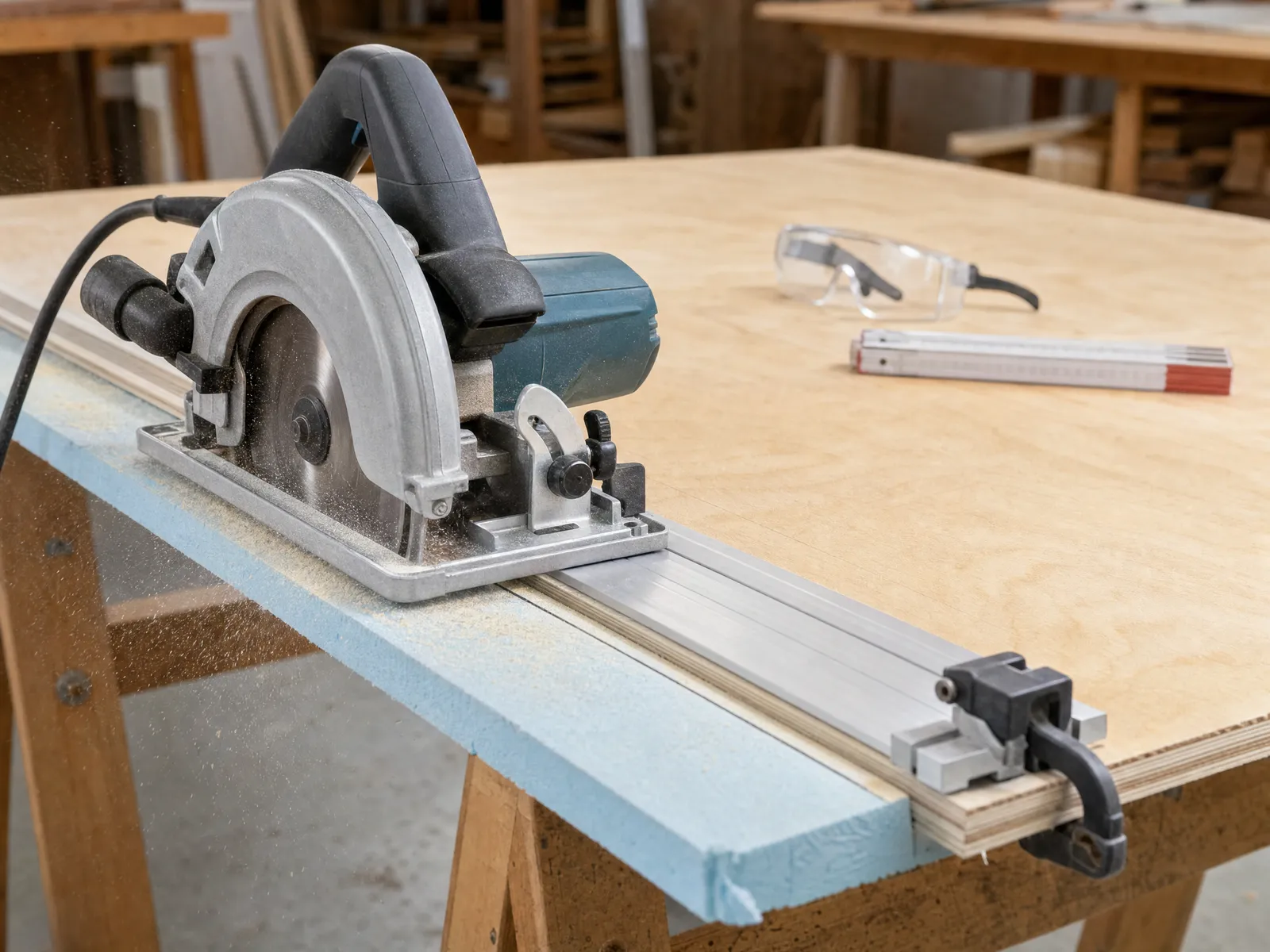
Support both sides. The offcut has to stay put, not drop and pinch. One Popular Woodworking shop tip lays the sheet on a full sheet of 2-in. rigid foam straddling two clamped sawhorses, noting that the usual alternative is three or four horses to stop cutoffs binding the blade and falling at the end of the cut; the blade bites about 1/8 in. into the foam.
Clamp the guide on the keeper side, so the offcut is the piece that falls away. Let the motor reach full speed before the blade touches wood, and walk the cut at a steady pace rather than forcing it.
And be honest about tear-out. None of these four guides publishes an anti-splinter or no-chip strip — that is a true track saw rail feature. A clamped guide controls the line, not the splintering, and anyone telling you a guide fixes chipped veneer is selling something.
The fix is the blade. According to Fine Homebuilding, a 40-tooth blade handles most plywood cuts, while veneered plywood and melamine want 60 or 80 teeth because the thin veneer tends to blow out on the underside of the cut. ToolsToday explains that more teeth mean a smaller bite per tooth and less chipping along the veneer, and cautions that which face goes down depends on the tool — do not carry table-saw advice straight over. how to choose a circular saw blade works through tooth counts properly.
Which method should you use?
Cutting under two feet, occasionally: the free factory-edge method, verified against a straightedge, or the POWERTEC 71705 at $35.99 if you would rather not re-clamp a board every time.
Multiple parallel rips off a decent panel edge: the Kreg Rip-Cut at $49.00, as long as your saw is not a worm drive and its guard is not plastic or bulky. Check the panel edge first; the cut inherits it.
Angles, bad edges, or anything that has to be straight regardless of the sheet: the BORA NGX bundle at $73.48, whose clamps lock at angles no edge guide can follow.
Breaking down full sheets: the Kreg Straight Edge Guide XL at $79.00 is the only one here with the reach, and the cutline indicator is a genuine convenience.
And know the limits. A circular saw cuts straight lines — curves and cutouts are a jigsaw job, and our best jigsaw for DIY picks cover that. If the saw in your hands is the bottleneck rather than the guide on top of it, our saw guide is the place to start.
Frequently asked questions
Why is my circular saw not cutting straight?
Almost always because it is being freehanded. A saw follows its shoe, so a fraction of a degree of drift becomes a visible bow over a few feet. The other two common causes are an unsupported offcut pinching the blade — Bosch's manual tells you to support large panels to reduce pinching and kickback — and a dull or warped blade. Clamp a straightedge and the problem usually disappears.
Can you use a circular saw as a rip saw?
Yes, and that is most of what these guides are for. A rip is a cut along the grain or along a panel's length, and either a clamped straightedge or an edge guide like the Kreg Rip-Cut, which rips to 48 in., will hold the line. Support the sheet underneath, set the depth so barely a tooth clears the stock, and keep the shoe pressed to the guide.
Is a DIY rip guide for a circular saw good enough?
For most home work, yes — Fine Homebuilding's own plywood guide is a shop-made shooter board using a plywood factory edge as the fence. The catch is the edge you build it from. Cabinetmakers on WoodWeb say they do not trust a factory edge and cut a fresh reference edge first, so check yours against a known straightedge or a string line before you trust it.
Do any of these guides stop splintering?
No. None of the four publishes an anti-splinter strip, which is a track saw rail feature rather than a clamp-edge one. A guide controls where the cut goes, not how cleanly the veneer breaks. Tear-out is a blade problem: Fine Homebuilding recommends 40 teeth for general plywood and 60 to 80 for veneered sheets and melamine.
About the Author
Cheryl Thompson
Cheryl Thompson is the tools editor at The DIY Tool Review. A lifelong fixer and self-confessed tool addict, she has spent years buying, borrowing and wearing out hand and power tools across home renovation, furniture building and everyday repairs. She writes hands-on, no-nonsense reviews to help fellow DIYers spend their money on the tools that actually last.