The Best Cordless Power Tools for Woodworking (2026)
A woodworking kit has an order: a saw, then a sander, then a jigsaw, then a compact router, then a brad nailer. Here are the six cordless tools we'd buy in that sequence — and the jobs where cordless still loses to a cord.

- Category
- Power Tools
- Tools tested
- 6
- Read time
- 16 min
- Updated
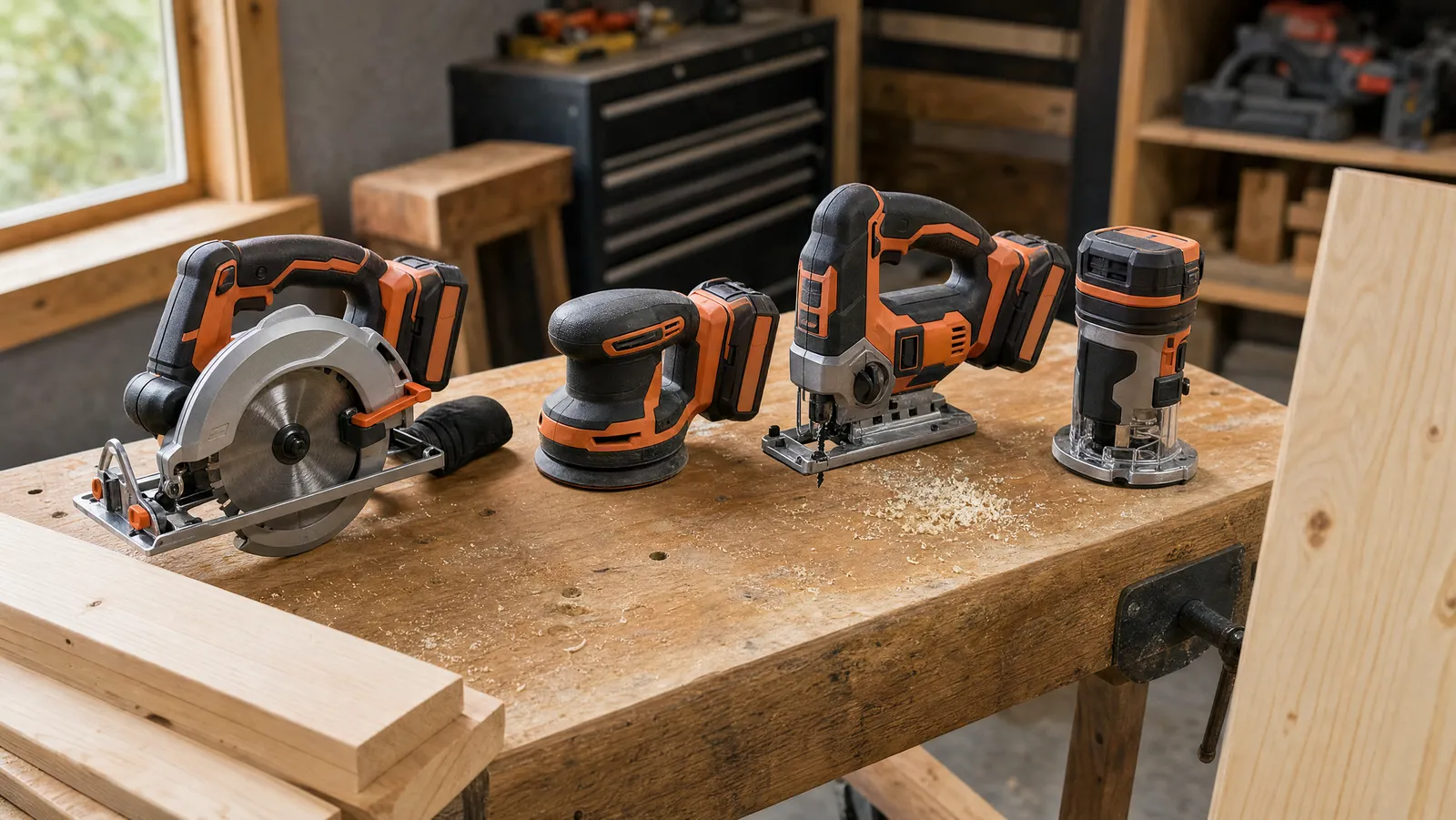
The best cordless tools for woodworking are a circular saw, a random orbit sander, a jigsaw, a compact router and — eventually — a brad nailer. Buy them in that order. The sequence matters more than the brand on the housing, because each tool only earns its keep once the one before it has.
This guide is for the DIYer who already owns a drill, maybe an impact driver, and now wants to build things — shelves, a workbench, a bookcase, a deck box. For the wider view of every category worth owning, start with our roundup of the best cordless power tools for DIY. Here we are narrowing it to wood.
How we picked
We have not tested these tools, and we will not pretend otherwise. Our selection is based on published manufacturer specifications, current price and availability, the breadth of each tool's battery platform, and — most of all — what the tool actually does for someone building furniture in a garage.
We also cannot publish star ratings or review counts: our product data source does not supply them, so you will not find a rating anywhere in this article. Where a performance figure appears — RPM, cuts per charge, depth of cut, battery capacity — it is the maker's own number, and we say whose.
Beyond that, two rules shaped the list. We favoured brushless motors where the manufacturer offers them — every pick here except the nailer has one. And we flagged every bare tool in plain language, because a bare tool is only a bargain if you already own the battery.
Prices are as of August 2026 and move constantly.
Buy them in this order
The single most useful thing we can tell you is not which sander to buy. It is when. A woodworker's cordless kit builds in a fixed order, and every tool below is close to useless until the one above it is in the shop.
Why a saw first? Because until you can cut a board to length and rip a sheet of plywood down to a size you can carry, you are assembling parts someone else cut. Why the sander second? Because the difference between a shelf that looks homemade and one that looks built is almost entirely surface prep, and hand-sanding a bookcase will make you hate the hobby.
The jigsaw, router and nailer are real tools with real jobs, but they are additions. If your budget stretches to two purchases this year, make them a saw and a sander.
First, pick a battery platform
Before any of this, settle the platform question. Cordless batteries are brand-specific by design: a DeWalt 20V MAX pack does not fit a Skil PWR CORE 20 tool, and no adapter is going to make that a good idea. Choose the system first, then buy tools into it.
It matters more here than in a general round-up, because half a woodworking kit is naturally bought as bare tools. Once you own two batteries and a charger, the sander and router below cost far less without them — but only if the badge matches.
If you have not committed to a system, our guide to the best cordless power tool brand for DIY walks through what each platform is good at. And if you are starting from nothing, a bundle is almost always cheaper than the same tools bought one at a time — our roundup of the best cordless power tool combo kits for beginners covers that route, and the first pick below is the woodworking version of the same idea.
The picks
Listed in the order we would buy them, not by preference. Each entry gives the specification that matters and the tradeoff.
Best starting bundle: DeWalt DCK307D1P1 3-tool kit

DeWalt DCK307D1P1 3-Tool
Three of the five woodworking tools in one box — compact router, random orbital sander and jig saw — plus a 5.0Ah XR pack, a 2.0Ah pack, a charger and a contractor bag.
Pros
- Covers the router, sander and jig saw in a single purchase
- Brushless motors on all three tools
- Two batteries and a 12V/20V MAX 4A charger included, so nothing is orphaned
Cons
- No circular saw, so you still need a saw for breaking down boards and sheet goods
- At $369.00 as of August 2026 it is the largest single outlay on this list
If you own a drill and nothing else, this is the most efficient single purchase on the page. It covers three of the five tools in the buying order — compact router, random orbital sander and jig saw — and it brings the batteries with it: a 5.0Ah XR pack, a 2.0Ah compact pack, a 4A charger and a contractor bag. DeWalt lists the 5.0Ah XR pack as providing up to 60% more capacity than the standard 20V MAX DCB200 pack, which is the difference between sanding a tabletop in one sitting and stopping to charge.
All three tools are brushless; DeWalt describes the DCS334 jig saw as delivering longer runtime than the older DCS331. The DCW210 sander and DCW600 router are the same models we recommend individually below.
The gap is the saw. There is no circular saw here, so you still need one of the two below. At $369.00 as of August 2026 it is the biggest cheque on this list, but it is the only pick that solves three tool problems and the battery problem at once.
Best circular saw: DeWalt DCS590WW1

DeWalt DCS590WW1
A full-size 7-1/4 in. brushless saw sold as a kit with battery and charger. DeWalt lists up to 5,500 RPM no-load and a 2-9/16 in. depth of cut at 90 degrees.
Pros
- Full-size 7-1/4 in. blade: 2-9/16 in. depth at 90 degrees and 2 in. at 45 degrees, per DeWalt
- Electric brake stops the blade from coasting after the trigger is released
- Sold as a kit, so the battery and charger are already in the box
Cons
- The most expensive saw here at $269.98 as of August 2026
- Our source data showed limited stock, so availability can fluctuate
This is the saw to buy if you intend to keep building. It takes a full-size 7-1/4 in. blade. DeWalt lists a maximum depth of cut of 2-9/16 in. at 90 degrees and 2 in. at 45 degrees, up to 5,500 RPM no-load and up to 368 cuts per charge, and calls it its most powerful 20V MAX circular saw at up to 1,700 MWO.
Translate that into shop terms. A nominal 2x4 is 1-1/2 in. thick, so DeWalt's 2-9/16 in. figure clears it at 90 degrees, and the separate 2 in. capacity at 45 degrees means it still clears a 2x4 bevelled over. On paper that also covers 8/4 stock and 3/4 in. plywood in a single pass, though we have not cut with it. The electric brake matters when you are lifting the saw off a sheet balanced on foam board.
At $269.98 as of August 2026 it is the priciest saw here, and our source data showed limited stock, so availability on this specific kit can fluctuate. It arrives as a kit with battery and charger, which softens the price if you are starting from zero.
Best budget saw: Skil CR6413B-11

Skil CR6413B-11
A compact 6-1/2 in. brushless saw kit that arrives with a 2.0Ah battery, a charger and an 18-tooth thin-kerf carbide blade for $102.79 as of August 2026.
Pros
- Battery, charger and a thin-kerf carbide blade all included at the kit price
- Blade-left design plus a Shadow Line LED for a clear view of the cut line
- Skil lists up to 5,500 RPM, and the saw has an electric brake
Cons
- A 6-1/2 in. blade gives less depth of cut than a 7-1/4 in. saw
- Ships with a single small 2.0Ah battery
Not everyone needs a full-size saw. This Skil is a 6-1/2 in. compact brushless kit that arrives complete: saw, PWR CORE 20 2.0Ah battery, charger and an 18-tooth carbide thin-kerf blade, for $102.79 as of August 2026. Skil lists up to 5,500 RPM and 105 cuts in 2x4 pine on a single charge with that 2.0Ah pack, and states that PWR CORE 20 packs wrap each cell in cooling material for 25% longer runtime and twice the battery life.
One thing we will not do is line up "368 cuts" against "105 cuts" as if they settled anything. Those are two manufacturers' own numbers, measured on different battery sizes and, in DeWalt's case, on unspecified material. They are not comparable, and anyone presenting them as a head-to-head is selling you something.
The real tradeoff is blade diameter. A 6-1/2 in. blade gives less depth of cut than a 7-1/4 in. one, which mostly shows up on bevel cuts and thick stock. If your work is plywood, 3/4 in. boards and the occasional 2x4 at 90 degrees, that limit will rarely bite, and the lighter saw is nicer to hold over a sheet of ply. If you plan to cut 8/4 hardwood or bevel through framing lumber, buy the 7-1/4 in.
Best sander: DeWalt DCW210B

DeWalt DCW210B
A brushless random orbital sander that DeWalt lists at 8,000 to 12,000 OPM variable speed, with a low-profile body that keeps your hand close to the work. Bare tool, $89.99 as of August 2026.
Pros
- Variable speed from 8,000 to 12,000 OPM for everything from stock removal to finish passes
- Low-profile height and a rubber overmold grip for control
- Replaceable 8-hole hook-and-loop pad and a dust-sealed switch
Cons
- Bare tool — no battery or charger included
- Collection is a one-handed dust bag; the DWV010 and DWV012 dust collectors are sold separately
A random orbit sander is the tool that makes your work look finished, and this is a well-specified one. DeWalt lists it as brushless with variable speed from 8,000 to 12,000 OPM, a low-profile body that puts your hand close to the work, a replaceable 8-hole hook-and-loop pad and a dust-sealed switch. Variable speed is not a gimmick — you want the high end for levelling and the low end for finish passes and softwoods that burnish.
It is a bare tool: no battery, no charger. On DeWalt 20V MAX that makes it a $89.99 sander as of August 2026; off it, it is not.
This is also the one pick where we would understand someone buying corded instead. Sanding is the longest continuous task in woodworking — a tabletop can be twenty or thirty minutes of uninterrupted running — which is exactly the duty cycle batteries dislike. A corded sander never stops, never needs a spare pack and usually costs less. Our comparison of corded versus cordless power tools lays out where each wins; sanding is the clearest case for the cord here.
Best compact router: DeWalt DCW600B

DeWalt DCW600B
A brushless compact router with a variable-speed dial, a depth-adjustment ring, soft start, an electronic brake and dual LEDs. Bare tool, $125.95 as of August 2026.
Pros
- Variable-speed dial lets you match the speed to the bit and the material
- Depth adjustment ring makes height changes quick
- Soft start and an electronic brake make it far easier to control
Cons
- Bare tool — no battery or charger included
- This same router is inside the DCK307D1P1 kit above, so buying both duplicates it
The router is where woodworking stops looking like carpentry. According to ToolsToday, a trim router handles shallow edge profiles such as roundovers and chamfers, flush trimming of edge banding and laminate, shallow dadoes and rabbets with an edge guide, hinge and hardware mortises with a jig, and template work with bearing-guided bits. ToolsToday also notes that most trim routers accept 1/4 in. shank bits and suit light passes rather than heavy material removal — so it is not a replacement for a full-size plunge router.
The DCW600B has the features that make a small router controllable: a variable-speed dial, a depth adjustment ring for fast height changes, soft start with electronic feedback to hold speed through a cut, an electronic brake, and dual LEDs so you can see the bit meeting the edge.
It is a bare tool at $125.95 as of August 2026. Note that this exact router is inside the DCK307D1P1 kit above — buy the bundle and you already own it.
Best brad nailer: Craftsman CMCN618C1

Craftsman CMCN618C1
An 18-gauge cordless brad nailer with battery and charger included, and no compressor, hose or gas cartridge to manage. Tool-free depth and jam settings. $229.00 as of August 2026.
Pros
- Fully cordless — no compressor, hose or gas cartridge
- Tool-free depth setting and tool-free jam clearing
- Battery and charger are included, plus a belt hook
Cons
- At $229.00 as of August 2026 it is the most expensive convenience on this list
- Drives adhesive-collated 18-gauge finish nails only
Buy this last. At $229.00 as of August 2026 it is the most expensive convenience on this list, and it does nothing you cannot do with glue, clamps and patience.
People buy it anyway for one reason: assembly time. An 18-gauge brad holds a joint closed while the glue does the real work, so you stop needing four clamps you do not own and stop waiting an hour between steps. It also handles trim, back panels, drawer bottoms and shop jigs. The Craftsman drives adhesive-collated 18-gauge finish nails, is fully cordless — no compressor, no hose, no gas cartridge — and has tool-free depth adjustment and jam clearing, with a battery and charger in the box.
For structural assembly, brads are not the answer; screws are, and that is where an impact driver earns its place. If you have not bought one yet, our guide to the best cordless impact drivers for DIY is the better place to spend $229 first.
What cordless still doesn't do well for woodworking
A round-up that admits its limits is the one worth trusting, so here is where the cord still wins.
Sustained sanding. Flattening a large glued-up panel is twenty or thirty minutes of continuous running. Cordless sanders do it, but across two or three packs — and swapping packs mid-panel is how you end up with uneven scratch patterns.
Long rip cuts in thick hardwood. Ripping 8/4 oak the length of a board is the highest-load, longest-duration cut a handheld saw ever makes. A cordless saw will manage it with a sharp thin-kerf blade and a steady feed, but it is working near its ceiling the whole way.
Anything stationary. Table saws, planers, jointers, drill presses and bench sanders are corded for good reasons: sustained load, high power draw, no reason to be portable. Cordless has not replaced them.
Dust collection. Most cordless sanders in this class collect into a bag, and a bag is not dust control — it catches chips and lets the fine fraction into the room. Real extraction means a hose and a vacuum, which means a cord anyway. The DCW210B at least has a port that fits DeWalt's DWV010 and DWV012 collectors, sold separately.
The practical answer for most home shops is a hybrid: cordless for everything that moves around the shop or goes outside, corded for whatever runs continuously. Which does mean a growing pile of packs and chargers to keep organised — our cordless tool storage and charging ideas guide covers how to stop that becoming a drawer full of dead batteries.
Blades, bits and abrasives matter more than the tool
A cheap saw with a sharp, correct blade will out-cut an expensive saw with a dull one, every time. The consumable is the cutting edge; the tool just spins it. Three things worth knowing:
Thin-kerf blades suit cordless saws. A thin-kerf blade removes less material per cut, so the motor works less. According to Key Blades and Fixings, thin-kerf blades typically run a kerf of around 2.2mm to 2.4mm (about 3/32 in.), and for cordless circular saws, track saws and mitre saws "using a thin kerf blade means the motor doesn't have to work as hard," which "translates directly into longer battery life, allowing you to get more cuts from a single charge." That is why the Skil kit above ships with one.
Tooth count is a job, not a quality rating. More teeth is not better; it is different. According to Tool Army's blade guide, fewer teeth cut faster and rougher while more teeth cut slower and cleaner, and it recommends 24T for framing and rough cuts in dimensional lumber, 40T for plywood, OSB and sheet goods, and 60T or higher for finish cuts in hardwood or trim. For most home woodworkers a single 40T thin-kerf blade covers the majority of the work, with a 24T kept for ripping.
Work through the grits. Abrasive is a progression, not a choice. Woodbin's sanding guide recommends roughly 100 or 120 grit for the first pass, 150 or 180 for the second and 220 for the last, and warns against jumping straight to the fine grit: "Don't be tempted to 'skip a grit' by going right to 220 or higher," because the finer paper is much less effective at removing the earlier sanding marks. Skipping ahead does not save time — it just hides coarse scratches until the stain finds them.
Safety
Frequently asked questions
Can you do real woodworking with only cordless tools?
Yes, for the work most home woodworkers actually do: shelves, cabinets, workbenches, boxes, trim, outdoor furniture. A circular saw with a straightedge guide replaces a table saw for breaking down sheet goods, a jigsaw covers curves, a compact router covers edges and joinery, and a sander covers finishing. Where cordless struggles is not capability but duration. Most people solve that by keeping one corded tool, usually the sander, and going cordless everywhere else.
Do I need a track saw?
No. A track saw is a lovely, expensive tool whose main advantage — a dead-straight, splinter-free cut in sheet goods — is largely reproducible with a circular saw and a straightedge clamped to the work. Rip a strip of plywood or MDF into a shop-made guide, clamp it to your line, run the saw's shoe against it, and you get repeatable straight cuts for the cost of two clamps. Buy the track saw later, if ever.
What size battery do I need for a circular saw?
Bigger than the saw needs to merely run. Saws are the highest-draw tool in a woodworking kit, and small packs empty quickly and sag under load. The Skil kit ships with a 2.0Ah pack, and Skil states 105 cuts in 2x4 pine on a single charge with it — fine for a project, tight for a day. Buying packs separately, we would want at least one 4.0Ah or 5.0Ah battery on the platform and keep the small ones for the sander and router. Our explainer on cordless power tool batteries covers what amp-hours and voltage actually mean.
Should I buy a combo kit or individual tools?
Buy the bundle if you are starting from nothing; buy bare tools once you are established on a platform. A bundle like the DeWalt DCK307D1P1 includes batteries and a charger, which are the expensive part of any first purchase. Once you own two decent packs the calculation flips, and bare tools like the DCW210B sander and DCW600B router become the cheaper way to expand. Either way, keep everything on one battery system — and if you are still deciding which categories to own beyond woodworking, our roundup of the best cordless power tools for DIY is the place to start.
About the Author
Cheryl Thompson
Cheryl Thompson is the tools editor at The DIY Tool Review. A lifelong fixer and self-confessed tool addict, she has spent years buying, borrowing and wearing out hand and power tools across home renovation, furniture building and everyday repairs. She writes hands-on, no-nonsense reviews to help fellow DIYers spend their money on the tools that actually last.