Impact Driver vs Drill: What's the Difference and Which Do You Need?
A drill spins a bit at steady torque and grips almost any shank. An impact driver adds rapid rotational hammer blows and takes only 1/4-inch hex bits. Here's exactly what that means for your projects — and why, if you're buying one tool, it should be the drill.

- Category
- Power Tools
- Tools tested
- 2
- Read time
- 12 min
- Updated
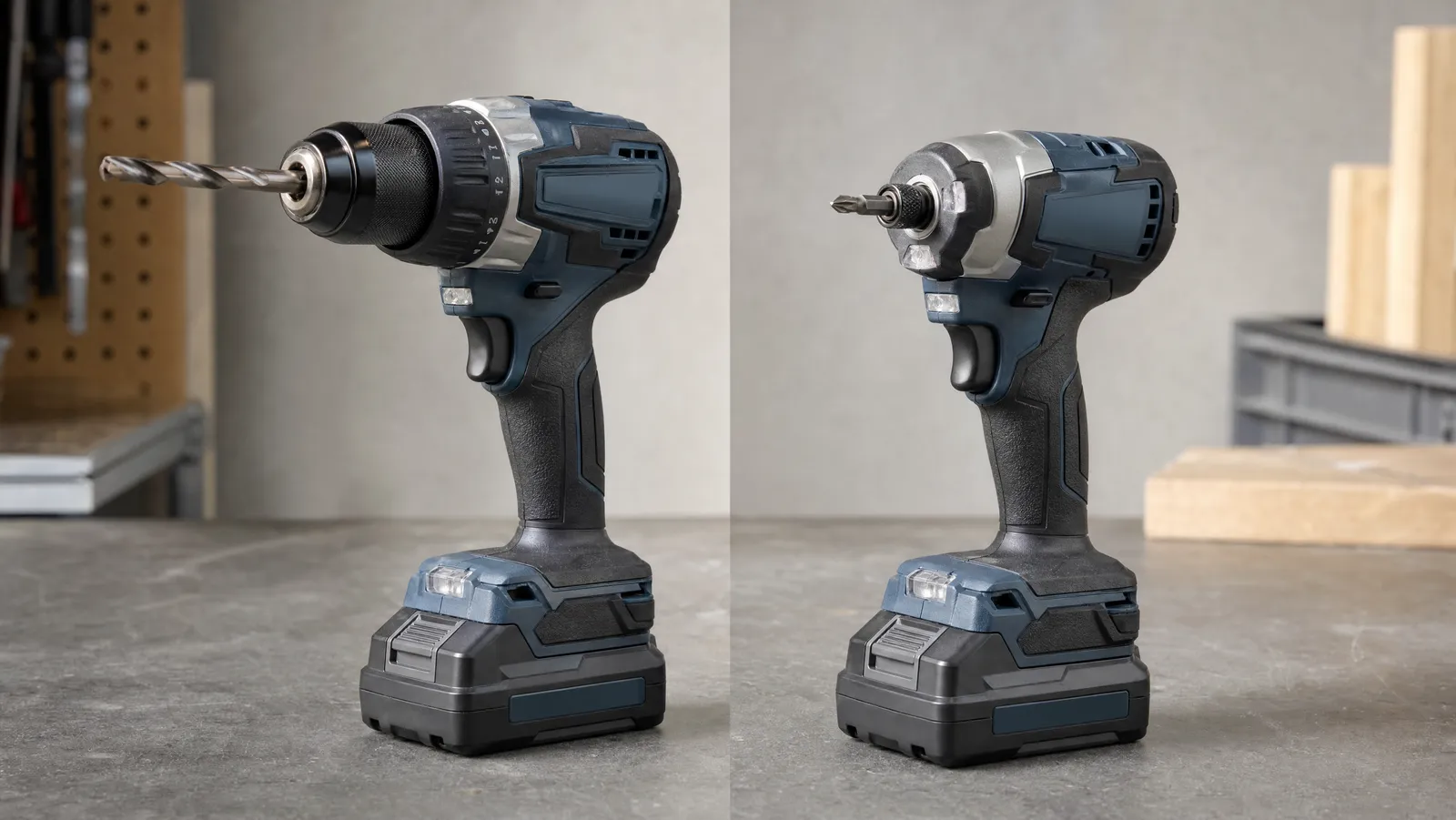
A drill spins a bit at a steady, adjustable torque and holds it in a chuck that grips almost any shank. An impact driver adds rapid rotational hammer blows to drive long fasteners, and it takes only 1/4-inch hex bits. That is the impact driver vs drill question answered in two sentences — and if you can only buy one, buy the drill.
They look like twins on the shelf, which is exactly why beginners buy the wrong one first. Below we explain the mechanism in plain English, show which tool wins which job, and name the two we would actually buy — part of our wider guide to cordless power tools for DIY.
The short answer
How each tool works
The difference isn't power, exactly. It's how the power arrives at the screw.
The drill
A drill/driver is a motor, a gearbox and a chuck. Pull the trigger and the chuck turns smoothly and continuously, at whatever speed your finger asks for. The chuck is the versatile part: a keyless three-jaw chuck clamps round shanks, hex shanks, spade bits, hole saws and paddle mixers, in a range of diameters.
The other half of a drill's character is the clutch — the numbered collar behind the chuck. Drills have it and impact drivers don't. As Pro Tool Reviews explains, it lets you control how deep a screw goes by causing the chuck to slip once a preset torque level is reached. Set it low for drywall or cabinet hinges and the drill stops driving before the screw head buries itself. Twist the collar to the drill icon and the clutch switches off, giving you full torque for making holes.
The impact driver
An impact driver drives screws by hitting them — sideways, around the axis of rotation. According to Pro Tool Reviews, the tool uses a spring, hammer and anvil: as the motor turns, the spring compresses and releases, forcefully driving the hammer around until it strikes rotationally against the anvil. Once a fastener puts up enough resistance to slow the anvil, that cycle repeats astonishingly fast — Pro Tool Reviews notes most impact drivers hit more than 50 times every second.
That hammering is why an impact driver delivers far more fastening force than a comparable drill/driver. Pro Tool Reviews describes the mechanism as creating much more force than a drill can typically muster in a similarly sized tool, and in its own head-to-head the impact driver was rated 2,000 in-lbs against 1,400 in-lbs for the drill. There are two catches. It has no clutch — Pro Tool Reviews notes impact drivers lack a mechanical clutch, and that they are designed not to cause reactive force on the user when a fastener binds. And it has no chuck, just a 1/4-inch quick-release hex collet.
Head to head: impact driver vs drill driver
Read that table and one thing jumps out: the drill's advantages are all about versatility, and the impact driver's are all about force. A drill is the tool that can do everything acceptably. An impact driver is the tool that does one job — sinking fasteners — brilliantly, and most other jobs badly or not at all.
The wrist-kickback row is the one beginners underestimate. When a long screw binds in a drill, all that torque has to go somewhere, and it goes into twisting the tool in your hand. An impact driver's blows are short and rotational, so the reaction never builds up. That's why people who frame decks reach for it even when a drill technically has enough grunt.
Which jobs need which tool
Forget spec sheets for a moment. Here's how it plays out on real Saturday-morning jobs.
Notice how the top half of that table is ordinary household work and the bottom half is construction. That's the honest dividing line. If your projects are shelves, curtain rails, flat-pack wardrobes and the occasional door handle, a drill covers all of it and an impact driver will mostly sit in the bag. The moment you start building something structural — a deck, a shed, a stud wall, a raised bed out of 4x4s — the impact driver stops being a luxury.
Flat-pack furniture deserves a special warning. Chipboard and MDF are soft, and the screws that come in the little bags are often soft too. An impact driver will drive one straight through the panel or snap its head off before you've registered what happened. Use the drill on a low clutch setting instead, or finish the last turn by hand. For a broader view of what belongs in a first kit, see our rundown of the cordless power tools every DIYer should own.
What an impact driver can't do
This is the part the marketing skips. An impact driver has real, permanent limitations, and none of them are fixable with technique.
It can't hold round bits. No chuck means no round-shank twist bits, no hole saws with round arbors, no paddle mixer, no countersink with a round shank. You can buy hex-shank drill bits, but the selection is narrower and the sizes cap out early.
It has no clutch, so it never eases off. A drill's clutch slips at a preset torque; an impact driver just keeps hitting. It will happily snap a brass screw, strip a Phillips head, or bury a fastener below the surface of soft pine. Control comes entirely from your trigger finger.
It's poor at precision. The hammering makes the tool jump slightly at the start of a hole, and there's no low, smooth speed for delicate work — a real problem in tile, thin metal or anything you can't afford to wander in.
It's loud. Pro Tool Reviews describes the impacting mechanism as very loud, while a drill makes much less noise. For scale, OSHA requires employers to make hearing protectors available to workers exposed to an eight-hour average of 85 dBA or more. You're not framing houses all day, but a set of cheap plugs in the tool bag is a sensible habit.
Do you need both?
Eventually, yes — and the honest answer is that almost everyone who buys the drill first ends up buying the impact driver within a couple of projects. The pair covers drilling and driving with no bit-swapping: pilot hole with one hand, screw with the other.
But you don't need both on day one, and you certainly shouldn't buy them separately at full price. The cheapest route to owning the pair is a two-tool combo kit, which bundles both tools with two batteries, a charger and a bag for typically less than the two kits cost individually — and guarantees they share a battery platform. We've compared the options in our guide to the best cordless power tool combo kits for beginners.
If you already own a drill you're happy with, skip the kit and buy a bare-tool impact driver on the same battery platform. That's usually the cheapest upgrade in cordless.
If you're buying one (or both)
To keep this a tool-vs-tool comparison rather than a brand argument, both picks below sit on the same battery platform — DeWalt 20V MAX — so the packs and charger are interchangeable between them. Buy the drill, and the impact driver later costs you a tool, not a whole new system.
The drill: DeWalt DCD771C2
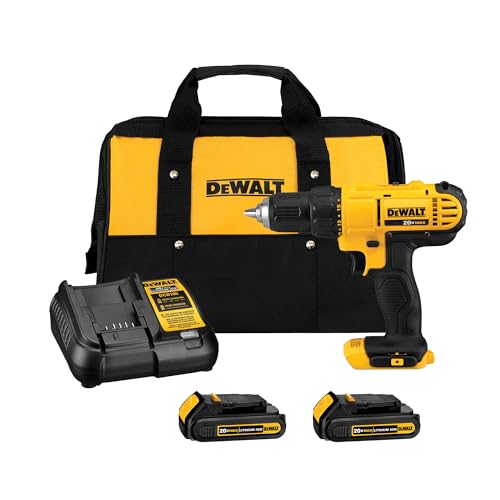
DeWalt DCD771C2
A compact two-speed 20V MAX drill/driver with a 1/2-inch ratcheting chuck, two batteries, a charger and a bag. DeWalt lists it for home repairs, DIY, light construction and drilling in wood, plastic and light metal.
Pros
- 1/2-inch single-sleeve ratcheting chuck grips round, hex and spade shanks alike
- Two speeds (0-450 and 1,500 rpm) cover both controlled driving and faster drilling
- Compact, lightweight body with an ergonomic handle fits into tight areas
Cons
- DeWalt states it is not suitable for drilling concrete or masonry, or for heavy-duty industrial use
- The two 1.3Ah batteries are small, so expect frequent swaps on longer sessions
This is the drill we'd hand a beginner. The 1/2-inch single-sleeve ratcheting chuck grips round, hex and spade shanks with real bite, and the two-speed transmission (0-450 and 1,500 rpm) gives you the slow, torquey gear for driving and the fast gear for drilling. It's compact and light enough to work above your head or inside a cabinet, and DeWalt rates it for home repairs, DIY, light construction and drilling in wood, plastic and light metal. Worth knowing before you buy: DeWalt's own listing states it is not suitable for drilling concrete or masonry — for that you want a hammer drill, not a plain drill/driver. The two 1.3Ah batteries are small, so plan on swapping often. Around $99 as of July 2026.
The impact driver: DeWalt DCF787C2

DeWalt DCF787C2
A brushless 20V MAX impact driver rated at 1,500 in-lbs of torque, with a 1/4-inch hex chuck, variable-speed trigger, two batteries and a charger — the tool you add when the screws get long.
Pros
- Rated 1,500 in-lbs of torque for the long fasteners a drill/driver struggles with
- Brushless motor, which DeWalt credits for efficient performance and runtime
- Variable-speed trigger plus an LED light with a 20-second delay for control in dark corners
Cons
- The 1/4-inch hex chuck accepts only hex-shank bits — no round-shank drill bits, spade bits or hole saws
- Costs meaningfully more than the drill kit, and stock was down to single digits at our last check
Add this when your fasteners outgrow the drill. It's rated at 1,500 in-lbs of torque — the figure that makes 3-inch deck screws a non-event — and DeWalt credits the brushless motor for efficient performance and runtime. The variable-speed trigger matters more than the headline torque: it's what lets you feather a screw into a delicate surface instead of firing it through. There's also an LED light with a 20-second delay, which is genuinely useful under a sink. The trade-offs are the ones every impact driver carries: a 1/4-inch hex chuck only, and no clutch. It runs about $138.97 as of July 2026, and stock was into single digits at our last check. If you want to weigh it against other options, we've rounded up the best cordless impact drivers for DIY.
Buy in that order — drill first, impact driver when the work demands it — and you'll never own a tool you don't use. When you're ready to widen the kit beyond these two, our guide to the best cordless power tools for DIY maps out what to add next and in what order.
Frequently asked questions
Can an impact driver drill holes?
Only with hex-shank drill bits, and not well. There's no chuck to grip a round shank, so your bit selection is limited to what's sold with a 1/4-inch hex end. Even then, the hammering makes the bit skate at the start of the hole and gives you no smooth low speed for control. Treat hole-drilling as something an impact driver can do in an emergency, not something it's for.
Can a drill drive long screws?
Yes, badly. A drill will sink a 3-inch deck screw if you lean on it, but it'll stall, cam out of the screw head and twist hard in your hand when the fastener binds. Do it fifty times and you'll feel it in your forearm. That's the exact gap the impact driver's hammer-and-anvil mechanism was invented to close.
Do I need impact-rated bits?
For an impact driver, yes — buy them. Tooled-Up warns that hex-shank bits that aren't impact rated may shatter under the tool's repeated blows. Impact-rated bits use tougher steel and a torsion zone that absorbs the shock. They cost a little more and last far longer, and a bit that shatters at 50 blows a second is not something you want near your face.
Is an impact driver the same as an impact wrench?
No, and they're confused constantly. Both use the same rotational hammering mechanism, but they're built for different fasteners. According to Pro Tool Reviews, an impact driver uses a 1/4-inch hex collet that accepts hex-shank bits, with the strongest models exceeding 2,000 in-lbs (167 ft-lbs) of torque, while an impact wrench uses a square drive that takes sockets and starts around 100 ft-lbs (1,200 in-lbs), climbing well past 1,000 ft-lbs (12,000 in-lbs) on the biggest models. Short version: driver for screws, wrench for nuts and bolts — lug nuts, suspension bolts, structural hardware.
Which should I buy first if I own no power tools at all?
The drill, without hesitation. It's the only one of the two that can make a hole, and it drives screws well enough for the vast majority of household jobs thanks to its adjustable clutch. Buy a decent two-speed drill, use it for six months, and let your own projects tell you whether you need the impact driver. If they involve decking, framing or long lag bolts, the answer will be obvious.
About the Author
Cheryl Thompson
Cheryl Thompson is the tools editor at The DIY Tool Review. A lifelong fixer and self-confessed tool addict, she has spent years buying, borrowing and wearing out hand and power tools across home renovation, furniture building and everyday repairs. She writes hands-on, no-nonsense reviews to help fellow DIYers spend their money on the tools that actually last.