Green Beam vs Red Beam Laser Levels: What's the Difference?
Bosch sells the same cross-line laser in red and green, which isolates what the green beam buys: 15 ft more rated range for $10.45 as of September 2026. Here is why, and when red still makes sense.

- Category
- Measuring & Layout
- Tools tested
- 3
- Read time
- 12 min
- Updated
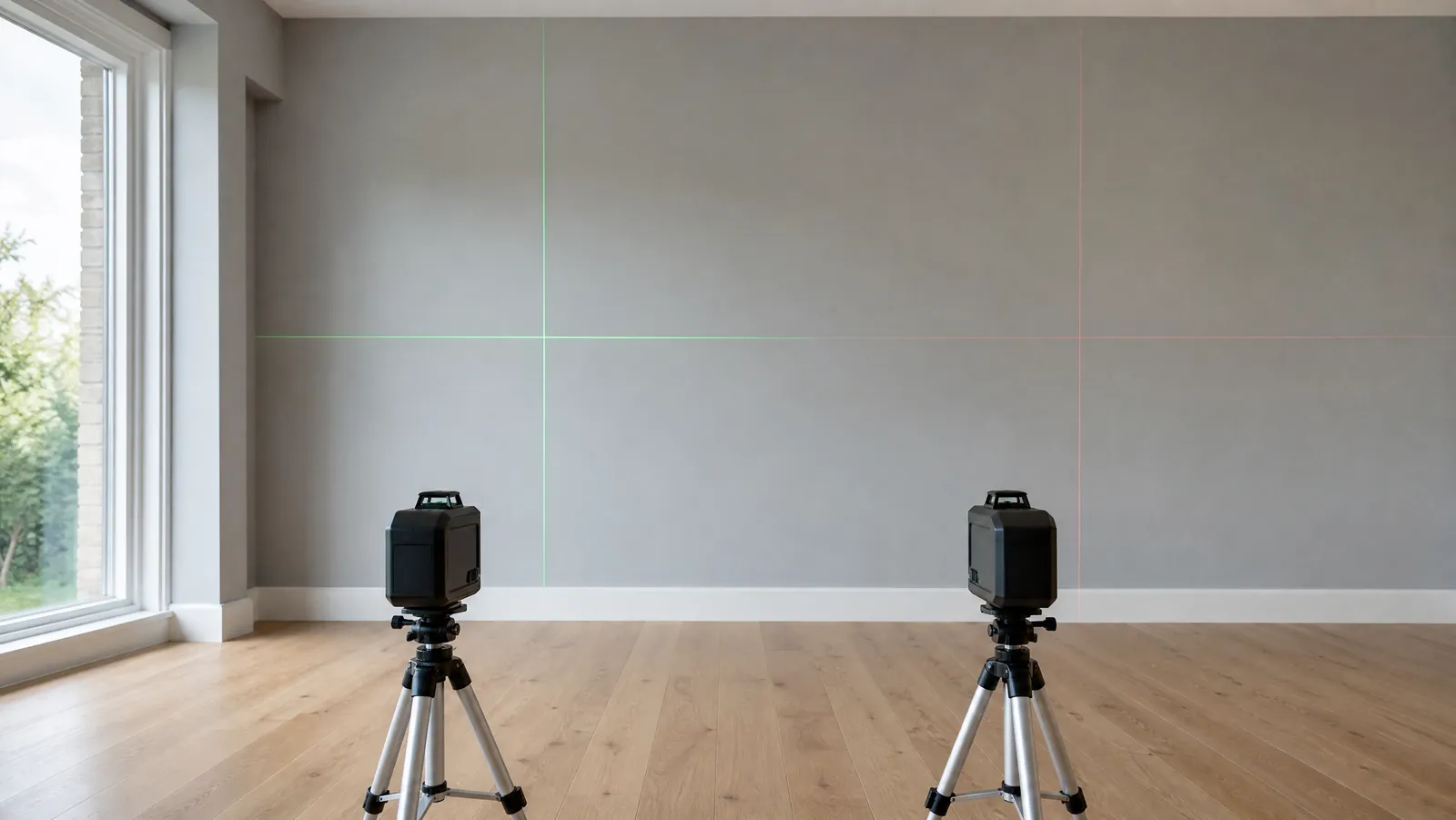
Green vs red laser levels is a question about your eyes, not the laser. At equal power the eye sees a green line as several times brighter than a red one, so for most indoor DIY green is worth the extra money. Red still suits small or dim rooms, tight budgets and receiver work outdoors.
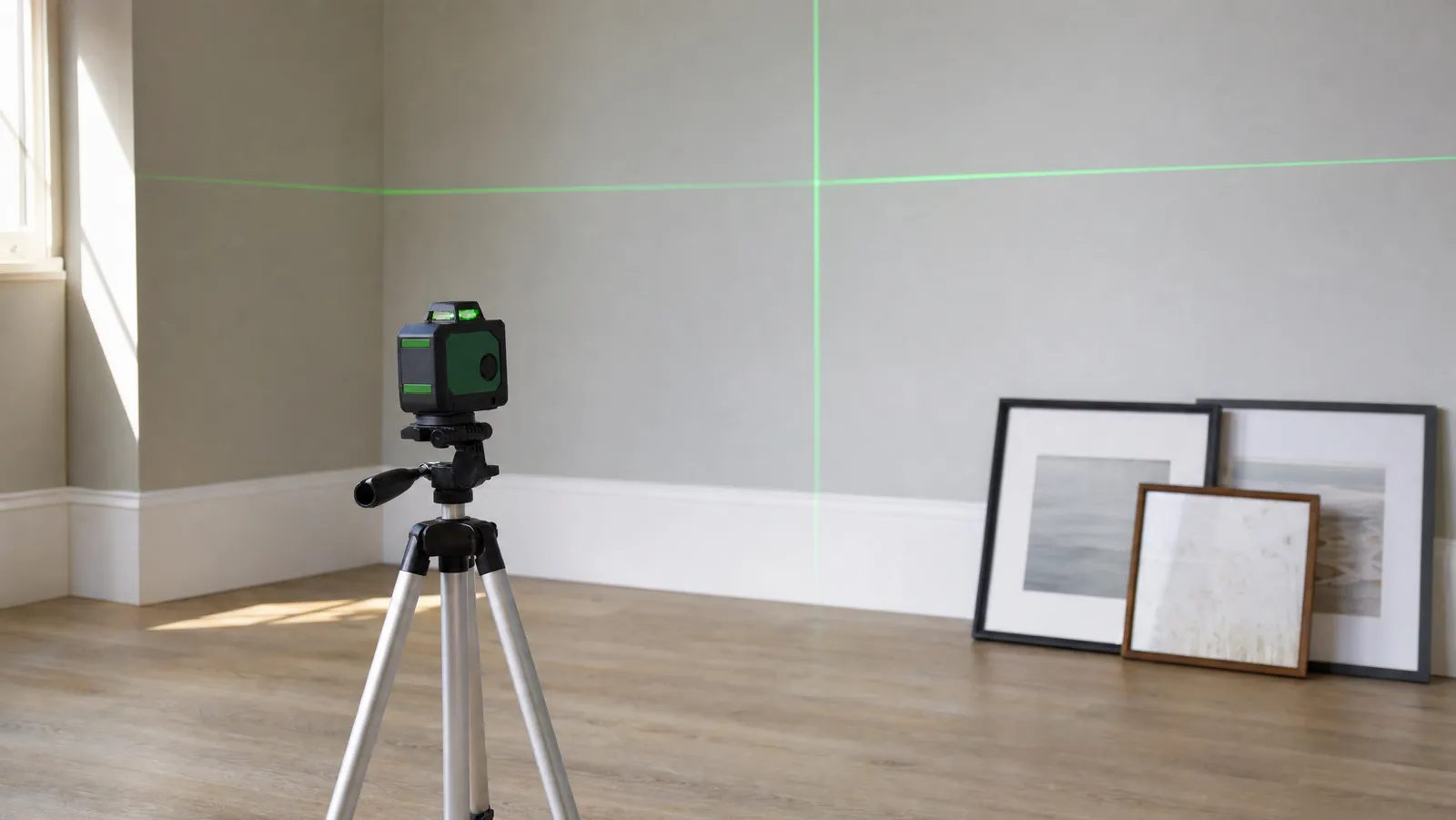
Most green-versus-red comparisons pit two different lasers against each other and credit the whole gap to colour. Bosch offers a cleaner test: it sells the same cross-line laser in both colours. The GLL50-20 (red) and GLL50-20G (green) share one body, one 0.77 lb weight, one IP55 rating, one Class 2 under-5 mW output rating and one plus-or-minus 3.5 degree self-leveling range. Whatever changes between them is what the green diode buys you. It is part of our guide to choosing measuring and layout tools for DIY.
The short answer on green vs red laser levels
Why green looks brighter: it is your eye, not the laser
Green laser level visibility is not about a higher power rating: both Bosch models carry the same Class 2, under-5 mW rating. What differs is how efficiently your eye turns each colour into brightness.
In daylight the eye is most sensitive at 555 nm, in the yellow-green. The International Commission on Illumination (CIE) publishes this as the photopic luminous efficiency function, V(lambda), which scores each wavelength against that 555 nm peak of 1.00. From the CIE's own data table:
Divide the 532 nm value by the 635 nm value and you get 4.1. That lands squarely on the "up to 4X brighter than standard red beams" line on Bosch's GLL50-20G page and the same claim in Motovera's listing, and laser-level maker PLS (Pacific Laser Systems) says a green appears four times as bright as a red at the same power. The 4x figure is the manufacturers' claim, not a measured result for any one tool, but the arithmetic supports something in that region.
Two caveats. Against a 650 nm red the same sum gives about 8, so the multiplier depends on which red you compare. And Bosch quotes bands, 500-540 nm green and 630-650 nm red, without saying where each diode sits, so treat 4x as a reasonable middle, not a guarantee. The direction is settled, though: even at the least favourable corner, 500 nm against 630 nm, green still comes out ahead, by about 1.2 times.
PLS puts it in working terms for its own lines: a red PLS line might be visible at 20 to 30 feet indoors, a green one at 45 to 60 feet on fresh batteries.
Green beam vs red beam on the same tool
Every spec below comes from Bosch's product pages and the manual the two models share.
What changes is a short list:
- Reach: 15 ft more, or 30%. Bosch's claimed 4x brightness did not buy four times the reach.
- Accuracy: about 1/16 in tighter at 30 ft. In metric, Bosch lists plus or minus 8 mm at 10 m for the red and 7 mm for the green. Real, but small.
- A soft pouch in the green kit.
- Price: $10.45 more as of September 2026.
Everything else holds still, above all the output class. The green GLL50-20G is not rated as a more powerful laser. It is the same power class, shifted into a colour your eye is better at seeing.
Watch the listings. Some retail listings for the green GLL50-20G repeat the red model's figures: 50 ft, 5/16 in at 30 ft and 630-650 nm. Trust Bosch's spec sheet.
What green costs you
The obvious cost is money: $10.45 on the Bosch pair as of September 2026, with the red at $77.99 and the green at $88.44, or about 13% more for the same tool. Prices move, so check before you buy.
The premium is not fixed across brands: the Motovera green in our examples is $49.99 as of September 2026, $28 less than even the red Bosch. In this set of three, brand moves the price more than beam colour does.
The less obvious cost is power. According to Huepar, green laser diodes require more power to operate, which shortens their battery life compared with red lasers. PLS agrees: a green laser consumes more battery power, and you will change batteries more often.
Bosch publishes no battery runtime for either model, on its product pages or in the manual, so we cannot tell you how many hours either one lasts. If you choose green, keep spare batteries in the kit.
Where red still makes sense
Are green laser levels better across the board, then? No. Red is a narrower answer, not a wrong one.
Small rooms. Bosch rates the red GLL50-20 to 50 ft, and PLS puts its own red lines at 20 to 30 feet of indoor visibility. If your far wall is well inside that, the green's extra reach goes unused.
Dim rooms. Ambient light is what washes a line out; Bosch's manual blames conditions such as direct sun for cutting the working range. In a basement or a garage in the evening, a red line has far less to compete with.
The lowest price within a brand. If $10.45 is the difference between buying a laser and not, the red does the same job over a shorter distance.
Receiver work. Once a detector is finding the line for you, what your eye prefers matters less. PLS says you can gain battery life and save money with a red PLS laser and detector, and Huepar notes that red lasers work with most detection systems on the market.
Outdoors, neither colour is enough
Bosch's manual footnote for both models is plain: the working range can be decreased by unfavourable environmental conditions, for example direct sun exposure. A green line holds out longer than a red one, but in full sun we would not plan a job around either unaided. PLS recommends a laser detector if your work is mostly outdoors, in very bright ambient conditions, or at distances beyond 30 feet, whatever the beam colour.
Receivers bring catches of their own:
- They need pulse mode, and often a matching brand. Huepar says its LR-6RG detector picks up red and green pulse beams at up to 200 ft, but only with the laser's pulse mode switched on, and it lists which Huepar lasers it works with. Match the list to your laser's model number.
- Not every laser supports one. Bosch's manual for the GLL50-20 pair does not mention a pulse mode or a receiver, so we would not plan detector work around either Bosch. The Motovera needs a receiver, not included, for bright outdoor work; confirm which one it supports first.
The three lasers, as examples
We do not hands-on test tools on this site. Everything below comes from published manufacturer specifications, current price and availability. These three illustrate the choice rather than rank it; for a proper shortlist, see the best laser levels for home use.
The green beam: Bosch GLL50-20G

Bosch GLL50-20G (green)
The green-beam version of Bosch's GLL50-20 chassis. Bosch lists a working range of up to 65 ft, leveling accuracy of plus or minus 1/4 in at 30 ft, a Class 2 diode under 5 mW at 500-540 nm, self-leveling to plus or minus 3.5 degrees, IP55, and two AA batteries, a magnetic mount and a soft pouch in the box.
Pros
- Bosch rates it to 65 ft, against 50 ft for the red version
- Tighter published accuracy: plus or minus 1/4 in at 30 ft
- Same 0.77 lb body, IP55 rating and magnetic mount as the red model
- Runs on AA batteries or Bosch's optional 3.7V lithium-ion pack
Cons
- Costs more than the otherwise identical red GLL50-20
- The 4x-brighter-than-red figure is Bosch's own claim
- Some retail listings repeat the red model's 50 ft and 630-650 nm figures - trust Bosch's spec sheet
Bosch lists up to 65 ft of working range, leveling accuracy of plus or minus 1/4 in at 30 ft and a Class 2 diode under 5 mW at 500-540 nm. It self-levels within plus or minus 3.5 degrees, is rated IP55, weighs 0.77 lb, and ships with two AA batteries, the integrated magnetic mount and a soft pouch.
The case for it over the red version is 15 more feet of rated range from the same body, plus slightly tighter published accuracy. Bosch says it projects up to 4x brighter than standard red beams. That is Bosch's claim, and the CIE numbers above make it a fair ballpark, not a measured fact for this unit.
At $88.44 as of September 2026, and prices move, it is the one we would pick for kitchens, living rooms and rooms with big windows. Check any listing against Bosch's spec sheet, because some repeat the red model's numbers.
The red beam: Bosch GLL50-20
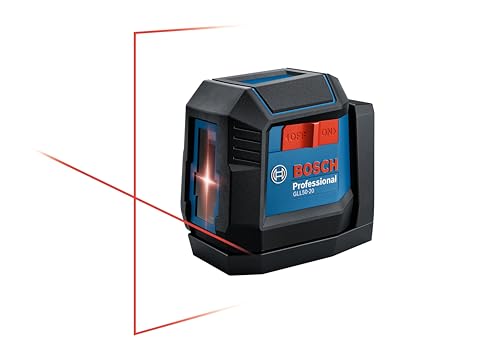
Bosch GLL50-20 (red)
The red-beam version of the same Bosch chassis. Bosch lists a working range of up to 50 ft, leveling accuracy of plus or minus 5/16 in at 30 ft, a Class 2 diode under 5 mW at 630-650 nm, self-leveling to plus or minus 3.5 degrees, IP55, and two AA batteries and a magnetic mount with a 1/4-20 thread in the box.
Pros
- The cheaper way into this Bosch cross-line laser
- Same 0.77 lb body, IP55 rating and magnetic mount as the green model
- Pendulum locks when switched off, so it travels safely
- Runs on AA batteries or Bosch's optional 3.7V lithium-ion pack
Cons
- Bosch rates it to 50 ft, 15 ft less than the green version
- A red line is harder to pick out in a brightly lit room
- No soft pouch in the box, unlike the green model
Same chassis, red diode. Bosch lists up to 50 ft of working range, leveling accuracy of plus or minus 5/16 in at 30 ft and a Class 2 diode under 5 mW at 630-650 nm. The rest matches the green: plus or minus 3.5 degree self-leveling, IP55, 0.77 lb, two AA batteries and a magnetic mount with a 1/4-20 thread. The pendulum locks when you switch it off, so it travels safely.
It gives up 15 ft of rated reach, a sixteenth of an inch of published accuracy and the soft pouch, and keeps everything else.
At $77.99 as of September 2026, it is the cheaper way into this Bosch. We would choose it for a basement, a garage or a small bathroom, where 50 ft is more reach than the room has. For receiver work, look instead at a laser whose maker documents a pulse mode.
Budget green: Motovera 100ft with tripod
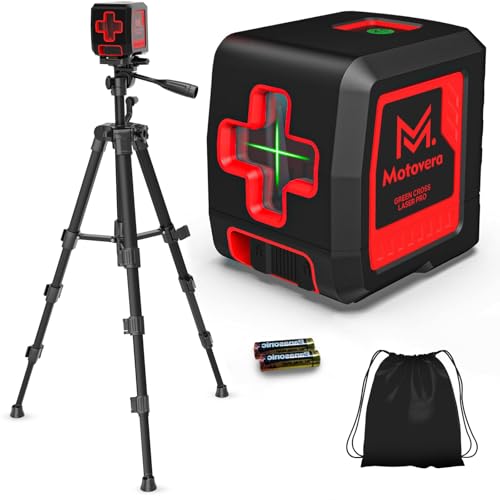
Motovera 100ft Green + Tripod
A lower-cost green cross-line laser with a tripod in the box. Motovera lists a green line visible to 100 ft indoors, accuracy of plus or minus 1/9 in at 33 ft, self-leveling within plus or minus 4 degrees with a lockable manual mode, Class II under 5 mW, and IP54.
Pros
- Tripod extending 15 to 46 inches included - nothing else to buy
- Green beam at a lower price than either Bosch
- Self-leveling and manual modes for sloped layouts
- IP54 rated
Cons
- Needs a receiver (not included) for bright outdoor work
- The 4x-brighter-than-red figure is Motovera's own claim
- AA batteries rather than a rechargeable pack
Motovera lists a green line visible to 100 ft indoors, accuracy of plus or minus 1/9 in at 33 ft, and self-leveling within plus or minus 4 degrees with a lockable manual mode for sloped layouts. It is listed as Class II under 5 mW and rated IP54, and a tripod extending from 15 to 46 inches comes in the box, which neither Bosch kit includes.
It makes one point: green is not only a premium option. At $49.99 as of September 2026 it costs less than either Bosch. We quoted it at $37.98 in August, which shows how much these prices move.
Two cautions. The 4x-brighter-than-red figure is Motovera's own claim. And do not read its 100 ft against Bosch's 65 ft as a like-for-like gap, since each maker rates range its own way.
What we would buy
Decide in this order:
- Where is the work? Mostly outdoors, or beyond 30 ft in bright light? Take PLS's advice and plan on a detector, choosing a laser whose maker documents a pulse mode before you pick a colour.
- How bright and how big is the room? Lit rooms, open-plan spaces and big windows favour green. A small or dim room is well served by red.
- What is the colour costing you? On the Bosch pair, $10.45. We would pay it for 15 more feet of rated range and the tighter published accuracy.
On that logic, for most homes we would buy the Bosch GLL50-20G green cross-line laser. If you want green and a tripod for less, the Motovera green cross-line laser with tripod is the budget route. Both prices are as of September 2026, and both move.
Who should keep the money? Anyone working mostly in one small or dim room, anyone who already uses a receiver, and anyone buying a laser for one job. And if you do not own a proper level yet, start there: our laser level vs spirit level comparison explains why the spirit level comes first, and the best levels for DIY covers which one to buy.
Common questions
Do laser enhancement glasses help? They can: Bosch says its laser viewing glasses filter out ambient light, making the laser appear brighter. They are not safety glasses. Bosch's manual says they do not protect against laser radiation, should not be worn as sunglasses or in traffic, and reduce colour perception. PLS says they reduce your ability to see other colours; it does not sell them and advises that any use on the job site be done with extreme caution.
Is a green laser more dangerous than a red one? Not on these tools' ratings. Bosch rates both versions Class 2 under 5 mW, and Motovera lists Class II under 5 mW; the colour changed the wavelength, not the class. The rule for both is Bosch's: do not point the beam at people or animals, and do not look into it yourself, not even from a long distance.
I am colour-blind. Should I avoid red? Possibly. According to EnChroma, red colours look darker than normal to people with protan-type colour vision deficiency, which it estimates accounts for about a quarter of red-green cases. If you know you are protan, green is the better bet.
Is a laser level the same as a laser measure? No. A laser level projects a reference line; a laser measure returns a distance. If distance is your problem, the comparison you want is a laser measure against a tape measure, not red against green.
Green or red: the last word
The Bosch pair settles this better than any multiplier on a box. Same body, same power class, and the green gets 15 ft more rated range and slightly tighter published accuracy for $10.45 more as of September 2026. The reason is your eye, which the CIE's daylight curve rates about four times more sensitive to a 532 nm green than a 635 nm red.
Buy green for most indoor work, red for small or dim rooms or the lowest price within a brand, and a receiver-ready laser for anything outdoors in the sun. For where a laser level sits in the rest of your kit, see our guide to the best measuring and layout tools.
About the Author
Cheryl Thompson
Cheryl Thompson is the tools editor at The DIY Tool Review. A lifelong fixer and self-confessed tool addict, she has spent years buying, borrowing and wearing out hand and power tools across home renovation, furniture building and everyday repairs. She writes hands-on, no-nonsense reviews to help fellow DIYers spend their money on the tools that actually last.