How to Choose a Circular Saw Blade (Tooth Count, Kerf and Material)
Diameter and arbor first, then tooth count, then kerf. One blade here publishes its kerf in inches — the other three just say 'thin kerf' and hope you don't ask.

- Category
- Saws & Cutting Tools
- Tools tested
- 5
- Read time
- 13 min
- Updated
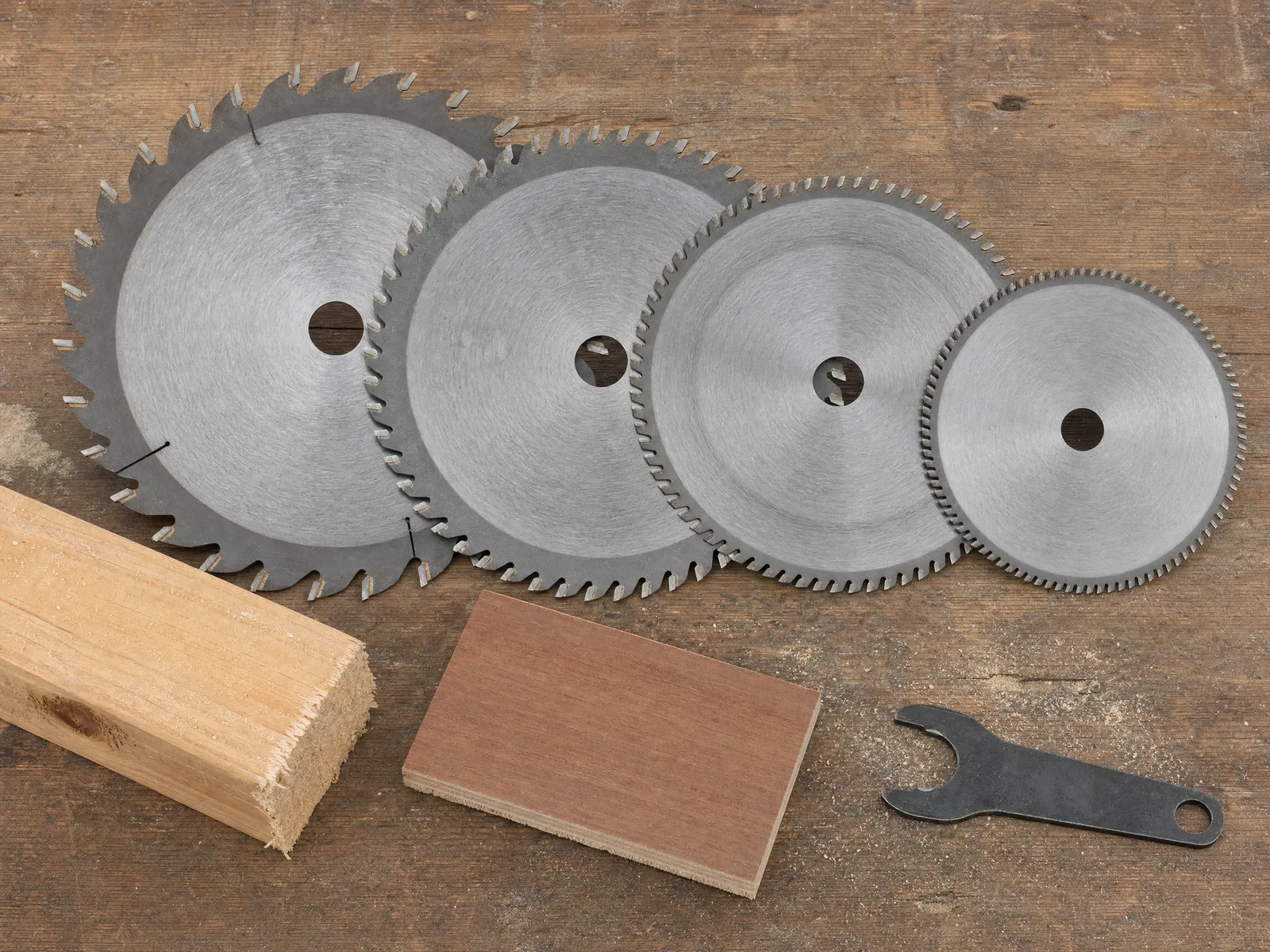
Here is how to choose a circular saw blade, in three decisions, in order. Match the diameter and arbor to your saw. Pick the tooth count for the material — 24 teeth for framing, 40 for general crosscutting, 60 for melamine and veneered plywood. Then check the kerf. Get the first one wrong and the other two never matter.
The blade, not the saw, decides what your cuts look like. A 60-tooth blade at $22.97 as of October 2026 does more for the edges coming off a budget saw than another hundred dollars of saw would — because most saws ship with a rough 24-tooth framing blade, and most people never take it off. This guide sits inside our wider guide to the best saw for DIY; if you are still choosing the tool, start with types of saws explained, then our best circular saw for DIY roundup.
Start with diameter and arbor
Diameter and arbor are a compatibility gate, not a preference. 7-1/4 in. with a 5/8 in. arbor is the standard corded size; 6-1/2 in. is the common cordless size. Three of the five blades here are 7-1/4 in.; the two Diablos are 6-1/2 in., so only the first three fit a standard corded saw.
There is a consequence of diameter almost nobody mentions: maximum rated RPM tends to rise as the blade gets smaller. Revvstark publishes 8,000 max RPM for its 7-1/4 in. set, and spec sheets for Diablo's 7-1/4 in. D0760A agree, though some retailers quote 10,000 for it; DEWALT and WORKPRO publish none. The 6-1/2 in. Diablo D0641X is rated higher: its Amazon listing and two retailers, Coastal Tool and Penn Tool Co, say 10,000 max RPM, though one OEM parts catalog lists 12,500, so treat the ceiling as unsettled.
Most sources attribute that ceiling to tooth-tip speed at the rim rather than motor speed. A 7-1/4 in. circle is 22.78 in. around, so 8,000 RPM moves a tooth about 15,184 ft a minute; a 6-1/2 in. circle is 20.42 in. around, so 10,000 RPM lands near 17,017 ft/min — roughly 12 percent faster at the tip. A single shared ceiling would cap the smaller blade nearer 8,900 RPM.
Tooth count: the only spec most people need
Tooth count is the speed-versus-finish dial. Fewer teeth: bigger gullets, faster chip clearance, a cooler blade, a rougher edge. More teeth: a finer edge, a slower feed, more heat.
According to ToolsToday's blade-type guide, rip blades carry "commonly 24–30 teeth" on a 10-inch disc, with "large gullets to clear big chips fast," while cross-cut blades run "typically 60–80 teeth" and "shallow" gullets. Those counts are for 10 in. blades, which is why a 10-inch miter saw blade carries far more teeth than a 7-1/4 in. one of the same type — covered separately in best miter saw for DIY.
Here is the ladder, diameter held constant.
Tooth count only compares at the same diameter. The 6-1/2 in. circle is 20.42 in. around against 22.78 in., so forty teeth sit about every 0.51 in. instead of 0.57 in. — roughly 10 percent closer. Matching that spacing on a 7-1/4 in. disc would take about 45 teeth. Where the picks below put a 6-1/2 in. 40T next to the 40T in a 7-1/4 in. set, read them as different blades, not two versions of one spec.
Drag to compare all 5 →
How many teeth for a 2x4?
Twenty-four. A 2x4 is dry softwood framing stock, you are cutting to length rather than chasing a finish, and 24 teeth clear chips fast enough to keep the cut cool. Put a 60-tooth blade on it and you get slower progress, more heat and, per ToolsToday, the "scorch marks" a struggling blade leaves.
Depth matters more than teeth here. According to HSE Blog's circular saw safety guide, "adjust so the blade projects only about a tooth's depth" below the workpiece, which "limits exposed blade and reduces the pinch surface"; pinch is the kickback mechanism, because "the kerf closes on the blade as the cut progresses." We cover setting depth and supporting the offcut in how to use a circular saw.
Kerf, and why it matters more on a cordless saw
Kerf is the width of the slot the teeth remove. Thinner kerf, less material per pass, less load on the motor. That is the whole mechanism — a thin kerf does not make a saw more powerful, it gives the motor less work to do.
Plugged into a wall you will barely notice. On a cordless saw it comes off the battery. According to Bosch's training material for its cordless blades, their "extra thin kerf up to 30% thinner" than the corded equivalents delivers "up to 2 times more cuts per battery charge" — Bosch's tests, Bosch blades against Bosch blades, so read it as a direction, not a number you will hit.
Only one of these listings publishes a kerf in inches: the Diablo D0641X, at 0.059 in. The DEWALT, Revvstark and WORKPRO listings say only "thin kerf", and Diablo's 60-tooth D0660A listing gives no figure either. A thinner plate is also less stiff, so an aggressive feed or unsupported board can wander. For the wider platform question, see cordless power tools for woodworking and cordless tool batteries explained.
Coatings, carbide and what "long life" actually means
Every blade here is carbide-tipped; what differs is how much each maker tells you. Diablo publishes TiCo Hi-Density carbide and a Perma-Shield non-stick coating on both blades; DEWALT, high-density tungsten carbide with a Tough Coat anti-stick coating; Revvstark, anti-kickback geometry; WORKPRO, carbide tips and ATB grinding.
Coatings earn their keep because resin is a real failure mode in softwood. According to HSE Blog, "resin buildup increases friction and heat; a hot blade distorts and binds." A non-stick face does not make a blade sharper — it postpones the day a gummed blade starts behaving like a dull one.
ToolsToday describes alternating top bevel as teeth ground "to shear fibers instead of tearing them," which is why ATB is standard for sheet goods. Diablo also publishes a 15-degree hook angle for the D0641X — moderately positive, which by ToolsToday's description is combination-blade territory, "moderate positive to keep things moving." An honest spec for a 40-tooth blade.
What none of these listings publishes is a lifespan. No cut counts, no hours. "Long life" here is an adjective.
Why half these listings won't tell you the kerf
The specs this article is built on are frequently missing from the products themselves. One published kerf across the five listings, and you cannot borrow it even inside one family: Diablo's own D0660A listing gives none.
The WORKPRO title and its own bullets disagree about what arrives. The title sells a "24T/40T/60T Wood Cutting Set," then a bullet says the blades are "available in different tooth counts to meet various needs" — the language of a variant picker, not a three-blade box — and the ASIN sits under a parent ASIN. We will not tell you three blades ship in it, because the listing does not say so clearly. Check the selected option and quantity before you pay. Those same bullets tell you to "check the blade size and arbor specifications of your saw" while never stating the blade's own arbor — exactly backwards.
The Revvstark 40T is sold as two blades at once. Its bullet calls it a "40 T Ripping&Crosscutting" blade, then says the finer edge "enables the blades to rip cut along the grain." Those are the two things tooth count trades off against each other. By ToolsToday's tooth-count ranges — written for 10 in. blades — a 40-tooth blade is a combination blade, which "won't perform as quickly as a dedicated rip blade or as cleanly as a fine cross-cut blade." That is fine; it is not what the bullet claims.
The price finding cuts both ways. One 6-1/2 in. Diablo 40-tooth blade at $23.99 as of October 2026 costs $2.40 more than the entire three-blade 7-1/4 in. Revvstark set at $21.59 — about $7.20 a blade; the single DEWALT 24T at $9.98 is roughly 1.4 times that per-blade price. Brand premium on carbide is real, but be even-handed: Diablo publishes a kerf, a hook angle, an arbor and a carbide grade, and the cheap set publishes none of them. Part of the price is disclosure.
The blades we would buy
The default 24-tooth: DEWALT DWA171424
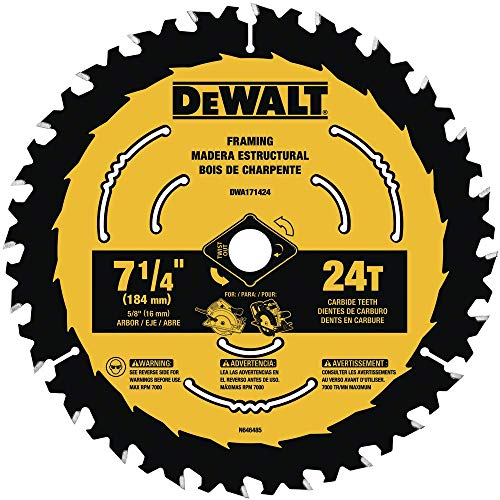
DEWALT DWA171424
The cheapest blade here and the one to keep mounted for framing and rough rips: 24 carbide teeth, thin kerf, and a reinforced shoulder for nail-embedded wood.
Pros
- Under $10, so dulling it on a deck board or a hidden nail costs nothing
- Reinforced shoulder is built for nail-embedded wood
- Anti-stick coating slows pitch build-up
- 24 teeth clear chips fast, which is what rip cuts need
Cons
- 24 teeth leave visible tear-out in plywood and melamine
- DEWALT gives no kerf measurement, only the words 'thin kerf'
- Wrong blade for finish work - this is the one you swap OUT for trim
At $9.98 as of October 2026, fifty cents off a $10.48 list, this is the blade you leave mounted for framing, deck boards and demolition. DEWALT publishes 24 high-density tungsten carbide teeth, a Tough Coat anti-stick coating and a reinforced shoulder for nail-embedded wood — the only feature here built for hitting a hidden nail. It says "thin kerf" and gives no number — at this price, less of a problem.
Cheapest way to own all three: Revvstark 3-pack

Revvstark 3-Pack
Three blades - 24T, 40T and 60T - for about $7.20 each. The cheapest way to stop using the wrong blade, which matters far more than brand.
Pros
- All three common tooth counts in one purchase, about $7.20 per blade
- Explicitly a 3-pack - you know what arrives
- Standard 5/8 in. arbor and 8,000 max RPM, so it fits any 7-1/4 in. saw
- Anti-kickback tooth geometry
Cons
- An unbranded carbide will not hold an edge like Diablo or DEWALT
- Its own bullets oversell the 40T as both a ripping and a crosscutting blade
- No published kerf measurement, only 'super thin laser cut kerf'
$21.59 as of October 2026, down from a $23.99 list, for 24T, 40T and 60T — about $7.20 a blade. It is explicitly a 3-pack, and it publishes what decides fitment: 7-1/4 in. (185 mm), a 5/8 in. (15.88 mm) arbor, 8,000 max RPM. Unbranded carbide will not hold an edge like Diablo's — but owning the right three cheaply beats owning one good one.
Starter set, with a caveat: WORKPRO 24/40/60

WORKPRO 24/40/60
Carbide-tipped ATB blades in the same three tooth counts - but read the listing twice before you buy, because the bullets and the title disagree about what you get.
Pros
- Carbide-tipped with ATB geometry at a set price
- Thin kerf reduces load on the motor
- Covers the same three tooth counts most DIYers need
Cons
- The title says 'set' while the bullets read like a variant picker - genuinely unclear what ships
- Publishes neither an arbor size nor a max RPM
- Tells you to verify the arbor yourself instead of stating it
$21.99 as of October 2026 for carbide-tipped, thin-kerf, ATB-ground blades the title lists in the same three counts — on paper the Revvstark's rival. The caveat is above: WORKPRO publishes neither an arbor size nor a maximum RPM. Confirm the variant and quantity, and check the arbor yourself.
Best finish blade for a cordless saw: Diablo D0641X

Diablo D0641X
The upgrade that transforms a 6-1/2 in. cordless saw: 40 ATB teeth on a 0.059 in. kerf, so it cuts cleaner while pulling less from the battery.
Pros
- 0.059 in. kerf is an actual published number, not a marketing phrase
- 40 ATB teeth give clean crosscuts in hardwood, softwood and plywood
- Thin kerf means less material removed, which stretches a battery charge
- Perma-Shield coating resists gumming and pitch
Cons
- $23.99 for one 6-1/2 in. blade - more than a three-blade 7-1/4 in. set costs
- 6-1/2 in. only, so it will not fit a standard corded 7-1/4 in. saw
- Sources disagree on its max RPM rating
The upgrade this guide is arguing for. $23.99 as of October 2026 buys 40 ATB teeth on a published 0.059 in. kerf, a 5/8 in. arbor, a 15-degree hook angle, TiCo Hi-Density carbide, Perma-Shield coating and laser-cut stabilizer vents. A thin plate removing less material is what a battery saw wants. It is 6-1/2 in. only, and its max RPM reads 10,000 or 12,500 depending on the source. If your cordless saw still wears its factory 24T, the Diablo D0641X is the best twenty-four dollars on this page.
Best for plywood and melamine: Diablo D0660A

Diablo D0660A
Sixty teeth on a 6-1/2 in. blade is the highest tooth density here - the blade for chip-free cuts in melamine, veneered plywood and delicate molding.
Pros
- Highest tooth density of any blade here - 60 teeth on a 6-1/2 in. disc
- Made for exactly the materials that tear out worst: melamine and veneered ply
- Perma-Shield coating keeps resin from building up between close-set teeth
- $22.97, currently below its $29.99 list price
Cons
- 60 teeth clear chips slowly - a poor choice for ripping or thick stock
- Its Amazon listing gives no kerf or max RPM figure, unlike the D0641X
- 6-1/2 in. only
Sixty teeth on a 6-1/2 in. disc is the tightest spacing here — one tooth every 0.34 in. by our arithmetic — and melamine and veneered ply tear out worst with anything coarser. At $22.97 as of October 2026 it sits under its $29.99 list, a cut of $7.02, about 23 percent. Diablo publishes the carbide grade, the coating and the intended materials but its listing for this model gives neither a kerf nor a maximum RPM — retailer spec sheets quote both, unconfirmed by Diablo — a strange gap from the brand that publishes both on the D0641X. A 7-1/4 in. 60-tooth Diablo does exist; the listings we checked were not showing stock, which is why this pick is 6-1/2 in.
When to replace a blade instead of sharpening it
Carbide can be reground, and for a big table saw blade that is usually right. For a 7-1/4 in. circular saw blade it often is not. ToolsToday's sharpening guide puts it plainly — "resharpen for edge wear, replace for structural damage or geometry loss" — and adds that "if sharpening costs approach the price of a new tool, replacement may be the better move." A $9.98 blade clears that bar immediately.
There is also a hard ceiling on regrinding. According to Woodworker's Journal, "after multiple resharpenings, the side clearance gets diminished as it approaches the thickness of the plate," and once it is gone the blade is finished however much carbide is left. Damage is simpler: HSE Blog says "remove cracked blades from service immediately," and warns that "a dull or wrong blade is a kickback waiting to happen, not just a slow cut."
So: own the right three tooth counts, keep a cheap 24T for anything that might hide a nail, and treat a cheap blade as a consumable. Still choosing the saw? Start with our DIY saw buying guide.
Frequently asked questions
What circular saw blade sizes are there?
Two matter for handheld saws: 7-1/4 in., the standard corded size, usually on a 5/8 in. arbor, and 6-1/2 in., the common cordless size. The five blades here split three to two along that line. Diameter and arbor both have to match your saw, and several of these listings never state the arbor.
What blade is best for cutting plywood?
A 40-tooth blade handles construction plywood fine. For veneered plywood and melamine, step up to 60 teeth: ToolsToday notes that crosscut-style blades use a hook angle "low or negative to control aggression and reduce splintering on veneers and laminates." Our pick there is the 60-tooth Diablo D0660A at $22.97 as of October 2026.
Does a thin kerf blade make a saw more powerful?
No. A thin kerf removes less material per pass, which reduces the load on the motor — a different claim. On a corded saw you will barely notice. On a cordless one it shows up as runtime: Bosch's training material credits its extra-thin-kerf cordless blades with "up to 2 times more cuts per battery charge" against its conventional range, by Bosch's own testing.
When should you use a circular saw fine tooth blade?
When the cut face is the finished face: melamine, veneered plywood, hardwood trim, delicate molding. A 60-tooth blade shears fibers instead of tearing them, at the cost of chip clearance. Keep it off framing lumber and thick stock, where slow clearance means burning.
About the Author
Cheryl Thompson
Cheryl Thompson is the tools editor at The DIY Tool Review. A lifelong fixer and self-confessed tool addict, she has spent years buying, borrowing and wearing out hand and power tools across home renovation, furniture building and everyday repairs. She writes hands-on, no-nonsense reviews to help fellow DIYers spend their money on the tools that actually last.