The Best Miter Saws for DIY (2026)
A sliding 10-inch saw crosscuts 2x12. A fixed 12-inch saw crosscuts 2x8 and costs $50.99 more. Blade diameter is not what decides how wide a miter saw cuts — the slide is.

- Category
- Saws & Cutting Tools
- Tools tested
- 5
- Read time
- 16 min
- Updated
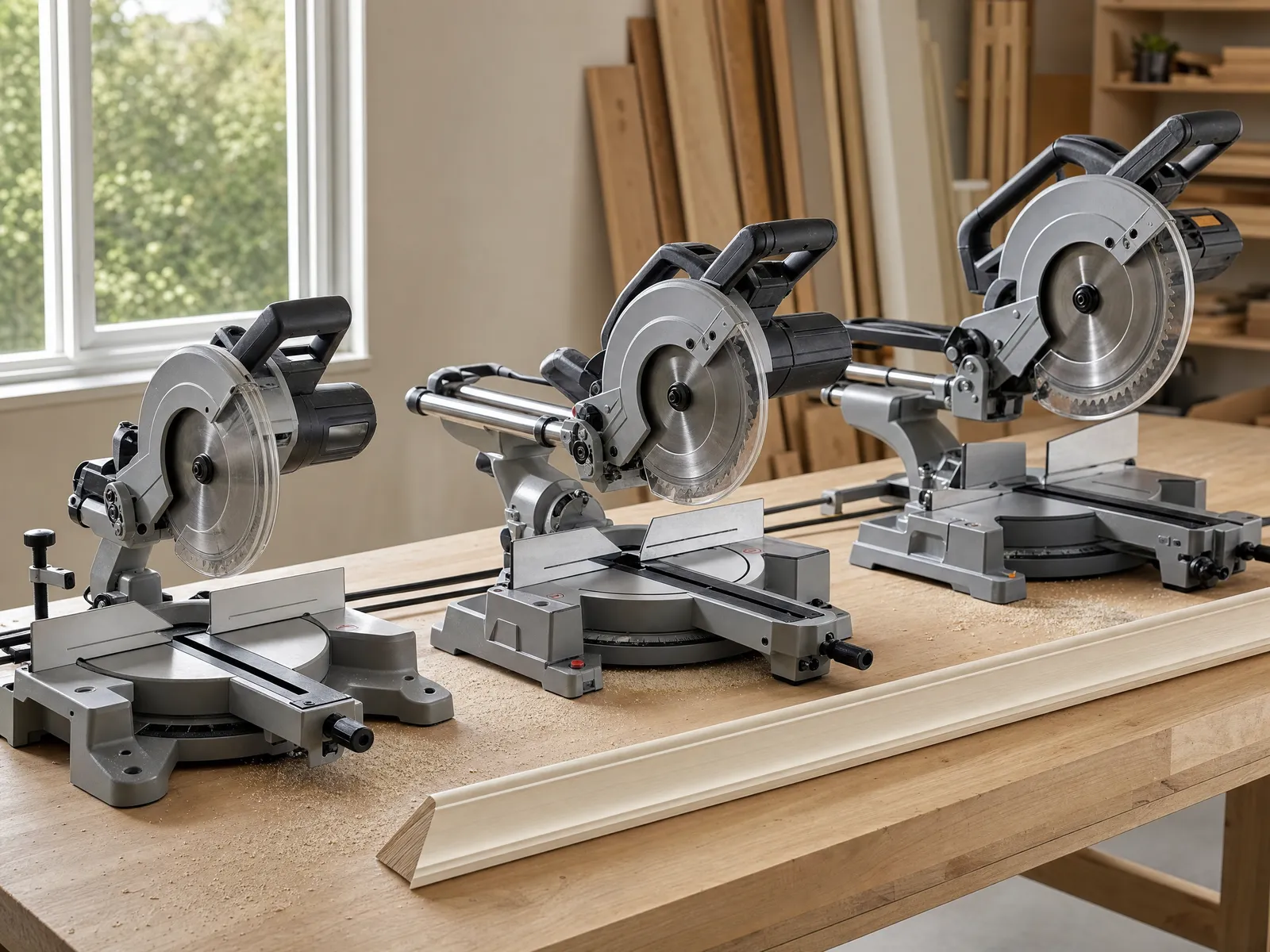
The best miter saw for DIY, for most people, is the Metabo HPT C10FCG2 at $169.00 as of October 2026 — a 24 lb, 15-amp 10-inch compound saw. If you want the one saw that stops you wondering about capacity, buy the SKIL MS6305-00 at $249.00 as of October 2026 instead. It slides, and it crosscuts 2x12.
That second sentence contains the comparison that should decide your purchase, and almost no roundup runs it. Here it is. SKIL publishes a 2x12 crosscut at 90 degrees for its sliding 10-inch saw. DEWALT publishes a 2x8 crosscut at 90 degrees for the fixed 12-inch DWS715 at $299.99 as of October 2026. Take one from the other — 299.99 minus 249.00 — and the sliding 10-inch cuts wider for $50.99 less. Blade diameter does not set crosscut width. The slide does. This guide sits inside our wider comparison of the best saw for DIY, and if you are still assembling a workshop, start with essential DIY tools before a saw this specialized.
How we picked
We have not bench-tested these saws, measured them, or timed a cut, and we are not going to imply otherwise. Every figure below comes from a manufacturer's published specification, a current product listing, or arithmetic you can redo from the table.
We publish no star ratings or review counts, because our product data source does not supply them. Where a spec appears, we name whose spec it is — and where a maker publishes nothing, we say so rather than fill the gap. Prices are as of October 2026 and move constantly.
Drag to compare all 5 →
A miter saw — mitre saw, outside the US — crosscuts boards to length and angle. It does not rip sheet goods, and it is rarely the first saw to buy: if you own none yet, the best circular saw for DIY does more jobs for less money, and types of saws explained covers the alternatives if you are not sure a miter saw is the right shape of tool.
What size miter saw is best for DIY? Start with the capacity ladder
Forget blade diameter and rank these five saws by what they cut in one pass at 90 degrees. The ladder runs 2x6, 2x8, 2x12, 2x14 — and it does not run in blade-size order.
One note on the Metabo HPT row: Metabo HPT does publish a capacity for the C10FCG2, as a feature bullet rather than a spec headline — its product page reads "CUTTING CAPACITY: 2x6 at 90° or 2x4 at 45°", and its spec table gives 2-5/16 in. x 5-21/32 in. at 90 degrees. Retailer listings and Pro Tool Reviews repeat the same figures.
Those nominal sizes are smaller than they sound. According to the Southern Pine Inspection Bureau, 2x4s and 2x6s finish half an inch under nominal width while 2x8s, 2x10s and 2x12s come in three-quarters under, because "green southern pine lumber shrinks in width and thickness as it dries" and "surfacing removes up to an additional ¼ inch from both dimensions." So a 2x6 is really 5-1/2 in. wide, a 2x8 is 7-1/4 in., and a 2x12 is 11-1/4 in.
Read the ladder with that in hand. A 10-inch fixed saw gets you to 5-1/2 in. — fine for 2x4 framing and most one-piece baseboard laid flat. The 12-inch fixed DWS715 adds 1-3/4 in. of width for $20.99 more. The sliding 10-inch SKIL jumps you to 11-1/4 in. for $50.99 less than that 12-inch saw.
So what does a 12-inch blade buy? A taller cut against the fence, not a wider one across the table. DEWALT rates the DWS715's tall sliding fence to support 5-1/2 in. of base molding standing upright. Cut tall baseboard vertically rather than flat and that is the spec that decides it — no 10-inch saw here has a published base-vertical figure that matches it.
One trap when comparing fence numbers: a "base molding vertical" figure and a "crown nested" figure are not the same measurement. Nested crown sits tipped back at its spring angle, so the number describes a diagonal. Compare base to base, or nested to nested — never one to the other.
Sliding or fixed?
A slide lets the blade travel on rails toward you, so cut width stops being a function of blade radius. That is the whole trick, and it is why the $249.00 SKIL out-cuts the $299.99 DEWALT by four inches of board width. It is not free:
- Bench depth. The rails have to travel somewhere. A slider needs clearance behind it and will not sit flat against a garage wall — exactly where most of us want a miter saw to live.
- Weight. Retailer item-weight listings put the SKIL MS6305-00 near 39 lb (about 17.8 kg); SKIL publishes no spec sheet we could find, so treat that as approximate. DEWALT publishes 36 lb for the 12-inch DWS715, so the sliding 10-inch is probably the heavier of the two.
Sliding saws also ask for one extra habit. According to Boston University's Environmental Health and Safety miter saw guidance, "while making a slide cut, KICKBACK can occur" — the blade binding in the workpiece so that "the saw blade is driven rapidly towards the operator." The same document says to "return carriage to the full rear position after each crosscut operation."
Both documents insist the board is clamped, not held: Boston University's guidance says the workpiece "must be secured firmly against the turn base and guide fence with a vise during all operations." Two of these five list a hold-down in the box: DEWALT ships a material clamp with the DWS780, and Metabo HPT's page lists a vise assembly with the C10FCG2.
Single bevel or dual bevel?
Bevel is the blade tilting out of vertical; miter is the table swinging left and right. A single-bevel saw tilts one way only, so opposing bevels on two ends of a board mean flipping the workpiece and re-marking it. A dual-bevel saw tilts both ways — you just change the setting.
Three of these five are single bevel. The Metabo HPT tilts 0 to 45 degrees left; the DWS713 and DWS715 both go 0 to 48 degrees left and 0 to 3 degrees right, which is a trim adjustment rather than a usable right bevel. The SKIL is dual bevel, with positive stops at 48 and 45 degrees left, 0, and 45 degrees right. The DWS780 is double bevel too — though DEWALT's page gives no bevel range in degrees for it, only the word "double."
Who needs dual bevel? If you cut crown, or trim with returns on both ends, it saves real time and a predictable mistake. For deck boards, shelves and 2x4s it is a non-issue — you will spend your life at 0 and 45.
Miter range is the quieter spec. Metabo HPT publishes 0 to 52 degrees left and right; SKIL publishes up to 50 degrees each way across 11 positive stops; DEWALT publishes 60 degrees right and 50 degrees left on the DWS780. For the DWS713 and DWS715, DEWALT publishes no miter range at all — only a stainless-steel detent plate with 14 positive stops, which is the spec that makes a setting repeatable. Whichever you buy, the angle has to be marked correctly on the board first: see how to use a speed square.
What a bigger blade really costs you
Here is the second pattern, and it runs cleanly across all five saws: RPM falls as blade diameter rises, while the motor never changes.
All five saws are 15-amp, so amperage is not a differentiator here. Anyone selling you a saw on its amp rating is selling a number every competitor has. The RPM figures are the makers' no-load speeds; the rim speeds are ours, derived as pi times blade diameter in feet times no-load RPM. They land between roughly 11,900 and 13,100 ft/min — and the 12-inch DWS715 at 4,000 RPM works out to exactly the same rim speed as the 10-inch SKIL at 4,800. A bigger blade is geared slower so the teeth are not moving faster.
That ceiling is not arbitrary. The Power Tool Institute's rule for matching a blade to a saw is to "make sure the speed marked on the blade is at least as high as the no load RPM marked on the tool." Blades carry their own maximum speed rating, and larger blades are generally rated for lower speeds.
Two other costs come with the bigger blade. Replacement blades: Ace Hardware lists a Diablo 10-inch, 40-tooth general-purpose blade at $39.99 as of October 2026, and we could not find a standalone 12-inch equivalent at the same tooth count to compare against — so treat "12-inch blades cost more" as the real but unquantified running cost it is. And weight: DEWALT publishes 36 lb for the DWS715 and no weight at all for the DWS713 or DWS780. The lightest figure any maker here publishes is Metabo HPT's 24 lb.
One aside: every saw here is corded, and for a bench tool that is the right answer — you want 15 amps continuously, not a battery sagging through a run of trim. Save the battery platform for the tools you carry, which we rank in cordless power tools for DIY.
The five best miter saws for DIY
Best overall: SKIL MS6305-00

SKIL MS6305-00
A sliding dual-bevel 10-inch that crosscuts 2x12 — wider than DEWALT's fixed 12-inch saw, for $50 less. This is the saw that makes the 12-inch question go away.
Pros
- Crosscuts 2x12 at 90 degrees - the widest cut of any saw here under $600
- Dual bevel means no flipping the workpiece for opposing miters
- LED shadow line shows the actual blade position rather than a projected laser
- 11 miter detents out to 50 degrees each way
Cons
- Retailer listings put it near 39 lb, heavier than the 12-inch DWS715's published 36 lb
- The slide needs clearance behind the saw, so it does not sit flat against a wall
- SKIL does not publish a public spec sheet for it
This is the saw we would buy, and the capacity ladder is why. SKIL publishes 2x12 at 90 degrees and 2x8 at 45, a dual bevel with stops at 48 and 45 left, 0 and 45 right, miter to 50 degrees each way across 11 detents, while retailer spec listings put the fence at 4-1/2 in. of base molding vertically or 6-1/4 in. of nested crown. Instead of a laser it uses an LED shadow line, which casts the blade's own shadow rather than projecting a beam you have to calibrate.
At $249.00 as of October 2026 it undercuts DEWALT's fixed 12-inch saw by $50.99 while cutting wider. Honest limits: retailer listings put it near 39 lb, SKIL publishes no spec sheet, and listings quoting 1800 W or 2000 W describe overseas variants on a different voltage — we would not rely on any wattage for the US model. The SKIL MS6305-00 is the pick that ends the capacity conversation.
Best first miter saw: Metabo HPT C10FCG2
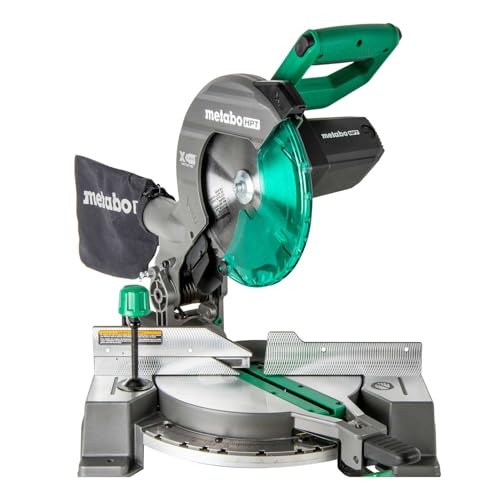
Metabo HPT C10FCG2
The cheapest saw here and the one most DIYers should buy: a 24 lb, 15-amp 10-inch compound saw that crosscuts the same lumber as DEWALT's $279 model.
Pros
- Lightest published weight in this group at 24 lb
- Crosscuts the same 2x6 at 90 degrees as the DEWALT DWS713 for $110 less
- Miters to 52 degrees left and right, past the usual 45-degree stop
- Backed by a 5-year Metabo HPT warranty
Cons
- Single bevel only - tilts left, so bevel cuts on the other end mean flipping the workpiece
- No slide, so it is capped at 2x6 crosscuts
- Capacity drops to 2x4 once you miter to 45 degrees, per Metabo HPT's own figure
At $169.00 as of October 2026 this is the cheapest saw here and the one most DIYers should actually buy. Metabo HPT publishes 24 lb, a 15-amp motor, 5,000 RPM, 0 to 45 degrees of left bevel, 0 to 52 degrees of miter left and right, and a 5-year warranty — and 24 lb is the lightest weight any maker on this page publishes.
Set it against the DWS713 and the arithmetic is uncomfortable for DEWALT: $279.00 minus $169.00 is $110.00 more for the same published 2x6 crosscut. What you give up is a slide and a second bevel direction — and at 45 degrees Metabo HPT's own figure drops to 2x4, where the DWS715 still takes a 2x6. The Metabo HPT C10FCG2 is where we would start.
Best fixed 10-inch: DEWALT DWS713

DEWALT DWS713
The reference fixed 10-inch: a stainless detent plate with 14 stops and a genuinely precise miter system. You are paying for repeatability, not capacity.
Pros
- Stainless-steel detent plate with 14 positive stops holds its settings
- Same 5,000 RPM as the Metabo and a 15-amp motor
- Bevels to 48 degrees left, past the usual 45-degree stop
- Ships with a 10-inch carbide-tipped blade, so it cuts on day one
Cons
- $110 more than the Metabo HPT for the same 2x6 crosscut capacity
- Single bevel, and no slide
- DEWALT publishes no weight, and its own page gives two different fence capacities
The reference fixed 10-inch, and what you are buying is repeatability rather than capacity. DEWALT publishes 2x6 at 90 degrees, 2x4 at 45, a 15-amp motor at 5,000 RPM, 0 to 48 degrees of left bevel, and a stainless-steel detent plate with 14 positive stops — settings you can return to without re-measuring.
At $279.00 as of October 2026 it is still $110.00 more than the Metabo HPT for identical published crosscut capacity, it is single bevel, and it does not slide. DEWALT publishes no weight for it, only calling the saw lightweight, and its own fence figures disagree with each other — see below.
The 12-inch step up: DEWALT DWS715

DEWALT DWS715
A 12-inch blade buys a taller cut, not a wider one: 2x8 at 90 degrees, and a 5-1/2 in. vertical fence. It is the saw to buy if you cut tall baseboard standing up.
Pros
- 5-1/2 in. vertical fence capacity handles tall baseboard upright
- 2x8 crosscut at 90 degrees without a slide
- Same 14-stop stainless detent plate as the DWS713
- DEWALT actually publishes its weight: 36 lb
Cons
- Spins at 4,000 RPM against the 10-inch DWS713's 5,000 - a bigger blade is a slower blade
- Crosscuts 2x8 while the $249 sliding SKIL does 2x12
- 12-inch blades cost noticeably more to replace than 10-inch
- 36 lb is not a saw you carry around casually
The saw that explains what a 12-inch blade is for. DEWALT publishes 2x8 at 90 degrees, 2x6 at 45, a tall sliding fence supporting 5-1/2 in. of base molding vertically, 36 lb, and 4,000 RPM from the same 15-amp motor as the 10-inch saws. If your project is a house full of tall baseboard cut standing against the fence, this is the pick — and the published weight is a courtesy its stablemates do not extend.
The case against it is the SKIL. At $299.99 as of October 2026 it costs $50.99 more than a saw that crosscuts 2x12 instead of 2x8. Its blade turns 1,000 RPM slower than the DWS713's, and 36 lb is not a tool you move casually.
Best for serious trim work: DEWALT DWS780

DEWALT DWS780
The saw almost no DIYer needs and every finish carpenter wants: 2x14 crosscuts, 7-1/2 in. nested crown, XPS shadow light and over 75% dust capture.
Pros
- 2x14 crosscut capacity at 90 degrees - more than twice the width the DWS713 can take
- 7-1/2 in. nested crown and 6-3/4 in. vertical base molding
- XPS shadow line casts a real blade shadow, needing no calibration
- Dust collection captures over 75% of dust, per DEWALT
Cons
- $649 - nearly four times the Metabo HPT, for capacity most DIY projects never reach
- Slowest blade here at 3,800 RPM
- DEWALT publishes neither a weight nor a bevel range for it
- Its published tool dimensions are plainly wrong, which is not a confidence builder
The saw almost no DIYer needs and most finish carpenters want. DEWALT publishes 2x14 at 90 degrees, 2x10 at 45, 6-3/4 in. of base molding vertically, 7-1/2 in. of nested crown, 3,800 RPM from a 15-amp motor, dust collection that "captures over 75% of dust generated," and the XPS LED cutline system that shadows the blade rather than projecting a laser. Its page also lists a blade wrench, material clamp and dust bag in the box, as Metabo HPT's does for the C10FCG2 (blade, vise assembly, dust bag and hex bar wrench).
Against the DWS713's 2x6 that is more than twice the width in real lumber: 5-1/2 in. against something over 13 in. Now the costs. At $649.00 as of October 2026 it is 3.84 times the Metabo HPT's price — we divided 649.00 by 169.00 to check — for capacity most DIY projects never reach. It is the slowest blade here, DEWALT publishes neither a weight nor a bevel range for it, and its published dimensions are wrong.
Read the spec sheet, not the headline
Capacity figures decide whether a saw can do your job. They are also the specs most often wrong or mismatched, and two of these five prove it.
1. DEWALT's own DWS780 page lists impossible dimensions. The tool dimensions given are 35 cm x 45 cm x 25 cm — about 13.8 x 17.7 x 9.8 in. A 12-inch sliding saw that crosscuts a 2x14 cannot fit in a box roughly 14 in. deep; the blade alone is 12 in. across, before the slide rails, motor, table and fence. The same figure is repeated verbatim as the first bullet of the Amazon listing, alongside a "1100 watt" rating that cannot describe this tool either, since 15 amps at 120 V is about 1,800 W. The point is not that a reseller copied a typo. It is that the error is on the manufacturer's page — the source we are all told to check against.
2. DEWALT's DWS713 page contradicts itself on the fence. The feature list says the vertical fence supports 4-1/4 in. of base molding; the overview on the same page claims 4-1/2 in. of crown nested vertically. We will not give you one number for that fence, because DEWALT gives two — and those two are not even the same measurement. Base molding stands flat against the fence; nested crown lies tipped back on its spring angle, measured on the diagonal.
The lesson is dull and useful. Check the maker's spec table, not the marketing bullet, then check that the two numbers you are comparing measure the same thing. We would rather tell you a spec is disputed than hand you a clean number we cannot stand behind.
Our verdict
Buy the Metabo HPT C10FCG2 at $169.00 as of October 2026 for your first miter saw. It crosscuts the same 2x6 as a saw costing $110.00 more, weighs 24 lb, and carries a 5-year warranty; for most home projects the rest of the money is better spent on a good blade.
Buy the SKIL MS6305-00 at $249.00 as of October 2026 if you want to stop thinking about capacity. The slide takes it to 2x12 — wider than the 12-inch DWS715 at $50.99 more — and the dual bevel stops you flipping boards. Buy the DWS715 only if you cut tall baseboard upright, and the DWS780 only if trim is your trade rather than your weekend.
What should not drive this decision is blade diameter. All five saws are 15-amp, the 12-inch models actually spin slower, and the widest cut on this page under $600 comes from a 10-inch saw with rails. For how a miter saw fits alongside everything else worth owning, start with our saw buying guide.
Frequently asked questions
What size miter saw is best for DIY?
Ten inches, for almost everyone. A 10-inch saw is cheaper, lighter and spins faster, and a sliding 10-inch like the SKIL MS6305-00 crosscuts 2x12 — wider than DEWALT's fixed 12-inch DWS715 manages at 2x8. Choose 12 inches only for the taller vertical fence: DEWALT rates the DWS715 to support 5-1/2 in. of base molding standing upright.
What is the best budget miter saw for DIY?
The Metabo HPT C10FCG2 at $169.00 as of October 2026. Metabo HPT publishes 24 lb, 15 amps, 5,000 RPM, 52 degrees of miter each way and a 5-year warranty. Its page lists a 2x6 crosscut at 90 degrees — the same capacity DEWALT publishes for its DWS713 at $279.00, or $110.00 more.
Do I need a sliding miter saw?
Only if you cut boards wider than about 5-1/2 in. A fixed 10-inch saw handles 2x4s, 2x6s and most trim laid flat. A slide roughly doubles that, but it needs clearance behind the saw so the tool will not sit against a wall, and the Power Tool Institute warns you must push a slider through the cut rather than pull it.
Is a 10-inch miter saw enough for baseboard?
Usually, if you cut it flat on the table — a 10-inch fixed saw clears a 5-1/2 in. board, and most one-piece baseboard is narrower than that. Cut it standing against the fence instead, or step up to tall base, and vertical fence capacity becomes the limit. That is the one job where a 12-inch saw earns the money.
About the Author
Cheryl Thompson
Cheryl Thompson is the tools editor at The DIY Tool Review. A lifelong fixer and self-confessed tool addict, she has spent years buying, borrowing and wearing out hand and power tools across home renovation, furniture building and everyday repairs. She writes hands-on, no-nonsense reviews to help fellow DIYers spend their money on the tools that actually last.