The Best Tool Chests for a Home Garage (2026)
Tool chests are sold on drawer count and total capacity. The number that decides whether one is still good in ten years is the per-drawer weight rating.

- Category
- Workshop & Storage
- Tools tested
- 5
- Read time
- 16 min
- Updated
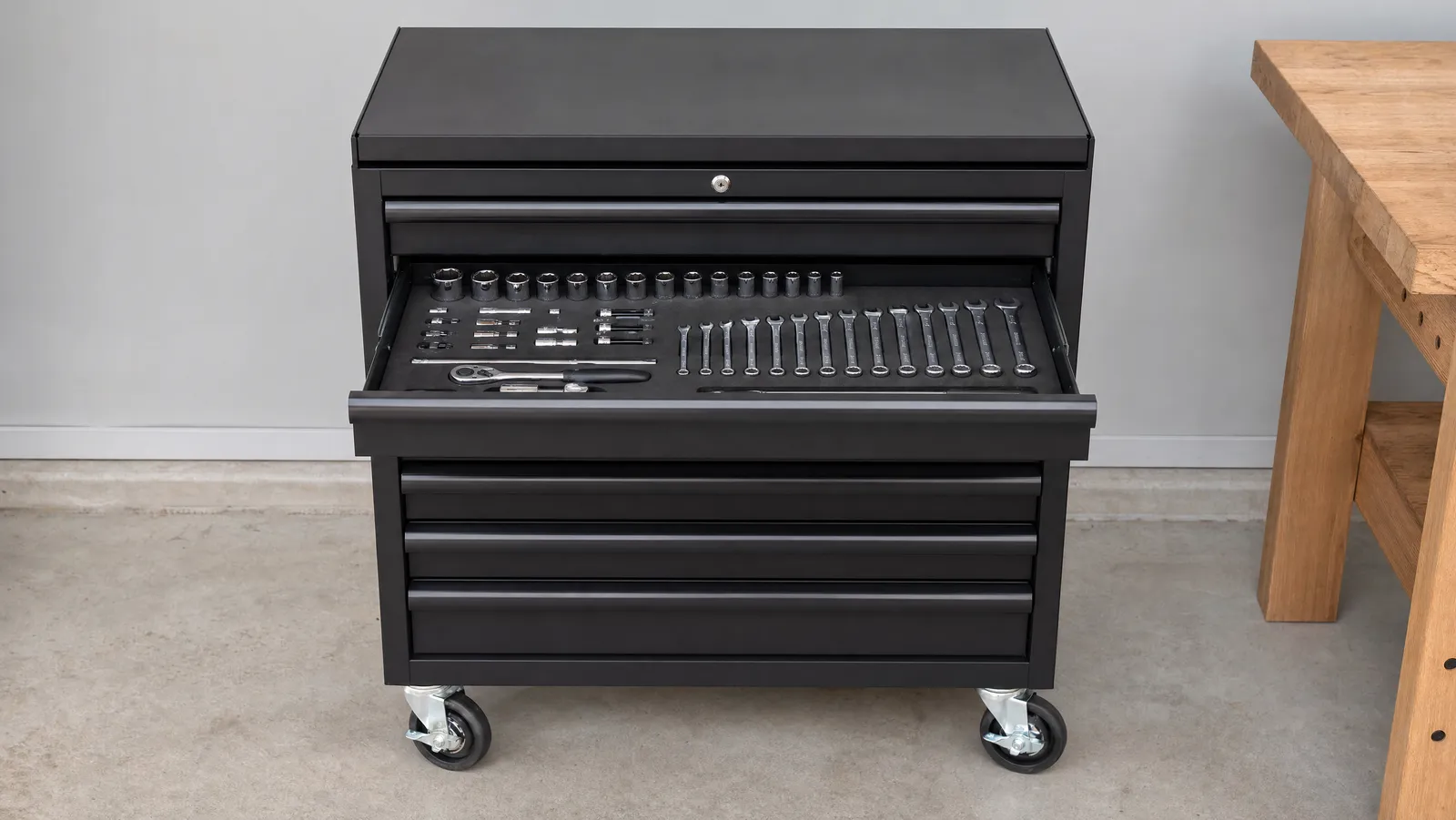
The best tool chest for a home garage, for most people, is the Craftsman 26 in. 5-drawer combo at $288.00 as of September 2026 — a top chest and a rolling cabinet in one carton, on full-extension ball-bearing slides that Craftsman rates at 30 lb per drawer. Buy on that per-drawer number, not on the drawer count.
Two things before you spend anything. Our garage tool storage guide argues for getting tools on the wall before you buy drawers, and we still think that is the right order. Then, when you do buy drawers, ignore the two numbers a tool chest is sold on. Drawer count and total capacity in cubic inches tell you almost nothing about whether a chest is still worth owning in ten years. The number that does is the weight rating on the slides under each drawer — and it varies by more than three times inside a single brand, on this very page.
How we picked
We have not tested these chests, and we are not going to pretend we have. Our picks come from published manufacturer specifications, current price and availability, and a view of what a homeowner actually drops into a drawer.
We also do not publish star ratings or review counts — our product data source does not supply them. Every performance figure below is the maker's own and we say whose: Craftsman lists, Winado quotes, Granper states. Prices are as of September 2026 and move constantly, so treat them as a snapshot rather than a promise.
The spec that actually matters: per-drawer weight rating
The clearest illustration comes from one brand, on this page.
Craftsman lists 30 lb full-extension ball-bearing slides on the 26 in. combo. Craftsman lists full-extension soft-close slides rated 100 lb per drawer on the 41 in. cabinet. Same maker, same product family, more than three times the rating. Nothing in the headline specs tells you that: one has five drawers, the other has ten, and both say full extension.
It helps to know what a slide rating rates. According to Accuride, a slide manufacturer, its slides are rated for "the dynamic (cycled) load that a pair of slides mounted 450mm apart can achieve without failure", and the static, resting capacity of each model is at least twice that figure — so a drawer sitting still has margin that the same drawer being yanked open does not.
Two consequences follow, and the Firgelli drawer slide guide spells both out. Ratings are quoted per pair, with each slide carrying roughly half the load. And exceeding the rating, even occasionally, can cause permanent deformation of the slide members, damage to the ball bearings or fastener failure — damage you will not see at the time, which shortens the life of the slide and raises the chance of a sudden failure later. Firgelli also notes that manufacturers typically rate slides at full extension — the worst case — and advises designing to no more than 70-80 percent of the rated capacity rather than planning to use every pound of it.
That is how a cheap chest dies. Not in one dramatic collapse, but as a drawer that grinds, then drops at the front, then will not close.
So work out what your heaviest drawer weighs. Two anchors to calibrate against:
- Hand tools are heavier than they feel. We could not find a weight for the Craftsman 230-piece mechanics tool set (70190) from Craftsman itself, and the retail listings we did find put it somewhere in the region of 21-23 lb. Tip one set into a single drawer and you are at roughly two-thirds to three-quarters of a 30 lb rating before you add a torque wrench, a breaker bar or a second ratchet.
- Cordless tools are lighter than they feel. TechGearLab measured BLACK+DECKER's 20V MAX drill/driver at 2.6 lb, and Pro Tool Reviews puts DEWALT's Atomic compact drill/driver (DCD708) at 2.4 lb bare and 3.1 lb with a 1.3 Ah battery. Three cordless tools with batteries on them is around 10 lb — comfortable in any drawer here.
Sockets, wrenches, clamps, a bench vise, cast-iron planes and anything in a hard case are what push a drawer over its rating. A drawer of cordless kit rarely does.
Steel gauge, and why the numbers run backwards
Craftsman lists 20-24 gauge steel for the 26 in. combo and 18-20 gauge I-frame construction for the 41 in. cabinet. Read those as scores out of 25 and you will get the comparison exactly backwards. A lower gauge number is thicker steel.
According to Metal Supermarkets' sheet metal gauge chart, mild steel measures 0.0478 in at 18 gauge, 0.0359 in at 20 gauge, 0.0299 in at 22 gauge and 0.0239 in at 24 gauge — thickness falls as the number climbs, and Metal Supermarkets notes that the gauge number itself holds no relationship to the actual measurement. Divide the ends of that range and the arithmetic is tidy: 0.0478 divided by 0.0239 is exactly 2. The thickest steel in the 41 in. cabinet is twice the thickness of the thinnest steel in the 26 in. combo.
Both chests are quoted as a range, which we read as a chest not being one sheet of steel: heavier material where load and impact are, lighter material on panels that only have to look flat. Craftsman publishes the range rather than a panel-by-panel breakdown, so read it as a band, not a guarantee about any one surface.
A rolling tool chest for a garage: what the casters buy you
Wheels are the whole reason a rolling tool chest for a garage beats a static cabinet, and they are also where the load numbers get confusing.
Craftsman lists a 300 lb load rating for the 26 in. combo on 3 in. x 1 in. casters, two of which lock and swivel. We read that as the loaded assembly on its wheels rather than a per-drawer figure — it answers a different question from the 30 lb slide rating. Granper lists five casters with two locking. The Winado has no wheels at all, just handles on both sides. The VERSASTACK tote rolls on its own wheels.
Small hard casters and a garage slab are not natural friends: expansion joints, a floor drain and the slight fall many garage floors are poured with all fight a 3 in. wheel. If you will genuinely move tools around, larger wheels or a tote beat a big cabinet you shove twice a year.
And lock the casters before you open a loaded drawer. A full-extension slide puts its load a drawer's depth outside the cabinet footprint, which is exactly the condition the Firgelli guide says the rating is defined at, and exactly the moment a chest on unlocked wheels decides to roll.
Best overall: Craftsman 26 in. 5-drawer rolling combo
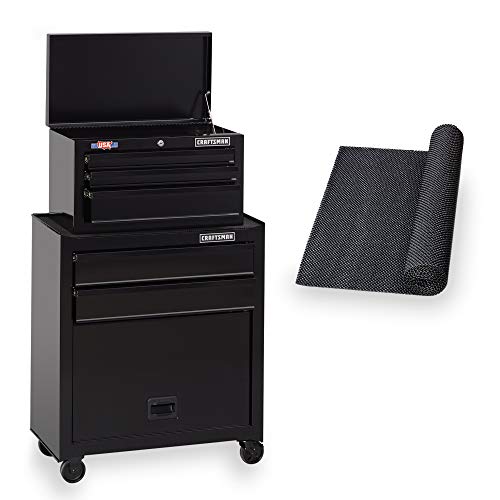
Craftsman CMST82763BK 26 in.
A chest-and-cabinet pair sold in one carton, with the chest shipped inside the cabinet. Craftsman lists 20-24 gauge steel, 30 lb full-extension ball-bearing drawer slides, a 300 lb load rating on 3 in. x 1 in. casters (two lock and swivel), and 10,227 cubic inches of storage. Made in USA with global materials.
Pros
- Chest and rolling cabinet in one purchase, so the working height is right from day one
- Full-extension ball-bearing slides rated 30 lb per drawer
- 300 lb load rating with two locking swivel casters
- 10,227 cubic inches of storage, per Craftsman
Cons
- 20-24 gauge steel is lighter than the 18-20 gauge on Craftsman own bigger chests
- 30 lb per drawer is modest if you store cast-iron hand planes or big socket sets
- At 26 in. wide it still needs real floor space
A combo is two products. The CMST82763BK is a top chest and a rolling cabinet sold in one carton, with the chest shipped inside the cabinet — which is why it is not really competing with a single box at half the price. You get a working height that is right from the first day rather than a five-drawer unit at knee level.
Craftsman lists 30 lb full-extension ball-bearing slides, 20-24 gauge steel, a 300 lb load rating on 3 in. x 1 in. casters with two locking swivels, and 10,227 cubic inches of storage. It is made in the USA with global materials.
The honest limits are on that same spec sheet. The 30 lb per-drawer rating is the lowest published figure among our picks, and the steel is lighter than the 18-20 gauge Craftsman puts in its own bigger cabinets. If your heaviest drawer is a full mechanics set, you are close to the limit on day one. If it is drills, drivers, tapes and screwdrivers, you are nowhere near it.
At $288.00 as of September 2026 it is our pick because the two-box format solves the problem people actually have: nowhere at waist height to put anything down.
Best value: Granper 5-drawer rolling tool box

Granper 5-Drawer
The value route to a rolling chest. Granper lists cold-rolled steel with three layers of powder coating, five drawers over an enlarged bottom cabinet for drills and larger tools, five casters with two locking, and EVA anti-slip mats in every drawer. Ships mostly assembled - wheels and side hooks are the only fitting.
Pros
- Well under half the price of the mainstream branded combo
- Bottom cabinet swallows drills and larger tools that will not lie flat in a drawer
- EVA mats in every drawer come fitted, not sold separately
- Arrives mostly assembled
Cons
- Granper does not publish a per-drawer weight rating, so compare it on nothing but its own description
- An unfamiliar brand with no dealer network behind it
- Every figure here is the maker own
At $125.99 as of September 2026, list price $159.99, this is about 44 percent of the $288.00 Craftsman combo - well under half, and the layout is arguably smarter for DIY: five drawers over an enlarged bottom cabinet that will take drills, a circular saw and the things that refuse to lie flat in a shallow drawer. Granper lists cold-rolled steel with three layers of powder coating, five casters with two locking, and EVA anti-slip mats fitted in every drawer rather than sold separately. It ships mostly assembled; wheels and side hooks are the only fitting.
The catch is what Granper does not say. Its listing copy carries no weight figure at all — not per drawer, not total. That is the single clearest difference between the $126 chest and the $288 one, and it is a difference in what the maker is willing to commit to in writing. Craftsman will put 30 lb on paper. Granper puts nothing on paper, so you have no number to check a heavy drawer against, and no number to hold anyone to.
Buy it with your eyes open: an unfamiliar brand, no dealer network, every figure the maker's own.
Best big chest: Craftsman 41 in. 10-drawer rolling cabinet
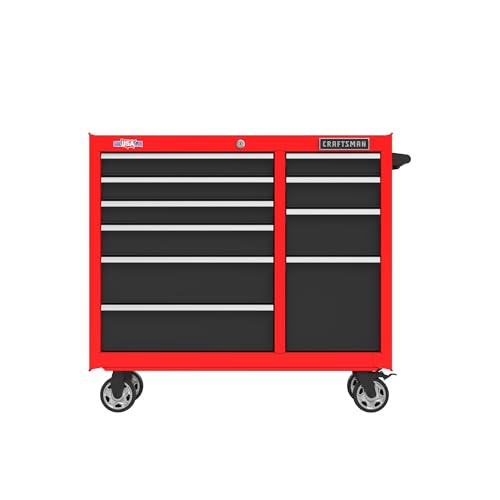
Craftsman CMST341102RB 41 in.
The step up to a proper shop cabinet. Craftsman lists 18-20 gauge steel I-frame construction, full-extension soft-close slides rated 100 lb per drawer, an embossed top mat, and an internal locking system with an over-mold key. Made in Sedalia, Missouri.
Pros
- 100 lb per drawer - more than three times the rating of the 26 in. combo
- 18-20 gauge steel I-frame is a genuinely heavier build
- Soft-close full-extension slides on all ten drawers
- Internal locking system secures every drawer at once
Cons
- Costs more than most of the tools a beginner would put in it
- 41 in. wide - this is a permanent floor commitment
- Heavy enough that you want it in its final position before you load it
This is the other half of the argument. Craftsman lists 18-20 gauge steel I-frame construction, full-extension soft-close slides rated 100 lb per drawer, an embossed top mat, and an internal locking system with an over-mold key that secures every drawer at once. It is made in Sedalia, Missouri.
A 100 lb rating changes what you can store without thinking about it: the mechanics set, the clamps, the impact sockets and a breaker bar can share a drawer and still sit inside the number. Soft-close is not a luxury either — it stops a loaded drawer being slammed shut, which is the kind of shock loading the Firgelli guide warns about.
The catch is the price against the contents. At $814.23 as of September 2026 this cabinet costs more than the entire tool collection of most people reading this; a beginner's budget tool kit covers the basics for a small fraction of it. Do not buy an $814 cabinet for eleven tools. At 41 in. wide it is also a permanent floor commitment, not something you reposition on a whim.
Best benchtop chest: Winado 24 in. 5-drawer

Winado 24 in. 5-Drawer
A benchtop chest for people with no floor to spare. Winado lists five drawers plus a top storage tray, drawers 20.94 in. long and 8.81 in. deep, four drawers 1.57 in. high with a 3.30 in. fifth, a 330 lb maximum load capacity, ball-bearing slides, lined drawers, carrying handles on both sides and a steel safety lock.
Pros
- Sits on a bench or a shelf - no floor footprint at all
- Handles on both sides, so it moves to the job
- 330 lb maximum load capacity, per Winado
- Safety lock stops drawers sliding out while you carry it
Cons
- Four of the five drawers are only 1.57 in. deep - fine for spanners, useless for a drill
- No wheels, and a loaded steel box is heavy to lift
- 330 lb is the total, not a per-drawer figure
If the floor is spoken for — and in a single garage with a car in it, the floor usually is — a benchtop chest is the honest answer. At $104.49 as of September 2026, list price $109.99, the Winado sits on a bench or a shelf and takes no floor at all. Winado lists five drawers plus a top tray, ball-bearing slides, lined drawers, handles on both sides and a steel safety lock that stops drawers sliding out as you carry it.
Read the dimensions carefully, because they decide what fits. Winado quotes drawers 20.94 in. long and 8.81 in. deep, with four drawers 1.57 in. high and a fifth at 3.30 in. An inch and a half of height is plenty for spanners, sockets, files and bits, and useless for a drill.
The 330 lb figure is a maximum load capacity for the whole box, not a per-drawer rating. Winado's listing gives no per-drawer number, so do not divide 330 by five and call it 66 lb a drawer — that is not what the figure means. And with no wheels, a loaded steel box is a genuinely awkward lift.
Best for moving tools around: Craftsman VERSASTACK 30-gallon

Craftsman VERSASTACK 30 Gal
Not a drawer chest at all - a 30-gallon rolling tote with a half-lid that opens without unstacking whatever is on top. Craftsman lists an IP54 dust and water resistance rating on both the chest lid and the half-lid, rust-resistant metal latches and hinges, a padlock eye, ribs for dividers, and compatibility with the VERSASTACK system.
Pros
- Cheapest way into a rolling storage system
- Half-lid reaches the contents without removing stacked boxes above
- IP54 rated for dust and water, per Craftsman - it can live in an unheated garage
- Padlock eye for securing tools
Cons
- One big bin, not drawers - small tools end up at the bottom
- Only earns its keep if you buy into VERSASTACK boxes on top
- IP54 is a dust and splash rating, not a seal - it is not waterproof storage
This one has no drawers. The CMST17870 is a 30-gallon rolling tote with a half-lid that opens without unstacking whatever is sitting on top of it. We include it deliberately: for a lot of people the real problem is not organizing the garage, it is carrying tools to the far end of the yard.
Craftsman lists an IP54 dust and water resistance rating on both the chest lid and the half-lid, rust-resistant metal latches and hinges, a padlock eye, ribs for dividers, and compatibility with the rest of the VERSASTACK system. According to Keystone Compliance, an IP testing laboratory, IP54 means dust-protected — a limited amount of dust may enter, but not enough to interfere with operation — and protected against splashing water from any direction. It does not mean sealed: IP54 is not rated against jets or immersion, and says nothing about the condensation an unheated garage produces when the temperature swings.
The obvious limitation is that one 30-gallon bin sorts nothing. Small tools migrate to the bottom. At $79.98 as of September 2026, list price $89.98, it is the cheapest way into a rolling system, and it earns its keep mainly if you buy into stacking VERSASTACK boxes above it.
Do you need a chest at all?
For a lot of homeowners the best garage tool organizer is not a chest. A drawer is the right home for a tool you reach for monthly, for anything with an edge, and for anything that comes in a set you would notice losing a piece from. It is an expensive and slow home for the six tools you use every week.
Before you commit three or four square feet of floor, compare a chest with pegboard, French cleat and slatwall — wall systems we cover separately. A wall costs less per tool stored and shows you what you own at a glance. Our order of operations is wall first, then a chest for what the wall cannot hold safely or tidily.
What we would buy
Drag to compare all 5 →
Under $130. The Granper at $125.99 if you want wheels and a bottom cabinet, the Winado at $104.49 if you want the floor clear. Neither publishes a per-drawer rating, so keep the heavy sets out or accept the risk knowingly.
Around $288. The Craftsman 26 in. combo. Two boxes, a published 30 lb slide rating and a 300 lb caster rating, and a brand with parts and dealers behind it.
Over $800, and only with the tools to justify it. The Craftsman 41 in. cabinet, for a garage where the tools are a serious collection and the cabinet will be the last one you buy.
Garage size decides more of this than budget does. Alan's Factory Outlet and Angi both put the average one-car garage at about 12 ft by 20 ft — 240 square feet. For two cars the commonly quoted figures run from 20 ft by 20 ft, which Angi calls the practical minimum, up to 24 ft by 24 ft as the comfortable size. A 41 in. cabinet is about 3.4 ft of wall: a serious fraction of a 12 ft bay with a car and a door in it, and invisible in a 24 ft by 24 ft garage. In the single bay, buy the benchtop chest or the 26 in. combo and put the difference into the wall.
Common questions
How much weight can a tool chest drawer hold?
Whatever the maker publishes for the slides, and not a pound more as a planning assumption. Craftsman rates the 26 in. combo at 30 lb per drawer and the 41 in. cabinet at 100 lb. Accuride, a slide manufacturer, defines its own ratings as the dynamic load a pair of slides can take without failure, so the figure already accounts for both sides of the drawer.
Is a 30 lb per-drawer rating enough?
For most homeowners, yes. Three cordless tools with batteries is around 10 lb, using measured weights from Pro Tool Reviews and TechGearLab. A 230-piece mechanics set is a different matter: retail listings for the Craftsman 70190 put it in the region of 21-23 lb, which uses up most of a 30 lb drawer on its own. If you own one of those sets, or serious cast iron, buy the higher rating.
Does steel gauge matter more than drawer count?
It matters more than it looks, and the numbers mislead. Lower gauge is thicker: per the Metal Supermarkets chart, 18 gauge mild steel is 0.0478 in and 24 gauge is 0.0239 in, exactly half. Drawer count tells you how finely you can sort, which is a preference. Gauge and slide rating tell you how long the thing survives being used.
Will a tool chest rust in an unheated garage?
We have no test data on any of these finishes, so we will not promise you a year figure. What we can say is what the specs cover and what they do not: Craftsman lists IP54 on the VERSASTACK tote, and per Keystone Compliance IP54 covers dust and splashing water only. Granper lists three layers of powder coating. Neither is a claim about humidity or condensation, which is what actually rusts tools in a garage.
The short version
Ignore drawer count. Find the per-drawer weight rating, weigh your heaviest armful of tools, and buy a chest whose published number clears it. The Craftsman 26 in. combo at $288.00 as of September 2026 is the one we would buy first, because Craftsman publishes 30 lb a drawer, 300 lb on the casters, and puts two boxes in the carton. Step up to the 41 in. cabinet at $814.23 only if your tools genuinely need 100 lb drawers, and treat the value picks as what they are: good value with no weight rating behind them.
And before any of it, put the weekly tools on the wall. That argument, and the rest of the system a chest fits into, is in our complete garage tool storage guide.
About the Author
Cheryl Thompson
Cheryl Thompson is the tools editor at The DIY Tool Review. A lifelong fixer and self-confessed tool addict, she has spent years buying, borrowing and wearing out hand and power tools across home renovation, furniture building and everyday repairs. She writes hands-on, no-nonsense reviews to help fellow DIYers spend their money on the tools that actually last.