8 Must-Have Cordless Power Tools for DIY Homeowners
The must-have power tools for DIY, in the order you should actually buy them — starting with the two every homeowner needs and ending with the three most people can skip for years.

- Category
- Power Tools
- Tools tested
- 6
- Read time
- 14 min
- Updated
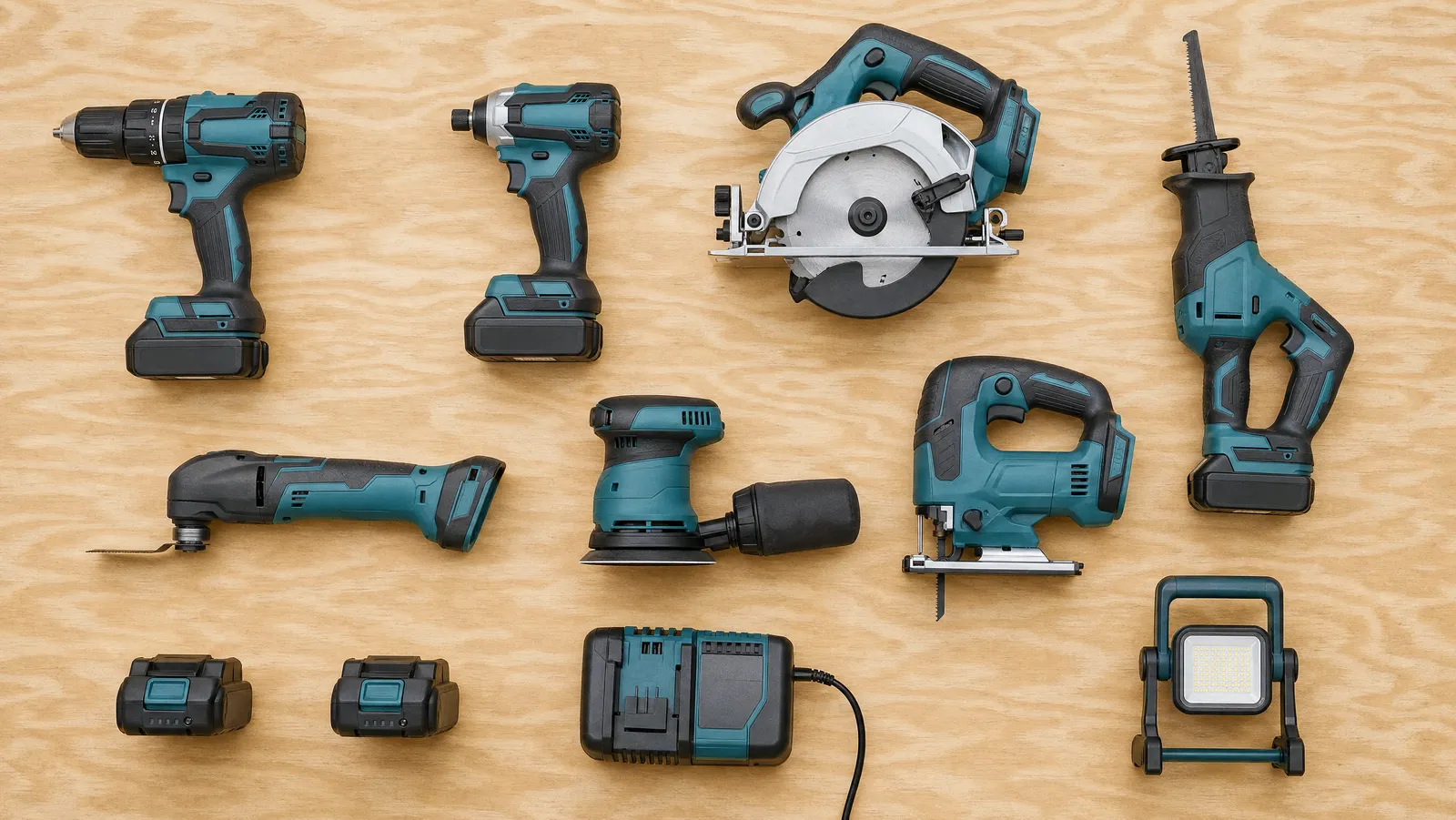
The must-have power tools for DIY, in the order a homeowner should actually buy them, are a drill/driver, an impact driver, a circular saw, a reciprocating saw, an oscillating multi-tool, a random-orbit sander, a jigsaw and a work light. That is the entire list. Most people never need more than the first two or three.
This guide is organized by tool type rather than by product, because the useful question is not which drill has the best packaging — it is what to own, and in what order. Tools one and two belong in every house. Tools three to five are for people who build and remodel. Tools six to eight are the ones you buy the week a job demands them. For the wider view of every category worth owning, our roundup of cordless power tools every DIYer should own covers the landscape; here, we are strictly ordering the shopping list.
Buy in this order
Work down the table. Rows one and two handle the overwhelming majority of household jobs — hanging shelves, assembling furniture, mounting a TV, replacing a deck board. Rows three to five only pay for themselves once you are cutting material, not just fastening it. Rows six to eight stay optional for years.
The pattern underneath it: fasten first, cut second, finish last. Most beginners reverse that, buying a saw before they own a driver they can trust.
One battery platform, eight tools
Choose the battery system before you choose the tool. Cordless batteries are brand-specific by design, so eight tools bought on eight platforms means eight chargers, eight incompatible packs and no shared spares. Eight tools bought on one platform means two or three batteries you rotate through everything. If the amp-hour and voltage jargon is new, our explainer on cordless power tool batteries explained unpacks it in plain English.
The choice also changes what tools cost. Once you are on a platform you can buy bare tools — the same saw sold without a battery or charger, for noticeably less. Two picks below are bare tools for that reason. Buy one on a brand you do not already own and you will open a box containing a tool you cannot switch on.
There is no universally best platform for a homeowner. Ryobi ONE+ is generally the cheapest route to a lot of tools; DeWalt 20V MAX and Makita LXT generally cost more per tool. Pick one and stop.
The eight tools
1. Drill/driver — the one tool everybody needs
If you own one power tool, own this one. A drill/driver bores holes and drives screws, and its adjustable clutch — the numbered collar behind the chuck — lets it stop twisting before it strips a screw head or sinks a fastener through cabinet plywood. That clutch is the reason a drill still belongs in your hands for delicate work even after you buy an impact driver, and it is the main practical difference between the two. If you want the longer version of that comparison, we cover the difference between an impact driver and a drill separately.
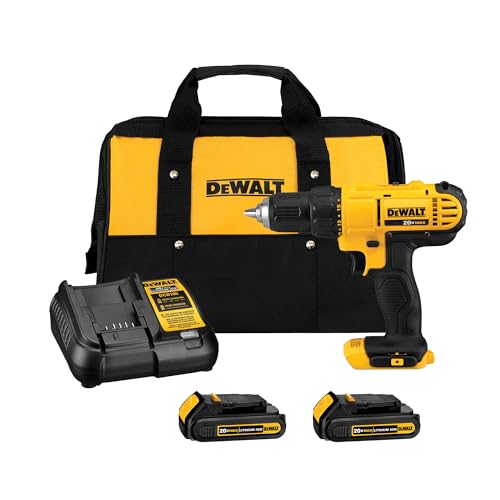
DeWalt DCD771C2
A compact two-speed 20V MAX drill/driver rated at 300 unit watts out, with a 1/2-inch ratcheting chuck, two 1.3Ah batteries, a charger and a contractor bag.
Pros
- Two speeds (0-450 and 1,500 rpm) cover both driving and drilling
- 1/2-inch single-sleeve ratcheting chuck grips bits tightly
- Complete kit: two batteries, charger and contractor bag included
Cons
- DEWALT lists it as unsuitable for drilling concrete or masonry
- The 1.3Ah batteries are small, so plan on short sessions or a spare
DeWalt's DCD771C2 is the default recommendation for a reason: a complete kit at $99.00 as of July 2026, with two 1.3Ah batteries, a charger and a bag. The two-speed transmission gives you 0-450 rpm for driving and 1,500 rpm for drilling, and the 1/2-inch single-sleeve ratcheting chuck takes larger bits than the 3/8-inch chucks on budget drills. The honest caveat is capacity in both senses: DeWalt lists this drill as unsuitable for drilling concrete or masonry, and those 1.3Ah packs are small.
2. Impact driver — for anything longer than 2 inches
An impact driver is not a second drill. It has no chuck and no clutch — just a 1/4-inch hex socket and a mechanism that adds rotational blows when the fastener gets tight. That is why it sinks a 3-inch deck screw or a lag bolt that would stall a drill and twist your wrist. The trade is control: it is loud, it will happily snap a small screw, and it cannot hold a round-shank drill bit. Our roundup of the best cordless impact drivers for DIY goes deeper on picking one.

Ryobi P235AK1
A 1/4-inch ONE+ 18V impact driver sold as a kit with a 1.5Ah battery and charger, which makes it a complete, low-cost entry onto the ONE+ platform.
Pros
- Ships as a kit with a 1.5Ah battery and charger, not as a bare tool
- Runs on the RYOBI ONE+ 18V battery system
- 1/4-inch drive, the standard size for impact-rated bits
Cons
- The listing publishes no torque or speed figures
- A single 1.5Ah battery is the smallest pack Ryobi bundles
Ryobi's P235AK1 is the cheap, sensible way to add one, at $79.99 as of July 2026 including a 1.5Ah battery and charger — a complete tool, not a bare one, and it puts you on the ONE+ platform. Be aware of what we cannot tell you: the listing publishes no torque, rpm or impacts-per-minute figures, so we will not quote any. If exact numbers matter, buy from a listing that states them.
3. Circular saw — the first real cutting tool
This is the tool that turns a pile of lumber into a project. A circular saw makes fast, straight cuts through boards and sheet goods, and according to Bosch Professional it is the tool suited to cutting quickly in a straight line rather than around a curve — which is exactly the division of labor between it and the jigsaw further down.

Ryobi ONE+ HP Circular Saw
A brushless 7-1/4-inch ONE+ HP circular saw spinning at 5,000 RPM, cutting 2-9/16 inches deep at 0 degrees — sold as a bare tool with no battery or charger.
Pros
- Brushless motor drives the 7-1/4-inch blade at 5,000 RPM
- Cuts 2-9/16 in. at 0 degrees and 1-13/16 in. at 45 degrees
- Bevel detents at 0, 15, 22-1/2, 30, 45 and 56 degrees
Cons
- Tool only — no battery and no charger in the box
- RYOBI's 3X faster cutting and 370 cuts per charge claims cite no baseline
Ryobi's ONE+ HP model is brushless, spins its 7-1/4-inch blade at 5,000 RPM, and cuts 2-9/16 inches deep at 0 degrees and 1-13/16 inches at 45 degrees — through nominal 2x lumber in one pass. Bevel detents at 0, 15, 22-1/2, 30, 45 and 56 degrees make angle changes repeatable, and there is an LED, a dust port adapter and a rafter hook. Two caveats. This is a tool-only listing: no battery, no charger, so the $133.99 price as of July 2026 is the real cost only if you already own ONE+ packs. And Ryobi's "3X faster cutting" and "up to 370 cuts per charge" figures are manufacturer claims with no stated baseline.
4. Reciprocating saw — for demolition and rough cuts
A reciprocating saw is the least precise tool here and the most satisfying. It is a blade on a piston, and its job is removal: cutting out a rotten sill, pruning a branch, slicing nail-embedded framing, taking a rusted bolt off a fence post. You buy it the first time you need to take something apart rather than put something together — and then it sits idle until the next demolition day, which is exactly why it ranks fourth and not second.
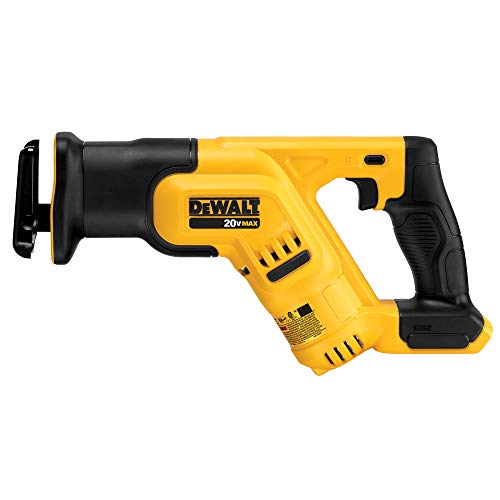
DeWalt DCS387B
A 14-inch compact 20V MAX reciprocating saw with a 1-1/8-inch stroke and 0-2,900 spm variable speed, built to fit between studs. Bare tool only.
Pros
- 14 inches long, so it fits between studs and into tight cavities
- 4-position blade clamp with tool-free blade changes
- Variable speed to 2,900 spm, plus a pivoting shoe and LED
Cons
- Bare tool — no battery and no charger included
- The compact body trades capacity for tight-space access
DeWalt's DCS387B is the compact one: 14 inches end to end, so it fits between studs and inside cabinets where a full-size saw will not go. The 1-1/8-inch stroke and 0-2,900 spm variable-speed trigger give you control over the cut, the 4-position blade clamp allows flush cutting, and blade changes are tool-free. Same warning as the circular saw: this is a bare tool — no battery, no charger — so $123.39 as of July 2026 assumes you are already on DeWalt 20V MAX. The compact body also trades capacity for that tight-space access.
5. Oscillating multi-tool — the problem solver
The oscillating multi-tool vibrates a blade side to side through a tiny arc, which sounds unimpressive until you need to cut a doorjamb flush to the floor for new flooring, plunge a rectangle into drywall, scrape old adhesive, or trim a pipe in a space too tight for anything else. It is the tool you buy after the job that made you wish you owned one. It is slow and its blades are expensive — but it does jobs no other tool can do at all.

DeWalt DCS356D1
A brushless three-speed 20V MAX XR multi-tool with wrench-free blade changes and a universal accessory adapter, supplied with a battery and charger.
Pros
- Brushless motor, which DEWALT says runs up to 57% longer than brushed
- Quick-Change system swaps blades and pads without wrenches
- Universal adapter fits most other brands of oscillating accessory
Cons
- Ships with a single battery, so there is no spare to swap in
- Blades and sanding pads are consumables you will keep rebuying
DeWalt's DCS356D1 comes with a battery and charger at $116.86 as of July 2026, so it is a complete purchase rather than a bare one. It is brushless, and DeWalt says the brushless motor delivers up to 57% more run time over brushed. Three speed settings plus a dual-grip variable-speed trigger cover everything from delicate scraping to fast cutting, and the Quick-Change system swaps blades without wrenches — a real convenience on a tool whose accessories wear out fast. The universal adapter fits most other brands of accessory. The kit includes only one battery, though.
6. Random-orbit sander — for finish work, not shaping
A random-orbit sander spins its disc while also moving it in a small orbit, so it does not leave the circular scratch pattern a plain rotary sander does. That makes it the right tool for preparing surfaces for paint or finish: doors, tabletops, deck rails, filled drywall patches. It is not a shaping tool and it is not fast at stock removal.
We are not naming a specific cordless model here, and that is deliberate. Sanding is one of the few DIY jobs that runs continuously for long stretches, which drains a battery faster than intermittent drilling or cutting does, and corded sanders remain cheap and light. If you already own a large battery, a cordless sander is a real convenience outdoors and on ladders. If you do not, this is the one tool here where staying corded costs you nothing.
7. Jigsaw — for curves and cutouts
The jigsaw is the circular saw's opposite number. According to Bosch Professional, jigsaws are the tool for cutting circles, curves and intricate shapes, and for making holes to fit around pipes and obstructions — work a circular saw physically cannot do. Cutting a sink opening, rounding a shelf corner, notching a board around a newel post: that is jigsaw territory.
Again, no specific pick. Most homeowners find they need a jigsaw only occasionally, and a jigsaw is only as good as its blade — a fresh blade in a modest saw beats a dull blade in an expensive one. Buy the cheapest one on your platform, spend the savings on a blade assortment for wood and metal, and accept that its cuts will need sanding afterwards. If you have to choose between the two saws, buy the circular saw first: straight cuts are far more common than curved ones.
8. Work light — the cheapest upgrade you will ever make
Under a sink, in an attic, in a garage at 6pm in December — the thing that most improves your work is often just being able to see. A cordless area light runs off the batteries you already own, stands or hooks where you need it, and costs a fraction of anything else here. It ranks last only because you can improvise it with a headlamp.
No pick here either, for a simple reason: the combo kit in the next section already includes an LED worklight, so buying that kit gets you tools one through five and the light in one purchase. If you assemble piece by piece instead, add the light on whichever platform you settled on.
Or buy five of them in one box
If that list reads like a lot of separate decisions, there is a shortcut. A combo kit bundles the tools, batteries and charger, generally for less than buying the same pieces one at a time, and it guarantees everything lands on one platform. We compare the field in our guide to the best cordless power tool combo kits for beginners.

Ryobi ONE+ P1819
Six ONE+ tools — drill/driver, impact driver, reciprocating saw, circular saw, multi-tool and an LED worklight — with 4.0Ah and 1.5Ah batteries, charger and bag.
Pros
- Covers five of the eight tool types here, plus the work light
- Two batteries (4.0Ah and 1.5Ah), charger, bag and accessories included
- RYOBI says over 125 ONE+ tools share the same 18V battery
Cons
- No random-orbit sander and no jigsaw in the box
- Consumer-grade tools rather than jobsite-duty ones
Ryobi's P1819 maps closely onto this article. It covers tool types one through five — drill/driver, impact driver, reciprocating saw, circular saw and multi-tool — plus the LED worklight from position eight, in one box with a 4.0Ah battery, a 1.5Ah battery, a charger, a bag and accessories, at $284.00 as of July 2026 against a $299.00 list price. Ryobi says over 125 ONE+ tools run on the same 18V battery, which is the real argument for the platform.
Be clear-eyed about what it is not. There is no random-orbit sander and no jigsaw in the box, so tools six and seven remain separate purchases, and these are consumer-grade tools rather than jobsite-duty ones. But if you want six of the eight tool types in one purchase, on one battery, this is the shortest route there.
What you don't need yet
Four tools show up constantly in DIY videos and belong on almost nobody's first list.
A table saw is a shop tool: it needs floor space, dust management and real technique, and a circular saw with a straightedge clamped to the work makes the same cut. A router is for edge profiles, dadoes and joinery — a woodworking tool, not a home-repair one. An angle grinder cuts and grinds metal and masonry, a job most homeowners face once every few years. And a nail gun only earns its keep when you are installing trim or framing by the hundred; below that, screws are cheaper and reversible.
None of these are bad tools — they are simply tools to buy when a project demands them. Buying ahead is how garages fill with equipment that never gets used.
A note on safety
Cordless tools feel domestic in a way corded ones do not, and that is exactly the trap.
Beyond that: read the manual, support your workpiece so it cannot pinch the blade, and keep both hands where the blade is not.
Buy in this order, buy on one platform, and be honest about which projects you actually take on. For the wider picture of every cordless category worth owning, read our complete guide to cordless power tools next.
Frequently asked questions
What's the first power tool I should buy?
A drill/driver, without qualification. It bores holes and drives screws, and its adjustable clutch keeps it from stripping heads or over-sinking fasteners. Buy it as a kit with batteries and a charger rather than as a bare tool — that first purchase is really you choosing a battery platform you will live with for years.
Do I need a circular saw if I have a jigsaw?
Yes — and buy the circular saw first. According to Bosch Professional, a circular saw is suited to cutting quickly in a straight line while a jigsaw handles curves and intricate shapes. Straight cuts account for most DIY cutting, and a jigsaw makes them slowly and rarely dead straight.
Are cordless tools powerful enough for a homeowner?
For virtually everything a homeowner does, yes. Modern 18V and 20V MAX platforms handle framing, decks, remodeling and repairs. Brushless motors help — DeWalt says the brushless motor in its multi-tool delivers up to 57% more run time over brushed. The real limit at home is battery capacity on long sessions, not raw power.
How many batteries do I actually need?
Two is the practical minimum — one in the tool, one on the charger. Most homeowners are well served by one small pack for drilling and driving plus one larger pack for saws and sanding, which drain faster. A third only makes sense once your days are long enough that two cannot keep up.
About the Author
Cheryl Thompson
Cheryl Thompson is the tools editor at The DIY Tool Review. A lifelong fixer and self-confessed tool addict, she has spent years buying, borrowing and wearing out hand and power tools across home renovation, furniture building and everyday repairs. She writes hands-on, no-nonsense reviews to help fellow DIYers spend their money on the tools that actually last.