The Best Finish Nailers for Trim and Baseboard (2026)
Four of these five listings publish a nail range, and all four top out at 2-1/2 in. — so the maximum tells you nothing. The minimum is the spec that decides whether a gun can fasten shoe molding.

- Category
- Nailers & Fastening
- Tools tested
- 5
- Read time
- 15 min
- Updated
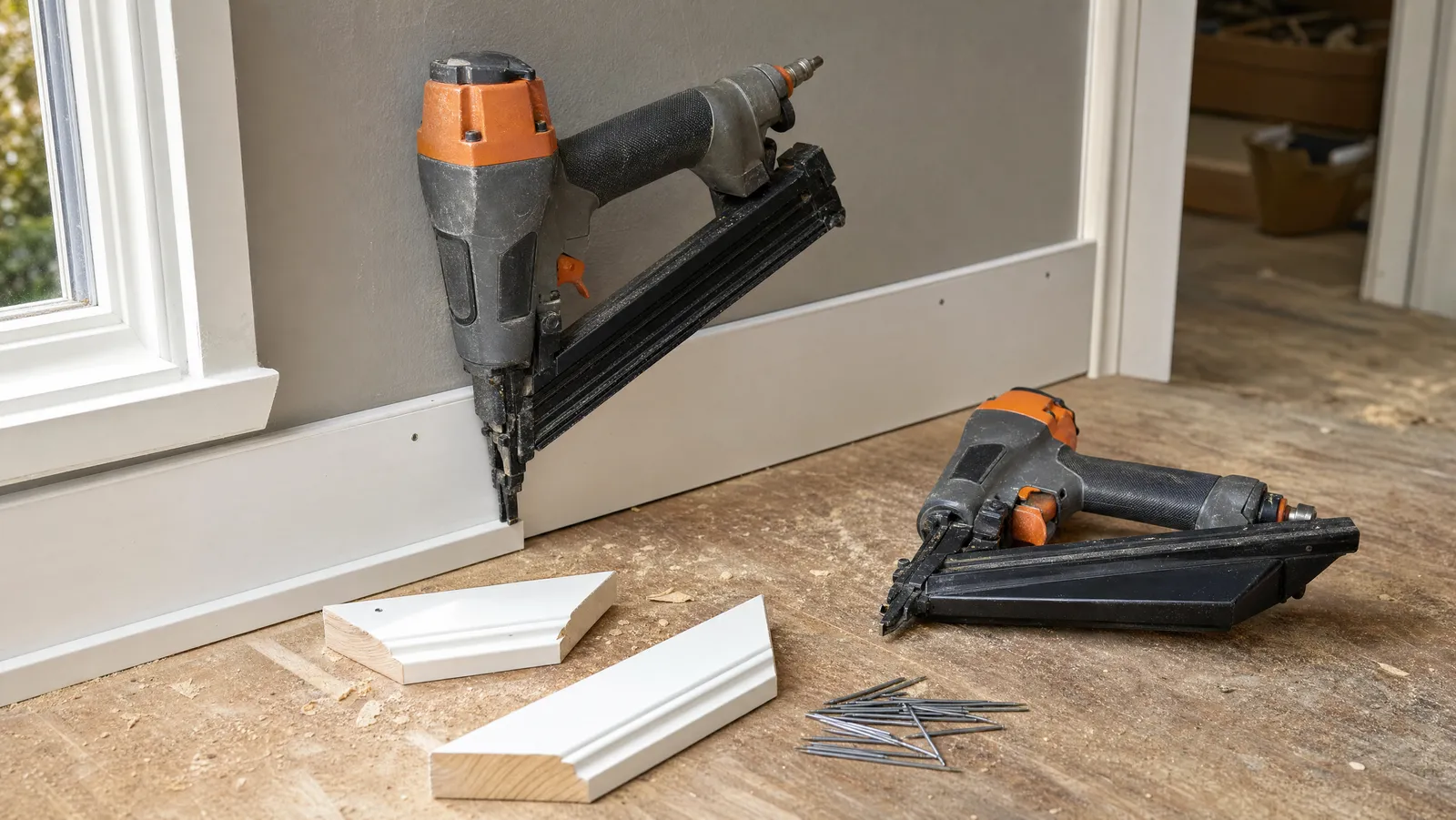
The best finish nailer for trim is the Metabo HPT NT65M2S at $109.00 as of November 2026. Its listing publishes 16-gauge nails from 1 in. up to 2-1/2 in., a 3.7 lb tool and a 5-year warranty. The spec that wins it the job is the one nobody leads with: that 1 in. minimum.
A hammer and nail set will hang baseboard, but will also split a miter return and dent a painted face. If you are not yet sure a finish nailer is the tool you need, start with the difference between a brad nailer and a finish nailer, or with the wider view in our guide to the best nail gun for DIY projects. If you already know you want one, here are the five we would buy — and the one number we used to separate them.
Our picks at a glance
Drag to compare all 5 →
The ladder runs from $59.46 to $169.00 as of November 2026 — a spread of $109.54, which makes the dearest gun about 2.8 times the price of the cheapest. The budget pick undercuts our top pick by $49.54, or roughly 45 percent. What that money does not buy is a longer nail range.
How we chose
We have not fired these guns. Everything below comes from each tool's own listing text plus cited editorial sources, and we flag every missing figure rather than filling the gap with a guess.
That turned out to be the interesting part. Only two of the five listings publish a weight — 3.7 lbs and 4.2 lbs, half a pound apart — and both are Metabo HPT. Only three state a warranty term. Only four publish a nail-length range at all. When a listing will not tell you what a tool weighs or how long it is covered, that is information too.
One caveat before the picks: if this is your first nail gun, an 18-gauge brad nailer is usually the better buy — cheaper, smaller hole, happier on small trim. Our best brad nailers for DIY picks cover that route. A finish nailer earns its place on real baseboard, casing and crown.
Why minimum nail length is the spec that matters
Now count the nail-range column. Four of the five publish a range, and every one of those four tops out at exactly 2-1/2 in. The maximum is not a differentiator — it is the same number four times, so a roundup that leads with it tells you nothing.
The floor is where they split, two and two. The NT65M2S and the SFN64 start at 1 in. The NT65MA4 and the BTFP71917 start at 1-1/4 in. That quarter of an inch decides whether the gun can fasten thin stock: shoe molding, door stop, a scribe strip. None of those is trying to reach framing — shoe pins into the baseboard, stop pins into the jamb — so a longer nail is not a safer nail. It is the one that punches out the back.
At the other end of the range, length is arithmetic rather than opinion. According to This Old House, baseboard should be fastened with 8d finish nails, "driving them at a slight downward angle near the top and bottom edges of the board," after you have located and marked the studs. According to Senco's penny-size chart, an 8d nail is 2-1/2 in. long. And according to Hunker, "the most common thickness of drywall used in residential interior construction is 1/2 inch."
Do the subtraction yourself. A 3/4 in. baseboard over 1/2 in. drywall eats 1-1/4 in. of nail before the point touches framing, leaving about 1-1/4 in. of a 2-1/2 in. nail in the stud. That is the whole of what size nails to use for trim and baseboard: your stock, plus your wall covering, plus the bite you want in the framing. Change one input and the answer changes, which is why no single number belongs in a buying guide.
Marking the framing is not optional either — our best stud finder picks are what make the length arithmetic worth doing. A 2-1/2 in. nail into drywall and air holds nothing.
Best overall: Metabo HPT NT65M2S

Metabo HPT NT65M2S
The full 1 in. to 2-1/2 in. range at 3.7 lbs with a 5-year warranty — matched on range here only by the budget pick, and the lightest of the two tools that publish a weight.
Pros
- Starts at 1 in., so it handles thin stock like shoe molding and door stop
- Reaches 2-1/2 in. for baseboard that has to catch framing
- 3.7 lbs, the lightest here of the two tools that publish a weight
- 5-year warranty and a tool-free depth adjuster
Cons
- Pneumatic — a compressor, hose and fittings are required and not included
- Straight magazine — the NT65MA4's listing claims its angled magazine is easier in tight corners
- Its Amazon listing lists no carrying case
At $109.00 as of November 2026 this is the gun that covers the most trim with the fewest compromises. Its listing publishes 16-gauge nails from 1 in. to 2-1/2 in. — the widest of the four published ranges here, matched exactly by the budget pick. It is also 3.7 lbs, the lighter of the only two tools here that publish a weight.
The rest reads like a tool somebody actually finished a house with: a selective actuation switch, so you can bump-fire a long run of base and switch back to sequential for a delicate return, plus a tool-free depth adjuster, a no-mar tip, a 360-degree adjustable exhaust port and an air duster button — all under the Metabo HPT Professional 5-Year Tool Warranty.
Its listing also quotes an award worth naming precisely: Metabo HPT says the tool was "Rated the Pro Preferred Nailer for 12 years running (2014 - 2025) by Builder and Developer Magazine." That is a trade-magazine reader award, not a bench test, and we would not buy on it.
The real cost is air. It is pneumatic, so a compressor, hose and fittings are required and none are included — and its magazine is straight, where Metabo HPT's own listing for the angled NT65MA4 claims easier placement in tight corners.
Best budget: NuMax SFN64
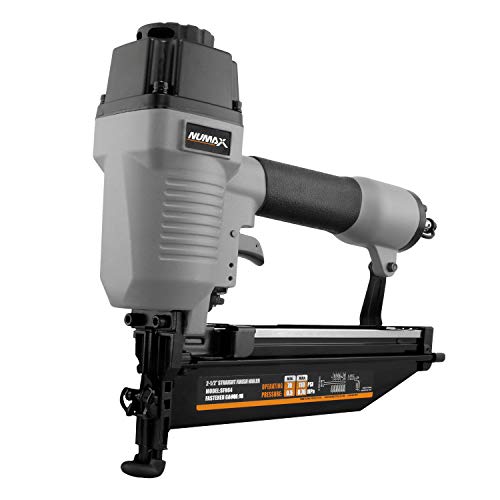
NuMax SFN64
The same 1 in. to 2-1/2 in. nail range as our top pick for roughly half the money — with a thinner spec sheet behind it.
Pros
- $59.46 — the cheapest nailer here by a clear margin
- Matches the top pick's full 1 in. to 2-1/2 in. nail range
- Tool-free depth adjustment and a quick jam release
- No-mar tip and adjustable exhaust, same as guns costing twice as much
Cons
- Its Amazon listing publishes no weight figure
- Its Amazon listing states no warranty term
- Described only as 'lightweight' with no number to check
- Pneumatic — compressor not included
The NuMax SFN64 is $59.46 as of November 2026 and publishes the identical 1 in. to 2-1/2 in. 16-gauge range as our top pick. On the one spec this guide says matters most, the cheapest gun here ties the winner. Sit with that before you spend more.
It also lists the features you would expect to pay up for: a one-piece hardened steel drive blade, a tool-free depth adjust wheel, a quick jam release, a no-mar safety tip and a 360-degree adjustable exhaust. Its listing names trim, crown moulding, window casing, door installation, baseboards and chair rails among its applications.
What you give up is the spec sheet behind the numbers. Its Amazon listing publishes no weight — the tool is described only as "lightweight," with nothing to check — and states no warranty term. For a weekend of baseboard every few years, that may be a fair trade. For a decade of ownership, it is the gap.
Best for tight corners: Metabo HPT NT65MA4 (15-gauge)

Metabo HPT NT65MA4
An angled magazine that reaches into inside corners a straight gun cannot, driving a heavier 15-gauge nail — at the cost of a 1-1/4 in. minimum.
Pros
- Angled magazine gets the nose into inside corners and tight returns
- 15-gauge holds harder than 16-gauge at the same length
- Publishes its weight: 4.2 lbs
- Same 2-1/2 in. ceiling as the straight 16-gauge guns
Cons
- Minimum nail 1-1/4 in. — it cannot do the thin stock the 1 in. guns handle
- This is a 15-gauge gun, so it leaves a larger hole than the 16-gauge picks
- Uses angled DA-style nails, a different consumable from straight 16-gauge strips
- Pneumatic — compressor not included
Read this one carefully, because it turns up in searches for 16-gauge nailers and it is not one. The NT65MA4 is a 15-gauge gun running angled DA nails — a different consumable from the straight 16-gauge strips the other picks take.
What you get for the switch is access. Its listing says the tool "includes an angled magazine for easier placement and operation in tight corners," which is the one thing a straight magazine genuinely struggles with: inside corners, tight returns, the nose-in angles of a stair skirt. It publishes 15-gauge nails from 1-1/4 in. to 2-1/2 in., a 4.2 lb tool — half a pound more than the NT65M2S, the only other published weight here — a tool-less depth adjuster and the same Metabo HPT 5-year warranty.
The trade-offs run both ways. A 15-gauge nail is thicker, so it holds harder than a 16-gauge nail of the same length, and leaves a bigger hole to fill. That 1-1/4 in. floor also puts thin stock out of reach. At $136.80 as of November 2026, this is a second gun for someone who already owns a 16-gauge.
Best cordless: CRAFTSMAN CMCN616B

CRAFTSMAN CMCN616B
No compressor, no hose — and read the title twice: this is a bare tool, with no battery, no charger and no published nail range.
Pros
- No compressor, hose or fittings to buy or carry
- Publishes a runtime claim: up to 375 nails per charge
- Tool-free jam and stall clearing
- If you already own CRAFTSMAN V20 batteries, this is a cheap way into cordless trim work
Cons
- Bare tool: a battery and charger are extra, so $149.00 is not the price you pay
- Its listing never states what length nails it takes — the one spec that decides trim work
- Its listing publishes no weight
- The 375-nails claim carries a double asterisk with no visible footnote on the listing
This is the one cordless option in this guide, and the appeal is obvious. Its listing says the "fully cordless design eliminates the need for compressors, hoses, and costly gas cartridges" — which, for a room of base or casing work up a ladder, is worth money. It adds tool-free jam and stall settings, a belt hook, VERSATRACK compatibility (clip sold separately) and a claim that the motor "drives up to 375 nails per charge**."
Two things about that listing, though, and they are why the next section exists. The title says "Bare Tool Only" — no battery, no charger — so $149.00 as of November 2026 is not the number you pay. And the listing never states what length nails the gun takes. Not in the title, not in the bullets. Of the five guns here it is the only one whose listing omits the single spec that decides whether a nailer suits your trim.
We are not calling the tool bad; we have not used it. We are saying the page you would buy it from will not tell you whether it can fasten your shoe molding — a strange place to be at $149.00 before batteries.
Best kit: BOSTITCH BTFP71917

BOSTITCH BTFP71917
A complete kit — case, fitting and spare no-mar tips — behind the longest published warranty here, if you can live with a 1-1/4 in. minimum.
Pros
- 7-year limited warranty (1 year in production applications), the longest of the three listings here that state a term
- Arrives as a kit: case, air fitting and spare no-mar tips
- Oil-free, so there is no oil to stain finished trim
- Dial-A-Depth and a selectable trigger
Cons
- $169.00 — the most expensive nailer here
- Minimum nail 1-1/4 in., so thin stock is out
- Its Amazon listing publishes no weight figure
- The 7-year term drops to 1 year in production applications, per its own listing
At $169.00 as of November 2026 this is the most expensive gun here, and the money buys completeness rather than capability. The kit ships with the nailer, a 1/4-inch air fitting, a carrying case and extra no-mar tips, so the only thing left on your list is the compressor. Its listing publishes 16-gauge nails from 1-1/4 in. to 2-1/2 in., oil-free operation that "reduces the risk of oil stains" on finished trim, a tool-free jam release, Dial-A-Depth control and a selectable trigger.
Its warranty needs both halves quoted. The listing reads: "7-Year Limited Warranty. 1-Year Limited Warranty in production applications." Seven years is the longest term stated by any of the three listings here that state one; one year is what you actually have if the gun gets used commercially. Roundups quote the first number. Quote both.
Its Amazon listing publishes no weight, and the 1-1/4 in. minimum rules out thin stock the way the NT65MA4's does.
15-gauge or 16-gauge for trim?
For most DIY trim, 16-gauge. Gauge describes wire thickness, and as A Concord Carpenter puts it, the gauge "refers to the diameter of the nail wire" — the bigger the number, the thinner the nail. According to Fine Power Tools, a 15-gauge nail measures 0.072 in. (1.828 mm) against 0.063 in. (1.60 mm) for a 16-gauge nail.
That small difference changes two things. The thicker shank and larger head of a 15-gauge nail give it more grip, which is why A Concord Carpenter says that "if you're working with thick, dense wood, or hanging doors you need a heavier 15 gauge nail." It also leaves "a much larger hole than a 16 gauge nail head" to fill, and the same article warns that "a 15 gauge nail can easily split delicate moldings." Base molding sits on its 16-gauge list.
So: 16-gauge for painted baseboard, casing, chair rail and crown; 15-gauge for solid-core doors and thick, dense stock if you do not mind filling bigger holes. Neither is the better tool — they trade hole size for grip. If the gauge system is still a fog, our nail gun types explained guide maps the gauges to the jobs.
Straight or angled magazine?
The practical difference is nose access, not power. An angled magazine lets the gun body swing clear of an adjoining wall so the tip can sit square in an inside corner. A straight magazine has to be tilted, which is how you get a nail that skates out through the face of the trim. Corner access is the published claim Metabo HPT makes for the NT65MA4.
The catch is that angled and straight nails are different consumables, and in this guide the angled gun is also the 15-gauge one. According to Fine Power Tools, if you want 15-gauge you will generally "want to find a finish nailer that offers an angled magazine" — so in practice the two choices tend to arrive together rather than separately.
For a first finish nailer, straight 16-gauge is the easier call: cheaper nails, more places to buy them, and the 1 in. minimum two of the three straight 16-gauge guns here publish.
Read the listing, not the title
Three of these five listings hide something a skimmer will miss. Together they make a checklist for any tool page.
The CRAFTSMAN CMCN616B carries two of the three. Its "drives up to 375 nails per charge**" claim ends in a double asterisk with no footnote text anywhere in the listing data, so the conditions behind the figure — nail length, battery size, temperature — are unstated. And its listing gives no nail-length range at all. We checked that listing's own text and nothing else; we did not fetch CRAFTSMAN's site this run, so read this as a complaint about the page you would buy from, not the company.
The BOSTITCH BTFP71917 is the warranty case: a 7-year headline that narrows to one year in production applications inside the same bullet. The Metabo HPT NT65MA4 is the gauge case — a 15-gauge gun with a 1-1/4 in. minimum sitting in search results beside 16-gauge guns with 1 in. minimums, close enough in name and price to be mistaken for a like-for-like alternative.
None of that makes these bad tools. It makes a listing a document to read, not skim.
What it really costs to go cordless
The CRAFTSMAN's $149.00 is a bare-tool price, so compare the whole path. Our top pick is $109.00 and needs air; the cheapest compressor we priced this run is a 3-gallon, 110 PSI, oil-free unit at $69.99. Add them and the pneumatic route is $178.99 — $29.99 more than the CRAFTSMAN's sticker.
Except the sticker is not the CRAFTSMAN's price. A battery and a charger are extra, and we did not price either this run, so its true all-in figure sits above $149.00 by whatever a V20 battery and charger cost on the day you look. If you already own the batteries, cordless is the cheaper and far more pleasant route. If you do not, the arithmetic can flip — and a compressor keeps earning its space inflating tires, blowing out dust and running a second nailer.
Whether you need the compressor at all is its own question, and we work through it in whether you need an air compressor for a nail gun. For the wider trade-off between hose and battery, see cordless versus pneumatic nailers.
Frequently asked questions
What size finish nailer is best for baseboard?
A 16-gauge finish nailer covers nearly all baseboard work. For length, do the arithmetic rather than copy a number: trim thickness, plus wall covering, plus the penetration you want in the framing. According to This Old House, baseboard gets 8d finish nails — 2-1/2 in., per Senco's penny chart — which over 3/4 in. trim and 1/2 in. drywall leaves roughly 1-1/4 in. in the stud.
Can one finish nailer do all my trim?
Mostly, if its minimum is 1 in. The two guns here that start at 1 in. can fasten shoe molding and door stop as well as full baseboard; the two that start at 1-1/4 in. cannot.
Is 15-gauge or 16-gauge better for trim?
Neither is better; they trade grip for hole size. According to Fine Power Tools, a 15-gauge nail is 0.072 in. thick against 0.063 in. for a 16-gauge, so it holds harder and leaves more to fill. For painted DIY trim, 16-gauge is the usual pick.
Do I need a cordless finish nailer?
Only if the hose is what is stopping you. A cordless gun removes the compressor but adds a battery platform you have to buy into, and the one cordless pick here is sold as a bare tool.
Which finish nailer to buy
Buy the Metabo HPT NT65M2S at $109.00. It publishes the full 1 in. to 2-1/2 in. range — matched here only by the budget pick — at the lighter of the only two published weights, with a 5-year warranty behind it.
If money matters more than paperwork, the NuMax SFN64 at $59.46 matches that nail range for $49.54 less, giving up a published weight and a stated warranty to do it. If you work a lot of inside corners and already own a 16-gauge gun, the 15-gauge NT65MA4 is the specialist. Want a case and a fitting in the box? The BOSTITCH BTFP71917 is the kit — read both halves of its warranty. And if you already own CRAFTSMAN V20 batteries, the CMCN616B is the cheap way out of the hose, so long as you accept that its listing will not tell you what nails it takes.
Still weighing nailer types rather than models? Start one level up with our nail gun buying guide.
About the Author
Cheryl Thompson
Cheryl Thompson is the tools editor at The DIY Tool Review. A lifelong fixer and self-confessed tool addict, she has spent years buying, borrowing and wearing out hand and power tools across home renovation, furniture building and everyday repairs. She writes hands-on, no-nonsense reviews to help fellow DIYers spend their money on the tools that actually last.