Circular Saw Kickback: What Causes It and How to Avoid It
Kickback is the kerf closing on a spinning blade and throwing the saw back along the line of cut. The cause is almost always how the work is held up — and the best fix is free.

- Category
- Saws & Cutting Tools
- Tools tested
- 4
- Read time
- 14 min
- Updated
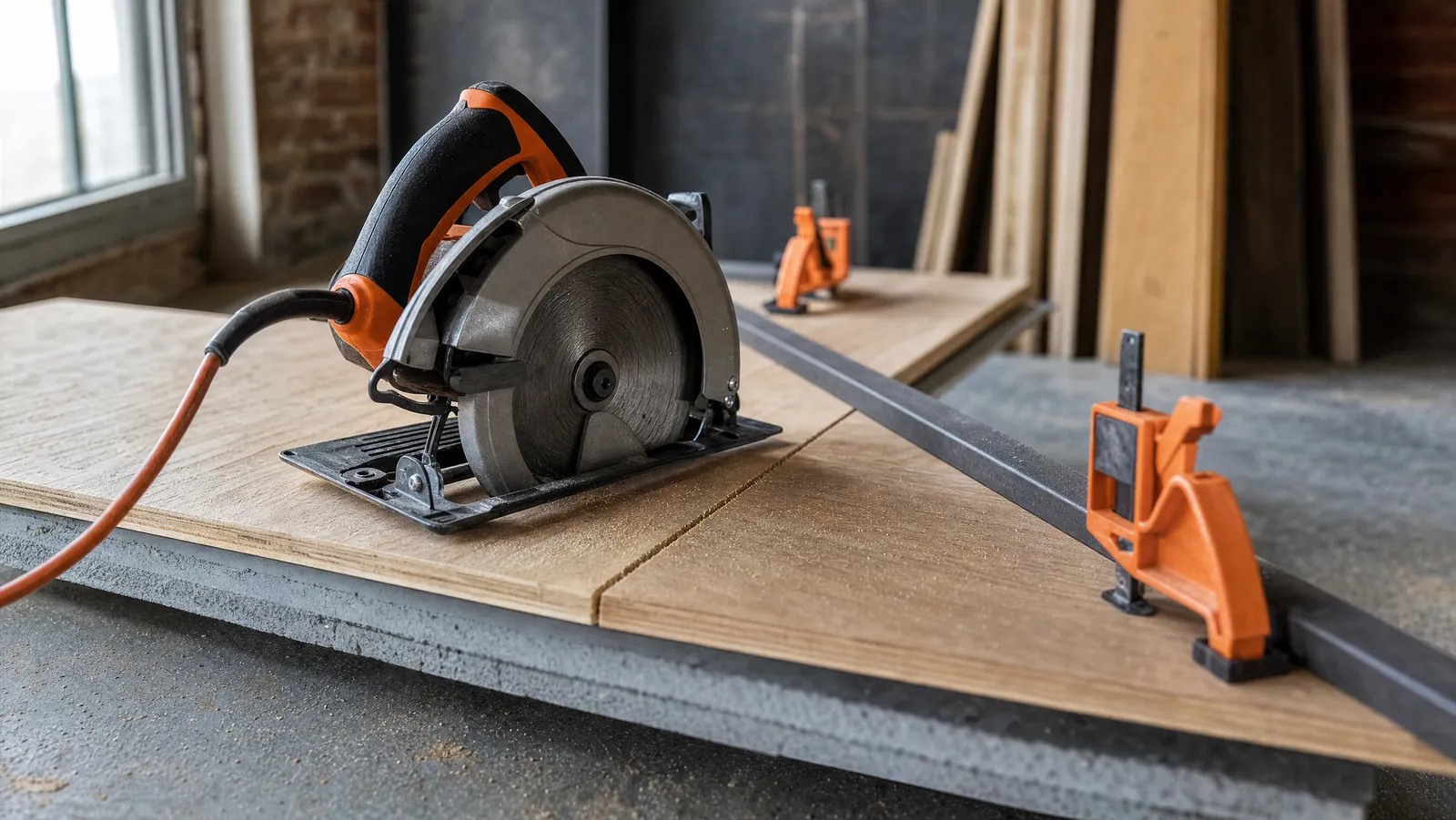
Circular saw kickback is the cut closing on a spinning blade. The kerf pinches, the blade stalls, and the motor's energy drives the tool back along the line of cut — toward you. Almost none of the fix is about the saw. It is about how the wood is held up while you cut it.
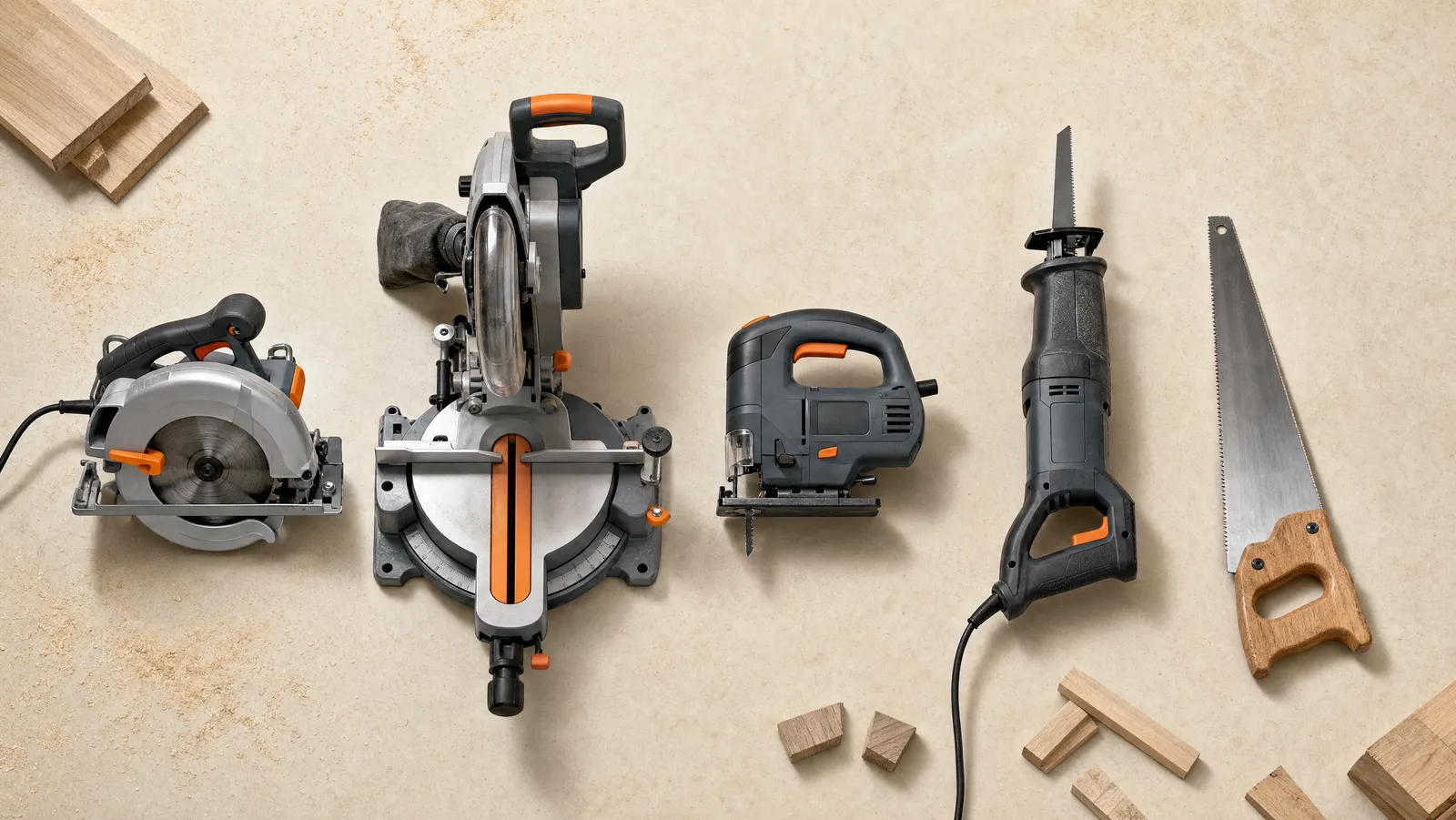
If you are still choosing your first saw, or placing a circular saw among the options in types of saws explained, read this first. If you own one but have never run it, start with how to use a circular saw.
What kickback actually is
The Power Tool Institute defines kickback as "a sudden reaction to a pinched, bound or misaligned blade" that "can cause an uncontrolled tool to lift up and out of the workpiece toward the operator" — and calls it "the result of tool misuse and/or incorrect operating procedures or conditions," not a defective saw.
Two events share the name. The blade binds and the tool is thrown: Bosch's circular saw safety instructions put it as "when the blade is pinched or jammed tightly by the kerf closing down, the blade stalls." The blade stops, the motor does not, and the saw is what moves. The blade climbs out: per the same instructions, "if the blade becomes twisted or misaligned in the cut, the teeth at the back edge of the blade can dig in," and the saw rides up out of the kerf. That is the one you get from steering mid-cut.
Why a circular saw has no riving knife
Readers often arrive asking about riving knives and anti-kickback pawls. Those are table saw parts. A circular saw has neither, and the guarding rules show why.
OSHA's stationary-saw standard says at 29 CFR 1910.213(c)(2) that "each hand-fed circular ripsaw shall be furnished with a spreader to prevent material from squeezing the saw," and at 1910.213(c)(3) that it "shall be provided with nonkickback fingers or dogs … so located as to oppose the thrust or tendency of the saw to … throw it back toward the operator." Both work only because the blade is fixed in a table, with somewhere behind it to mount a fixed part — the spreader to hold the kerf open, the nonkickback fingers to grip the stock so it cannot be thrown back.
On a circular saw the blade travels with the tool, so there is no behind. OSHA's portable-tool standard at 1910.243(a)(1)(i) asks for something else: saws with a blade over 2 in. "shall be equipped with guards above and below the base plate or shoe," and "when the tool is withdrawn from the work, the lower guard shall automatically and instantly return to covering position." That guard protects you from the blade. It does nothing to hold the cut open.
Which raises a different question: do you need a table saw? For plenty of DIY work the answer is no. Your protection here is the guard plus your technique, and the Power Tool Institute is blunt: "Never alter or defeat the guard (e.g., tying back or removing the guard)." If a jig stops a guard closing freely, the jig is wrong for that saw.
The five things that cause it
1. Pinching. The kerf closes. The Power Tool Institute says to "support large panels … so they will not pinch the blade," and to "be very cautious of stock which has knots, is warped, or has visible pitch" — stock "most likely to create pinching conditions and possible kickback."
2. Twisting. Steering off the line binds the blade against the side of the kerf. The Power Tool Institute's rule for guided cuts is the fix: "if a fence or guide board is used, be certain the blade is kept parallel with it."
3. Catching on entry. It also says to "allow the blade to reach full speed before contacting the workpiece," and on a restart to "center the saw blade in the kerf and check that saw teeth are not touching the material."
4. A dull, dirty or wrong blade. The most underrated cause. The Power Tool Institute notes "a sharp blade will tend to cut its way out of a pinching condition"; a dull one will not. It also says "overheating a saw blade can cause it to warp and result in kickback," listing "buildup of sap on the blades, insufficient blade set, dullness, and unguided cuts" as causes. Unsure what is on your saw? See how to choose a circular saw blade.
5. Too much blade below the work. More exposed blade means more of it available to grab, and more energy to throw the tool.
The habit that matters most: never cut between two supports
The mistake we see most: stock goes across two sawhorses and the cut is made in the middle, between them. As the kerf opens, both halves hinge down and inward, the slot closes on the blade, and the saw comes back.
Bosch's instructions say supports "must be placed under the panel on both sides, near the line of cut and near the edge of the panel" — close to the cut on both sides, not bridging a gap. The Power Tool Institute puts it as: "minimize blade pinching by placing the saw shoe on the clamped, supported portion of the workpiece, and allowing the cut off piece to fall away freely."
The offcut must be free to fall. That is the test. If it will sag, hinge or pivot toward the blade, the setup is wrong.
The free version, which is the best version
- Rigid foam insulation on the garage floor. Lay the sheet on it, set the blade to just clear the foam, and cut. Everything is supported on both sides, so neither half can sag into the kerf, and the blade scores foam, not concrete.
- Four 2x4s flat on the ground, perpendicular to the cut, two on each side of the line. Nothing bridges, nothing hinges.
- Cut the end off, not the middle, so the offcut hangs free past the support.
For sheet goods we would take foam over sawhorses every time: it works better and costs less. Horses earn their place on framing lumber and waist-height work.
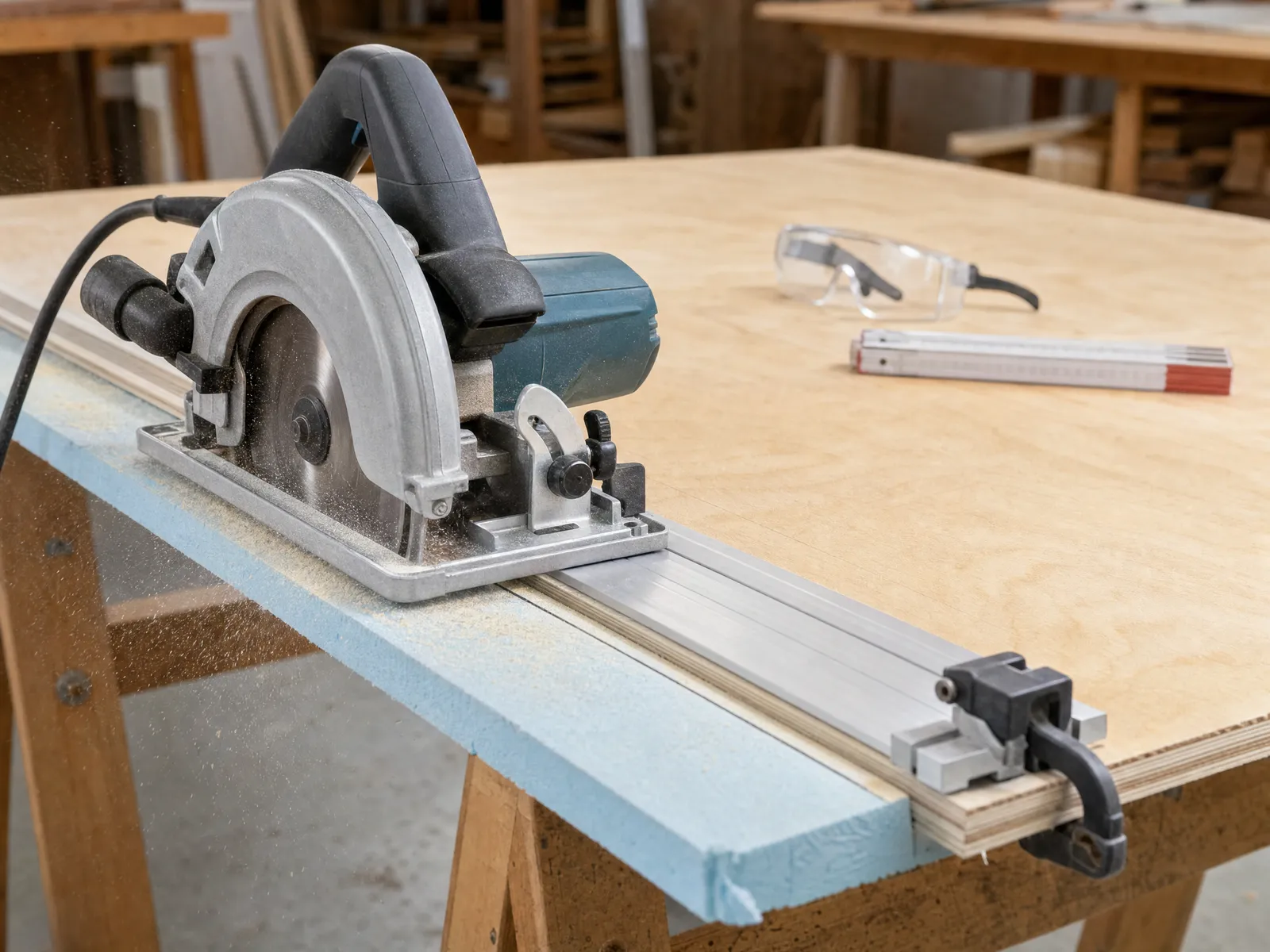
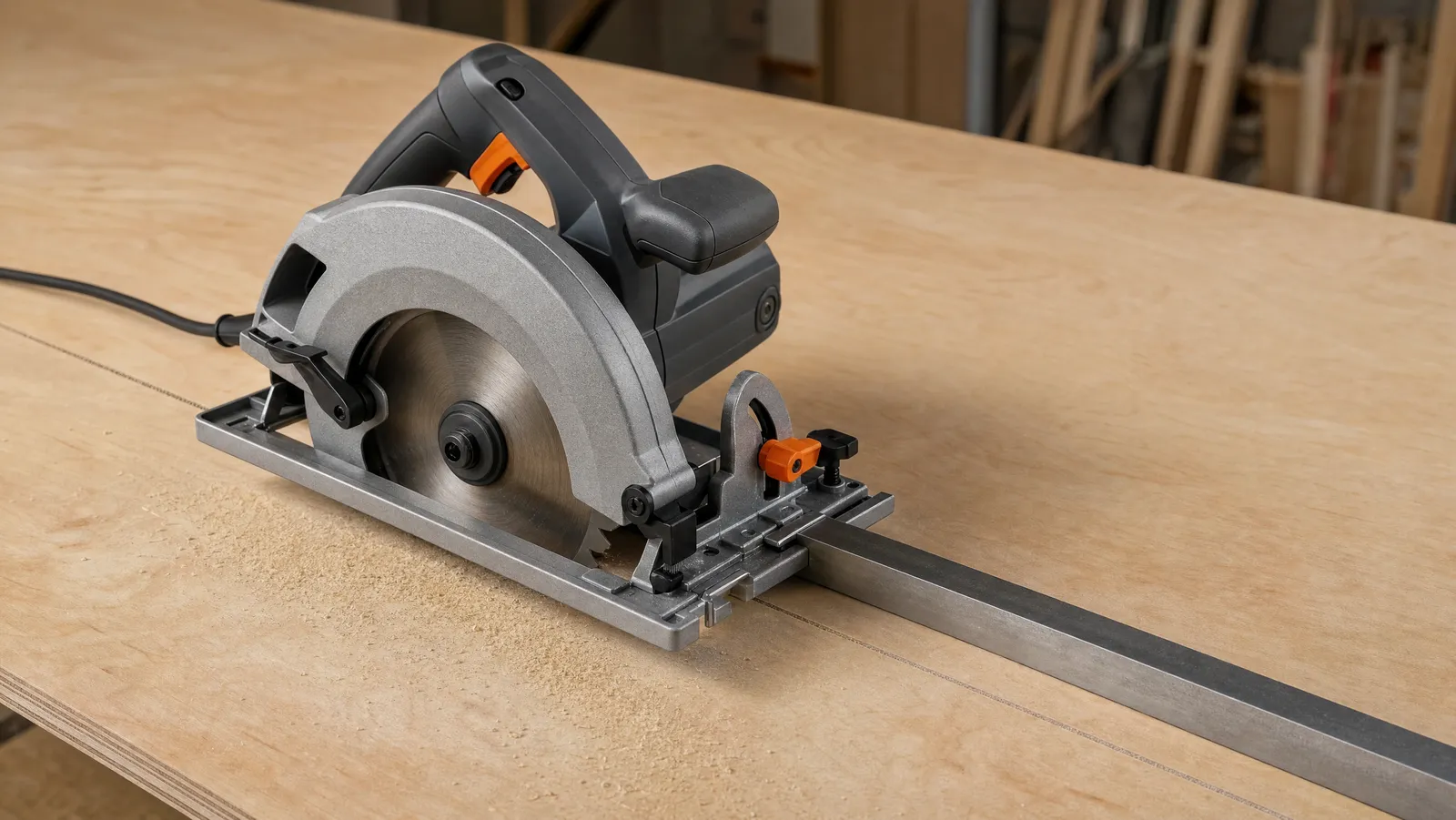
Steering is the other half, so clamp a straightedge rather than freehanding a long cut. Our guide to how to cut straight with a circular saw covers the setup; a straightedge clamped at both ends removes the small mid-cut corrections that bind a blade.
Support and workholding, priced
There is no anti-kickback gadget for a circular saw. Nothing below prevents kickback: support and workholding remove one cause, the kerf closing, and technique does the rest. Two purchases touch that mechanism, and one has a listing problem that is also a safety problem.


Drag to compare all 4 →
The sawhorse trap: one horse, or two?
So do the arithmetic. Two CRAFTSMAN horses are 2 × $16.98 = $33.96; the Amazon Basics set of 2 is $49.48 as of October 2026. The CRAFTSMAN pair lands $15.52 cheaper and carries the higher published pair figure — 1,000 lb per pair against 900 lb. Both figures are maker-published; neither was load-tested by anyone but the maker.

CRAFTSMAN CMST11154
A sound, cheap steel sawhorse — as long as you notice you are buying one, not two.
Pros
- $16.98 per horse is the lowest price in this guide
- Side latches let two stack into one carry unit
- Anti-slip rubber pads keep it from walking on a smooth floor
- CRAFTSMAN publishes 1,000 lb capacity per pair, higher than the other option here
Cons
- Ships as ONE sawhorse despite a capacity figure quoted per pair — budget for two
- No work-holding hooks or shelf
As a horse it is fine: folding legs, anti-slip rubber pads, side latches that stack two for carrying. The defect is in the listing, not the build — order the quantity you meant.
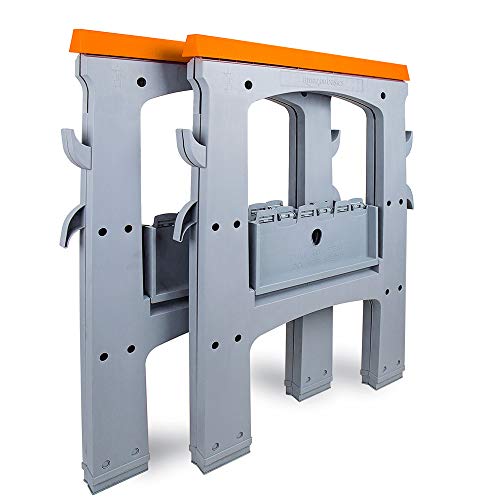
Amazon Basics pair
Two horses, assembled, with a stated capacity that is honest about how the load has to be spread.
Pros
- Arrives as a pair, so you can support both sides of a cut on day one
- The listing states the 900 lb figure is across BOTH horses rather than implying it per horse
- Locking braces and non-slip feet
- Six hooks per horse for holding stock or wrapping a cord
Cons
- $49.48 is the highest price in this guide
- 900 lb across the pair is the lower of the two published pair figures here
The Amazon Basics set cannot be misread: a pair, assembled, with locking braces, non-slip feet and six hooks per horse. Its listing states the 900 lb figure as "evenly distributed across both sawhorses" rather than letting you assume per horse — a caveat we wish more listings volunteered.
Clamps: the bigger box is the worse buy
The Power Tool Institute's rule is unambiguous: "clamp workpieces securely. Check frequently to be sure clamps remain secure." A workpiece that can shift is one that can pinch — which is why clamps are on our list of essential diy tools.
HORUSDY sells two sets sharing a parent ASIN and identical spec wording, so this is apples to apples. Count the contents. The 6-pack is 2 × 6 in. bar clamps, 2 × 12 in. bar clamps and 2 × 6 in. spring clamps — 4 bar clamps of 6 pieces. The 8-pack is titled "8-Pack Bar Clamps," yet its own contents bullet lists 4 × 6 in. bar, 2 × 12 in. bar and 2 × 6 in. spring — 6 bar clamps of 8 pieces. The only difference between the boxes is two extra 6-inch bar clamps.
Now divide. The 6-pack at $19.99 as of October 2026 is $19.99 ÷ 6 = $3.33 a piece. The 8-pack at $30.59 as of October 2026 is $30.59 ÷ 8 = $3.82 a piece — about 49 cents a piece worse.
Sharper still: the gap of $30.59 − $19.99 = $10.60 buys two 6-inch bar clamps, or $5.30 each — roughly 59% above the 6-pack's average piece price, for its smallest bar clamp. On bar clamps alone the 6-pack is $19.99 ÷ 4 = $5.00 each against $30.59 ÷ 6 = $5.10. The smaller set wins on every denominator.
Buy the 6-pack. Both sets quote "up to 150 lbs of squeeze capacity," but that is listing wording with no maker spec sheet behind it — a claim, not a specification. The nylon bodies flex under load — fine for holding a straightedge and pinning stock down.
Blade depth, blade condition, and standing in the right place
Set the depth shallow. Bosch says to "adjust the cutting depth to the thickness of the workpiece," and that "less than a full tooth of the blade teeth should be visible below the workpiece." The Power Tool Institute uses the same limit. We give no figure in inches: blade diameters differ, so judge by the teeth. Bosch adds that the depth and bevel levers "must be tight and secure before making the cut"; one that slips mid-cut hands you a lot more blade.
Stand out of the line of travel. The Power Tool Institute says to "keep hands and body away from and to the side of the blade," and "always have both hands on the saw, never hold a workpiece in your hand or across your leg." Directly behind the saw is where the tool goes if it comes back.
Let it stop before you lift it. "Never remove the saw from a cut while the blade is rotating," per the same sheet; if the blade binds or the saw stalls, "release the switch immediately" and wait. And never reach under the saw or workpiece: "the blade is exposed under the workpiece and the saw guard cannot protect your body here."
Check the guard every cut. Bosch's test: "check the guard for proper closing before each use," and "do not operate the saw if the guard does not move freely and enclose the blade instantly." A guard that hangs up is a repair, not a workaround — and if the saw is sticky or has a bent shoe, replacing it is the safety fix. Our picks: best circular saw for diy.
Eye and ear protection
No product cards here — the authorities put it better than a shopping list. The Power Tool Institute's sheet illustrates it on the tool: safety glasses, no loose clothing or jewelry, firm footing in a clean area.
Cal State Chico's Environmental Health and Safety job safety analysis for operating a portable circular saw asks for more — "Safety Glasses, Goggles, or Face Shield (whichever is appropriate for work being performed)," a dust mask or N95 respirator depending on the material, safety shoes or boots, and earmuffs or earplugs. It also wants long pants and long hair tied back, and keeps work gloves for handling the blade, not running the saw.
On hearing: according to Harvard's Environmental Health and Safety office, OSHA's noise standard at 29 CFR 1910.95 triggers employer obligations once exposure reaches an 8-hour time-weighted average of 85 decibels. That is written for workplaces, not garages, and we have measured nothing ourselves — but it is why every university shop sheet we read pairs hearing with eye protection.
Putting it together
- Support under the whole cut, both sides of the line — foam, 2x4s or a pair of horses. Never cut between two supports.
- Check the offcut can fall away free. If it will sag or pivot inward, move the supports.
- Clamp the work and the straightedge, and check they are still tight.
- Sharp, clean, correct blade, set so less than a full tooth shows below the work.
- Guard closing freely, depth and bevel levers locked.
- Full speed before the blade touches wood, both hands on, standing to the side of the line of travel.
- Let the blade stop on its own before lifting the saw out.
Seven habits, no purchases, and together they remove almost every mechanism by which a circular saw comes back at you. If you are still deciding which saw to own, our best saw for DIY guide is the place to start: kickback is a technique problem, but a saw you can control makes technique easier to practise.
Frequently asked questions
Why does my circular saw keep kicking back?
Usually the support, not the saw. If the stock bridges two sawhorses and you cut between them, both halves sag inward and pinch the blade — support under the whole cut so the offcut falls free. The other causes: a dull blade, too much blade below the work, steering mid-cut.
What are the main circular saw hazards?
Three. Kickback — the kerf closing on the blade and driving the tool back. Blade contact, especially under the work, where the Power Tool Institute warns the guard "cannot protect your body." And what is behind the cut: know that before you start, because wiring and pipes hide in walls.
Is circular saw kickback dangerous?
Yes. The Power Tool Institute describes kickback as causing "an uncontrolled tool to lift up and out of the workpiece toward the operator," and calls the circular saw "probably the most commonly used power saw and perhaps the most commonly abused." We quote no injury figures we cannot verify, but the mechanism speaks for itself.
Do any accessories prevent circular saw kickback?
No. There is no riving knife, no pawl and no aftermarket gadget for a circular saw — those parts belong to table saws, where the blade is fixed. Sawhorses, foam and clamps remove one cause by stopping the kerf closing. The rest is technique: depth, blade condition, entry speed, where you stand.
About the Author
Cheryl Thompson
Cheryl Thompson is the tools editor at The DIY Tool Review. A lifelong fixer and self-confessed tool addict, she has spent years buying, borrowing and wearing out hand and power tools across home renovation, furniture building and everyday repairs. She writes hands-on, no-nonsense reviews to help fellow DIYers spend their money on the tools that actually last.