The Best Saws for DIY: Which One to Buy First (2026)
Buy one saw, not five. A circular saw at $69.00 as of October 2026 does more jobs per dollar than anything else on this page, and the miter saw most people want first is 45 percent of the whole five-saw total on its own.

- Category
- Saws & Cutting Tools
- Tools tested
- 5
- Read time
- 20 min
- Updated
For most DIYers the best saw for DIY is a corded circular saw. One tool rips a sheet of plywood lengthways, crosscuts a 2x4 and bevels to 45 degrees, for $69.00 as of October 2026. Buy that first. The other four saws below only start to make sense once it is already in the garage.
Add all five picks together and you get $371.98 — 69.00 plus 169.00 plus 54.00 plus 24.99 plus 54.99, every price as of October 2026. That is a map, not a shopping list. The miter saw alone accounts for $169.00 of it, which works out at 45.4 percent of the whole page in a single tool, and it is also the only saw here that cannot rip a board lengthways at all. The three-saw version most homeowners actually need comes to $147.99: circular saw, jigsaw, hand saw. If you are starting further back than that, our guide to essential DIY tools covers what belongs in the drawer before any saw does.
Which type of saw do you actually need?
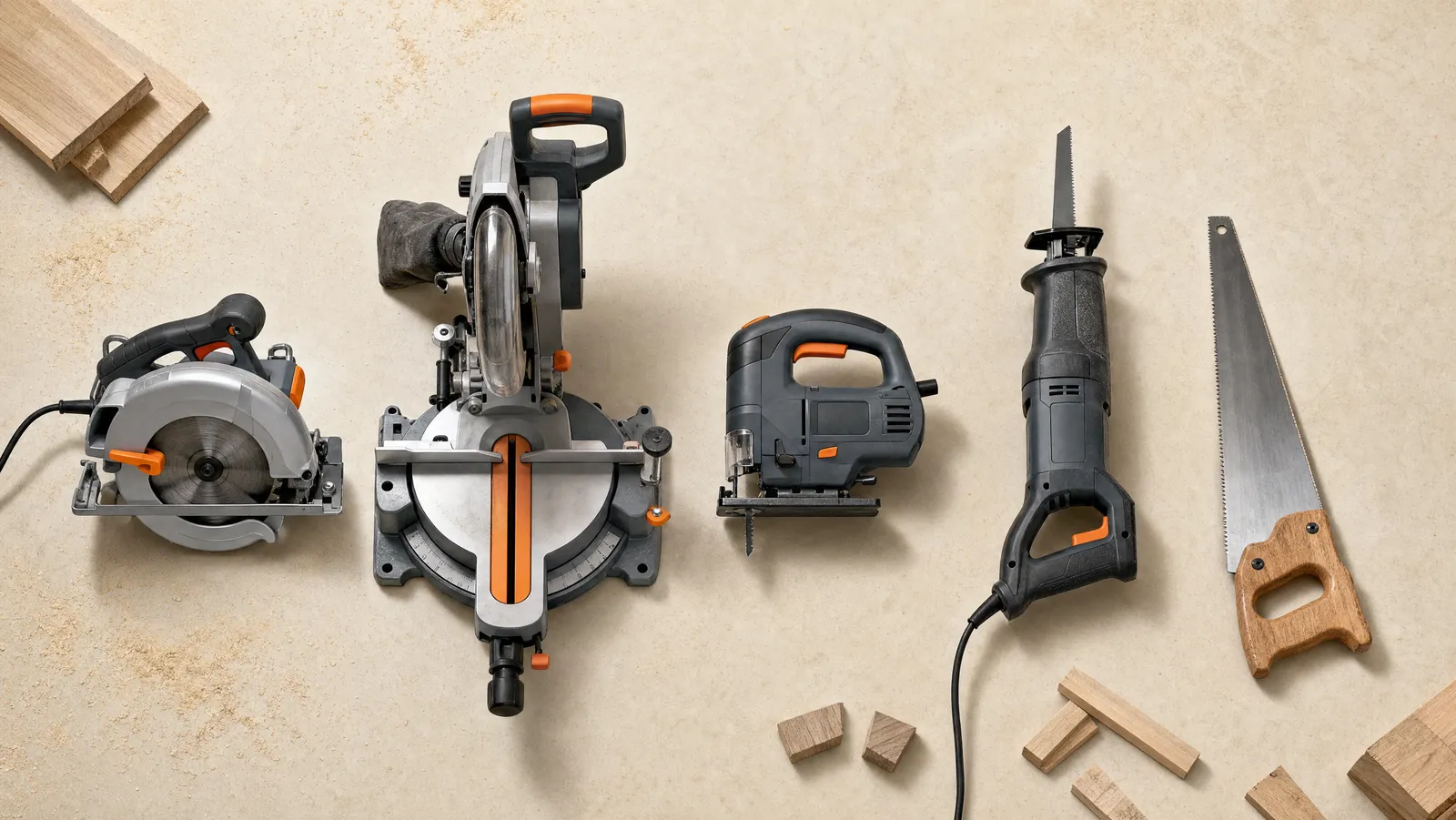
Start from the cut, not the tool. There are really only five cutting jobs in a house, and each has a saw that owns it:
- Long straight cuts at full depth — ripping plywood, crosscutting framing lumber. Circular saw.
- Repeatable angles — baseboard, door casing, picture frames, deck rails. Miter saw.
- Curves and interior cutouts — a sink hole in a worktop, a shelf scribed to an uneven wall. Jigsaw.
- Demolition — studs, nail-embedded wood, pipe, old window frames. Reciprocating saw.
- One cut, right now — a single shelf, a trimmed dowel, a cut inside a finished room. Hand saw.
A full tour of types of saws explained would run to a dozen more machines — band saws, scroll saws, tile saws, chainsaws — but those five cover very nearly everything a homeowner cuts.
The useful way to read the list is that each of these saws exists because it does something the other four do badly. That is also why "which saw is best" is the wrong question. A jigsaw is not a worse circular saw; it is a different cut. And a jigsaw or a reciprocating saw will not stand in for a circular saw on long straight cuts in sheet goods — the blade is unsupported and it wanders.
Drag to compare all 5 →
If you buy exactly one thing after reading this, make it the SKIL 5280-01 circular saw. Everything else on this page is an answer to a problem you have not had yet.
Circular saw: the first power saw to buy
The circular saw wins on depth and on versatility, and depth is the spec that decides it. Under the American Softwood Lumber Standard (PS 20), the Commerce Department product standard administered by the American Lumber Standard Committee, a nominal 2x4 is surfaced to 1.5 in. by 3.5 in. once it has been dried and planed. SKIL rates the 5280-01 at 2-7/16 in. of cut depth at 90 degrees, so laying a 2x4 flat and cutting through the 1.5 in. dimension leaves about 15/16 in. of depth unused. Tilt the shoe over and SKIL's figure drops to 1-15/16 in. at 45 degrees, which still takes a beveled cut through 2x stock.
That is the whole argument. One tool crosscuts framing lumber, rips a sheet of plywood down its length, trims a door bottom and cuts a bevel, with a 15 amp motor turning 5,300 rpm and a bevel range to 51 degrees with a positive stop at 45 — all figures SKIL publishes for this saw.
Which model to buy is a narrower question than which type: best circular saw for DIY comes down to depth of cut, bevel range, whether the shoe is stamped or cast, and whether you want a cord. Ours has a cord, and we think that is the right trade at this price — a 15 amp motor never sags and never needs charging.
Our pick: SKIL 5280-01 7-1/4 in. circular saw
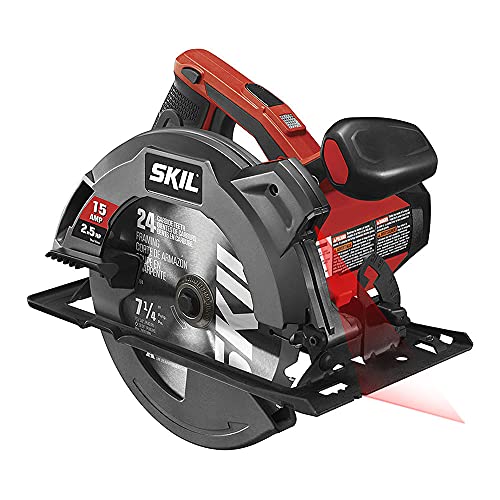
SKIL 5280-01
The one saw to own if you only own one. SKIL rates it at a 15 amp motor, 5,300 rpm, 2-7/16 in. of depth at 90 degrees and 1-15/16 in. at 45 degrees, with a bevel to 51 degrees and a positive stop at 45. That depth rips sheet goods and crosscuts framing lumber, which no other saw here does, and it costs $69.00 as of October 2026.
Pros
- Handles both rip and crosscut work in dimensional lumber and plywood
- Full 15 amp motor and a 51-degree bevel
- Cuts 2-7/16 in. deep at 90 degrees - clears a 2x4 with room to spare
Cons
- Corded, so you are tied to an outlet
- Freehand cuts need a straightedge to come out square
- At 8.7 lb it is heavier than the cheaper SKIL 5080-01
Be clear about the honest weakness. A circular saw is only as straight as whatever is guiding it. Freehand, following a pencil line down 8 ft of plywood, nobody gets a square edge — the laser guide on this model helps you start, not finish. Budget for a clamped straightedge or a shop-made guide from day one. At 8.7 lb it is also heavier than SKIL's cheaper 5080-01, which matters more than you expect when the cut is over your head.
Miter saw: trim, angles and repeat cuts
Here is the one job a circular saw genuinely does badly: the same angle, forty times, with every cut identical. Cut forty lengths of baseboard freehand and the miters will not close. Cut them on a miter saw against a fence and they will.
That capability is expensive. Our miter saw pick is $169.00 as of October 2026 against a five-saw total of $371.98 — divide one by the other and the miter saw is 45.4 percent of everything on this page. It is also about six and three-quarter times the price of the hand saw: 169.00 divided by 24.99 is a 6.76x spread from cheapest to dearest. It is the single biggest decision here, and it buys the narrowest capability.
Metabo HPT publishes a full crosscut in 2x6 at 90 degrees and 2x4 at 45 degrees for the C10FCG2. Using the same PS 20 dimensions, a 2x6 is actually 1.5 in. thick by 5.5 in. wide, so that is a one-pass crosscut on the widest board most decks and stud walls use. It is a non-sliding, single-bevel compound saw: the head tilts left only, and the arm does not slide, so wider boards than its published capacity are outside what it can do.
Choosing between models of this type — the deeper version of best miter saw for DIY — is mostly a decision about single versus dual bevel and sliding versus fixed, and both of those cost money you may prefer to spend elsewhere.
Our pick: Metabo HPT C10FCG2 10 in. compound miter saw

Metabo HPT C10FCG2
The saw that makes trim, baseboard and picture frames come out tight - the one job a circular saw does badly. Metabo HPT gives it a 15 amp motor at 5,000 rpm no-load, 0-52 degrees of miter left and right, 0-45 degrees of bevel to the left only, a full crosscut in 2x6 at 90 degrees and 2x4 at 45 degrees, and a 10 in. 40-tooth carbide blade in the box. It is $169.00 as of October 2026, down from a $179.00 list price.
Pros
- Repeatable angle cuts - 0-52 degrees miter either way
- Crosscuts a 2x6 at 90 degrees in one pass
- 24 lb and 18.5 in. wide, so it stores on a shelf
- Five-year warranty
Cons
- Single bevel - it only tilts left
- Cannot rip a board lengthways at all
- Easily the biggest spend on this page
Buy this third or fourth, not first. It cannot rip, it cannot cut a curve, and it cannot cut a hole in the middle of anything. What it can do is make trim look professional, and Metabo HPT backs it with a five-year warranty. Metabo HPT lists it at 24 lb and 18.5 in. wide, so it stores on a shelf, which is not true of most saws in this class.
Jigsaw: curves, cutouts and sink holes
The jigsaw is the only saw on this page that can start a clean cut in the middle of a panel. Drill a starter hole, drop the blade in, and you can cut a sink opening in a worktop, a speaker hole in a cabinet door or a shelf scribed to a wall that is not plumb. No other tool here does that neatly.
SKIL lists the JS314901 with a 6 amp motor, a four-stage orbital action, a tool-free blade clamp and a tool-free adjustable shoe for angled cutting. Orbital action is worth understanding: the blade is nudged forward on the up-stroke rather than moving straight up and down, which cuts faster in wood. This Old House advises setting the orbital action to 0 when cutting metal, which is why four settings beat one. SKIL also markets the saw's work light as giving "10x more light than standard LED," but that is SKIL's own claim with no stated baseline, so treat it as marketing rather than a measurement.
Picking a model is a short exercise. The honest version of best jigsaw for DIY is blade-change speed, how many orbital settings there are, and how firmly the shoe locks at an angle — because a shoe that creeps turns a square cut into a bevel.
Our pick: SKIL JS314901 6-amp corded jigsaw
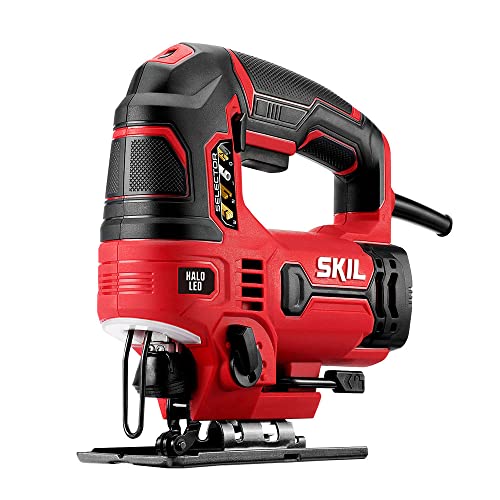
SKIL JS314901
The only saw here that cuts a curve, a circle or a sink hole in the middle of a worktop. SKIL lists a 6 amp motor, four-stage orbital action, a tool-free blade clamp and a tool-free adjustable shoe for angled cutting. At $54.00 as of October 2026 it is the cheapest way to add a kind of cut nothing else in the garage can make.
Pros
- Cuts curves, circles and interior cutouts nothing else here can
- Four-stage orbital action to suit different materials
- Blades change without a tool
Cons
- Slowest and least accurate for long straight cuts
- Blade can flex and bevel the cut in thick stock
- SKIL markets it as giving '10x more light than standard LED' - that is SKIL's figure, with no stated baseline
Where it disappoints is long straight cuts. The blade is only held at the top, so in thick stock it flexes and the cut comes out slightly beveled even with the shoe set at 90 degrees. Cut curves with it and cut straight lines with something else.
Reciprocating saw: demolition and awkward places
A reciprocating saw is a wrecking tool wearing a saw's name. It is the thing you reach for when a stud has to come out of a wall, a rusted pipe has to be cut in a crawl space, or an old window frame needs to leave the building. The blade sticks straight out in front of the handle, which lets it reach into places a round blade physically cannot.
SKIL lists the 9206-02 with a 7.5 amp motor, variable speed, tool-less blade changes, a metal gear housing, a pivoting foot and a counterbalance for vibration control. That counterbalance matters more than the amperage: this is the harshest-feeling saw in any garage.
It is also loud. According to Bob Vila's roundup of the loudest power tools, which draws on NIOSH tool testing, reciprocating saws usually run around 106 dBA and can reach 112 dBA, and cutting metal makes them noisier still. NIOSH sets its recommended exposure limit for occupational noise at 85 dBA averaged over an eight-hour workday, so hearing protection is not optional with this one.
If any saw in your kit makes a case for going cordless, it is this one — demolition happens in crawl spaces and on roofs, where an extension cord is a liability. Our guide to must-have cordless power tools covers how to pick a battery platform before you buy into one.
Our pick: SKIL 9206-02 7.5-amp reciprocating saw
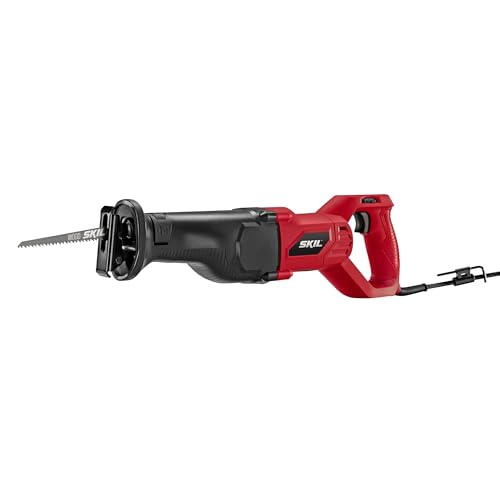
SKIL 9206-02
A demolition tool rather than a woodworking one: it cuts out studs, nails, pipe and old window frames. SKIL lists a 7.5 amp motor, variable speed, tool-less blade changes, a metal gear housing, a pivoting foot and a counterbalance for vibration control. It is $54.99 as of October 2026, and it is the fourth saw to buy, not the first.
Pros
- Cuts through nail-embedded wood and metal that would ruin other blades
- Reaches into walls, floors and other places a round blade cannot
- Tool-less blade changes and a pivoting foot
Cons
- Leaves a rough cut - not a finish tool
- Vibrates more than any other saw here
- Little use for furniture or sheet-goods work
This is the fourth saw to buy, not the first. It will not help you build a bookshelf, cut a cabinet panel or trim a door. If you are not removing anything, you do not need it yet.
Hand saws still earn their place
Every workshop should own a hand saw, and the reason has nothing to do with nostalgia. It is setup time. One cut — a shelf an inch too long, a dowel to shorten, a plug to trim flush inside a finished room — is faster by hand than by the time you have found an outlet, set a depth and put on glasses and ear defenders.
Our pick is 8 TPI. TPI means teeth per inch, and it is the number that decides how a hand saw behaves. According to the hand saw guide published by RS Components, blades with fewer than 7 TPI are sold as coarse-toothed, 7 to 11 TPI counts as medium-toothed and 12 TPI or more is fine-toothed, and the more teeth per inch a blade has, the finer the cut tends to be. Jorgensen sells this blade as coarse; by that classification 8 TPI actually lands at the low end of the medium band, which is a sensible general-purpose place to be — fast enough through a 2x4, fine enough not to shred plywood.
Jorgensen lists a 15 in. SK5 high-carbon steel blade with a Teflon coating and triple-ground teeth, in an aluminum-framed handle with 45 and 90 degree angle guides built into it. Jorgensen also advertises "50% faster cuts," which is the company's own claim with no stated baseline, so we would ignore it. The handle guides, on the other hand, are genuinely useful: they turn the saw into its own square for rough work.
Technique matters more than the tool here, which is why how to use a hand saw is worth twenty minutes of reading — start on the pull stroke with your thumb as a fence, use the full length of the blade, and let the saw's weight do the cutting.
Our pick: JORGENSEN 15 in. hand saw, 8 TPI
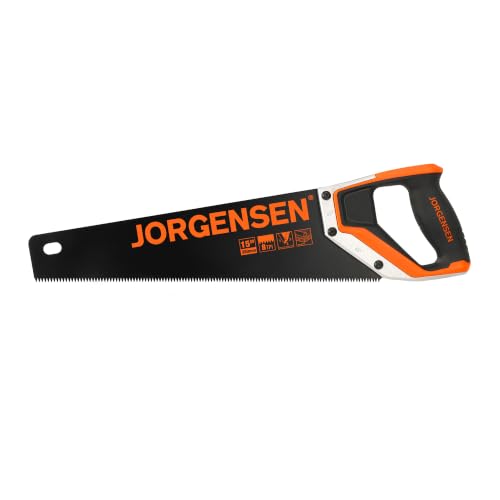
JORGENSEN 15 in.
Twenty-five dollars, no cord, no battery, no setup - and still the fastest way to make exactly one cut. Jorgensen lists a 15 in. SK5 high-carbon steel blade with a Teflon coating and 8 TPI triple-ground teeth, in an aluminum-framed handle with 45 and 90 degree angle guides built in. It is $24.99 as of October 2026, the cheapest saw on this page by a wide margin.
Pros
- Nothing to charge or plug in
- 45 and 90 degree guides molded into the handle
- Quieter and dust-free compared with any powered saw
- Cheapest saw on this page
Cons
- Slow and tiring over many cuts
- Staying square takes practice
- Jorgensen's '50% faster cuts' claim has no stated baseline
At $24.99 as of October 2026 this is the cheapest tool on the page, and we would keep the Jorgensen 15 in. hand saw hanging by the garage door rather than in a drawer. If you are assembling everything at once, our budget starter tool kit guide shows where a cheap hand saw sits against the rest of a first kit.
Do you need a table saw?
Asked plainly — do you need a table saw — the answer for most homeowners is no, and certainly not first. A table saw owns one thing: repeatable rips, where a board is pushed past a fixed blade against a fence, over and over, to identical width. If you are building cabinets or face frames, nothing else is as fast or as accurate.
For everybody else there are two real costs. The first is space: a table saw needs infeed and outfeed room on top of its own footprint, which in a one-car garage usually means moving the car.
The second is risk, and it is worth looking at squarely. According to the U.S. Consumer Product Safety Commission, a special study of 2007 and 2008 data found about 67,300 medically treated blade-contact injuries from table saws each year, including an average of about 11 amputations every day. Those numbers are why the agency has pursued a blade-contact safety standard for the category. No other saw on this page keeps a spinning blade exposed at waist height while your hands push stock toward it.
Our position: start with a circular saw and a clamped straightedge. A guided circular saw rips sheet goods perfectly well. Buy a table saw when you can name the specific repeated cut you need it for.
Track saw or circular saw for sheet goods?
A track saw is a circular saw that rides on an aluminum guide rail, usually with a plunge action, a fine blade and a dust port. The rail has a rubber edge that grips the panel, and you line the rail up on the cut line itself rather than measuring an offset.
The comparison people actually want is track saw vs circular saw, and it is honest to say the track saw cuts cleaner, splinters less and is far easier to get square on a full sheet. It can easily cost several times the price of our circular saw pick at $69.00 as of October 2026, and that money buys accuracy on one kind of cut.
What closes most of the gap is cheap. Clamp a straight factory edge to the panel, run the saw's shoe against it, and fit a high-tooth-count blade. According to the home-improvement column Here's How, blades with 60 or 80 teeth are the right choice for high-quality veneered plywood and some plastics, where thin face veneers tear out on the underside of the cut. A 60-tooth blade on a guided circular saw gets you most of the way to track-saw quality for the price of a blade.
The other half of the job is support. OSHA's woodworking eTool notes that kickbacks happen when stock twists and binds against the side of the blade, so a sheet sagging under its own weight is the enemy — put the panel on rigid foam or a sacrificial grid and cut right through it, so nothing can close on the blade.
The blade matters more than the saw
Two definitions first. Kerf is the slot the blade cuts — the material it removes. The arbor is the shaft the blade bolts onto, and a blade's center hole has to match it, which is why you check the arbor size before buying a blade, not after.
Now the part that costs people money. The blade in the box is almost never the blade for the job. According to Here's How, a 24-tooth blade is a reasonable compromise and is the most common blade supplied with new circular saws, but the same column recommends 40 or more teeth for plywood and plastics to limit tear-out, and 60 or 80 teeth for high-quality veneered plywood and some plastics. Metabo HPT, for its part, includes a 10 in. 40-tooth carbide-tipped blade with the C10FCG2, which is a sensible general-purpose trim blade out of the box.
The practical rule is that tooth count trades speed for finish. Few teeth remove more material per rotation and cut fast and rough, which is what you want ripping framing lumber. Many teeth take smaller bites and leave a cleaner edge, which is what you want on a cabinet panel. Tooth count does more for the quality of your cut than motor amps ever will, which is why how to choose a circular saw blade is worth its own guide.
Two blades cover a homeowner: a 24-tooth framing blade and a 40-tooth or higher finish blade. Swapping between them takes a minute and costs less than upgrading the saw.
Learning to run a circular saw
The mechanics are simple and almost nobody is taught them. Here is the order we use.
- Set the depth first. Set it so the blade clears the underside of the board by about a quarter inch. Less blade exposed means less to grab, less to bind, and a cleaner cut.
- Support the work on both sides of the cut line, and let the offcut fall free. A piece that pinches as it drops is the start of most bad outcomes.
- Let the saw reach full speed before the blade touches wood. Starting a cut on a spinning-up blade loads it sideways.
- Watch the shoe, not the blade. The guard hides the blade anyway; the shoe edge against your guide is what is actually steering the cut.
- Keep the cord behind you and over the shoulder away from the blade.
Protection is not negotiable, and the numbers say why. According to Bob Vila's roundup of the loudest power tools, drawing on NIOSH tool testing, circular saws usually produce about 108 dBA, with a dull blade or tough material making it worse. NIOSH's recommended exposure limit for occupational noise is 85 dBA averaged over an eight-hour workday. Safety glasses, ear protection and a dust mask for sheet goods, every time.
Everything above is mechanics; how to use a circular saw well is habit, and habits are built in the first ten cuts you make.
Getting a genuinely straight cut
Nobody cuts straight freehand over any real distance. Learning to cut straight with a circular saw is a technique question with a cheap answer: give the saw something to run against.
The easiest guide is a straight piece of material clamped to the work — a factory-edge offcut of plywood, a steel ruler, a level. The step people skip is measuring the offset: the distance from the blade to the outside edge of the shoe. Measure it once, write it on the saw with a marker, and clamp your guide that far from the cut line. Get the offset wrong and the cut is parallel to the line, just not on it.
Three more things that help:
- Cut on the waste side of the line. The blade removes about an eighth of an inch of kerf, and it has to come out of the part you are throwing away.
- Score first in veneered material. A shallow first pass at about 1/16 in. of depth severs the face veneer so the full-depth pass cannot lift it.
- Put the good face down on a standard circular saw. The teeth enter from the bottom and exit through the top, so any tear-out happens on the upward side.
Keep the saw moving at a steady pace. Forcing it bogs the motor and burns the cut; hesitating lets the blade dwell and leaves a scorch mark you will sand later.
Kickback, and the habits that prevent it
Understanding circular saw kickback is the one piece of saw theory worth memorizing. According to OSHA's woodworking eTool, a kickback occurs when a saw "seizes the stock and hurls it back at the operator," which can happen when the stock twists and binds against the side of the blade or is caught in the teeth. The same OSHA material notes that a blade that is not sharpened, or that is set at an incorrect height, can cause kickbacks, that poor-quality lumber with knots or foreign objects contributes, and that kickbacks occur more often when ripping than when crosscutting.
Read that list backwards and you have the prevention checklist:
- Keep the blade sharp. A dull blade needs force, and force is what twists the stock.
- Set the blade height correctly — shallow, clearing the work by about a quarter inch.
- Support the work so the kerf cannot close. Both sides supported, offcut free to fall.
- Expect trouble when ripping, which is the cut OSHA flags as higher risk, and go slower.
- Look at the board before you cut it. Knots, old nails and twisted stock all behave unpredictably.
- Stand out of the line of the blade, not directly behind the saw, and release the trigger the instant a cut feels wrong.
The common thread is that kickback is a pinching problem, not a power problem. A 15 amp motor does not cause it; a sagging sheet of plywood and a dull blade do.
Frequently asked questions
What is the best all around saw for home use?
A 7-1/4 in. circular saw. It is the only power saw here that handles both rip cuts along a board and crosscuts across it, at a depth that clears 2x framing lumber. Our pick is $69.00 as of October 2026. It will not cut curves or make repeatable miters, but it covers more of a homeowner's cutting than any other single tool.
Is a jigsaw or a circular saw better for a beginner?
Buy the circular saw first, even though the jigsaw feels less intimidating. A jigsaw cuts curves and interior cutouts beautifully but is slow and imprecise on long straight cuts, and it cannot stand in for a circular saw in sheet goods. Most beginner projects need straight cuts at full depth, which is exactly the circular saw's job.
Which saw to buy for DIY if the garage is tiny?
Start with the circular saw, the jigsaw and the hand saw — $147.99 together as of October 2026, and all three hang on a wall. Skip the miter saw until you have trim work to do; Metabo HPT lists our pick at 24 lb and 18.5 in. wide, which is shelf-storable, but it still wants a stand and infeed space to be useful.
Do I need a corded or a cordless saw?
Corded, for a first saw. A 15 amp corded circular saw never loses power as a battery drains and costs less than a bare cordless tool plus a battery and charger. Cordless earns its premium on the reciprocating saw, where you are cutting in crawl spaces and on roofs with no outlet nearby.
Explore the full series
- The Best Circular Saws for DIY (2026) — Why the circular saw is the one power saw to own first, and the four specs that separate a $44 saw from a $141 one.
- Types of Saws Explained: Which One Do You Actually Need? — Nine saw types, what each is genuinely for, and the three most DIYers ever actually need.
About the Author
Cheryl Thompson
Cheryl Thompson is the tools editor at The DIY Tool Review. A lifelong fixer and self-confessed tool addict, she has spent years buying, borrowing and wearing out hand and power tools across home renovation, furniture building and everyday repairs. She writes hands-on, no-nonsense reviews to help fellow DIYers spend their money on the tools that actually last.