Pegboard vs French Cleat vs Slatwall: Which Tool Wall Should You Build?
Two of these three are products you buy. The third is a system you build. Here is the honest comparison on cost per square foot, tools, hours and how easily you change your mind.

- Category
- Workshop & Storage
- Tools tested
- 3
- Read time
- 14 min
- Updated
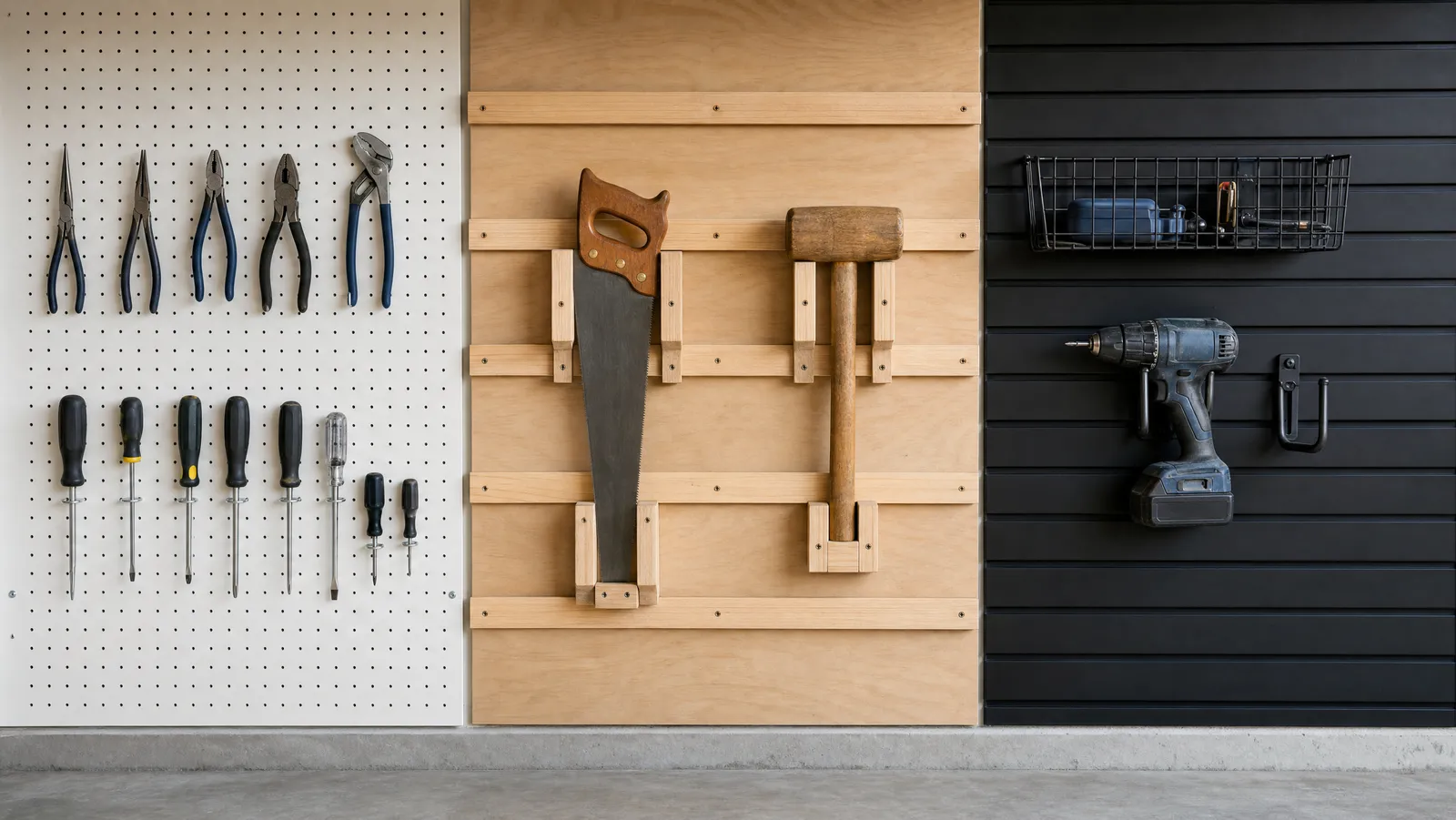
Pegboard vs French cleat vs slatwall comes down to one thing the shelf label hides: two of these are products you buy, and one is a system you build. Pegboard if you want a wall up this afternoon, slatwall if you want big hooks and a finished look, French cleat if you own a saw and a free weekend.
One thing to say plainly before the numbers start: we do not hands-on test tools. Every product figure below comes from the maker's published specification and the current listing price, and we tell you whose number it is. This comparison is part of our guide to the best garage tool storage for a home shop, and the three products are illustrative examples of each system rather than a ranking of brands.
The short answer
Two of these you buy, one you build
Search Amazon for a French cleat and most of what comes back is picture-hanging Z-clips, because there is no off-the-shelf French cleat panel the way there is an off-the-shelf pegboard or slatwall panel. Ready-made cleat hardware does exist - cleat-ripping jigs, lock clips and small wooden cleat kits are all listed as of September 2026 - but none of it is a wall you buy by the square foot. The system itself is a strip of plywood ripped at 45 degrees and screwed to your studs. Bob Vila puts the mechanism plainly: the beveled top edge of a French cleat is cut at 45 degrees, and positioning the second cleat over the lip of the installed wall cleat interlocks the two securely.
That asymmetry is the whole comparison. A pegboard panel and a slatwall panel are objects with a price and a delivery date. A French cleat wall is a weekend. The cleat rail and every holder that hangs on it is something you cut yourself, which is why French cleat is at once the cheapest system per square foot and the most expensive in hours. Family Handyman rates its own French cleat tool wall project at "Multiple Days" with a materials cost of $251 to $500, adding that you could build it for about half the price using 3/4-in. CDX construction plywood.
So the honest question is not which system is best. It is what are you actually short of: money, time, or the ability to change your mind later? A wall is only worth building once you own enough tools to lose one — a different problem from owning the tools worth owning first.
Pegboard vs slatwall on cost per square foot
Here is the arithmetic, with the sources attached. Prices are as of September 2026 and they move.
Hardboard pegboard. Lowe's lists a brown hardboard pegboard panel, 47.75 in. by 95.75 in., at $25.46 as of September 2026, and sheet-goods pricing moves by store. A nominal 4 ft. by 8 ft. sheet covers 32 square feet, so that is about $0.80 per square foot.
PVC slatwall. The NeatiEase panels are $149.99, and NeatiEase lists the 4 ft. by 8 ft. set as covering 32 square feet. That is $4.69 per square foot, or close to six times the hardboard.
French cleat. Lowe's lists a McCorry 3/4-in. by 4-ft. by 8-ft. sanded plywood sheet at around $69.85, which is $2.18 per square foot of sheet — but a cleat wall never covers the wall. Rip that sheet into 5 in. strips, bevel each down its centre, and you get roughly 120 linear feet of cleat after saw kerf. Rails every 10 in. up an 8 ft. by 8 ft. wall is about nine rows, or 72 linear feet. So the rails for 64 square feet of wall use around 60 percent of a sheet, near $0.65 per square foot, with the offcut going into holders.
The metal pegboard kit. The Wall Control kit is $120.04, and we are not going to quietly divide that into a per-square-foot figure. The kit price includes hooks and accessories, and every raw-sheet price above includes none — hooks for a bare sheet are a real second purchase. The listing also gives a 4 ft. kit without a coverage figure, so any number we produced would be a guess dressed as arithmetic.
Two costs hide in that table. A plain hardboard sheet cannot go flat on the wall: according to Wallwerx, on a flush wall surface furring strips are needed to set standard pegboard away from it so accessories can be inserted into the holes, with 1x2 or 1x3 the usual strip. Add strips and screws to the pegboard line. And the French cleat line buys rails only — the hours are the price, not the plywood.
Pegboard: cheapest in, easiest to change

Wall Control 4 ft. Kit
A metal pegboard kit that ships with its own hooks and accessories. Wall Control describes its metal board as more than ten times stronger than conventional pegboard, accepting both standard 1/4 in. pegboard pegs and its own slotted tool-board pegs, and mounting directly to studs or drywall with no furring strip or framework behind it.
Pros
- Mounts flat to studs or drywall - no furring strips to build first
- Takes both conventional 1/4 in. pegs and Wall Control slotted accessories
- Metal board will not blow out around the holes the way hardboard does
- Hooks and accessories are in the box
Cons
- Costs several times what a sheet of hardboard pegboard costs
- The 10x strength figure is Wall Control own claim, not an independent test
- Fixed hole grid - heavy or odd-shaped tools still need the right hook
Wall Control describes its metal board as more than ten times stronger than conventional pegboard. That is Wall Control's own marketing claim, not an independent test, and we have seen no third-party comparison that puts a number on it. The rest of the listing is more checkable: the board takes both conventional 1/4 in. pegboard pegs and Wall Control's own slotted accessories, and mounts directly to studs or drywall with no furring strip or framework behind it — which removes the extra job a hardboard sheet creates.
Peg size matters because of interoperability. According to Wallwerx, pegboard holes are typically standardised at 1/4 in. diameter on a 1 in. grid, which is why a bin or hook from one maker usually drops into a board from another. You cannot assume that of slatwall accessories between brands — we could not verify any cross-brand slatwall standard, so check before you commit to a hook set.
Pegboard's real weakness shows up on day one: hardboard blows out around the holes under heavy or awkward tools, and standard J-hooks lift out with the tool. Metal board fixes the first problem at several times the price. Neither fixes the second — that is a job for hook locks.
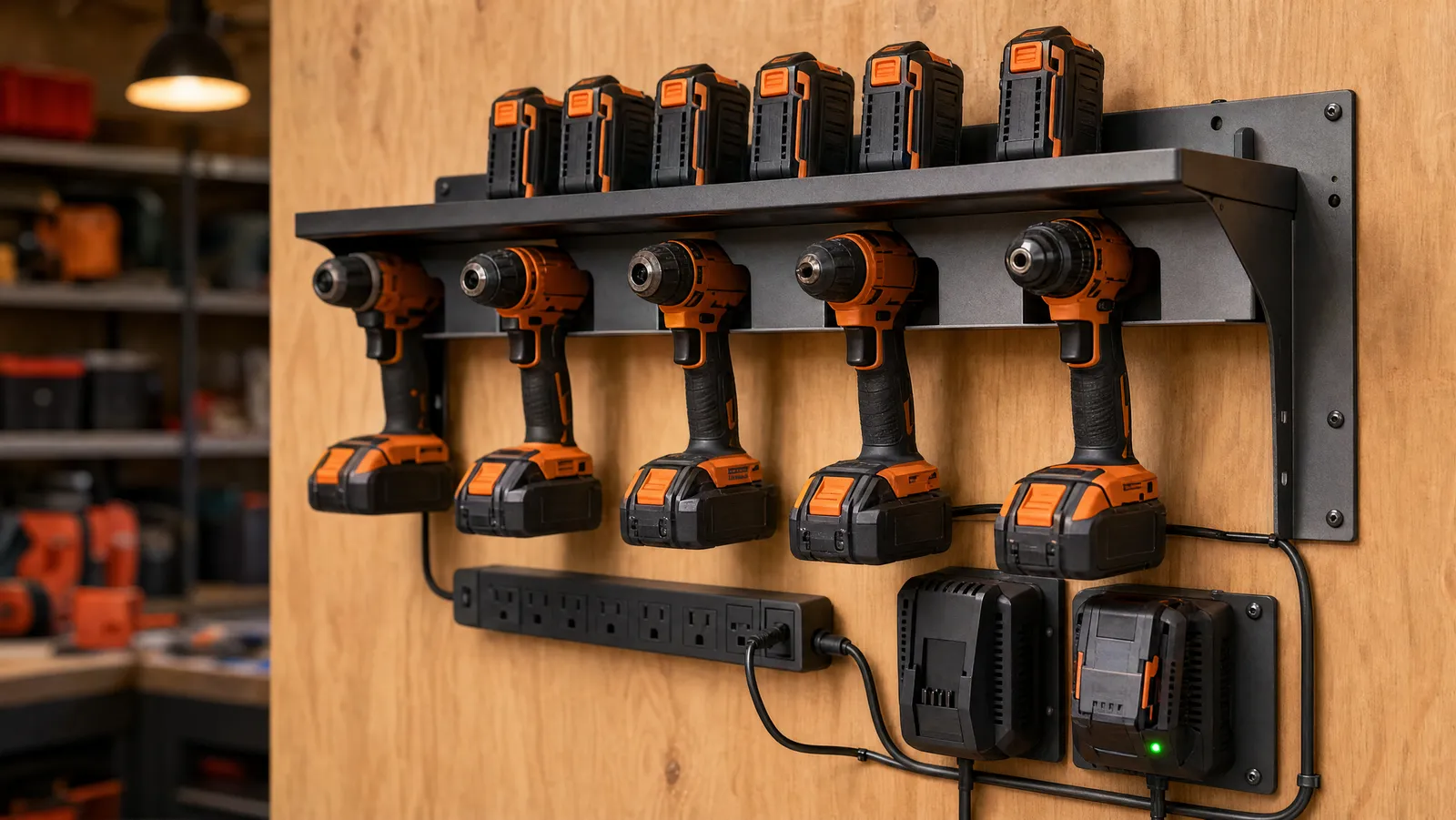
Pegboard is also the wrong home for anything that needs a plug. Chargers want air around them and a socket near them, which means a shelf rather than a hook, and we go through the layout in our guide to cordless tool battery storage and charging.
Slatwall: the heavy-duty, finished-looking option

NeatiEase 4x8 ft Slatwall
PVC slatwall sold as 1 ft x 4 ft sections that interlock into a 4 ft x 8 ft, 32 square foot wall. NeatiEase describes the PVC as waterproof, moisture-proof, fire-resistant and resistant to fading, drying, cracking and peeling, with interlocking seamless grooves and fixing to studs, drywall or masonry with screws.
Pros
- Continuous slots mean a hook goes anywhere along the run, not just on a hole
- PVC does not rust or rot in a damp unheated garage
- Interlocking sections let you cover exactly the wall you have
- Takes the large hook and basket accessories a pegboard cannot
Cons
- The most expensive of the three systems per square foot
- Load claims are relative to unnamed traditional plastic panels, with no stated pound figure
- Hooks and baskets are almost always extra
Slatwall's advantage over pegboard is geometric. NeatiEase sells this as 1 ft. by 4 ft. sections that interlock into a 4 ft. by 8 ft. wall covering 32 square feet, and because the slots run continuously a hook goes anywhere along the run instead of on the nearest hole in a grid — which is why it takes the large hooks and baskets a pegboard cannot. NeatiEase describes the PVC as waterproof, moisture-proof, fire-resistant and resistant to fading, drying, cracking and peeling, fixed to studs, drywall or masonry with screws. In an unheated garage that matters, because hardboard swells and steel finds something to rust.
Now the catch. NeatiEase states its load capacity only as three times that of unnamed traditional plastic wall panels, with no pound figure anywhere. You cannot plan a tool wall around a relative claim: three times an unknown is still an unknown. For contrast, a competitor publishes an absolute number — Proslat's FAQ states that its PVC slatwall "can hold up to 75 lbs. per sq.ft." That is Proslat's figure for Proslat's panel and tells you nothing about this one, but it does prove the number can be published when a maker wants to.
Proslat's fitting advice is worth borrowing whoever you buy from: on concrete or block it says to fasten 2 x 3 in. studs vertically at 16 in. spacing and fix the panels with 1-1/2 in. number 8 pan head screws. Same message as the rest of this article — the panel is only as good as what it is screwed to.
French cleat: the one you make yourself

Houseables Z-Clips
Aluminium Z-clips - the only part of a French cleat wall you can actually buy. Houseables sells them for mirrors and picture frames and rates the set to 50 pounds, supplying three pairs of brackets with anchors, screws, bumpers and a small level. On a tool wall they hang a cabinet or a shop-made holder; the cleat rail itself you cut from plywood.
Pros
- Costs a fraction of any panel system
- Lets a shop-made holder hang anywhere along a cleat rail
- Includes anchors, screws and a small level
Cons
- Sold as a picture and mirror hanging kit, not a tool-storage product
- The 50 lb rating is Houseables figure for picture hanging, not a shop rating
- Buys you only the clips - the cleat rail and every holder is still yours to build
Read that card carefully: it is here to make a point, not as a recommendation. Houseables sells these Z-clips as a mirror and picture hanging kit, not a tool-storage product, and the 50 lb rating is its own figure for picture hanging, not a shop rating. What $11.99 buys as of September 2026 is three pairs of aluminium brackets with anchors, screws, bumpers and a small level. On a tool wall they will hang a cabinet or a shop-made holder. They will not build you a cleat wall: the ready-made cleat hardware you can buy is sold by the clip or the holder, not by the square foot of wall.
The rail is yours to cut. Family Handyman's build sets the saw to 45 degrees, leaving about a 1/8 in. flat at the point of each bevel, then fixes the wall cleats with a pair of 1-1/4 in. trim-head screws every 16 in., 1 in. in from the top and bottom edges. Bob Vila recommends 3/4 in. plywood where the cleats will carry power tools and other heavy objects. That is the whole technology: two opposing bevels, and a load that pulls the holder into the wall rather than off it.
What you get for the hours is a wall where every holder is shaped for its tool — a drill cradle with a bit strip under it, a chisel rack with the right slot widths. Holders slide sideways along a rail in seconds, so horizontally the wall is infinitely rearrangeable. Vertically it is not: a holder can only live where a rail is, which is why people run rails the full height of the wall. All of it needs a saw you can trust for a repeatable rip.
Whatever you pick, the fixing is the weak point
All three systems fail in the same place, and it is not the panel. It is the screws.
Hit studs. Trusscore's framing guide puts 16 in. on centre as the standard spacing for residential wall framing, and says 24 in. on centre is used instead in many walls including garages, basements and energy-efficient builds; International Residential Code section R602.3.1, which governs stud size, height and spacing, requires utility grade studs to be spaced no more than 16 in. on centre. So in most US homes you have a fixing point every 16 in. - but by Trusscore's own account a garage is one of the walls that may be framed at 24 in., so find the studs rather than assume the spacing. The panel should meet every one it crosses — Bob Vila's cleat instruction is one 3 in. number 10 screw through the cleat into every stud it crosses.
If part of a run lands on bare drywall, be conservative and be specific about whose number you are trusting. Tanner Bolt's guide to toggle bolts gives up to 30 lb for a 1/8 in. toggle in 3/8 in. wallboard and up to 55 lb in 3/4 in. wallboard, and 100 to 105 lb for a 1/2 in. bolt in 3/4 in. wallboard. Read the wallboard thicknesses in those figures: neither is the 1/2 in. drywall in most American homes, so treat any published anchor rating as indicative, halve it in your head, and never use it as the design load for a wall of tools.
Which one we would build
Short of money, and the wall has to work this week: hardboard pegboard on furring strips, plus the hooks you need. At about $0.80 per square foot that is 32 square feet of storage for the price of a decent hand saw, and you can move a hook the second you get the layout wrong — which you will.
Short of time, and willing to spend to skip the job: the metal pegboard kit. At $120.04 as of September 2026 it costs several times a hardboard sheet, but the hooks are in the box, it mounts straight to studs or drywall with no furring strips, and the metal board does not blow out around the holes. Kit pricing moves more than sheet-goods pricing, so check the current Wall Control kit price before you decide.
Want it to look finished, and to hang big awkward things: PVC slatwall. The highest price per square foot here, hooks extra, but the continuous slots and large accessories are a capability the other two lack, and PVC does not care that your garage is damp.
Own a table saw and like the work: French cleat, every time. It is the only one of the three that ends up fitted to your tools rather than to a grid, and the plywood is cheap — as long as you are honest that you are spending a weekend, not an afternoon.
One boundary worth drawing whichever you choose: a wall is for the tools you reach for weekly, in sight and in one movement. Sockets, bits and fasteners belong in drawers, which is why we cover the best tool chest for a home garage separately.
Common questions
Can you mix two systems on one wall?
Yes, and it is often the sensible answer: pegboard or slatwall over the bench for small hooks and bins, with a cleat rail above or beside it for the heavy, oddly shaped things no hook fits. The systems do not interfere with each other; they just need separate fixings into the same studs.
Do pegboard hooks from different brands fit each other?
Usually, on conventional board. Wallwerx describes the standard as 1/4 in. holes on a 1 in. grid, and accessories built to that pattern generally interchange. Proprietary systems are the exception: Wall Control's board takes conventional 1/4 in. pegs as well as its own slotted accessories, but those slotted accessories are not a standard other boards share. Slatwall is the one to check hardest, since we found no published cross-brand standard.
How much weight can a tool wall hold?
Honestly, we cannot tell you, and neither can most listings. NeatiEase publishes no pound figure for these panels, Houseables' 50 lb is a picture-hanging rating for its set of clips, and Proslat's 75 lb per square foot applies to Proslat's own product. Those are not even the same kind of number - a rating for a set of hangers, a load per square foot of panel, and a relative claim with no unit at all - so do not line them up against one another. The number that governs your wall is the fixing: screws into studs at 16 in. on centre, against an anchor in drywall whose rating, per Tanner Bolt's figures, depends on a wallboard thickness you probably do not have.
Is slatwall worth six times the price of pegboard?
For bulky things — extension cords, a hedge trimmer, folding chairs, bags — yes, because the big hooks and baskets it takes have no pegboard equivalent we would trust. For hand tools, pegboard does the same job for a fraction of the money.
Where we would start
Put something on the wall this month rather than the perfect thing next year. A sheet of hardboard pegboard and a packet of hooks tells you within a fortnight which tools you reach for daily and which you never touch — and that map is what makes a French cleat wall worth building later, because by then you know what shape the holders need to be. Whatever you put up, screw it into studs. When the wall is done and the floor is still a mess, our full garage storage guide covers what comes next.
About the Author
Cheryl Thompson
Cheryl Thompson is the tools editor at The DIY Tool Review. A lifelong fixer and self-confessed tool addict, she has spent years buying, borrowing and wearing out hand and power tools across home renovation, furniture building and everyday repairs. She writes hands-on, no-nonsense reviews to help fellow DIYers spend their money on the tools that actually last.