Laser Measure vs Tape Measure: Which Is More Accurate?
On paper the two are close. In practice a tape wins under 10 ft and at the saw, and a laser wins across rooms, up walls and whenever you work alone.

- Category
- Measuring & Layout
- Tools tested
- 3
- Read time
- 12 min
- Updated
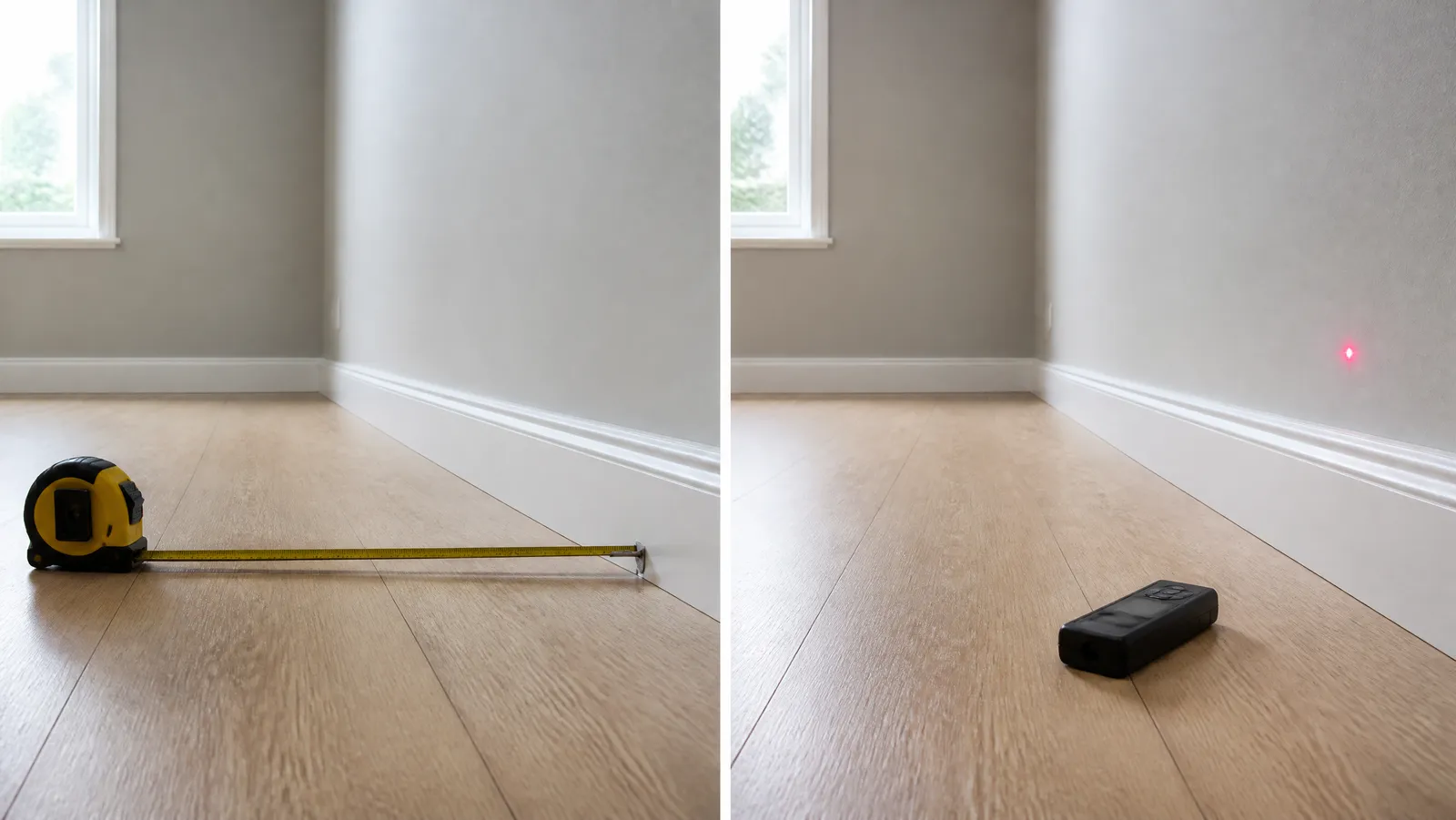
In the laser measure vs tape measure question, neither tool is more accurate on paper: both are good to about 1/16 in over a room-sized span. In practice, the tape is as accurate and faster under roughly 10 ft and for anything you will mark or cut, and the laser is more accurate across rooms, up walls and whenever you work alone.
The difference is in how each tool fails in your hands. A tape goes wrong through hook play, sag and misreading; a laser through the wrong reference edge, a tilted wrist and a bad target. That is why our measuring and layout tools for DIY guide puts the tape first and the laser second.
The short answer
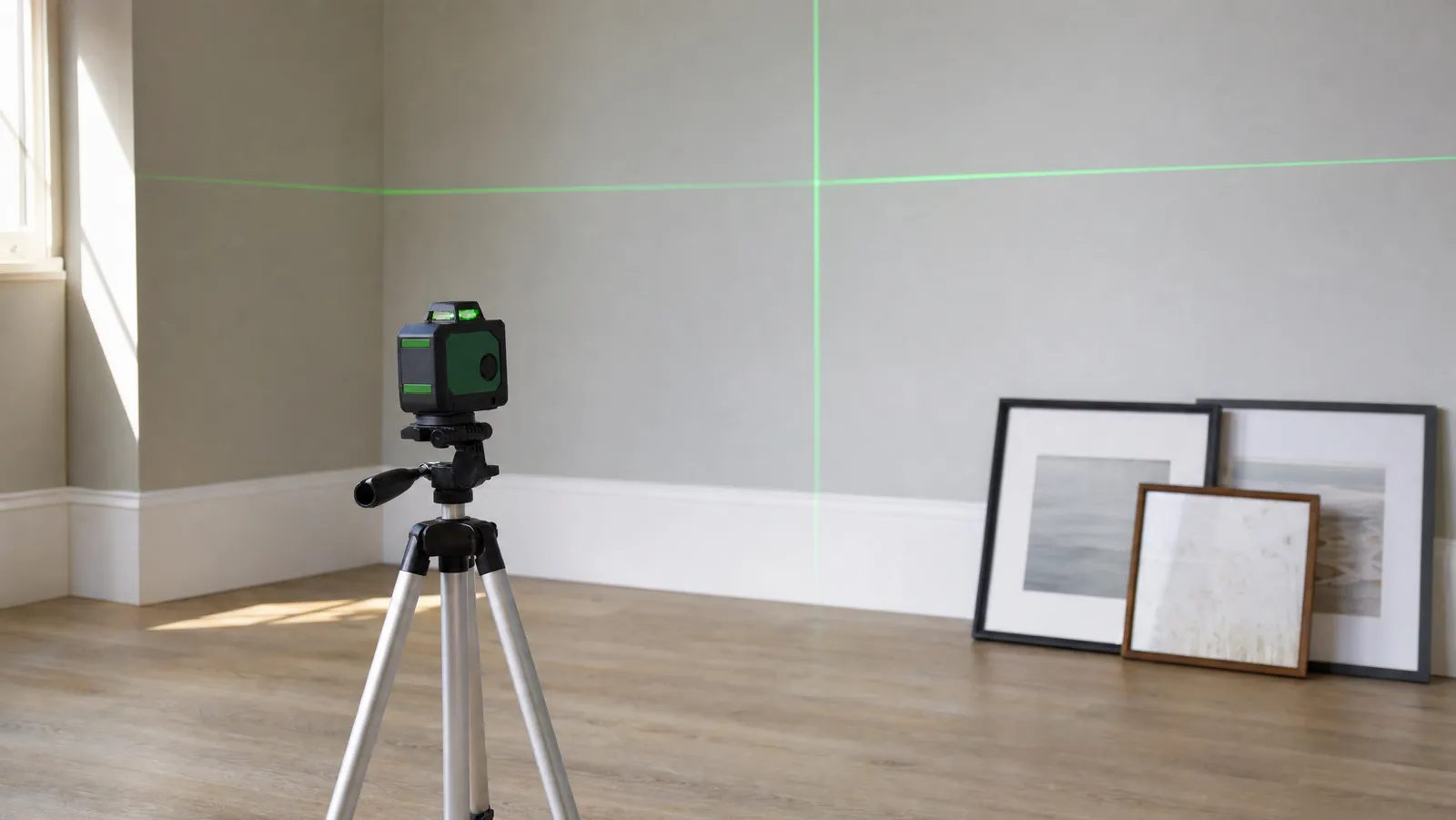
One naming trap: a laser level projects a reference line and knows nothing about distance, while a laser measure, as Johnson Level describes it, sends out a beam that reflects off a surface back to the instrument. If a level line is what you need, see the best laser levels for home use. Both come with red or green beams, and we cover green versus red laser beams separately.
Laser measure vs tape measure: the accuracy numbers
Most laser distance measure vs tape measure comparisons stop at the box. Compare what each tool is allowed to get wrong instead.
The US tape rule. NIST Handbook 44, the US code for trade measuring devices, gives metal tapes a stepped tolerance: plus or minus 1/32 in up to 6 ft, 1/16 in from 7 to 30 ft and 1/8 in from 31 to 55 ft. NIST tests tapes supported on a flat surface, and flexible tapes of 25 ft or less that are not normally used under tension are tested with none. Sag is not in the number.
The European tape rule. According to the UK's Measuring Instruments Regulations 2016, which mirror the EU Measuring Instruments Directive, the maximum permissible error in millimetres is a + bL, with L the length rounded up to the next whole metre. Class II uses a = 0.3 mm and b = 0.2 mm; the tighter Class I uses 0.1 mm for both. Measuring from an end face, which on a pocket tape means the hook, adds 0.2 mm in Class II.
The laser spec. Bosch lists the GLM100-23 at plus or minus 1/16 in out to 100 ft, but its manual calls that the favourable-conditions figure and adds 0.05 mm per metre of distance (plus or minus 5/32 in, plus 0.15 mm per metre, in unfavourable conditions); Mileseey lists its D5 at plus or minus 2 mm, about 0.08 in. ISO 16331-1, the test standard for handheld laser distance meters, says a specification written to it must state accuracy under favourable conditions (a white, diffuse target, low background light, about 20 °C) and under unfavourable ones. Treat a single headline figure as the good-day number.
The EU column below is our arithmetic. At 10 ft (3.05 m), L rounds up to 4 m: 0.3 + (0.2 × 4) + 0.2 = 1.3 mm. At 25 ft (7.62 m), L is 8 m: 0.3 + 1.6 + 0.2 = 2.1 mm. The laser column adds Bosch's 0.05 mm per metre to its 1/16 in: at 25 ft, 0.0625 + 0.015 = about 0.078 in.
At 6 ft a tape is allowed half the laser's error. At 10 and 25 ft the two sit within about two hundredths of an inch. Only past 30 ft does the laser pull clearly ahead. For most DIY lengths, the spec sheet is a tie. One caveat: the tape columns describe what a tape must meet as a legal measure, and the Stanley figures we worked from quote no accuracy class.
Is a laser measure accurate in real rooms?
Yes: to its spec, on a good target, held square, from the right edge. Miss any of those and the display will not tell you.
The reference edge. Johnson Level's manual for its 40-6001 says the default is the rear of the instrument for all modes. Choose the wrong edge for how you are holding it and every reading is out by the tool's length, 4.7 in on that model per its spec sheet. That is 75 times its rated plus or minus 1/16 in, and it looks exactly like a correct number.
The tilt. A laser measures along the beam. Aim at a flat wall 20 ft away with the tool tilted 5 degrees and the beam travels 20 / cos 5°, or 20.08 ft: about 0.9 in long.
A 2-degree tilt you would never see costs 0.15 in at 20 ft, about twice the Bosch's rated error.
The target and the light. According to ISO 16331-1, the more reflective the target, the better the measurement. The standard puts indoor background light typically below 3,000 lux, but says sunlight reflected off an outdoor target might reach 100,000 lux and degrade performance. Johnson's manual lists glass, water and high-gloss surfaces as causes of measuring errors, and says dark or porous ones may return an error.
Where the tape wins
- Marking and cutting. Hook the board, run the blade, tick the pencil at the number. A laser gives you a number you still need a tape to put on the wood.
- Short spans. Up to 6 ft NIST allows a tape 1/32 in, half the Bosch's rated error, and a tape is quicker to pull than a laser is to set up.
- Outside dimensions. A laser needs a solid surface to bounce off, so it cannot measure to an edge in mid-air.
- Curves and simplicity. A blade bends round a post; a beam only goes straight. There is also nothing to charge or set.
- Stud marks. Stanley lists 16 in and 19.2 in stud centre markings on the FatMax blade.
Once the tick is on the board, square it across; see how to use a speed square.
Where the laser measure wins
- Long spans alone. No helper, no sag, no hook to slip.
- Ceiling heights. Stand it on the floor and fire upward. No ladder.
- Whole rooms and tall walls. Mileseey lists area, volume and Pythagorean modes plus an angle sensor for the D5, so a few shots give you a flooring estimate or a gable height.
- Reading. A display has no sixteenths to miscount.
The mistakes that make each one wrong
Tape measure mistakes
- Hook play. The loose hook is deliberate. According to Pro Tool Reviews, it moves by its own thickness, so zero sits on the back of the hook when you pull over an edge and on the front when you push against a wall. That only works on an undamaged hook. If a tape has been dropped on its hook, burn an inch: measure from the 1 in mark and subtract it. We cover that in how to use a tape measure like a pro.
- Reading at an angle. A graduation seen from the side appears to shift. Put your eye straight over it, or tick a pencil mark instead of reading a number.
- Sag and bends. Stanley lists an 11 ft standout for the FatMax. Past it the blade droops, and a sagging or bent blade reads long because the curve is longer than the straight line. Support the middle, measure in two straight legs, or use the laser.
- The helper at the far end. A hand slightly off the mark adds error you cannot see. A clamp or nail does not wander.
Laser measure mistakes
- Wrong reference edge. Johnson Level's advice is to make sure the meter is set to the right position (front, rear or corner extension piece). Check again when you move to a window reveal.
- Tilt. Take three or four readings, as Johnson's manual suggests for critical measurements, and keep the shortest; against a flat wall, the square shot is the shortest.
- Wrong surface. On a long shot, check the dot is on the wall, not a door frame.
- Glass, dark or shiny targets. Johnson's manual suggests placing a white sheet of paper over the target.
- Sunlight. Shade the target, measure at dusk (Johnson's manual says range may be greater then), or use the tape.
The three tools, as examples
We do not hands-on test tools. Everything below comes from published manufacturer specifications, current price and availability. These three illustrate the categories; they are not a ranking.
The tape
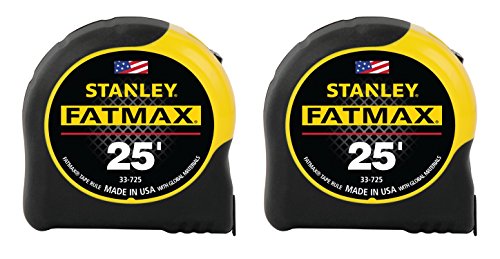
Stanley FatMax 25 ft 2-Pack
Stanley lists an 11-foot standout plus 16-inch and 19.2-inch stud centre markings, blade armour on the first 3 inches and a Mylar film over the rest. Two in the box.
Pros
- 11-foot standout reaches across a room unsupported
- 16 in and 19.2 in stud centre marks built into the blade
- Blade armour coating on the high-wear first 3 inches
- Two tapes - keep one in the car
Cons
- Bulkier in the pocket than a 16 ft tape
- Past the standout it sags, and long spans need a second person or a hook point
- You are paying for two
Stanley lists an 11-foot standout, 16 in and 19.2 in stud centre markings, blade armour on the first 3 inches and a Mylar film over the rest. In this comparison the standout matters most: it is how far the blade reaches before it folds, so it is the practical limit of measuring alone. Beyond 11 ft you want a helper, a hook point or a laser.
The stud marks save arithmetic. The 16 in marks match common stud spacing, and five 19.2 in spaces make exactly 8 ft.
At $40.95 as of September 2026 for the pair, and prices move, that is about $20.50 a tape. The catch is bulk: a 25 ft blade is a heavier pocket than a 16 ft one. The upside of two is one for the drawer and one for the car.
The laser measure

Bosch GLM100-23 Blaze
A pocket-size, two-button laser measure. Bosch lists a range of up to 100 ft, accuracy of plus or minus 1/16 in, a real-time measuring mode, a rounding button that reads from 1/2 in down to 1/32 in, a backlit display and two AAA batteries in the box.
Pros
- Bosch rates it plus or minus 1/16 in in good conditions, over up to 100 ft of range
- Real-time mode updates as you walk toward or away from a wall
- Rounding button reads to the nearest 1/2 in down to 1/32 in
- Weighs 0.19 lb, so it genuinely lives in a pocket
Cons
- Distance only: Bosch describes two buttons, measure and round, with no area or volume maths
- Needs a solid surface to bounce off - it cannot measure to an edge in mid-air
- Runs on two AAA batteries, so keep spares in the drawer
Bosch lists the GLM100-23 at up to 100 ft and plus or minus 1/16 in, with a real-time mode that updates as you walk toward or away from a wall and a rounding button that sets the display from the nearest 1/2 in down to 1/32 in. It weighs 0.19 lb.
Rounding earns its keep: a 1/32 in display shows more precision than you can mark, so round coarser for rough work. Real-time mode is the practical fix for tilt: pan slowly across the wall and keep the smallest reading.
It is distance only. Bosch describes two buttons, measure and round, and lists no area, volume or Pythagorean modes. If the Amazon listing title mentions AA batteries, go by Bosch, which lists two AAA. At $62.99 as of September 2026, and prices move, it costs more than both Stanley tapes and still cannot mark a board.
The budget laser with maths

Mileseey D5
The low-cost route to the maths a tape cannot do. Mileseey lists a 70 m (229 ft) range, accuracy of plus or minus 2 mm (about 0.08 in), an electronic angle sensor to plus or minus 0.3 degrees, area, volume and 3-point Pythagorean modes, 30 stored readings, IP54 and two AAA batteries.
Pros
- Calculates area and volume for flooring and paint estimates
- Angle sensor works out horizontal distance and height from a sloped shot
- Stores 30 readings, so you can measure a whole room before writing anything down
- IP54 splash and dust resistance, per Mileseey
Cons
- Every figure here is Mileseey's own, not independently tested
- More modes means more buttons to learn than a two-button tool
- Like every laser measure, its usable range drops in bright sunlight
Mileseey lists a 70 m (229 ft) range, plus or minus 2 mm accuracy, an electronic angle sensor to plus or minus 0.3 degrees, area, volume and 3-point Pythagorean modes, 30 stored readings, IP54 and two AAA batteries. That is precisely what the Bosch leaves out, at $26.09 as of September 2026 (prices move), well under half the price.
Every one of those figures is Mileseey's own, not an independent test. Its 2 mm is a shade looser than Bosch's figure, and irrelevant for paint. The angle sensor is the real gain: from a sloped shot it works out horizontal distance and height, so you can size a stair run or a gable from the ground.
The trade is buttons: more modes, more ways to have the wrong one selected. Indirect modes also need a steady hand; Johnson Level's manual advises holding the tool in one position and pivoting your wrist between shots.
How to choose the best laser measure for home use
- Range you will use. Measure your longest room. Extra range mostly matters outdoors, where sunlight shortens it anyway.
- A comparable accuracy figure. Plus or minus 1/16 in, about 1.6 mm, is roughly where both our examples sit. A maker that also quotes unfavourable conditions, as ISO 16331-1 asks, is telling you more.
- Area and volume maths, if you estimate flooring or paint.
- An angle sensor, for heights, slopes and stair runs.
- Reference-point switching with a clear on-screen indicator.
- A readable display. Bosch lists a backlit one on the GLM100-23.
What we would buy
A 25 ft tape first. It does the job you do most and never needs charging. The Stanley FatMax 25 ft two-pack covers the house and the car.
A laser second, when you start measuring rooms rather than boards. For distances alone, the Bosch GLM100-23 is the one we would buy: two buttons, few ways to be wrong. If you will genuinely use area, volume and angle modes, the Mileseey D5 does all three for well under half the price, on Mileseey's own figures.
Who should skip the laser? Anyone whose projects are shelves, trim and flat-pack furniture, anyone who always has a helper, and anyone who measures mostly outdoors in daylight.
So which is more accurate?
Neither, on the spec sheet. Under 10 ft the tape is as accurate, quicker, and the only one that marks a board. Across a room, up a wall or on your own, the laser is more accurate in practice because it takes sag, hook play and misreading out of the job, provided you set the reference edge, hold it square and give it a decent target.
Buy the tape first; add the laser when rooms, not boards, become the job. For where both sit in a complete kit, start with our measuring and layout tools hub.
About the Author
Cheryl Thompson
Cheryl Thompson is the tools editor at The DIY Tool Review. A lifelong fixer and self-confessed tool addict, she has spent years buying, borrowing and wearing out hand and power tools across home renovation, furniture building and everyday repairs. She writes hands-on, no-nonsense reviews to help fellow DIYers spend their money on the tools that actually last.