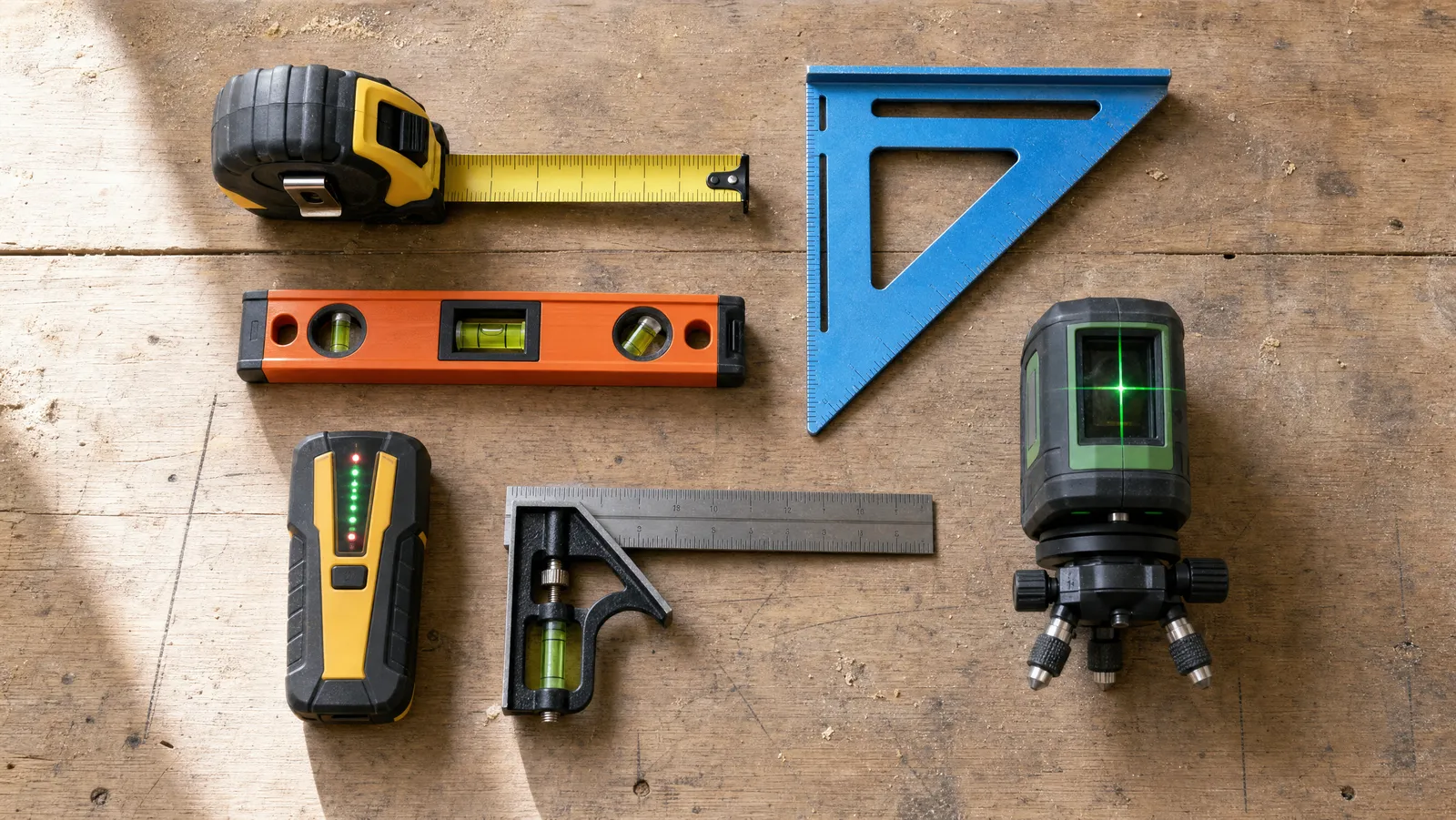
Laser Level vs Spirit Level: Which Do You Actually Need?
A spirit level is a contact tool whose useful length is its actual length. A laser projects a reference across a room and holds it there so you can work alone. They fail in opposite directions, which is why the honest answer is buy the level first and add the laser when the job gets long.

- Category
- Measuring & Layout
- Tools tested
- 2
- Read time
- 13 min
- Updated
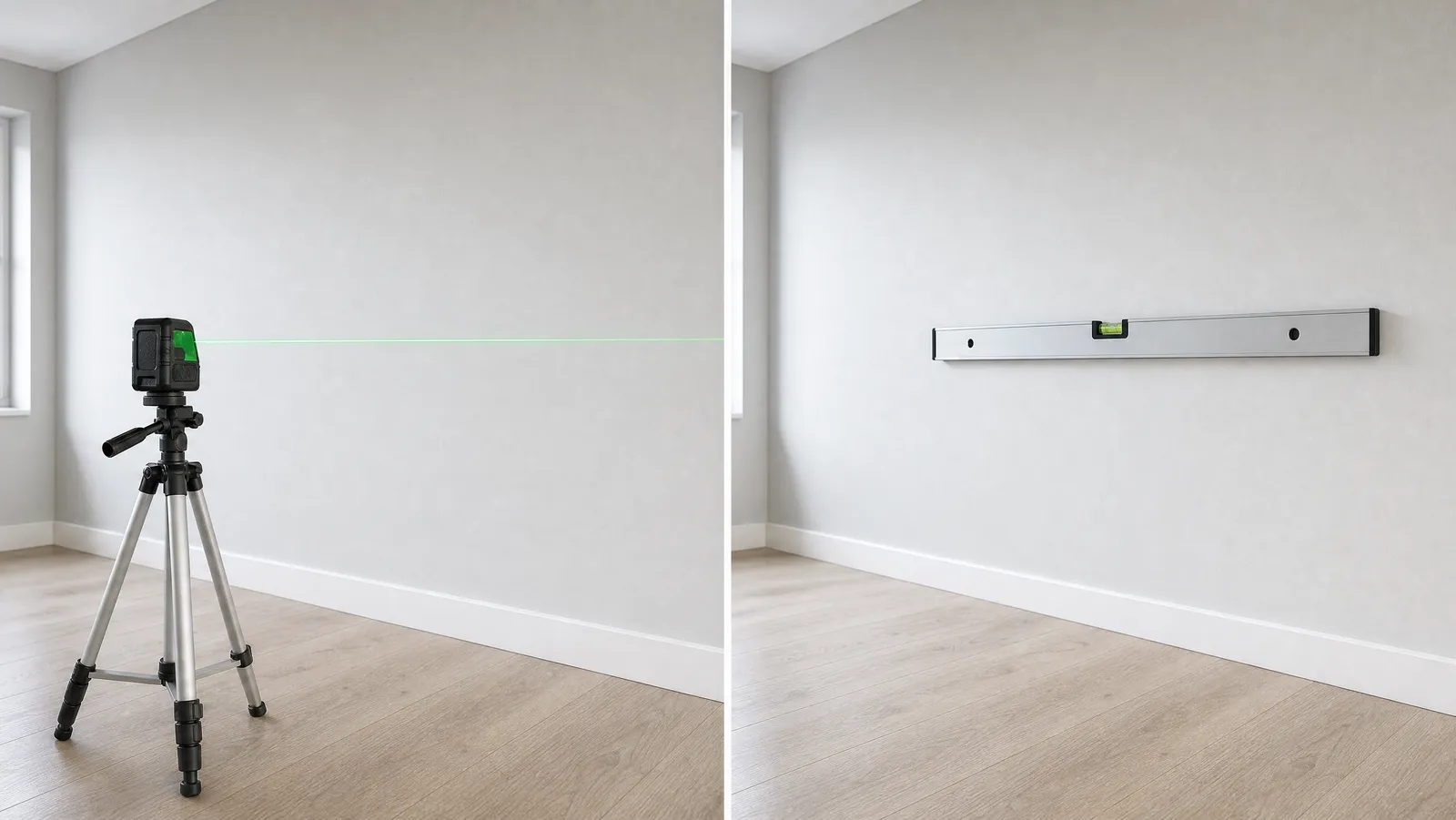
Laser level vs spirit level is not the either/or question the shelf makes it look like. A spirit level is a contact tool whose useful length is its actual length. A laser throws a reference across the room and holds it there while both your hands are busy. Buy the spirit level first, and add a laser the day you start working alone.
They fail in opposite directions, which is why most households that do more than hang pictures end up owning both. A laser cannot tell you that one cabinet door hangs a hair out of plumb. A spirit level cannot hold a line across twelve feet of wall while you drill. Below we set the two error models side by side and give you the order to buy in. This sits inside our wider measuring and layout tools for DIY guide.
The short answer
What each tool physically does
A spirit level is a machined straightedge with sealed vials of liquid set into it. The liquid does not fill the vial, so a bubble sits in the gap and floats to the highest point. The vial is curved, so that highest point is the middle only when the reference edge is level. Everything the tool tells you is about the surface it is touching, along the span it covers.
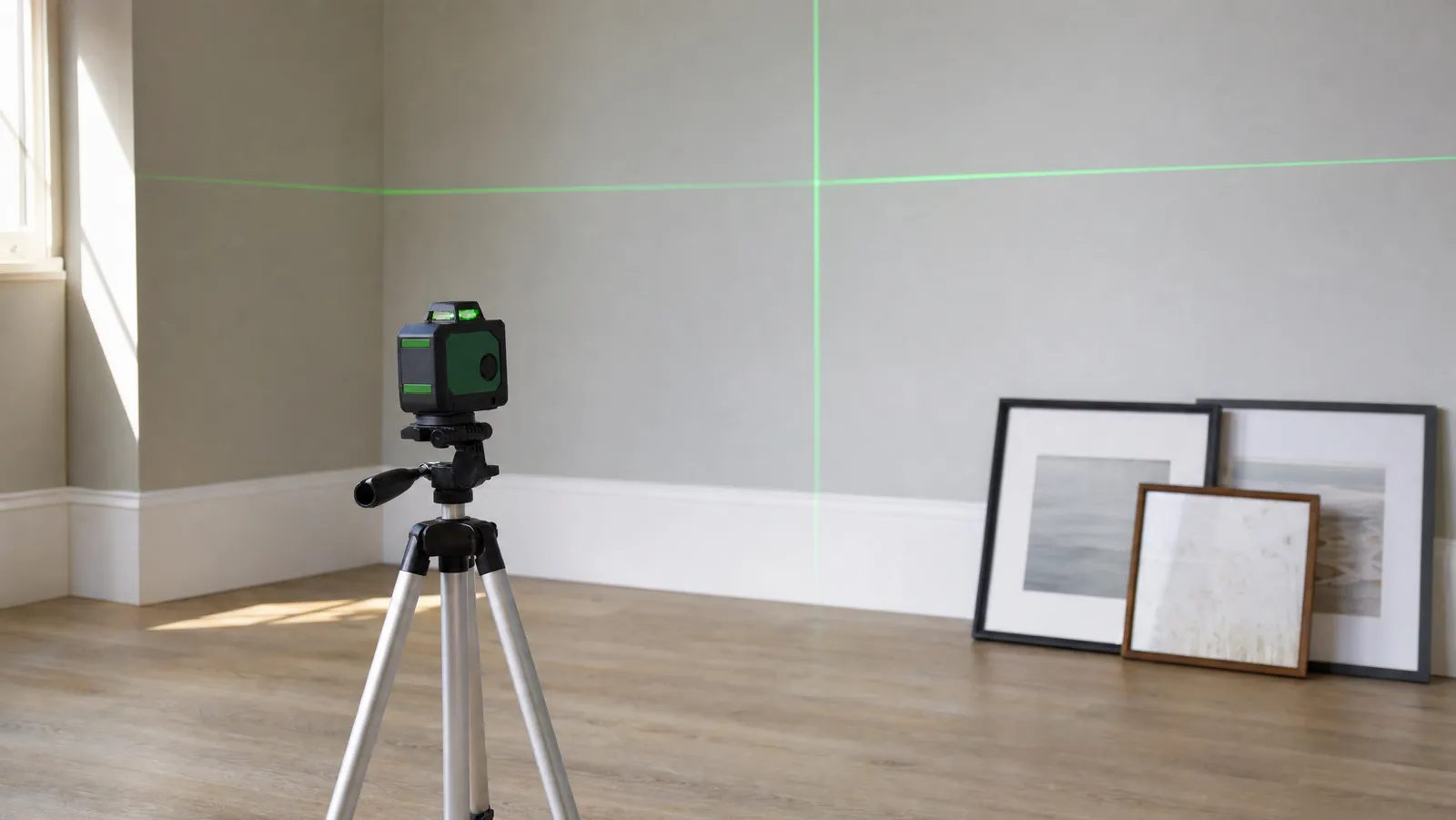
A laser level does something different in kind. It fans a beam through a lens into a line, then keeps that line horizontal for you. On the self-leveling models almost every homeowner buys, the mechanism is a pendulum. Kapro describes it plainly: the pendulum swings freely and aligns itself with gravity, and the laser beam follows the pendulum, keeping the line level. Magnetic damping, Kapro adds, slows the oscillation so the pendulum settles faster, giving a stable line without wobble.
The consequence is that a laser has no idea what it is pointing at: it projects a plane and leaves you to decide what to do with it. A spirit level has no idea what is happening more than a foot away. Hold that difference in your head and the buying decision mostly answers itself.
Spirit level vs laser level accuracy: the numbers are not comparable
This is where the shelf comparison falls apart, because the two specs are quoted in different units and mean different things.
Motovera quotes the laser at plus or minus 1/9 inch at 33 feet. That is an angular tolerance dressed up as a distance: stand twice as far away and the possible error doubles. That odd 1/9 inch is a metric figure in imperial clothing — it is what you get converting 3 mm at 10 m.
Vial accuracy is quoted per unit of length instead. According to Johnson Level, the best spirit levels are accurate to plus or minus 0.5 mm per metre, which it gives as 0.0005 inches per inch or 0.029 degrees, with the next tier down at 0.75 mm per metre or 0.043 degrees. That figure does not grow with distance, because a vial has no distance. It only ever describes the span the tool covers. A longer spirit level is more accurate over a wall than a short one purely because it spans more of the wall — the vial is not better, the sample is bigger.
Here is what that looks like if you scale both figures out. The laser column uses Motovera's own number; the vial column uses Johnson's professional tolerance.
Two things fall out of that table. Over a short span the laser's stated tolerance is actually tighter than a good vial's — angularly it is about 0.016 degrees against 0.029. And over any span longer than the level you own, the vial column stops existing. That is the real trade: you are not buying accuracy with a laser, you are buying reach.
One caveat on the laser column: those are the manufacturer's numbers under manufacturer conditions. RayXact's calibration guide recommends a field verification test before every new job for finish work, professional calibration every six months for a daily-use rotary laser, and a check at least every twelve months otherwise. A spirit level has nothing to drift. A laser dropped in a truck bed has.
Where a laser level genuinely wins
Four situations, all the same shape: the reference has to stay in place while you move.
A run of cabinets or shelves. Set the line once and hang every unit to it. With a spirit level you re-establish the reference at every bracket, and small errors stack across the run.
A tile course. Cumulative error is the enemy in tile, and a projected line does not accumulate anything. You either sit on the line or you do not.
A gallery wall. Cross-line models put a plumb line up as well, so you get centres as well as heights without a pencil, a string and a friend.
Anything you are doing alone. This is the honest headline. A laser is a second pair of hands that never moves and never has to be somewhere at four o'clock. If you work solo, that is worth more than any accuracy figure on the box.
Suspended ceilings belong on the list for the same reason: the reference is a plane at a fixed height around a whole room, which is what a laser produces and what a four-foot level cannot. If you have decided a laser is the answer, we compared the sensible options in the best laser levels for home use.
Where a spirit level genuinely wins
Short spans against something you can touch. Is this shelf level? Is this door plumb? Is the washing machine flat? Those are contact questions, and putting a laser on them is like using a theodolite to find your keys.
Outdoors in daylight. The failure most buyers do not see coming. Dovoh notes that a green beam is generally more visible than red in daylight, but that a detector is what finds the beam beyond the range your naked eye can see — and detectors are sold separately and need pulse mode switched on. Assume a sub-$50 laser is an indoor tool unless you buy the receiver too.
Angles that are not level or plumb. A torpedo with 30, 45 and 90 degree vials reads a conduit bend or a stair stringer directly. A cross-line laser reads exactly two angles.
Cost, batteries and durability. Nothing to charge, nothing to calibrate. It works in a power cut, in the rain, and in eleven years' time.
There is a related question we treat separately — a laser measure against a tape measure — because distance and level are different problems. And for finding what is behind the plasterboard before you drill on your nice new line, that is a third tool again: see the best stud finders for DIY.
The two tools, as examples
Before the cards: we do not hands-on test tools on this site. Everything below comes from published manufacturer specifications, current price and availability, and we say so in every guide so you can weight our opinions accordingly. These two are illustrative of their categories, not a shortlist — for a proper shortlist see the best levels for DIY.
The laser
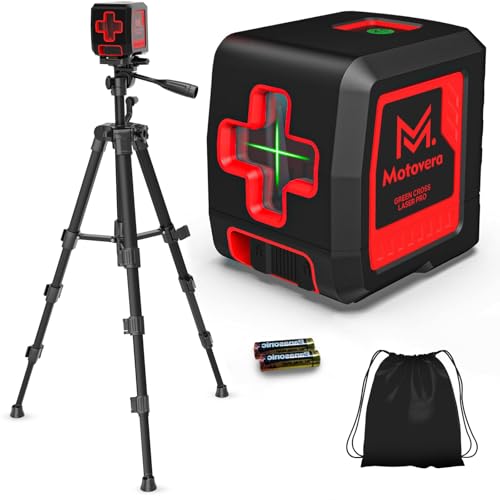
Motovera Green Cross Line
Motovera lists a green cross-line laser visible to 100 ft indoors, an accuracy of plus or minus 1/9 inch at 33 ft, self-leveling within plus or minus 4 degrees with a lockable pendulum for manual mode, Class II under 5 mW, IP54, and a tripod, batteries and bag in the box.
Pros
- Projects a reference line across a whole room and holds it there
- Manufacturer accuracy of plus or minus 1/9 inch at 33 ft
- Self-leveling within 4 degrees, with a manual mode for slopes
- Tripod, two AA batteries and a carry bag included
Cons
- Needs batteries, and outdoors you need a receiver sold separately
- The 4x-brighter-than-red figure is the maker’s own claim
- More tool than a picture-hanging job actually requires
Motovera lists a green cross-line laser visible to 100 feet indoors, accurate to plus or minus 1/9 inch at 33 feet, self-leveling within plus or minus 4 degrees with a lockable pendulum for manual mode. It is rated IP54 and listed as Class II under 5 mW, and the box includes a tripod, two AA batteries and a bag. That last detail matters: a laser without a mount is a laser you balance on a paint tin.
The green beam is the sensible choice indoors for a reason that has nothing to do with marketing: Photonics Online says the human eye is especially sensitive to green light, which appears almost 30 times brighter than red at the same power. Motovera's own figure is that its beam is four times brighter than standard red lasers, and that is the manufacturer's claim, not a measured result we can verify. We look at green versus red laser beams properly in a separate piece.
At $37.98 as of August 2026 — and laser prices move constantly — this is the class of tool where a homeowner gets essentially all of the benefit. The catches come with the bracket: it eats AA batteries, and outdoors you will need a receiver that is sold separately. It is also, frankly, more tool than hanging one picture requires.
The spirit level

Klein Tools 935AB4V
Klein lists a patented magnet track holding captive rare-earth magnets, vials at level, 90, 45 and 30 degrees, a V-groove for pipe and conduit and a thumb screw for hands-free work on round stock.
Pros
- Nothing to charge, nothing to break, nothing to calibrate
- Magnets hold it on a steel stud or an appliance hands-free
- Reads 30 and 45 degrees as well as level and plumb
- Fits in a back pocket
Cons
- Only as long as it is - six inches of reference, no more
- Cannot project a line across a room or work solo on a cabinet run
- Its ±0.029-degree vial tolerance only ever describes the six inches it touches
Klein lists a patented magnet track holding captive rare-earth magnets, vials at level, 90, 45 and 30 degrees, a V-groove for pipe and conduit, and a thumb screw so it will sit hands-free on round stock. That is why a six-inch torpedo earns its place in so many tool bags: four angles, it sticks to a steel stud or a boiler while both your hands are elsewhere, and it fits in a back pocket.
It also shows the category's honest ceiling. It is only as long as it is — six inches of reference, no more — and it cannot hold a line across a room or work solo on a cabinet run. On paper the vial itself is not a weak one: Klein publishes a vial accuracy of plus or minus 0.029 degrees for the 935AB4V, which is exactly the tolerance Johnson Level quotes for the best spirit levels. What it does not have is reach. That 0.029 degrees only ever describes the six inches the tool is touching, while the Motovera's 1/9 inch at 33 feet is a figure that travels — and grows as it goes.
At $29.97 as of August 2026, it costs less than the laser and does the job you will do far more often. If you own no level at all, start here, then add a 24 or 48-inch one when you begin hanging things wider than your hand.
Self-leveling, and what happens past 4 degrees
Motovera lists self-leveling within plus or minus 4 degrees, with a lockable pendulum for manual mode. Two things follow from that, and both confuse first-time buyers.
The first is that the pendulum does the levelling, not the electronics. Kapro's description applies: it hangs, gravity finds vertical, the beam follows. That is why you must let the tool settle before you mark anything, and why you should lock the pendulum for transport if the model lets you — the lock is protection as much as it is a slope mode.
The second is what happens past the range. Kapro notes that if the device is tilted beyond its levelling range, most tools alert the user, and the lines may blink or an indicator may appear. A flashing laser line is a warning, not a fault. The pendulum has hit the end of its travel and the line is no longer level. Level the tripod or the surface until the flashing stops; do not return the tool.
Manual mode inverts that. Lock the pendulum and the beam points wherever the housing does, which is what you want for a handrail, a drainage fall or a ramp. Just remember you locked it — a locked pendulum on a job that needed a level line wastes an afternoon.
Is a laser level worth it? What we would actually buy
Yes, if you work alone or your projects are wider than your longest level. No, if they are not — and there is no shame in the second answer.
The order we would buy in:
- A torpedo level first, around $30. It answers the most common question in the house and it will outlive you.
- A 24 or 48-inch level second, if you hang shelves, fit doors or tile. Length is accuracy in this category, and a longer level fixes more problems than a laser does.
- A cross-line laser third, around $38, and only when a specific job asks for it. Cabinets, tile, a gallery wall, a ceiling.
If you want to jump straight to it, the two we have used as examples here are the Klein Tools 935AB4V torpedo level and the Motovera green cross-line laser. Both prices are as of August 2026 and both move.
Who should skip the laser entirely? Anyone whose DIY stops at pictures, curtain poles and flat-pack furniture; anyone who always has a second pair of hands; and anyone whose next job is outdoors in daylight, because without a receiver the beam will not be there when you look for it. Rent one for the single kitchen you fit and put the $38 towards a longer level instead.
Laser level or spirit level: the last word
A spirit level tells you the truth about one thing you are touching. A laser tells you the same truth about a line across a room, and holds it there while you work. That is the whole difference, and it is why the real question is "which first", not "which one".
Start with the level. Add length before you add lasers. Buy the laser when a job — not a spec sheet — asks for it, and when it does, buy the cheap green cross-line one and put the savings into tile. For where each tool sits in a complete kit, start with our measuring and layout tools hub.
About the Author
Cheryl Thompson
Cheryl Thompson is the tools editor at The DIY Tool Review. A lifelong fixer and self-confessed tool addict, she has spent years buying, borrowing and wearing out hand and power tools across home renovation, furniture building and everyday repairs. She writes hands-on, no-nonsense reviews to help fellow DIYers spend their money on the tools that actually last.