The Best Cordless Impact Drivers for DIY (2026)
An impact driver is the tool that sinks long screws and lag bolts without stripping heads or wrecking your wrist. Here are the five we'd recommend for home DIY — and why the battery you already own matters more than any torque number.

- Category
- Power Tools
- Tools tested
- 5
- Read time
- 14 min
- Updated
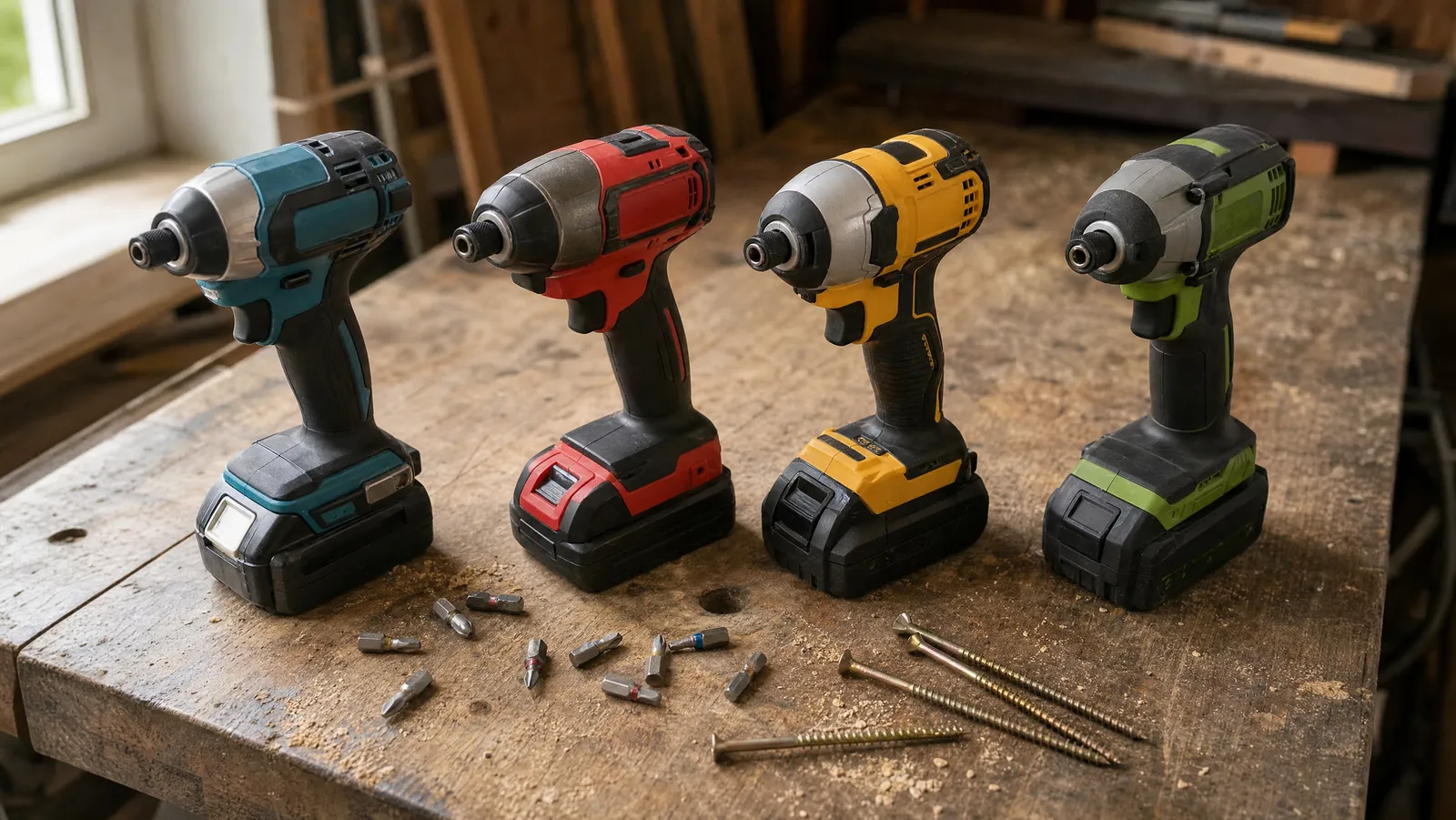
An impact driver is the tool that sinks long screws and lag bolts without stripping the head or wrecking your wrist. The best cordless impact driver for DIY isn't the one with the biggest torque number on the box, though — it's whichever solid brushless model runs on the battery platform you already own. Get that part right and everything else is detail.
If you own nothing yet, we'd start with the DeWalt DCF787C2 kit: brushless, 1,500 in-lbs, two batteries and a charger in the box. Below are five picks, a plain-English translation of the specs that matter, and the one buying trap that catches almost everybody. For the wider view of what belongs in a cordless arsenal, start with our best cordless power tools for DIY guide.
Drag to compare all 5 →
Prices here run from $65.00 for a bare-tool Milwaukee to $177.85 for the Makita kit as of July 2026, and those numbers move — sometimes weekly. Two of the five are bare tools, meaning no battery and no charger in the box. We flag that every single time it comes up, because it's the biggest source of sticker shock in this category.
What an impact driver actually does
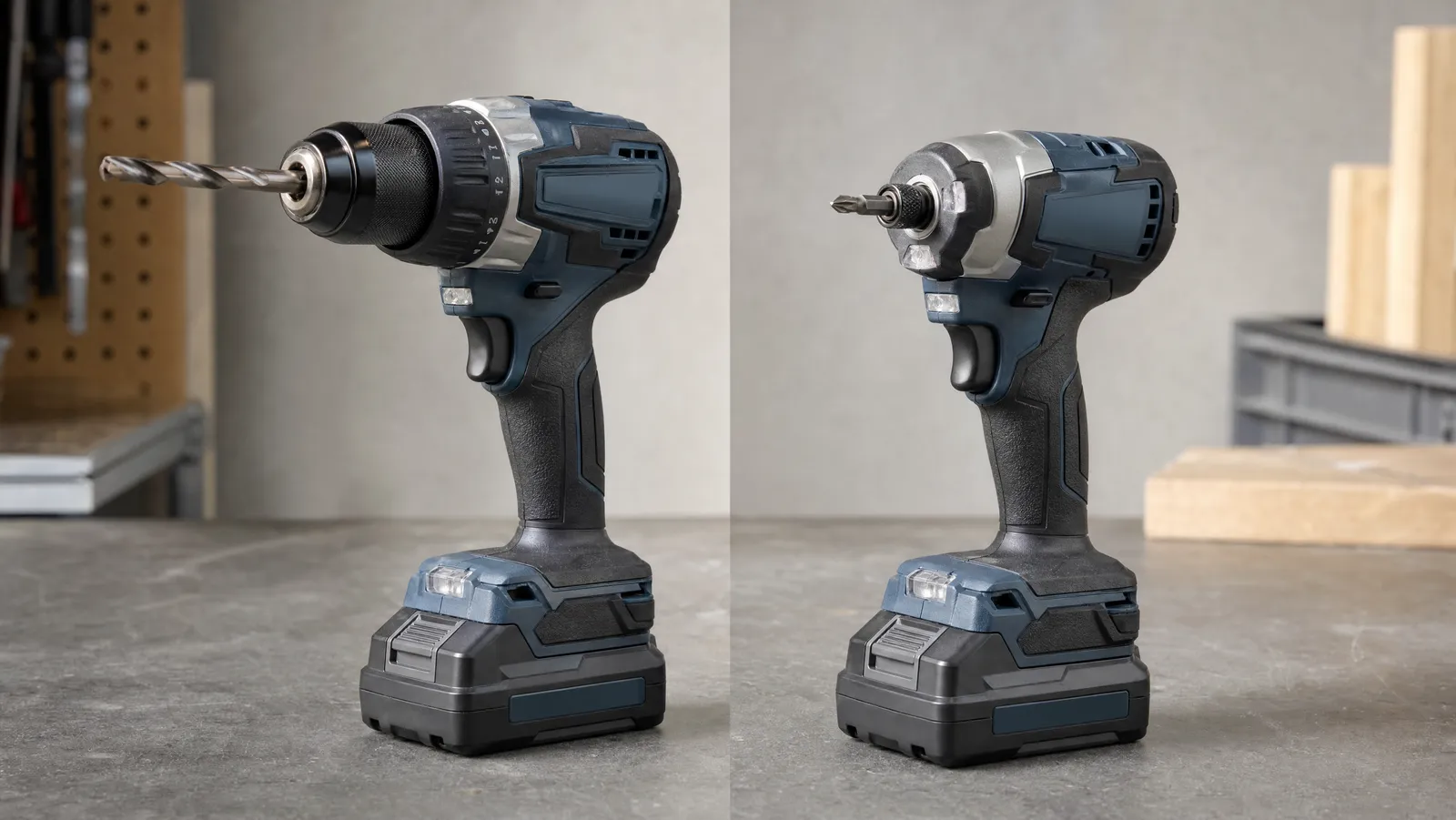
An impact driver drives fasteners. A drill makes holes. That's the whole distinction, and it comes down to what's inside the housing: a spring, a hammer and an anvil. As Engineer Fix describes it, the motor winds the spring, the spring releases the hammer, and the hammer strikes the anvil rotationally to turn the bit. Pro Tool Reviews notes this cycle can exceed 3,000 impacts per minute — roughly 50 hits per second — which is why an impact driver sounds like a tiny machine gun instead of a motor.
Why that beats a drill on fasteners: the twisting force never has to travel through your wrist. A drill fights you, building steady torque until the fastener binds and the tool tries to spin out of your hands. An impact driver delivers the same work as thousands of tiny rotational blows, so a 3-inch deck screw disappears into the board, the bit stays seated in the screw head, and your forearm takes almost none of the reaction.
What it's bad at matters just as much. There's no keyed or keyless chuck — only a 1/4-inch hex collet — and according to Tool Compatibility, round-shank drill bits simply won't fit it, so twist bits, hole saws and forstner bits are off the menu unless they come with hex shanks. There's also no clutch, so an impact driver will happily bury a screw straight through drywall or shear the head off a small brass screw. For clean, precise holes and delicate driving, you still want the drill. We unpack the whole thing in the difference between an impact driver and a drill.
How we picked the best impact driver for home use
Short and honest: we weight the battery platform more heavily than any number printed on the tool.
- Platform first, tool second. An impact driver is one of maybe a dozen tools you'll eventually hang off the same batteries. Buying a slightly better driver on a system you don't own means a second charger, a second set of packs and no shared spares. If that logic is new to you, our guide to cordless power tool batteries explained covers voltage, amp-hours and why packs never cross brands.
- Brushless wherever the budget stretches. Tool-industry comparisons generally put brushless motors at roughly 85-90% efficiency against 75-80% for brushed ones — more runtime per charge and a motor with no carbon brushes to wear out.
- Live listings, current prices. Every spec and price below comes from the live retail listing on the day we pulled it. Prices move, so treat them as a snapshot, not a promise.
- No star ratings. Our product data source doesn't provide star ratings or review counts, so we don't quote them. We'd rather tell you what a tool is than repeat a number we can't verify.
- Bare tools flagged loudly. Two picks here ship without a battery or charger. That's a great deal or a trap depending entirely on what's already in your garage.
The best cordless impact drivers for DIY
We've ordered these by who they're for, not by price. Read down until one matches the batteries in your garage and the money in your pocket.
Best Overall: DeWalt DCF787C2

DeWalt DCF787C2
A brushless 20V MAX impact driver rated at 1,500 in-lbs of torque, sold as a complete kit with two batteries and a charger — nothing else to buy on day one.
Pros
- Brushless motor for efficient performance and runtime
- 1,500 in-lbs of torque covers the majority of DIY fastening jobs
- Complete kit: two batteries and a charger included
- Variable-speed trigger plus an LED with a 20-second delay
Cons
- Costs more up front than a bare tool if you already own 20V MAX packs
- Stock showed only 8 left at our July 2026 check, so availability moves
This is the one we'd hand a homeowner who owns no cordless platform yet. It's brushless, it's rated at 1,500 in-lbs of torque, and it arrives as a complete kit — two batteries and a charger — so there's no follow-up purchase. That torque figure lands exactly where it should for DIY: Pro Tool Reviews argues that an impact driver in the 1,500-1,800 in-lbs range, paired with decent speed, will do 95% of the work faster than a slower high-torque tool. The variable-speed trigger gives you control on delicate surfaces, and the LED stays lit for 20 seconds after you let go, which is genuinely useful under a sink. Our reservation: at $138.97 as of July 2026 you're paying kit prices, and if you already own 20V MAX packs you'd save real money on a bare tool instead. Stock was thin at our July 2026 check, too.
Best Budget: Ryobi P235AK1

Ryobi P235AK1
The cheapest honest way onto a big battery platform: a 1/4-inch ONE+ 18V impact driver that arrives with a 1.5 Ah battery and a charger for $79.99 as of July 2026.
Pros
- Under $80 as of July 2026 — the lowest entry price on this list
- Battery and charger included, so it works straight out of the box
- Joins RYOBI's 18V ONE+ system, so every other ONE+ pack fits it
Cons
- Just one small 1.5 Ah battery — no spare while that pack charges
- The listing publishes no torque, speed or motor specs, so you're buying on brand
At $79.99 as of July 2026, this is the cheapest sensible entry point here — and unlike the Milwaukee bare tools, it comes with a 1.5 Ah battery and a charger, so it works the moment you open the box. The real argument for it isn't the driver, it's the door it opens: RYOBI's 18V ONE+ system is one of the largest consumer battery platforms going, and every ONE+ pack you buy later fits this tool. Be clear-eyed about the tradeoffs. The Amazon listing publishes no torque, speed or motor specs at all, so you're buying on brand rather than numbers — RYOBI's own Direct Tools Factory Outlet listing for the P235 quotes up to 1,600 in-lbs, though figures vary across revisions of this driver. And one 1.5 Ah pack means no spare while it charges. Budget for a second battery.
Best Bare Tool: Milwaukee 2656-20

Milwaukee 2656-20
An M18 impact driver rated at 1,500 in-lbs, sold as a bare tool for $65.00 as of July 2026 — a genuine bargain if, and only if, you already own M18 batteries.
Pros
- $65.00 as of July 2026, against a $71.99 list price
- Variable-speed trigger drives the motor to up to 3,450 impacts per minute
- LED lighting array sits just below the quick-connect chuck
- REDLINK electronics talk to the M18 pack to reduce overheating risk
Cons
- Battery and charger are not included — this is the power tool only
- Only makes financial sense if you're already on Milwaukee's M18 platform
Read this carefully: no battery, no charger. This is the power tool only, at $65.00 as of July 2026 against a $71.99 list price. If you already own Milwaukee M18 packs, it's the best value on this page by a distance. If you don't, the real cost is $65 plus a battery plus a charger, which lands it well above the DeWalt kit. Milwaukee lists the tool at 1,500 in-lbs, and its variable-speed trigger drives up to 3,450 impacts per minute. The textured rubber grip helps in slippery conditions, the LED array sits just below the quick-connect chuck, and Milwaukee says its REDLINK electronics let the tool and the M18 pack communicate to reduce overheating risk. It's compatible with the M18 lithium-ion battery family, from the 48-11-1815 up to the 48-11-1860.
Best for Comfort: Makita XDT131

Makita XDT131
A BL Brushless LXT kit rated at 1,500 in-lbs of max torque with a wide 0-3,400 RPM variable-speed range, and it ships with a larger 3.0Ah battery.
Pros
- BL Brushless motor delivers 1,500 in-lbs of max torque
- Variable speed of 0-3,400 RPM and 0-3,600 IPM suits a wide range of fasteners
- Makita says eliminating carbon brushes lets the motor run cooler and longer
- Ships with a 3.0Ah battery rather than the usual 1.5Ah starter pack
Cons
- The priciest pick here at $177.85 as of July 2026
- Stock showed only 2 left at our July 2026 check
If you're driving fasteners for hours — a deck, a fence, a full run of cabinets — this is the one we'd want in hand. The BL Brushless motor delivers 1,500 in-lbs of max torque across a wide variable-speed range of 0-3,400 RPM and 0-3,600 IPM, which is what makes it feel controllable rather than violent: you can feather it into a cabinet screw and still bury a structural screw at full trigger. Makita says eliminating carbon brushes lets the BL motor run cooler and more efficiently for longer life. It also ships with a 3.0Ah battery — double the capacity of the 1.5Ah starter packs most kits include — so you spend less of the afternoon at the charger. The catch is price: $177.85 as of July 2026 makes it the most expensive pick here, and stock was down to two units when we checked.
Best Compact: Milwaukee M12 FUEL 2553-20

Milwaukee M12 FUEL 2553-20
Milwaukee's 12V FUEL driver puts 1,300 in-lbs and 4-mode drive control into the smallest package here. It's a bare tool on the M12 platform — not M18.
Pros
- POWERSTATE brushless motor delivers 1,300 in-lbs of fastening torque
- 4-mode drive control gives finer command of output speed and power
- REDLINK PLUS intelligence guards against overloading and overheating
- Runs on Milwaukee's 12V M12 packs, the lightest battery system here
Cons
- Bare tool — no battery and no charger in the box
- M12 is a separate system from M18, so M18 packs will not fit it
Also a bare tool — no battery, no charger — and, importantly, it runs on Milwaukee's 12V M12 system, not M18. The two platforms look similar and share nothing; an M18 pack will not fit this tool. With that said, this is the pick for tight cabinets, overhead work and anyone who finds full-size drivers tiring. The POWERSTATE brushless motor puts out 1,300 in-lbs of fastening torque, which is less than the 18V tools above but plenty for cabinet screws, hinges, deck boards and general assembly. Its best feature is 4-mode drive control, which lets you dial output speed and power down for small fasteners — the closest an impact driver gets to a clutch. Milwaukee says its REDLINK PLUS intelligence guards against overloading and overheating. At $142.00 as of July 2026 before you add a battery, it's a specialist's choice, not a first tool.
Kit or bare tool? Read this before you buy the cheapest one
Here's the trap. Scroll a list of impact drivers by price and the Milwaukee 2656-20 looks like the obvious winner at $65.00 — nearly half the DeWalt kit. But $65 is the real price only if you already own M18 batteries and a charger. If you don't, you have to add a pack and a charger, and the total sails past the complete DeWalt kit that includes two batteries.
The flip side is just as true. If you already run DeWalt 20V MAX or Milwaukee M18 tools, buying another kit means paying for batteries and a charger you don't need. In that case the bare tool is the smart purchase, every time.
There's a third route worth knowing about if you're starting from zero: buy the impact driver as part of a bundle. A drill-and-impact-driver pair usually costs less than the two tools bought separately, and it settles your platform choice in one decision. We compare the bundles worth buying in our roundup of the best cordless power tool combo kits for beginners.
What to look for in an impact driver
Five specs actually change how the tool feels. Everything else on the box is marketing.
Torque is the headline number, and it's the one people overrate. Pro Tool Reviews found that a driver in the 1,500-1,800 in-lbs band with good speed beats a slower, higher-torque tool on 95% of jobs — and notes elsewhere that lag bolts and other big structural fasteners are tough going for impact drivers with only mid-range torque, where 2,000 in-lbs and up starts to matter. For homeowner work, four of our five picks sit at 1,500 in-lbs and the fifth at 1,300, which is the right neighborhood.
Speed modes and drive control matter more than most buyers realize. A single-speed impact driver is either off or hammering, which is how small screws get sheared off. The Milwaukee M12 FUEL's 4-mode drive control and the Makita's 0-3,400 RPM variable range both exist to solve that problem.
Size and weight decide whether you finish the job. An impact driver is naturally shorter than a drill because it needs no chuck, and that stubby nose is the reason it gets into places a drill can't.
Impact driver vs drill: do you need both?
Yes, eventually — but not on day one. Start with the drill. A drill/driver can bore holes and, with a light touch on the clutch, drive screws too. An impact driver can only drive; it can't hold a round-shank bit, and it has no clutch to protect a delicate fastener.
The moment you'll wish you had both is the first time you sink a dozen 3-inch screws into a deck frame with a drill and your wrist is done after four. That's the job the impact driver was built for, and once you own one you'll stop reaching for the drill for anything with threads. The practical workflow is to keep a drill bit in one and a driver bit in the other, so you're not swapping chucks all afternoon. For a fuller breakdown of which tool does what, read the difference between an impact driver and a drill.
So, to bring it home: pick your battery platform first, buy a brushless driver in the 1,500 in-lbs range, and only go bare-tool if the packs are already on your shelf. For most people reading this, that means the DeWalt DCF787C2 kit or, on a tighter budget, the Ryobi. When you're ready to fill out the rest of the garage, our cordless power tool buyer's guide maps out what to add and in what order.
Frequently asked questions
Can an impact driver drill holes?
Only with the right bits. An impact driver has a 1/4-inch hex collet rather than a chuck, and Tool Compatibility notes that round-shank drill bits won't fit it. You can buy impact-rated hex-shank twist bits and spade bits, and they work fine for rough holes. But there's no clutch and no low-speed precision, so for anything that needs to be clean, round and exactly where you marked it, use the drill.
Do I need a brushless impact driver?
For DIY, brushless is worth it if the budget allows, but a brushed tool won't fail you. Brushless motors are generally cited at roughly 85-90% efficiency versus 75-80% for brushed, so you get more work per charge and a motor with no carbon brushes to wear out. On a tool you use for weekend projects rather than eight hours a day, that shows up mainly as fewer battery swaps and a longer service life.
What torque do I actually need?
Between 1,500 and 1,800 in-lbs covers nearly all home DIY. Pro Tool Reviews puts it plainly: a driver in that range with good speed will finish 95% of jobs faster than a slower tool with a bigger torque number. The exception is lag bolts and other big structural fasteners, which Pro Tool Reviews says are tough going for impact drivers with only mid-range torque — that's where 2,000 in-lbs and up earns its keep. If you're mostly driving deck screws, cabinet screws and structural screws, don't pay extra for torque you'll never use.
Can I use regular drill bits in an impact driver?
No — use impact-rated hex-shank accessories only, and this is a safety issue, not a durability one. As Fanttik explains, standard bits are made for the lower, steadier torque of a drill; they're comparatively brittle and prone to shattering under the hammering of an impact driver, which can send metal fragments flying. Impact-rated bits use tougher steel such as S2 and usually include a torsion zone — a deliberately narrowed section of shank that twists slightly to absorb torque spikes before they reach the tip. Wear eye protection either way.
About the Author
Cheryl Thompson
Cheryl Thompson is the tools editor at The DIY Tool Review. A lifelong fixer and self-confessed tool addict, she has spent years buying, borrowing and wearing out hand and power tools across home renovation, furniture building and everyday repairs. She writes hands-on, no-nonsense reviews to help fellow DIYers spend their money on the tools that actually last.