The Best Laser Levels for Home Use (2026)
For most homeowners a $30-50 self-leveling green cross-line laser is the entire correct answer. Here are six picks, what the accuracy specs actually mean on a real wall, and the expensive features you can safely skip.

- Category
- Measuring & Layout
- Tools tested
- 6
- Read time
- 18 min
- Updated
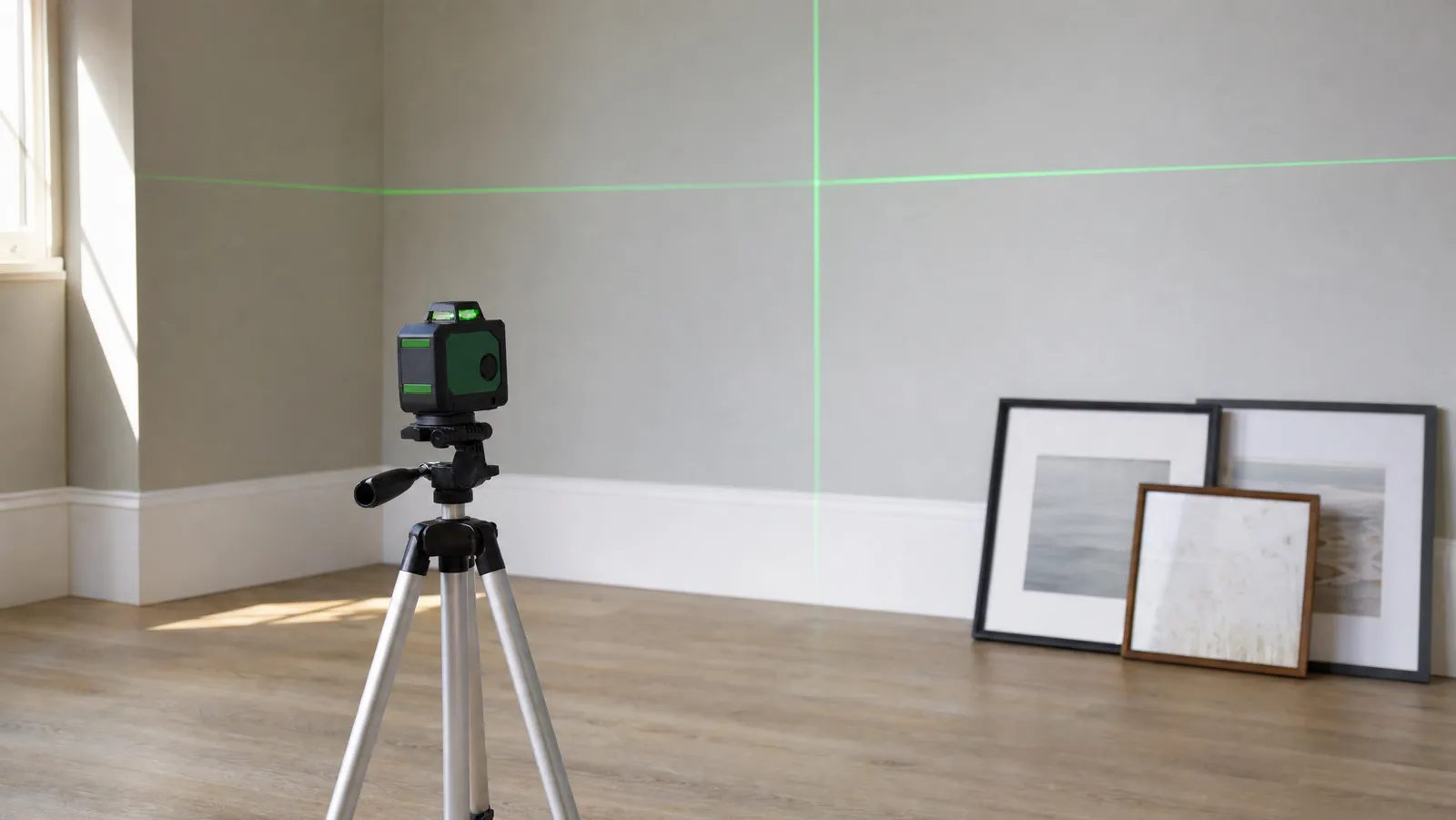
The best laser level for home use is a self-leveling green cross-line unit costing $30 to $50 — for most people, that is the entire answer. Our overall pick is the Motovera 100ft green cross-line laser at $49.99 as of August 2026, because the tripod that makes a laser useful is already in the box.
Everything above that price does not do the same job better. It does a different job — points instead of lines, jobsite abuse instead of a spare-room shelf, outdoor range instead of indoor visibility. Knowing which you need is most of the decision, and it is the instinct that runs through our guide to the best measuring and layout tools: buy the thing that removes the error you keep making, not the thing with the longest spec sheet.
How we picked
We have not tested these tools, and we are not going to pretend we have. Our selection comes from published manufacturer specifications, current price and availability, and a view of what a homeowner actually points a laser at — cabinets, tile, shelves, curtain rails, a picture wall.
We also do not publish star ratings or review counts. Our product data source does not supply them, so you will not find one anywhere on this page. Every performance figure below — accuracy, fan angle, run time, leveling range — is the manufacturer's own number, and we say whose.
Two rules shaped the list. First, green beam wherever the budget allows, for reasons we go into next. Second, we flagged every catch in bold: red beams, missing brackets, receivers sold separately, and manual modes that quietly stop the tool leveling itself.
Prices are as of August 2026 and move constantly.
Green or red? Start here
This is the decision that determines everything else, and it is not about accuracy. A red laser and a green laser of the same quality put the line in the same place. The difference is whether you can see it.
Your eye is the reason. Human photopic vision — the daylight-adapted response of the cone cells — peaks at 555 nm, in the green part of the spectrum. On the CIE photopic luminous efficiency table the eye's response is 0.710 at 520 nm — a typical green laser diode — against 0.107 at 650 nm, a typical red one. That is roughly six to seven times more sensitivity for the same optical power, which is why a red line fades into a bright room while a green one stays readable.
Manufacturers put bigger numbers on it than that. Huepar's red-versus-green comparison claims green is "10-50 times more visible"; we would treat that as a marketing range rather than a measurement, but the direction of the effect is not in dispute.
That is a visibility difference, not a precision difference, and it matters most in exactly the conditions a homeowner works in: a kitchen at midday with the blinds open, a garage with the door up.
The costs of green are real but small. According to Huepar, green diodes require more power to run, which shortens battery life, and green laser levels generally carry a higher price than the red versions. Huepar does not attach a percentage to that premium, and neither will we — at the prices below, the gap between our red pick and our cheapest green one is about $16.
The picks
Listed in the order shown above, each with the one job it is best at. Editorial opinion is ours; every number is the maker's.
Best overall: Motovera 100ft green cross-line with tripod
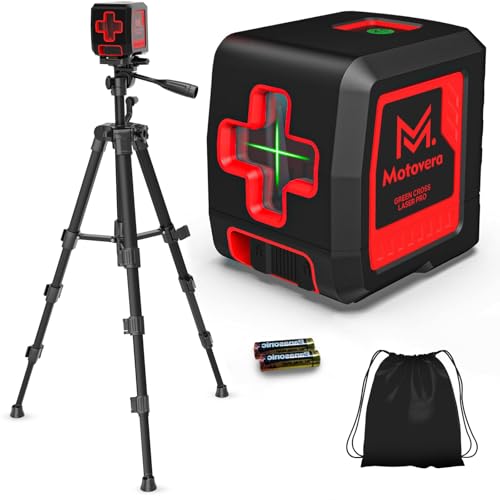
Motovera 100ft Green + Tripod
A green cross-line laser that ships with an aluminum tripod, so there is nothing else to buy. Motovera states +/-1/9 in accuracy at 33 ft, a 110-degree fan, self-leveling within +/-4 degrees and IP54 protection.
Pros
- Comes with a tripod extending 15 to 46 inches - no extra purchase
- Green beam stays visible indoors at up to 100 ft
- Self-leveling and manual modes for sloped layouts
- Pulse mode works with a receiver (sold separately)
Cons
- Tripod is aluminum, not a heavy jobsite stand
- Receiver for outdoor pulse work is not included
This is the pick because of what is in the box, not what is on the spec sheet. A laser level is only as level as whatever it is sitting on, and "whatever it is sitting on" is usually a wobbly stack of books. Motovera includes an aluminum tripod extending from 15 to 46 inches, covering everything from tile layout at floor level to a cabinet line at counter height.
The stated specifications are the ones you want at this price: +/-1/9 in accuracy at 33 ft, a 110-degree fan, self-leveling within +/-4 degrees and IP54 protection. Motovera also states the green beam stays visible indoors at up to 100 ft, which is more room than most houses have.
Two honest caveats. The tripod is aluminum — fine for a spare room, not a jobsite stand you can lean on. And the pulse mode that lets the laser work outdoors needs a receiver, which is not included.
At $49.99 as of August 2026 it is $19 more than the bare Huepar below — and a tripod you would have to buy separately is not far off that. That is the whole argument.
Best budget green: Huepar 9011G

Huepar 9011G
The value green-beam pick. Huepar lists +/-1/9 in accuracy at 33 ft, a 110-degree field, self-leveling in under 3 seconds and a magnetic bracket in the box.
Pros
- Green beam at roughly half the price of the premium picks
- Self-levels in under 3 seconds per Huepar
- Magnetic bracket included
- 1/4-20 thread fits any camera tripod
Cons
- Runs on AA batteries rather than a rechargeable pack
- No tripod in the box
If you already own a camera tripod, buy this instead and save the difference. The 9011G has a 1/4-20 thread, which is the standard camera tripod thread, so the photo tripod in your closet becomes a laser stand for free.
Huepar lists the same +/-1/9 in at 33 ft accuracy as our overall pick, a 110-degree field, and self-leveling in under 3 seconds — the figure that matters when you move the tool along a wall a dozen times. A magnetic bracket is in the box, which handles steel studs, electrical boxes and any door frame with a hinge.
The catches: it runs on AA batteries rather than a rechargeable pack, and there is no tripod in the box. Alkalines are a mild annoyance rather than a real cost, and they have one advantage a lithium pack does not — you can fix a dead laser at a gas station.
At $30.99 as of August 2026 it is a dollar more than the DOVOH below and $19 less than our overall pick, and for a homeowner who already owns a tripod, the smartest $31 on this page.
Best rechargeable: DOVOH C2-120G

DOVOH C2-120G
Uses a rechargeable lithium battery instead of alkalines, with a USB-C cable in the box. DOVOH quotes up to 8 hours of continuous operation and uses two separate laser diodes for the horizontal and vertical lines.
Pros
- Rechargeable - no AA batteries to keep buying
- DOVOH quotes up to 8 hours per charge
- Separate diodes for each line give a crisper cross
- 5-year accuracy warranty from DOVOH
Cons
- Receiver for pulse mode sold separately
- Rechargeable packs eventually lose capacity
The case for this one is that you will never think about batteries. DOVOH uses a rechargeable lithium battery with a USB-C cable in the box, and quotes up to 8 hours of continuous operation per charge. Eight hours is a full day of tiling, and USB-C means the cable is already on your desk.
The more interesting detail is optical. DOVOH uses two separate laser diodes, one for the horizontal line and one for the vertical, rather than splitting a single beam — which tends to mean a cleaner cross, with neither line dimmed to feed the other. DOVOH also backs it with a 5-year accuracy warranty.
Two caveats. The receiver for pulse mode is sold separately, same as the Motovera. And rechargeable packs lose capacity over years in a way alkalines do not — a laser you use six times a year may outlive its own battery.
At $29.99 as of August 2026 it is the cheapest pick here that is not red, which makes the AA-versus-USB-C question a genuine coin flip against the Huepar.
Best pocket laser: Fanttik D2

Fanttik D2
A 0.56 lb pocket laser for picture hanging and shelves. Fanttik lists a 2200 mAh rechargeable battery good for up to 10 hours, accuracy within 1/8 in at 30 ft, and a magnetic bracket with 360-degree rotation.
Pros
- Weighs 0.56 lb - genuinely pocketable
- Fanttik claims up to 10 hours per charge
- Magnetic bracket rotates 360 degrees
- USB-C charging
Cons
- Small body is less stable than a tripod-mounted unit
- Best suited to light interior work, not framing
This is the one that lives in a drawer instead of a case, and that changes how often you use it. Fanttik lists the D2 at 0.56 lb — small enough that you stop treating "get the laser out" as a decision.
Fanttik lists a 2200 mAh rechargeable battery good for up to 10 hours, accuracy within 1/8 in at 30 ft, USB-C charging, and a magnetic bracket that rotates 360 degrees so you can swing the line rather than remount the tool. For a gallery wall, a row of hooks or a floating shelf, that combination is close to ideal — though it will not find the studs you need to anchor into, which is what the best stud finders for DIY are for.
The limits are the obvious ones. A small body on a bracket is less stable than a tripod-mounted unit, and stability is where most real-world error comes from. It is best suited to light interior work, not framing. Note too that our product data does not state a self-leveling range for the D2 the way it does for the Motovera and RockSeed, so confirm that before you buy — we are not going to assume it.
At $34.94 as of August 2026 it costs more than the better-specified Huepar. You are paying for the form factor.
Cheapest that works: RockSeed LV1

RockSeed LV1
A red-beam cross-line laser for under fifteen dollars. RockSeed lists +/-1/8 in accuracy at 30 ft, a 110-degree fan, IP54 protection and dual self-leveling/manual modes.
Pros
- Costs less than a decent tape measure
- Self-leveling and manual modes at this price
- IP54 rated with 4 ft drop protection
- Batteries and pouch included
Cons
- Red beam is much harder to see than green
- Magnetic bracket sold separately
At $13.70 as of August 2026 this costs less than a decent tape measure, and it is a real self-leveling cross-line laser rather than a toy. RockSeed lists +/-1/8 in accuracy at 30 ft, a 110-degree fan, IP54 protection with 4 ft drop protection, and dual self-leveling and manual modes. Batteries and a pouch are included.
The beam is red, and that is the whole catch. Everything in the green-versus-red section above applies here: in a bright room, at any distance, you will be squinting at a line that a green laser would have made obvious. The magnetic bracket is also sold separately, so budget for that or plan on a tripod.
We would still recommend it in two situations. If your total budget is under $20, this beats not owning a laser by an enormous margin. And as a second unit to leave in the truck or the garage, $13.70 rather than $50 is the sensible call.
Best premium: Bosch GPL100-30G

Bosch GPL100-30G
A three-point alignment laser rather than a line laser: it transfers level, plumb, 90-degree and grade points. Full rubber overmold, VisiMax power management and a hard case.
Pros
- Bosch build quality and a hard carrying case
- Transfers points for level, plumb, 90 degrees and grade
- Full rubber overmold protects impact points
- Pendulum locks for transport
Cons
- Projects points, not lines - different job from a cross-line laser
- Most expensive pick here
Read the description carefully, because this is not a more expensive version of the tools above. The GPL100-30G projects points, not lines. It is a three-point alignment laser that transfers level, plumb, 90-degree and grade points around a room.
That is a different job. Points are what you want for transferring a mark from one wall to the opposite wall, squaring a partition off an existing wall, setting posts or dropping a ceiling mark to the floor. Lines are what you want for a run of cabinets, a course of tile or a shelf.
What the money buys is durability: full rubber overmold on the impact points, a hard carrying case, VisiMax power management, and a pendulum that locks for transport — the single feature most likely to keep a laser in calibration over years of being thrown in a bag. Our product data does not state an accuracy figure for it, and we are not going to invent one.
At $139.00 as of August 2026 it is the most expensive pick here by a factor of three. Buy it if you are squaring rooms and transferring points. Buy a green cross-line laser if you are hanging things.
What the accuracy numbers actually mean
"+/-1/9 in at 33 ft" is a number almost nobody translates, so here is the translation.
According to RayXact, a spec like +/-1/8 in at 30 ft does not mean the tool is accurate to 1/8 in as a flat statement. It means the line stays within that band at that distance, under the conditions the manufacturer used to produce the figure, and error grows in direct proportion beyond it. RayXact puts consumer-grade cross-line accuracy at around +/-1/8 in per 30 ft and professional grade at +/-1/16 in per 30 ft, with dot and plumb lasers the loosest of the lot at about +/-1/8 in per 20 ft.
Scaled down to the distances in an actual house, the numbers get reassuring fast.
Across a 12 ft run of wall cabinets, a laser rated +/-1/9 in at 33 ft is allowed to be out by roughly a twenty-fifth of an inch — about the width of the pencil line you would mark with. Any of these tools is far more accurate than the thing you are levelling, which is why the spec is rarely what fails you. According to RayXact, mounting error and thermal effects stack directly on top of that published tolerance rather than being contained by it; it cites a slab warming from 62 to 88 degrees F bending the beam enough to read 3/32 in high at 40 ft. The laser is not your weak link; the milk crate it is standing on is. Nor does the laser replace how to use a tape measure like a pro — it fixes level, not length.
Self-leveling vs manual
Self-leveling is not a software feature. According to Kapro, most self-leveling lasers hang the emitter on a pendulum that swings freely until it aligns with gravity, and these systems often use magnetic damping to slow the oscillation so the pendulum settles faster. Set the tool down roughly flat and gravity does the rest. Tilt it beyond its leveling range and, as Kapro puts it, most tools alert you — the line flashes or refuses to appear. That is the tool telling you it cannot promise level, not a fault.
Kapro does not publish a typical figure for that range; the makers do. Motovera states +/-4 degrees for our overall pick, and DOVOH lists the same +/-4 degrees for the C2-120G. Huepar states self-leveling in under 3 seconds. Bosch's pendulum locks for transport, which is that same mechanism protected against being shaken to death in a bag.
Here is the part that catches people out. Several cheap laser levels — including some sold with "self-leveling" in the title — have a manual mode, and manual mode locks the pendulum. Both the Motovera and the RockSeed list dual self-leveling and manual modes. In manual mode the tool is no longer levelling itself at all: it projects a line at whatever angle you tilted it to, which is exactly what you want for a stair stringer or a drainage slope, and exactly what you do not want when you assume the line is level. If a line looks wrong, check the mode switch before you blame the tool.
Separately, there is a whole category of budget "laser levels" that never self-level — a diode with a bubble vial glued to the side, levelled by eye. Those are a different product, and none of our six picks is one. We have a roundup of the best levels for DIY coming, covering torpedo and box levels, plus a piece on whether you want a laser level or a spirit level at all; neither is published yet.
What you can skip
Most of the money spent on laser levels by homeowners goes on things a homeowner never uses.
A receiver. A receiver, or detector, is what makes outdoor work possible. According to Huepar's guide to using a laser level outdoors, bright midday sunlight cuts the beam's visibility badly, and a detector — which beeps or flashes when it finds the beam — is "indispensable" for long-distance outdoor work because the beam may not be visible to the naked eye at all. Two catches the marketing skips: receiver manufacturers, Huepar and Firecore among them, state that the laser must have a pulse mode and it must be switched on, and that red and green units run at different frequencies, so the receiver has to be compatible with your beam colour. Genuinely necessary for a deck line across a yard. Entirely pointless for a shelf. Both the Motovera and the DOVOH support pulse mode with a receiver sold separately; skip it until you have an actual outdoor job.
A 360-degree or three-plane laser. A 3D laser that wraps a line around every wall is a wonderful thing for someone installing a suspended ceiling in an office. In a house you work one wall at a time, and a cross-line laser plus five minutes of moving it does the same job for a fifth of the price.
A rotary laser. These are grading and site-layout tools. If you are not setting foundation heights or running drainage across a lot, you will never switch it on.
A tripod — but only if you already own one. This is the exception. A laser needs a stable, adjustable mount more than any other accessory, which is why our overall pick includes one. If you own a camera tripod, the 1/4-20 thread on the Huepar means you already have the mount.
Are laser levels safe to use at home?
Household laser levels are low-power tools, but we are not going to hand you a blanket "yes". Here is what the standard actually says, and where it is weaker than it sounds.
According to the University of Illinois Division of Research Safety, Class 2 under IEC 60825-1 is "limited to the visible portion of the spectrum (400-700 nm) and to an output of 1 mW for continuous wave lasers", and for that class "the natural aversion reaction to bright visible light (0.25s) is expected to protect the eyes from damage". In other words the safety margin is not built into the beam — it is built into your reflex.
And that reflex is less reliable than the classification assumes. Published field trials by Reidenbach and colleagues, summarised by LaserPointerSafety.com, found a blink reflex in only around 16 to 20 percent of several hundred subjects exposed to Class 2 beams, varying by wavelength; the researchers concluded that neither blinking nor head and body movement reliably limits exposure to 0.25 seconds. Do not treat "it's only Class 2" as permission to look at it.
The practical rules follow from that. Do not look into the aperture, and turn your head away rather than waiting to blink. Set the tool below or above standing eye height where you can, and keep children and pets out of the plane of the beam — a cat will absolutely chase a green line. Laser products sold under IEC 60825-1 are labelled with the classification, the maximum output and the wavelength, so read that label when the tool arrives rather than assuming. None of our six picks has a laser class stated in the product data we work from, so we will not tell you what class they are.
The best laser level for home use, in one sentence
Buy a self-leveling green cross-line laser for $30 to $50 and stop there. The Motovera 100ft green cross-line laser at $49.99 as of August 2026 is the one we would buy first, because the tripod is included and a laser without a stable mount is a decoration. If you already own a camera tripod, the Huepar 9011G at $30.99 as of August 2026 is the same capability for less money.
Skip the receiver, the 360-degree unit and the rotary laser. Spend the difference on what makes a laser useful: a stable tripod, a sharp pencil and the habit of marking every point before you move the tool.
For where a laser level sits among everything else you measure and mark with — tapes, squares, stud finders, spirit levels — start with our guide to the best measuring and layout tools, which lays out what to buy first and what can wait.
About the Author
Cheryl Thompson
Cheryl Thompson is the tools editor at The DIY Tool Review. A lifelong fixer and self-confessed tool addict, she has spent years buying, borrowing and wearing out hand and power tools across home renovation, furniture building and everyday repairs. She writes hands-on, no-nonsense reviews to help fellow DIYers spend their money on the tools that actually last.