The Best Jigsaws for DIY (2026)
Bosch publishes the same 3,100 SPM for its $119 jigsaw and its $199 one, and the $54 SKIL has more orbital settings than the bare-tool CRAFTSMAN. On jigsaws, the headline numbers are the ones that matter least.

- Category
- Saws & Cutting Tools
- Tools tested
- 5
- Read time
- 15 min
- Updated
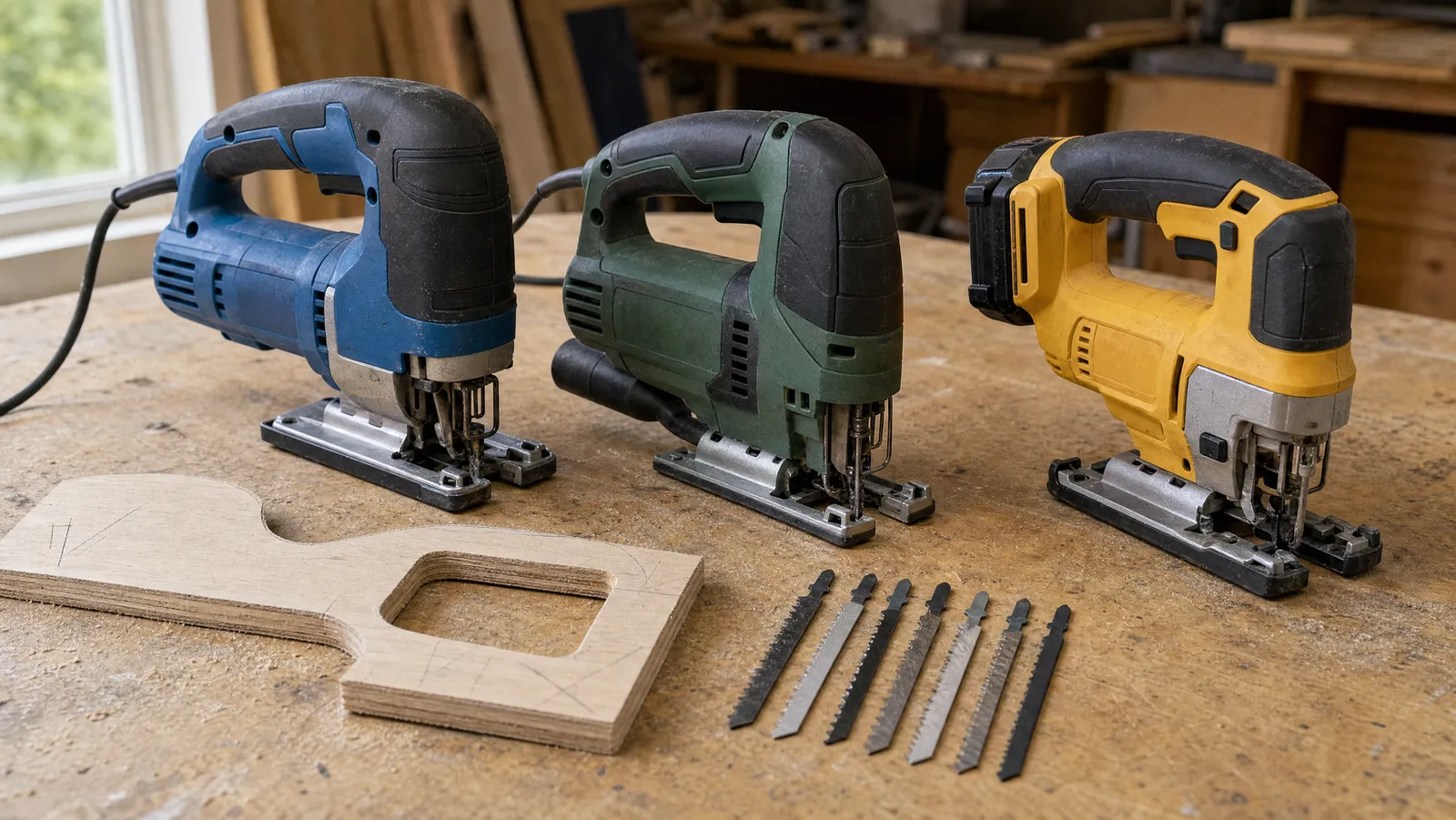
The best jigsaw for DIY is the Bosch JS260 at $119.00 as of October 2026: 6.0 amps, four orbital settings, and the same published 3,100 strokes per minute as the Bosch that costs $199.00. If budget is the deciding factor, buy the SKIL JS314901 at $54.00 as of October 2026 — a complete corded saw with four orbital settings of its own.
Here is what a price column will never tell you. Two of the five saws below ship without a battery or a charger, and the two Bosch saws publish an identical stroke rate $80.00 apart. This guide sits inside our wider coverage of the best saw for DIY; if you own no power saw at all, start with a circular saw instead — see best circular saw for DIY — because a jigsaw is the second saw you buy, somewhere just behind the essential DIY tools every household needs.
How we picked
We have not bench-tested these five saws, timed them or cut anything with them. Every figure here comes from the manufacturer's own published feature bullets and the current retail listing, read on 23 October 2026.
We publish no star ratings or review counts, because our data source does not supply them. Where a maker publishes nothing, we say so — that absence turns out to be the most useful thing in this category. Prices are as of October 2026 and move constantly.
Drag to compare all 5 →
The sticker price is not the price
Read the price ladder on its own and it looks orderly, every figure as of October 2026: $54.00 SKIL JS314901, $119.00 Bosch JS260, $144.26 DEWALT DCS331B as a bare tool, $149.00 CRAFTSMAN CMCS650B as a bare tool, $199.00 Bosch JS470E.
Now read the product titles. The DEWALT's own title says "Tool Only." The CRAFTSMAN's says "Bare Tool Only." Neither includes a battery or a charger. The SKIL and both Bosch saws are 120-volt corded tools that need nothing but an outlet.
The arithmetic matters here. Against the complete, corded Bosch JS260 at $119.00, the bare DEWALT is $25.26 more and the bare CRAFTSMAN is exactly $30.00 more — before a battery. The gap between the two cordless saws themselves is only $4.74, which is noise.
None of that makes them bad tools. It makes them platform tools. If DEWALT 20V MAX packs are already charging in your garage, the DCS331B is a cheap way to add a saw, and that is the whole argument for building around one battery system — the case we make in must-have cordless power tools. If you own no batteries, buy corded.
Orbital action is the whole point of a jigsaw
Orbital action is the one setting that changes the character of the cut. According to This Old House, it "is a setting on a jigsaw that allows the blade to move in an elliptical pattern instead of up and down," producing a "more aggressive cutting action, enabling faster and more efficient cuts." At the 0 setting "the blade moves straight up and down, similar to a sewing machine needle," which the same guide calls "ideal for creating intricate scroll cuts, cutting metal, and making precise, clean cuts in thin materials."
This Old House also says most jigsaws offer settings "typically ranging from 0 to 3" — four positions counting off. So the number to compare is how many stops you get.
Here is where price stops helping. Four of these five saws publish four orbital settings: the SKIL, both Bosch saws and the DEWALT. The CRAFTSMAN CMCS650B publishes three — the fewest in the group, on the second-dearest sticker. The $54.00 SKIL gives you one more stop than the $149.00 bare-tool CRAFTSMAN, and the dearest saw here is 3.69 times the price of the cheapest for exactly the same orbital count.
That is not a reason to skip the CRAFTSMAN. It is a reason to stop treating the orbital spec as a premium feature. It is standard.
T-shank, U-shank, and jigsaw blade selection
Jigsaw blades come in two mounting styles, and this is the one compatibility question in the category that can actually cost you money.
According to the blade guide at Industrial Tool Supplies (ITS), "T-shank blades are most common and fit quick-release jigsaws," while U-shank blades are "less common and used on older tools needing a screw clamp." ToolsToday agrees that U-shank blades "are found in older models," and adds the caveat that matters here — "Some saws will accept either type of blade."
That is precisely the split in this lineup:
- CRAFTSMAN CMCS650B — the only saw here that publishes acceptance of both T and U shank blades.
- Bosch JS260 — T-shank only, and Bosch states outright that it "does not accept U-Shank blades."
- Bosch JS470E and DEWALT DCS331B — T-shank.
- SKIL JS314901 — SKIL does not publish a shank type at all.
T-shank is the modern standard, so "T-shank only" is not a defect; it is what a 2026 blade rack is full of. The CRAFTSMAN's dual clamp is worth real money in exactly one situation: you inherited a box of old U-shank blades and want to use them.
Blade geometry matters more than the clamp. ITS recommends roughly "6–10 TPI for fast cuts in softwood" and "12–20 TPI for fine finish work in hardwood, MDF or ply," and for metal says to "use HSS or BIM blades with fine teeth (18+ TPI)." ToolsToday states the trade-off plainly: "The fewer the teeth, the faster the blade will cut," but "blades with fewer teeth also mean a rougher finish," and for thin material you want "as fine teeth as possible." The same logic drives circular-saw blades, which we cover in choosing a saw blade.
Stroke rate does not track price
Strokes per minute is the number every jigsaw listing leads with, and it is the number that correlates worst with price in this group.
Three findings fall straight out of that table.
Bosch publishes 3,100 SPM for both of its saws. The JS470E and the JS260 carry the identical figure, and the difference between them is $199.00 minus $119.00 — $80.00. That money buys 7.0 amps instead of 6.0, a die-cast foot with a steel insert, a blade-ejection lever, and a published accessory kit with a carrying case. It does not buy a faster stroke.
The highest published stroke rate belongs to the cheaper cordless saw. The CRAFTSMAN CMCS650B publishes up to 3,200 no-load SPM as a bare tool at $149.00 — above the $199.00 Bosch, which is $50.00 dearer, and 200 SPM above the bare-tool DEWALT's variable 0–3,000.
And the group cannot be fully ranked anyway, because SKIL publishes no SPM figure for the JS314901. Treat that 3,200 as the highest number on a spec sheet, not a cutting-speed verdict: strokes per minute is typically measured with no load.
One more pairing: the SKIL and the Bosch JS260 are both rated 6.0 A, and the Bosch costs $65.00 more. The amps are identical. The clamp, the footplate and the published stroke rate are not.
What a jigsaw is not for
A jigsaw's job is curves, cutouts and anywhere a bigger saw cannot reach. According to Kreg, a jigsaw is "capable of making straight cuts, curves, and intricate patterns with ease," and "unlike circular saws or table saws, jigsaws offer greater maneuverability, making them ideal for detailed and intricate cuts."
The limit is the blade itself. Kreg warns that applying too much force causes "blade deflection," and notes that in thick lumber "the blade may deflect during the cut due to the thickness." A jigsaw blade is unsupported below the shoe, so a long cut can drift out of square even when the saw body does not move. For long straight cuts in sheet goods the real question is track saw vs circular saw, not which jigsaw — and if you are not certain a jigsaw is the right tool for the cut you have in mind, types of saws explained walks through the alternatives.
Two habits from the same guide: "secure the material with clamps to prevent movement during cutting," and "unplug the saw or remove the battery before changing blades." Kreg also says to "use a guide fence or a straightedge for precision" — which does more for a jigsaw cut than any spec above.
The five best jigsaws for DIY
Best overall: Bosch JS470E

Bosch JS470E
The most complete tool here: 7.0 amps, a die-cast foot, a blade-ejection lever and a case with blade, overshoe and anti-splinter insert — all of it included, no battery to buy.
Pros
- The only saw here whose maker publishes a full included-accessory list: overshoe, anti-splinter insert, blade, bevel wrench and case
- Blade ejection lever means never touching a hot blade
- Die-cast foot with a steel insert, the most rigid base in this group
- Highest amperage of the three corded saws here at 7.0 A, and corded — no battery to buy or charge
Cons
- Most expensive saw here at $199.00
- Its 3,100 SPM is identical to the $119.00 JS260 — the extra $80.00 does not buy a faster stroke
- T-shank blades only
- Corded
This is the most complete jigsaw on the page, and it is the only one whose maker tells you what is in the box. Bosch publishes the contents outright: the saw, one non-marring overshoe, one anti-splinter insert, one T-shank blade, a bevel wrench and a carrying case. It is rated 7.0 A — the highest of the three corded saws here — with 3,100 SPM, four orbital settings, a multidirectional T-shank clamp, a large die-cast foot with a steel insert, and a blade-ejection lever Bosch says "eliminates need to touch hot saw blade."
At $199.00 as of October 2026 it is also the most expensive saw here. Be clear-eyed about the premium: its 3,100 SPM is the same figure Bosch publishes for the $119.00 JS260, so the $80.00 buys build and contents, not speed. If you want the tool you will still own in fifteen years and the case to keep it in, the Bosch JS470E is it.
Best value: Bosch JS260

Bosch JS260
Hits the same published 3,100 SPM as Bosch's $199.00 JS470E for $80.00 less, with the same multidirectional T-shank clamp and low-vibration plunging mechanism.
Pros
- Same published 3,100 SPM as the JS470E, which costs $80.00 more
- Bosch's multidirectional T-shank clamp and low-vibration plunging mechanism
- Heavy-gauge steel footplate rather than stamped thin stock
- Always-on dust blower keeps the cut line clear without a switch to remember
Cons
- T-shank blades only — Bosch says plainly it does not accept U-shank
- Bosch publishes no accessory, blade or case list for it, unlike the JS470E
- Corded, and $65.00 more than the SKIL for the same 6.0 A rating
This is the saw we would buy. At $119.00 as of October 2026 it carries the same published 3,100 SPM as its $199.00 sibling, the same four orbital settings, the same multidirectional T-shank blade clamp, and Bosch's precision-machined plunging mechanism and low-vibration design. The footplate is heavy-gauge steel rather than stamped thin stock, there is a variable-speed dial plus an accelerator trigger, and the dust blower is always on, so there is no switch to forget.
Two honest marks against it. Bosch states explicitly that it "does not accept U-Shank blades." And Bosch publishes no accessory, blade or case list for this model, where it publishes a full one for the JS470E — which is not the same as confirming it ships bare, but does mean you cannot plan on a case. At $65.00 over the SKIL for the same 6.0 A rating, the Bosch JS260 is paying for the clamp, the foot and a published stroke rate.
Best budget jigsaw: SKIL JS314901
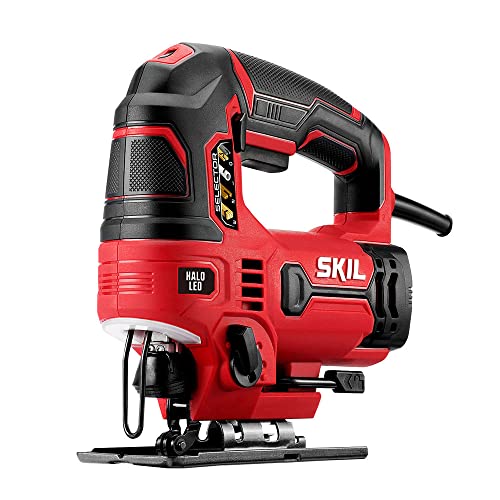
SKIL JS314901
The cheapest saw here and a complete tool out of the box: 6 amps, four orbital settings and tool-free blade changes for a third of what the cordless bare tools cost.
Pros
- Cheapest saw here at $54.00, and nothing else to buy — it is corded and complete
- Four orbital settings, the same count as the two Bosch saws and one more than the $149.00 bare-tool CRAFTSMAN
- Tool-free blade changes and tool-free bevel adjustment
- Switchable dust blower, so you can turn it off when it would blow debris at you
Cons
- SKIL does not publish a strokes-per-minute figure for it
- Corded, so you are tethered to an outlet and an extension cord
- 6.0 A ties the Bosch JS260 for the lowest amperage of the three corded saws here
At $54.00 as of October 2026 this is the cheapest saw here and a complete tool: 120-volt corded, 6.0 A, with four orbital settings — one more than the $149.00 bare-tool CRAFTSMAN. Blade changes are tool-free, the shoe bevel adjusts without a tool, and the dust blower has an on/off switch, which the always-on Bosch design does not. There is a two-finger trigger for speed control and a Halo LED; SKIL's own bullet claims that light gives "10x more light than standard LED," which is SKIL's marketing comparison and not something we can verify.
What you give up is information. SKIL publishes no strokes-per-minute figure for it, and no shank type either, so you are buying on amps and features alone. For four weekends a year of curves in plywood, the SKIL JS314901 is the right call, and the $145.00 you did not spend on the JS470E buys a lot of blades.
Best cordless jigsaw for DEWALT owners: DEWALT DCS331B

DEWALT DCS331B
An all-metal keyless blade change and a shoe bevel with detents at 0, 15, 30 and 45 degrees — but it is a bare tool, so the sticker price is not the price you pay.
Pros
- All-metal lever-action blade change and all-metal bevel shoe — the most robust mechanisms here
- Bevel detents at 0, 15, 30 and 45 degrees, the only saw here with published intermediate stops
- Cordless freedom if you already own DEWALT 20V MAX batteries
- Adjustable (not fixed) dust blower
Cons
- BARE TOOL — $144.26 buys the saw only; a battery and charger are extra
- Lowest published top stroke rate in this group at 3,000 SPM
- T-shank blades only
- Pointless unless you are already on the DEWALT 20V MAX platform
The mechanisms on this saw are the best here. DEWALT publishes an all-metal, lever-action keyless blade change and an all-metal keyless shoe bevel with detents at 0, 15, 30 and 45 degrees — the only saw in this group with published intermediate bevel stops. It runs variable 0–3,000 SPM with four-position orbital action, takes T-shank blades, and has an adjustable rather than fixed dust blower.
Two caveats. It is a bare tool at $144.26: no battery, no charger. And 3,000 SPM is the lowest published top stroke rate here. DEWALT publishes no amperage for it, which is correct — cordless tools are not rated in amps — and is exactly why a power comparison across this lineup is meaningless. Buy it if you are already on 20V MAX; if you are not, it is the wrong saw.
Most blade-flexible: CRAFTSMAN CMCS650B

CRAFTSMAN CMCS650B
The only saw here that takes both T-shank and U-shank blades, and the highest published stroke rate in the group at 3,200 SPM — but it is a bare tool with only three orbital settings.
Pros
- The only saw here that accepts both T-shank and U-shank blades
- Highest published stroke rate in this group at 3,200 SPM — above the $199.00 Bosch
- Brushless motor, the only one in this lineup
- Onboard LED work light
Cons
- BARE TOOL — $149.00 is the saw alone; battery and charger cost extra
- Only three orbital settings, one fewer than the $54.00 SKIL
- Most expensive sticker of the two cordless saws here
- Bevel stops are not published beyond 'up to 45 degrees'
This is the specialist. The CMCS650B is the only saw here that accepts both T-shank and U-shank blades, which matters if you inherited a drawer of old blades and resent buying new ones. It is also the only brushless motor in the lineup, publishes the highest no-load stroke rate here at 3,200 SPM, and has an onboard LED and a shoe that bevels up to 45 degrees.
The compromises are real. It is a bare tool at $149.00 — battery and charger extra — which makes it the dearer of the two cordless saws by $4.74 of sticker plus whatever a pack costs. It publishes three orbital settings, the fewest here and one fewer than the $54.00 SKIL. And its bevel stops are not published beyond "up to 45 degrees," so the DEWALT's listed detents are the known quantity.
What the makers do not publish
Four of these five saws are missing a spec that would change somebody's decision, and the pattern is consistent.
- SKIL publishes no strokes-per-minute figure for the JS314901 — the headline spec every competitor leads with.
- SKIL does not publish a shank type either, the one compatibility fact that can leave you with blades that do not fit.
- Bosch publishes no accessory or case list for the JS260, while publishing a complete one for the JS470E. That is an absence of information, not a confirmation that the saw ships bare; we would ask the retailer before assuming either way.
- Neither cordless saw publishes an amperage, because amps describe current draw from a wall outlet and these run on battery packs. Any roundup that ranks all five on "power" has invented the comparison.
The specs that decide whether a jigsaw suits you are the ones that go missing: what is in the box, what blades it takes, how rigid the foot is. Amps and SPM are the ones printed in bold.
Our verdict
Buy the Bosch JS260 at $119.00 as of October 2026. It publishes the same 3,100 SPM as the $199.00 JS470E, with the same four orbital settings and the same multidirectional T-shank clamp, and the $80.00 you keep is the clearest saving in this category. Buy the Bosch JS470E if you want the die-cast foot, the blade-ejection lever and the only published accessory list here. Buy the SKIL JS314901 at $54.00 as of October 2026 if the saw is for occasional curves — four orbital settings and nothing else to purchase.
Take the DEWALT DCS331B only if 20V MAX batteries are already in the house, and the CRAFTSMAN CMCS650B only if dual T- and U-shank blade acceptance solves a problem you actually have. Both are bare tools, and both need a battery and a charger you have to buy.
What should not drive this decision is stroke rate, which runs 3,000 to 3,200 SPM across the four saws that publish a top figure while prices range from $119.00 to $199.00. For where a jigsaw sits among the saws worth owning, start with our saw buying guide for DIYers.
Frequently asked questions
What is the best jigsaw for DIY?
The Bosch JS260 at $119.00 as of October 2026. Bosch publishes 6.0 A, 3,100 SPM, four orbital settings and a multidirectional T-shank clamp — the same stroke rate and clamp as its $199.00 JS470E. It is corded, so there is no battery to buy, and nothing about the dearer Bosch cuts faster on paper.
What is the best jigsaw for beginners?
The SKIL JS314901 at $54.00 as of October 2026. It is corded and complete, changes blades and adjusts its bevel without tools, and publishes four orbital settings — one more than the $149.00 bare-tool CRAFTSMAN. The honest limitation is information: SKIL publishes neither a stroke rate nor a shank type for it.
Is a cordless jigsaw worth it?
Only if you already own the batteries. Both cordless saws here are bare tools — the DEWALT DCS331B at $144.26 and the CRAFTSMAN CMCS650B at $149.00 include no battery and no charger, so each costs more than the complete $119.00 corded Bosch before you power it. On one battery platform, the DEWALT is a cheap way to add a saw.
What jigsaw blade should I use?
Match the teeth to the material. ITS recommends about 6–10 TPI for fast cuts in softwood and 12–20 TPI for fine finish work in hardwood, MDF or ply, and HSS or bi-metal blades with 18+ TPI for metal. Check the shank first: T-shank fits most modern saws, and only the CRAFTSMAN here publishes U-shank acceptance too.
About the Author
Cheryl Thompson
Cheryl Thompson is the tools editor at The DIY Tool Review. A lifelong fixer and self-confessed tool addict, she has spent years buying, borrowing and wearing out hand and power tools across home renovation, furniture building and everyday repairs. She writes hands-on, no-nonsense reviews to help fellow DIYers spend their money on the tools that actually last.