How to Store Hand Tools on a Wall So You Actually Find Them
A loaded tool wall pulls down and outward, which is why the mounting tabs on an 18 in. magnetic bar sit 16 in. apart. Where you screw it and how high you hang it decide whether you ever find anything.

- Category
- Workshop & Storage
- Tools tested
- 3
- Read time
- 13 min
- Updated
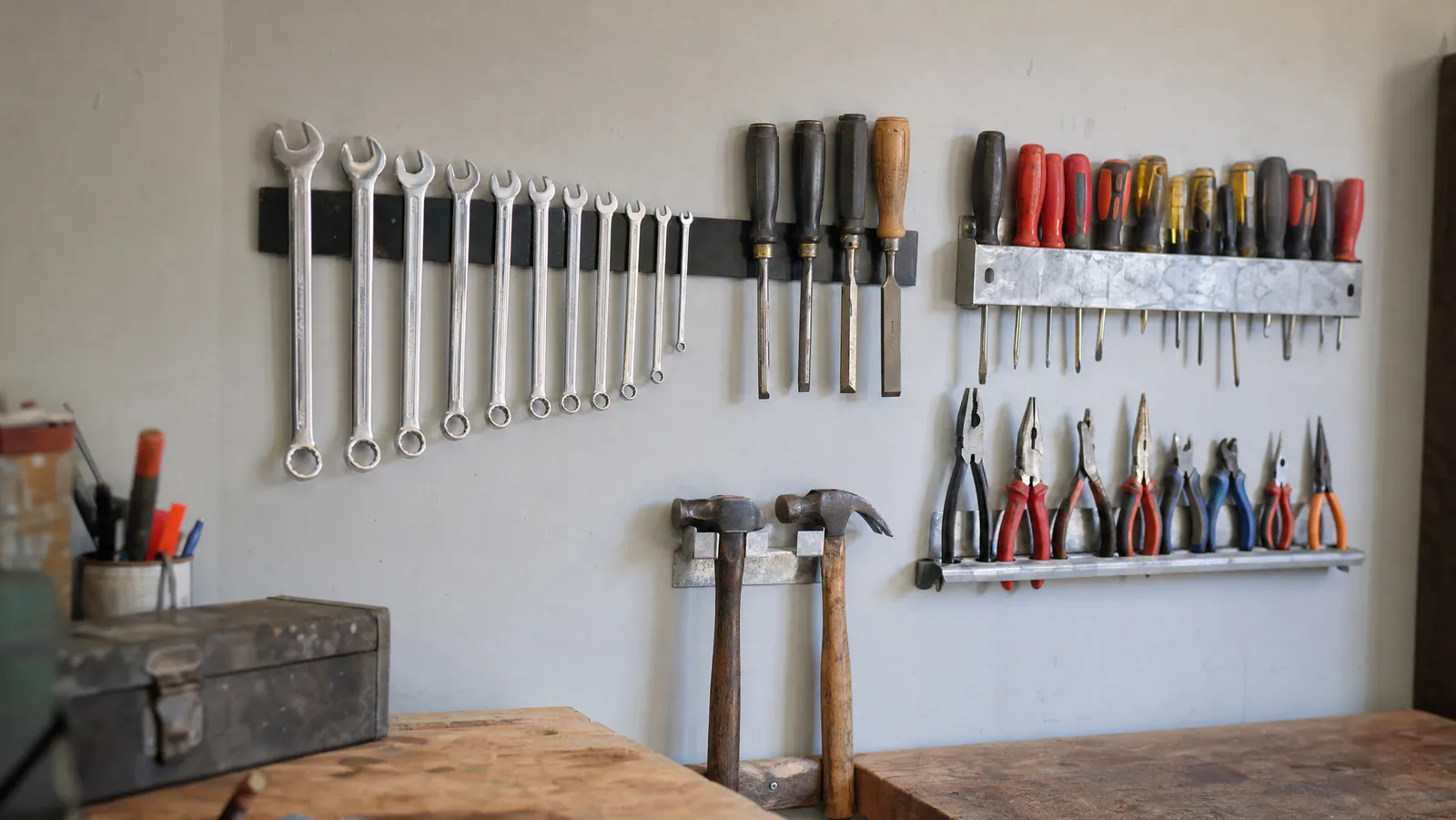
To store hand tools on a wall, screw your holders into studs rather than drywall, keep the tools you use weekly between hip and eye height, and give every tool one fixed spot. The holder format matters far less than those three decisions. Findability comes from the layout, not from the hooks.
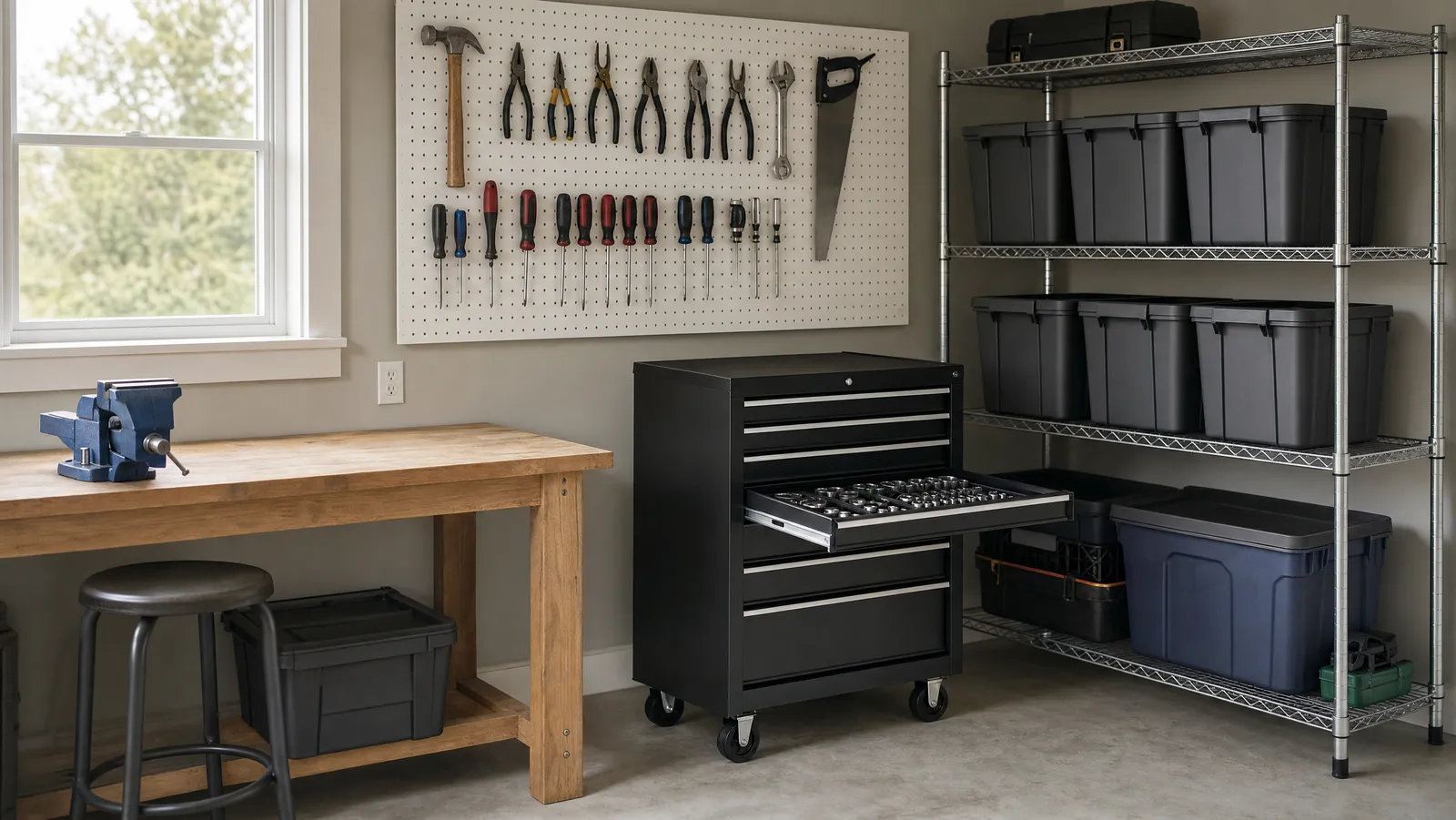
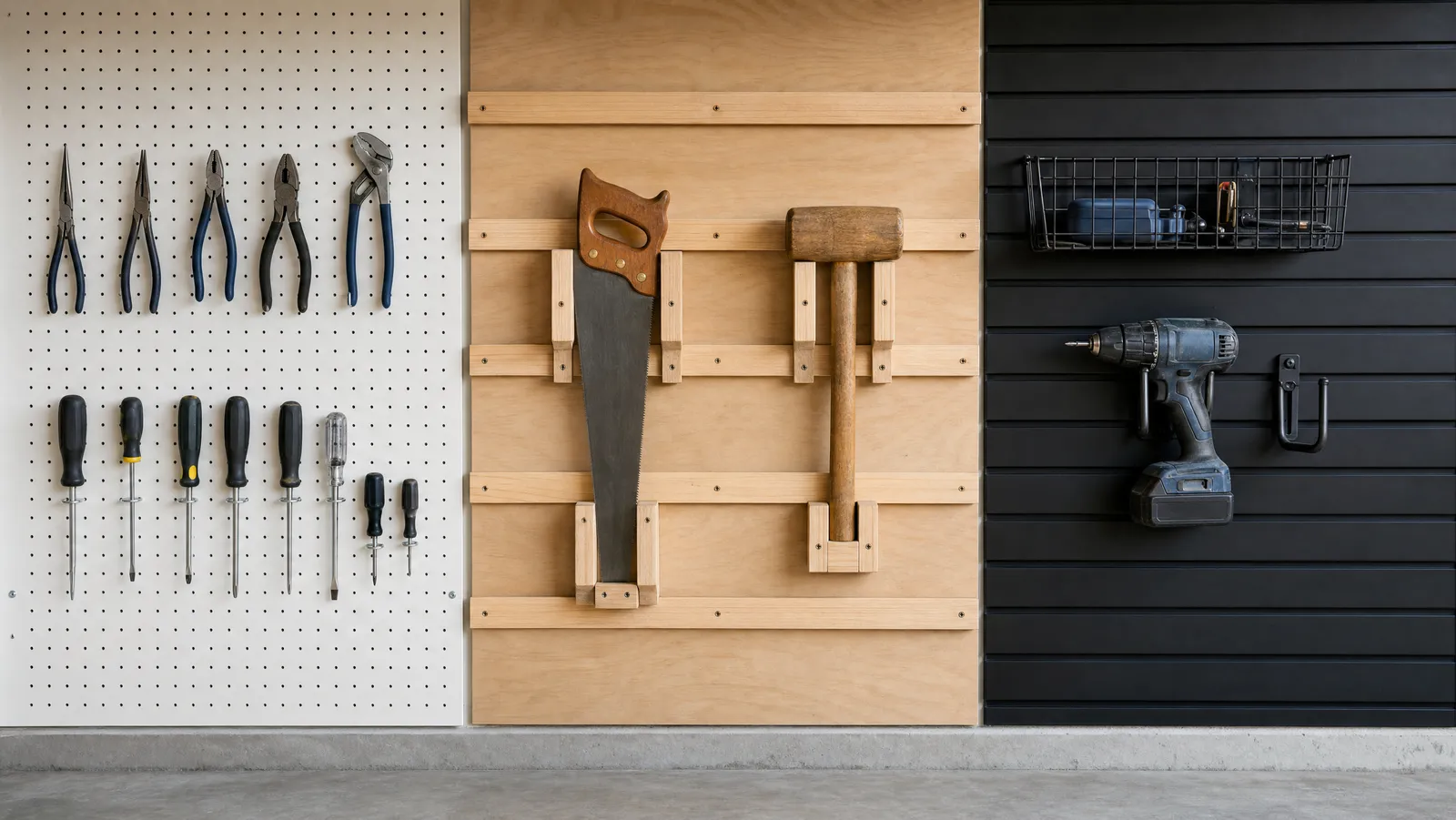
One decision comes before all of it, and it is not a holder. The backing board comes first — bare drywall, pegboard, slatwall or a French cleat rail changes what you can mount, where, and how cheaply you change your mind. We compare those three in pegboard, French cleat and slatwall compared, and the order of operations is in our garage tool storage guide.
We have not handled the three organizers below. Every figure is the maker's published specification or the current listing price, and we say whose: Master Magnetics lists, the Pilida listing claims, CASOMAN counts. Prices are as of October 2026, and we publish no star ratings or review counts — our data source does not supply them. These three are not a ranking but one example each of the three formats a hand-tool wall is built from: a magnet, a moulded holder, a clip rail.
Start with what you screw into, not what you hang
A tool wall is not a shelf. Holders stand an inch or two off the wall and the tools stand further, so the load sits outside the wall plane and pulls down and outward at once. Then add the part no spec sheet covers: you yank a wrench off, lean on a rack, hang a bag on a bracket meant for a square. Design for the tug, not the tool.
Which means studs — and the clearest evidence that makers already assume studs is sitting on the hardware. Master Magnetics lists two welded steel mounting tabs, 16 in. apart, on an 18 in. bar — an inch in from each end. Sixteen inches on centre is the US residential default: International Residential Code section R602.3.1 governs stud size, height and spacing, with 16 in. on centre the standard figure for load-bearing stud walls and 24 in. permitted in the cases set out in IRC Table R602.3(5). Jaspector's summary of the 2024 code explains why it is 16: panel goods come in 4 ft modules, so at 16 in. centres a panel edge lands on a stud at 16, 32 and 48 in.
So the bar has been designed to be screwed into two studs. The maker put the tabs where the timber is. Apply that to every holder you mount, including those whose screw holes landed wherever the moulding allowed.
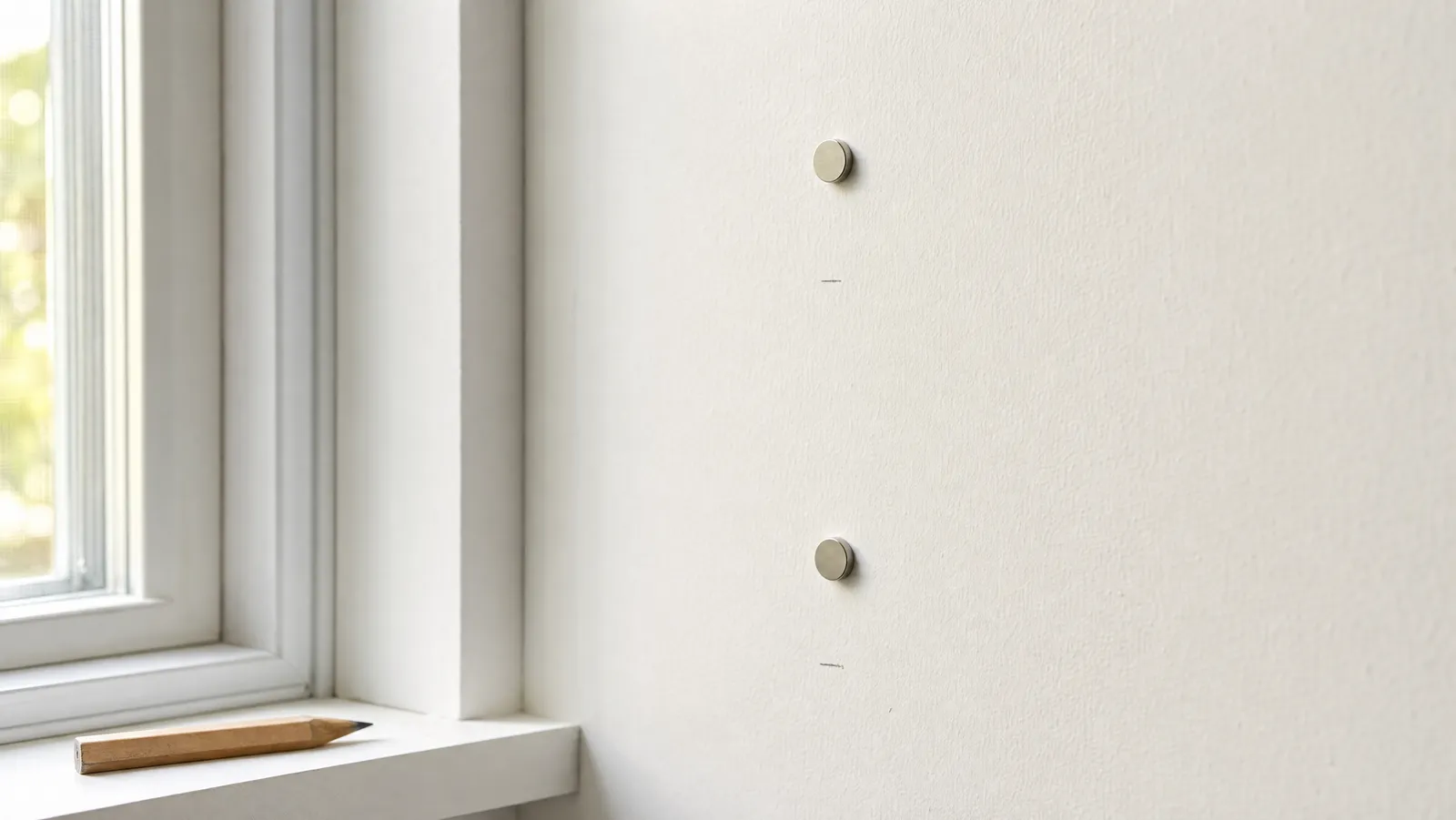
Find the timber first. A rare-earth magnet locates the drywall screws, and a vertical line of two of them is a stud — the full method is in find a stud without a stud finder.
If you rent, or the stud is in the wrong place
Use an anchor, but know what you are buying. TOGGLER, which manufactures them, publishes one headline figure for its SNAPTOGGLE heavy-duty toggle bolt: it "supports up to 238 lbs. in 1/2" drywall". That is a real manufacturer figure, and it is a maximum, not a working load — the page gives one number per substrate and no load direction. A tool wall loads an anchor in the awkward direction, so treat the maximum as a ceiling you stay well under.
Our rule for drywall-only runs: light holders, light tools, nothing you would mind landing on the car. The screwdriver rail can live on an anchor. The hammer rack should not.
The reach band: put tools where your hand already goes
A wall works when a tool goes back without you thinking about it. That is a question about your body, not your garage, and most walls fail it because they get filled wherever space happened to be free.
Industrial ergonomics names the band that matters. Cisco-Eagle, a materials handling supplier, calls the upper front reach zone "prime space because it requires little or no movement from basic work position to access it", and places the ergonomic golden zone "between the waist and shoulders". That literature is about lifting, and a chisel weighs nothing, so we stretch the top: on a tool wall you are optimising seeing as much as reaching.
- Hip to eye — the band. Tools you touch weekly: screwdrivers, pliers, tape, square, hammer, the wrenches you actually use.
- Above eye height. Long, light, occasional — a level, a spare saw, clamps.
- Below hip height. Heavy things, and nothing you need in a hurry.
One consequence: buy short holders, not long ones. Master Magnetics offers the same bar in 6, 13, 18 and 24 in. lengths, and a 13 in. bar inside the band beats a 24 in. bar that starts in the band and finishes above it.
One tool, one spot — and make the empty spot visible
The other half of findability is the opposite of flexible. A wall where anything can hang anywhere is a wall you have to search.
Industry solved this with shadow boards. As ASG Services, which builds them for 5S programmes, describes it, a shadow board holds each tool against an outlined silhouette, and "when a tool is removed, its outline remains visible, so anyone walking past can see instantly whether it has been returned."
A moulded holder gives you that discipline for free: a slot shaped like a screwdriver takes only a screwdriver, and an empty slot is a visible hole. That is the strongest argument for moulded holders over a magnet, and it has nothing to do with holding power. A magnetic bar is the opposite — it holds a wrench anywhere along its length, which sounds like a feature and behaves like a filing cabinet with no dividers.
Matching wall mounted tool holders to tool families
The limit on a magnet is metallurgical, and it catches people out on tools that look like steel. Per K&J Magnetics, a magnet manufacturer, ferritic stainless such as 430 "is ferromagnetic. Magnets stick to it", while austenitic grades are "only weakly magnetic, and some are not magnetic at all" — K&J lists 316 as "not magnetic" and 304 as "not magnetic, or a little magnetic after cold work". Aluminium and plastic are not in the conversation at all.
A good claw hammer is the test case: the head is ferrous and the handle is not, so a magnet holds the head and lets the handle swing. The hammer gets a moulded rack; the chisels get the magnet.
The three formats side by side
Read the middle column. One publishes a force figure; two publish inventory counts. None publishes what a holder carries once it is on your wall.
The magnetic bar: flat ferrous steel, and nothing else

Master Magnetics 18 in. bar
An 18 in. black powder-coated bar whose two welded steel mounting tabs sit 16 in. apart - exactly standard US stud spacing, because the maker expects it to land on two studs. Master Magnetics lists a 20 lb per inch pull force, 0.25 in. diameter holes in the tabs, two mounting screws in the box, and the same bar in 6 in., 13 in. and 24 in. lengths. The company describes itself as USA-based and in business since 1976.
Pros
- Two mounting tabs 16 in. apart - designed to be screwed into two studs
- 20 lb per inch pull force, per Master Magnetics
- Four lengths - 6, 13, 18 and 24 in. - so a bar can be sized to a reach band
- Two mounting screws included
Cons
- Holds ferrous steel only - no wooden handles, hand planes or aluminium levels
- Nothing fixes a tool in a set place, so you lose one tool, one spot
- The 20 lb per inch figure is pull force measured on flat plate, not a capacity for the bar
- A tapered, chrome-plated wrench gives a magnet less flat contact than a steel plate does
Master Magnetics lists an 18 in. bar in black powder coat, a 20 lb per inch pull force, two welded steel mounting tabs with 0.25 in. holes spaced 16 in. apart, and two mounting screws in the box. The same bar comes in 6, 13 and 24 in. versions, and the company describes itself as USA-based and in business since 1976.
We would not turn the 20 lb per inch figure into a capacity for the bar, and nor should you. Pull force per inch is measured against a thick, flat steel plate. A tapered chrome combination wrench touches the magnet along a narrow line rather than a face, so multiplying 20 by 18 would be our arithmetic wearing the maker's name.
It earns its keep on flat ferrous steel inside the reach band — chisels, small squares, open-end wrenches, screwdriver shafts, pliers hung by the jaws. At $21.44 as of October 2026 it is the cheapest way to move a dozen steel tools off the bench and into your eyeline.
Two honest limits. It holds ferrous steel only, so a wooden-handled hammer, a hand plane, an aluminium level and anything plastic are out. And it does not hold a tool in a place, which costs you the discipline that makes a wall fast. Use a magnet as a staging strip for the five tools in play right now, not as the whole wall.
The moulded set: one slot per tool, and a listing that argues with itself

Pilida 4-piece set
Four galvanized steel holders - screwdrivers, wrenches, pliers and hammers - each moulded to take one tool family and nothing else. The listing claims 25 screwdriver slots (15 regular plus 10 large), 12 wrench slots plus 9 other tool slots, and a pliers holder and hammer rack that between them take up to 21 pliers and 10 hammers. The listing contradicts itself on the wrench range: the title says 9-24 mm, the bullet says 10-24 mm metric and 5/16 in. to 15/16 in. SAE. No load rating is published for any of the four pieces.
Pros
- A moulded slot per tool family is the format that genuinely enforces one tool, one spot
- Galvanized steel rather than plastic, per the listing
- Covers the four families most DIY walls need: drivers, wrenches, pliers, hammers
- 25 screwdriver slots and 12 wrench slots, per the listing
Cons
- The listing disagrees with itself on the wrench range - 9 mm in the title, 10 mm in the bullet
- No weight or load rating published for any of the four pieces
- 21 pliers and 10 hammers is far more than most DIY readers own - part of the set is spare
- The dearest of the three formats here at $35.99 as of October 2026
This is the format that delivers findability: four galvanized steel holders, one per tool family, each moulded so only the right tool fits. The Pilida listing claims 25 screwdriver slots (15 regular plus 10 large), 12 wrench slots plus 9 further tool slots, and a pliers holder and hammer rack that between them take up to 21 pliers and 10 hammers.
The listing disagrees with itself about the wrenches, and it matters more than it sounds. The title says the holder is "9mm-24mm"; the bullet says it "Fits Metric (10 mm to 24 mm) and SAE (5/16" to 15/16")". One millimetre is a rounding error unless you own a 9 mm wrench, in which case it decides whether the set fits your set. We would plan around the bullet's 10-24 mm and treat the 9 mm as unconfirmed.
Read the other counts the same way: 21 pliers and 10 hammers is not a DIY collection, it is a workshop's. Buy this set for the screwdriver and wrench holders — the two families where moulded slots pay off hardest — and treat the rest as spare. At $35.99 as of October 2026 it is the dearest option here, and the one we would put in the middle of the band. No load rating is published for any of the four pieces, so the screws are doing unquantified work. Find studs.
The clip rails: hanging tool storage you can keep in size order

CASOMAN 10-piece rail set
Ten plastic rails - 6 for screwdrivers and 4 for wrenches - holding tools in sliding clips rather than fixed slots. CASOMAN's listing counts 13 red, 13 orange and 13 blue screwdriver clips plus 52 black wrench clips, which is 91 clips in the box, and describes a tensioning system that grips different sized screwdrivers, wrenches and other small tools. The listing says the rails can be wall mounted horizontally, set on a workbench, or used inside a toolbox.
Pros
- 91 clips across 10 rails, per the listing, at $19.77 as of October 2026
- Three screwdriver clip colours let you code slotted, Phillips and Torx on one rail
- Clips slide, so a graduated set stays in size order and can be re-spaced
- Mounts on a wall, sits on a bench or goes in a toolbox, per CASOMAN
Cons
- Plastic tensioning clips are a wear item - a loose clip drops a screwdriver
- No weight or load rating published
- Needs a flat backing board, so the wall itself has to be solved first
The cheapest and most flexible of the three. CASOMAN's listing counts 6 screwdriver rails and 4 wrench rails, with 13 red, 13 orange and 13 blue screwdriver clips — 39 in all — plus 52 black wrench clips: 91 clips across 10 rails, roughly 22 cents a clip at $19.77 as of October 2026. A clip is not a tool, though — the listing describes a tensioning system that grips different sizes and never says how many clips one screwdriver occupies.
The three clip colours are the genuinely useful feature, and almost nobody uses them properly. Do not distribute them for decoration. Give one colour to each driver type — red for slotted, orange for Phillips, blue for Torx — and the rail becomes an index you read from across the garage. Same trick as a shadow outline, done with colour instead of shape.
Clips also slide, which is the other reason to pick this format: a graduated set stays in size order, and adding a 19 mm means re-spacing clips, not buying a holder.
Two limits. These are plastic tensioning clips, and a tensioning clip is a wear item — it loosens with use, and a loose clip drops a screwdriver. And a rail needs a flat backing board along its whole length, so the format assumes the wall is already solved. Back to the pegboard, cleat and slatwall comparison if it is not.
What does not belong on a wall at all
- Anything heavy. Bench grinders, vices, cast-iron planes, a full socket set. Weight belongs low, on a shelf or bench, loading straight down into something structural.
- Anything you use twice a year. A wall's value is instant access — spend it on the ten tools you touch weekly. The tile cutter can live in a box.
- Anything that drips. Adhesives, finishes, solvents, oil cans. A tipped bottle runs down everything below it.
- Anything small and loose. Screws, bits, washers, anchors, driver inserts — a bin problem, not a hook problem, and the format that solves them is small parts and fastener organizers.
- Battery packs and chargers. A charger needs an outlet and airflow, which a holder moulded for hand tools cannot give it.
Common questions
How high should hand tools be mounted on a wall?
Put the weekly tools between your hip and your eye line, measured on yourself at the wall rather than taken from a chart. Cisco-Eagle places the ergonomic golden zone "between the waist and shoulders" for materials handling; on a tool wall we extend it to eye height, because the point is seeing as well as reaching. Long, light, occasional items go above; heavy items below.
Can you hang hand tools on drywall without hitting a stud?
Within limits. TOGGLER publishes that its SNAPTOGGLE heavy-duty toggle bolt "supports up to 238 lbs. in 1/2" drywall" — a genuine manufacturer figure, and a maximum rather than a working load. A tool wall pulls outward as well as down, so stay well under any published number, keep heavy holders on timber (find the studs first), and give anchor-only runs light tools.
Will a magnetic tool bar hold all my hand tools?
No. It holds ferrous steel — wrenches, chisels, pliers, small squares, screwdriver shafts — and not a wooden-handled hammer, a hand plane, an aluminium level or anything plastic.
The short version
Screw it into studs. Keep the weekly tools between hip and eye height. Give every tool one spot, and make the empty spot visible.
The hardware is the cheap part. All three formats here come to $77.20 together as of October 2026, and a sensible wall is usually a mix: moulded screwdriver and wrench holders in the middle of the band, a short magnetic bar beside them for chisels and squares, clip rails for graduated sets, and nothing heavy, drippy or rarely used on the panel at all. Prices move, so check the current price on the Master Magnetics bar first.
And decide the backing board before you buy a single holder. That decision, and the rest of the system a tool wall fits into, is in our garage tool storage guide.
About the Author
Cheryl Thompson
Cheryl Thompson is the tools editor at The DIY Tool Review. A lifelong fixer and self-confessed tool addict, she has spent years buying, borrowing and wearing out hand and power tools across home renovation, furniture building and everyday repairs. She writes hands-on, no-nonsense reviews to help fellow DIYers spend their money on the tools that actually last.