Types of Saws Explained: Which One Do You Actually Need?
Forget the taxonomy. What type of saw you need depends on one thing: whether you are cutting along a board, across it, or in a curve. Here is every common saw, what it is genuinely for, what it is bad at, and the three most people should actually own.

- Category
- Saws & Cutting Tools
- Format
- How-to guide
- Read time
- 13 min
- Updated
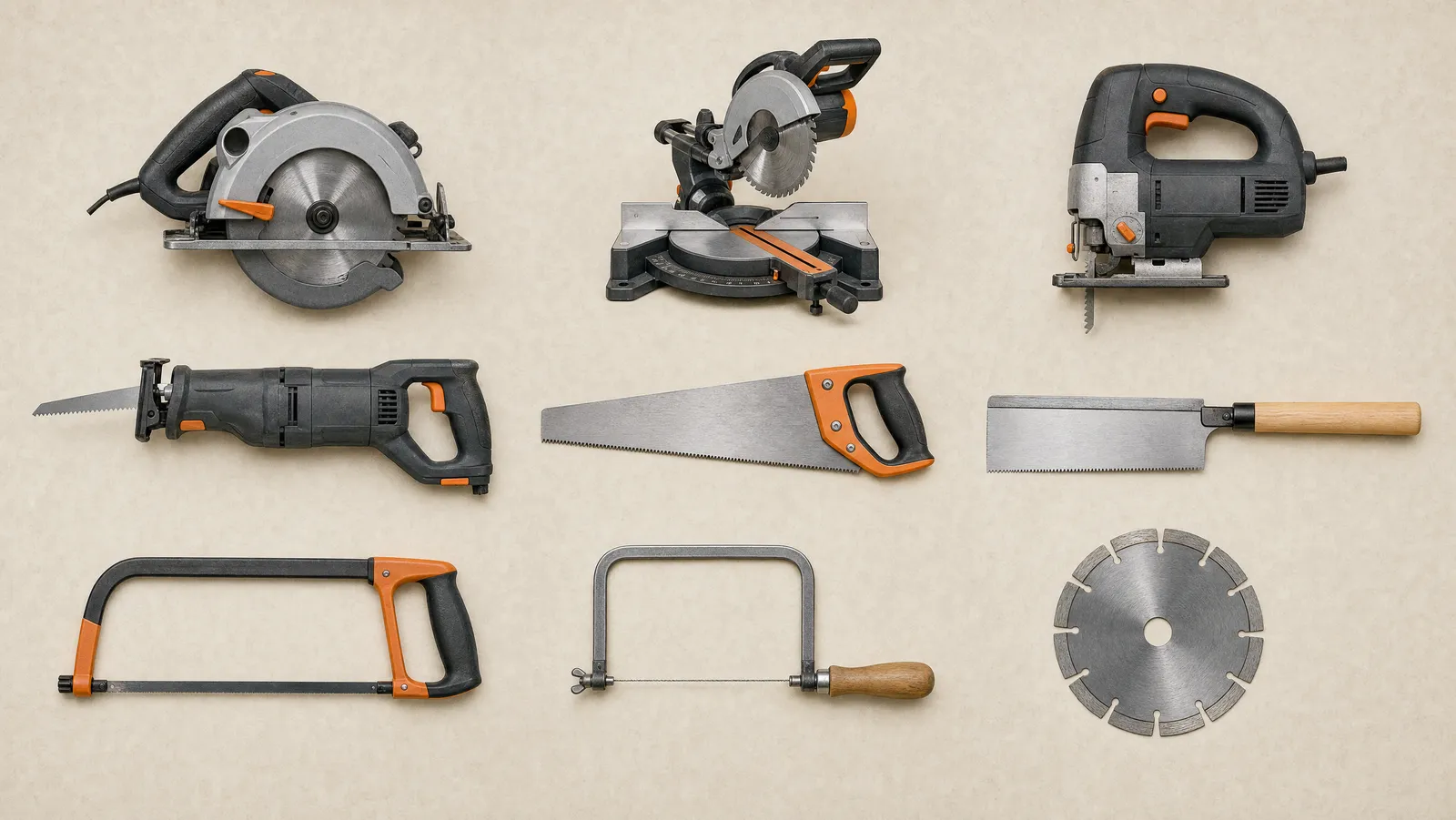
Most DIYers only ever need three saws. What type of saw you need comes down to a single question: are you cutting along a board, across it, or in a curve? Along the grain is a circular saw's job. Across it is a miter saw's. Curves belong to a jigsaw. Everything else on the wall at the home center is a specialist.
Saw shopping goes wrong in a predictable way: people buy by appearance — a miter saw looks like a real workshop tool, so it goes in the cart first — then discover it physically cannot make the cut they bought it for. So this guide walks the cut first, the tool second. If you want the shopping version with specific picks instead, start with our guide to which saw to buy for DIY work; if you are still assembling the basics, it sits alongside the rest of our essential DIY tools.
Start here: what are you actually cutting?
Five cut types cover nearly everything a homeowner does.
A rip cut — along the board. According to TSO Products, a rip cut runs parallel to the wood grain and is what you use to reduce a board's width, resaw thick stock, or break down lumber to rough size. TSO notes these cuts are naturally aggressive because the blade works with the grain structure, which allows faster feed rates but often leaves a rougher surface that needs smoothing afterward. Ripping is a circular saw with a guide, a track saw, or a table saw — and nothing else.
A crosscut — across the board. TSO Products describes a crosscut as a cut across the grain, perpendicular to the fiber direction, used to trim boards to length, cut joinery that runs across the grain, or create clean edges for glue-ups. Because you are severing fibers rather than following them, TSO says crosscuts demand more precision but typically come off the saw cleaner. This is miter saw territory, and a circular saw does it fine too.
A curve or an interior cutout. Sink holes, outlet notches, a curved plywood shape for a kid's project. Jigsaw, or a band saw if the stock is thick.
Demolition. Cutting through things rather than cutting them to size — old framing with nails in it, rusted pipe, a stuck window frame. Reciprocating saw.
Tile, stone and masonry. A different category entirely, because the enemy is dust rather than splinters. Snap cutter or wet saw.
Teeth, kerf and TPI: the three words on the blade package
Three terms decide whether a cut comes out clean. Kerf is the slot of material the blade removes as it passes — cut on the wrong side of your pencil line and you lose that width from the workpiece. TPI means teeth per inch. According to Homebuilding & Renovating, TPI is the number of teeth you will find on each inch of a saw or saw blade, counted from the gullets — the gaps at the base of the teeth, which Norton Abrasives says clear dust build-up out of the cut. Norton's saw blade teeth guide sets the material ranges: roughly 6 to 20 TPI for wood and other soft materials, and 14 to 36 TPI for harder materials like metal.
The Home Depot's reciprocating blade guide puts the trade-off in one line: low-TPI blades deliver faster cuts with rougher edges and suit wood, while high-TPI blades deliver smooth, slow cuts and are the better choice for metal. That is the whole rule. Fewer teeth, faster and rougher. More teeth, slower and cleaner. A blade that cuts badly is far more often the wrong blade than the wrong saw.
Job-to-saw matrix: what to grab, and what people grab instead
The saws, one at a time
Circular saw
The one we would buy first. A handheld motor spinning a blade — typically 7-1/4 in. on DIY-grade saws — that you push through the work rather than feeding work past the blade. According to Bob Vila, a circular saw has the flexibility to cut small 2x4s, wooden beams, plywood sheets and large boards, which is a fair summary of why it is the default. It rips, it crosscuts, it bevels, and it goes to the material instead of making the material come to it.
What it is bad at: repeatable precision. Freehand, a circular saw wanders. Clamp a straightedge to the work and it becomes genuinely accurate — the single habit that separates good results from firewood. If that points you at a circular saw — and for most people it does — the best circular saw for DIY comes down to depth of cut and weight rather than brand. Beginners: yes, buy this one.
Miter saw
A blade on a hinged arm that chops down onto stock held against a fence, with the arm pivoting left and right for angles. For cutting a lot of pieces to the same length, or mitering trim at 45 degrees, nothing is faster or more repeatable.
What it is bad at: everything else. According to Bob Vila, miter saws are not designed for rip cuts — the blade is set up for crosscuts, and a table saw is the tool for ripping along the grain. Bob Vila also notes you cannot move material through a miter saw, so capacity is limited by blade size and table size: wide boards and sheet goods are out. Beginners: not first. Buy it when you have a trim or decking project that needs dozens of identical cuts.
Jigsaw
A narrow blade reciprocating up and down through a flat shoe, free to turn as you steer. It is the saw most DIYers reach for to cut a curve, and it will start a cut in the middle of a panel.
What it is bad at: square edges in thick material. Rockler's jigsaw guidance points at a heavy-duty, rigid blade — a more massive blade deflects less — and at slowing down and steering the saw rather than forcing it through, because pushing a jigsaw sideways or faster than it wants to go deflects the blade and leaves a cut that wanders in and out of square, with a wavy edge on the underside. Ryobi's support documentation makes the same point from the blade side: a thin blade in thick material can cause deflection, so match blade thickness to the stock. Treat a jigsaw as a curve tool, not a straight-line tool. Beginners: yes, second purchase.
Reciprocating saw
A long blade punching in and out of a nose-heavy body, used one-handed or two. It is a demolition tool: nail-embedded lumber, stubborn pipe, roots, pallets, anything you are removing rather than building with. Blade choice does most of the work: per The Home Depot's blade guide, use the low-TPI end for wood and the high-TPI end for metal.
What it is bad at: any cut you will later look at. The cut line is rough and wanders, and the saw jumps if the shoe is not pressed hard against the work. Beginners: no, until you have something to tear out — then it is the only sane option.
Hand saw
A toothed steel plate and a handle, and for a surprising number of jobs still the correct answer. One cut in one board, a trimmed dowel, a branch, a quick cut in a finished room. It costs a fraction of any power saw, needs no battery, and the tooth logic is identical — coarse teeth for fast rough work, fine teeth for clean cuts.
What it is bad at: volume, and anything in hardwood past a few inches. Beginners: yes — own one regardless of what else is in the garage.
Table saw
The blade lives in a table and the work moves past it. That inversion is what makes it the serious ripping machine: a fence holds the cut width so every board comes out identical.
What it is bad at: safety margin, and portability. According to the Consumer Product Safety Commission's 2017 Federal Register notice on table saws, there were an estimated 33,400 emergency-department-treated table saw injuries in 2015, of which CPSC staff estimated 30,800 — about 92 percent — involved contact with the blade. It is why a homeowner's first ripping setup should be a circular saw and a clamped guide. Beginners: no. It is a project-driven purchase, not a starter tool.
Track saw
A circular saw that rides in a guide rail instead of a baseplate on bare wood. The rail is the upgrade. According to Kreg, track saws excel at precise, splinter-free cuts without the extra accessories a circular saw needs for pinpoint accuracy, and plunge action is standard on them. Kreg's guide tracks carry a zero-clearance anti-chip strip that supports the wood fibers at the cut line to cut tear-out in plywood, MDF and hardwood, and Kreg points to cabinetry, sheet goods and fine woodworking as the natural uses.
What it is bad at: price, and rough work — paying track-saw money to cut deck framing makes no sense. Beginners: no — but if your projects are mostly sheet goods, it is the one specialist tool worth jumping to early.
Band saw
A continuous looped blade running through a table, which lets it cut curves in stock far thicker than a jigsaw can handle squarely, and resaw a board into thinner slices. It cuts metal too with the right blade: Milwaukee's standard bi-metal portable band saw blade for metal is a 10/14 TPI blade, which Milwaukee lists for strut, conduit, angle iron, copper tube, threaded rod and pipe.
What it is bad at: straight cuts in wide panels, and floor space. It earns its corner of the garage only if you make curved parts. Beginners: no. Most DIYers will never need one, and that is fine.
Tile and masonry saw
A diamond-rimmed blade — no teeth — fed with water. Wet cutting is the entire point, and not only for blade life. A tile-cutting safety guide from WC Safety notes that porcelain, ceramic and quarry tile contain crystalline silica and that OSHA's construction silica standard, 29 CFR 1926.1153, is built on controlling dust at the source rather than relying on a respirator, with a construction exposure limit of 50 micrograms per cubic meter averaged over eight hours. The same guide's advice: pick the lowest-dust method that can make the cut — a snap cutter produces almost no dust, a wet saw traps most of the rest, and dry-cutting with a grinder is a last resort.
What it is bad at: wood, and tidiness — it throws slurry. For a bathroom-sized job of straight cuts, a snap cutter is usually enough, and we compare those in our rundown of DIY tile cutters. Beginners: rent or buy cheap, per project.
The three-saw answer
The honest short list, in the order we would buy it.
- Circular saw. Rips, crosscuts, bevels, handles sheet goods, travels to the work. With a clamped straightedge it covers most homeowner cutting.
- Jigsaw. The practical way to cut a curve or start a hole in the middle of a panel. Cheap, and it fails gracefully.
- Miter saw. Buy it when you have a job with repetition — trim, decking, framing a wall — not before.
If you are building a cordless kit, the first two are natural battery-platform purchases and slot neatly into the must-have cordless power tools most people end up owning. After those three, let a specific project decide: a track saw if you cut cabinet-grade plywood, a reciprocating saw before a demolition weekend, a wet saw the week you tile.
So which type of saw do you need?
Name the cut, then pick the tool. Along the grain or across a sheet: a circular saw and something straight to clamp to it. Across a board, over and over, at an angle: miter saw. A curve or a cutout: jigsaw. Something to tear out: reciprocating saw. Tile: snap cutter or wet saw, kept wet. Everything else here is a specialist that a project will eventually justify — or never will, which is fine.
When you are ready to turn that into a purchase, work through our DIY saw buying guide and buy for the cut you actually make most.
Frequently asked questions
What saw should I buy first?
A circular saw. It rips along the grain, crosscuts, bevels, and breaks down plywood, and it goes to the material instead of needing the material brought to it. Add a clamp-on straightedge and its accuracy approaches a table saw's for a fraction of the money and risk. A jigsaw is the sensible second buy, for curves and cutouts.
What is the most versatile saw for DIY?
The circular saw, for the reason Bob Vila gives: it has the flexibility to cut 2x4s, beams, plywood sheets and large boards. No other saw covers both cut directions and sheet goods. Its weakness is repeatability, and a clamped guide fixes most of that. A jigsaw is more versatile in shape but far less accurate in a straight line.
Do I need a table saw if I already have a circular saw?
Most DIYers do not. A table saw's advantage is repeatable rip width, which matters if you are building cabinets or furniture. It also carries real risk: CPSC staff estimated 30,800 blade-contact injuries from table saws in 2015 alone. For occasional ripping, a circular saw with a clamped straightedge or a track saw gets you there more safely.
How many teeth should my saw blade have?
It depends on the material. According to Norton Abrasives, roughly 6 to 20 TPI suits wood and softer materials while 14 to 36 TPI suits harder materials like metal. The Home Depot frames the trade-off the same way: fewer teeth cut faster and rougher, more teeth cut slower and cleaner. Keep one coarse and one fine blade for each saw.
About the Author
Cheryl Thompson
Cheryl Thompson is the tools editor at The DIY Tool Review. A lifelong fixer and self-confessed tool addict, she has spent years buying, borrowing and wearing out hand and power tools across home renovation, furniture building and everyday repairs. She writes hands-on, no-nonsense reviews to help fellow DIYers spend their money on the tools that actually last.