How to Organize a Tool Chest, Drawer by Drawer
Sort by weight and frequency, not by tool type: heavy and rarely used at the bottom, daily drivers at waist height, small parts up top. Plus the honest math on foam.

- Category
- Workshop & Storage
- Tools tested
- 3
- Read time
- 13 min
- Updated
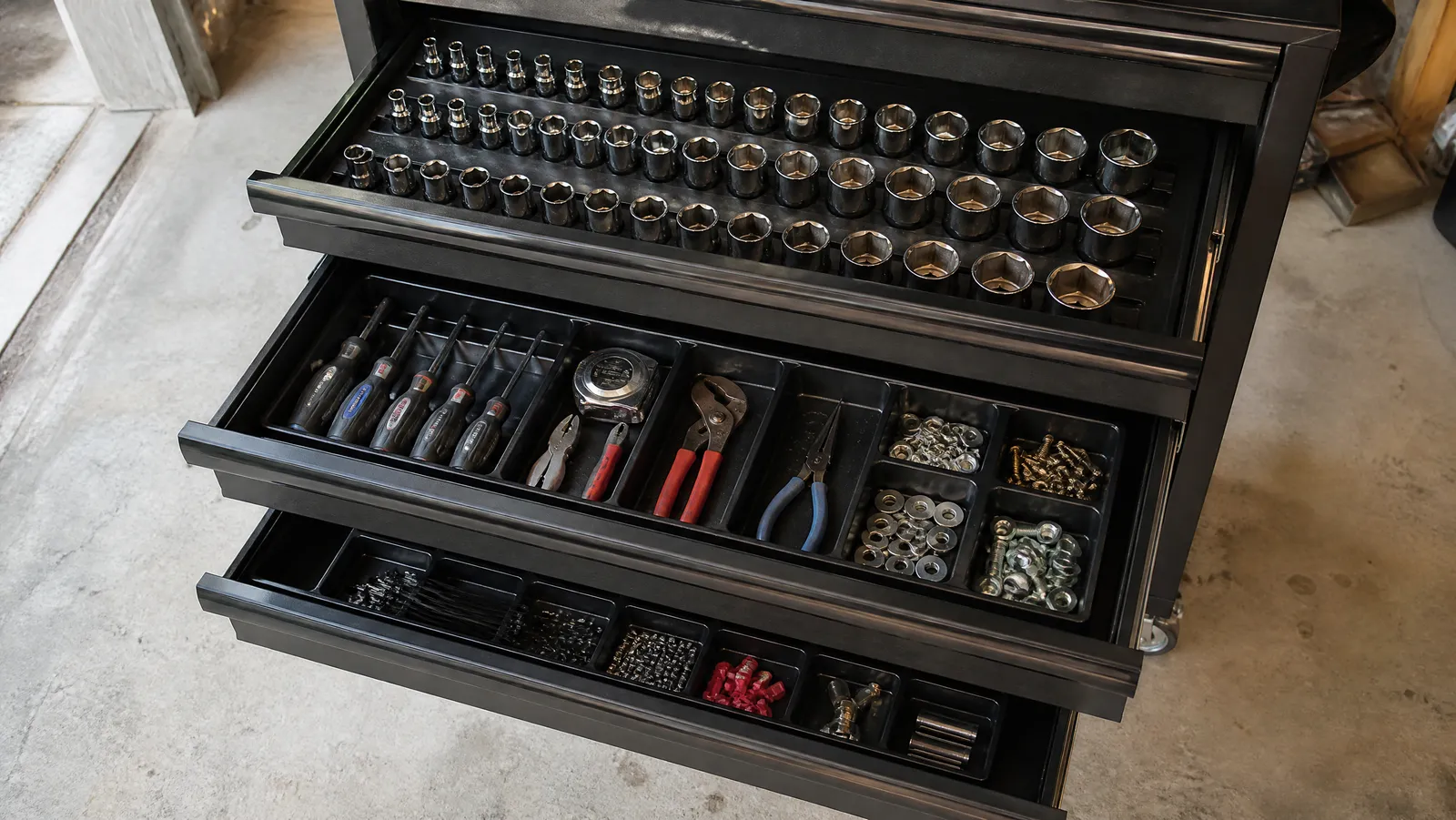
The fastest way to organize a tool chest is to sort by weight and frequency, not by tool type. Heavy and rarely used goes in the bottom drawer. The ten tools you touch every week go at waist height. Small parts and sockets go up top. Then give each drawer one job, label it, and put tools back before you walk away.
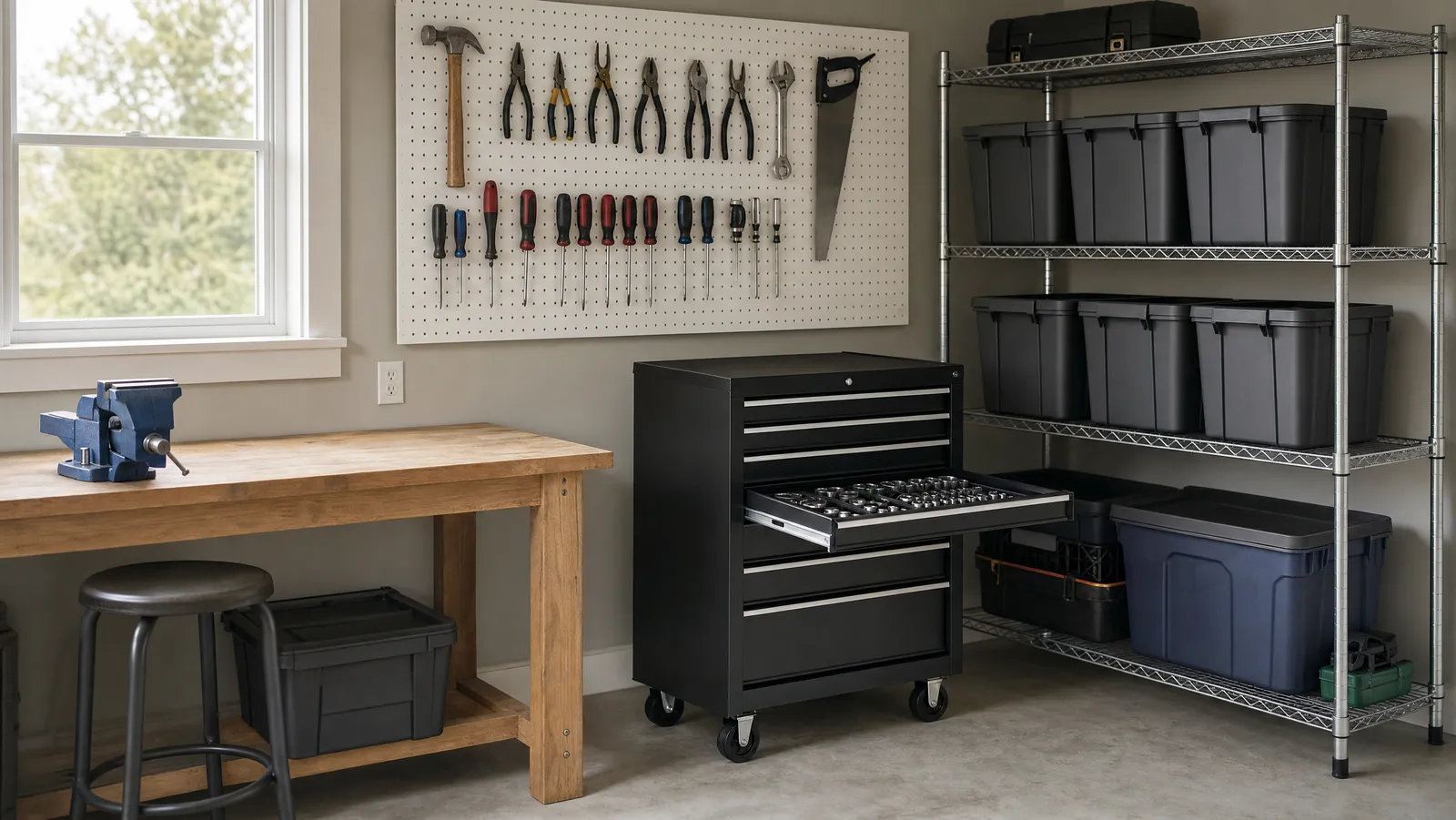
That order is not tidiness, and it is not our invention — it is what the chest manufacturers ask you to do, for reasons that have nothing to do with looking organized. Our garage tool storage guide covers where a chest belongs in the wider system; this is about what happens inside it: the layout, the four ways to divide a drawer, and the habit that keeps it working past the first month.
Weight goes down, frequency goes up
Start with the safety rule, because it constrains everything else.
Husky's use and care guide for its 52 in. 18-drawer chest and cabinet set (model HOTC5218B1QES) leads its safety section with "Do not open more than one drawer at a time", and third on the same list adds "To help prevent the product from tipping, load the product starting with the bottom drawers." Between them, those two instructions write your layout. Under a DANGER heading the guide adds that you should not move the chest before closing and locking every drawer, because the drawers could come open and make it unstable and tip.
Harbor Freight's owner's manual for its item 64864 chest and cabinet combo says it differently: a total combined weight capacity of 4,400 lb, qualified as "evenly distributed from bottom up", with a warning under the heading "to prevent serious injury and death from tipping" not to exceed that capacity and not to open more than one drawer at once.
The physics is plain. A chest is a tall box on a small footprint, a full-extension drawer puts its load a drawer's depth outside that footprint, and the higher that happens the less it takes to pull the thing over. Weight low is ballast; weight high is leverage against you. The layout below is not a preference — it is the load order the manuals ask for, with frequency breaking ties.
The drawer-by-drawer layout
Here is the prescription, top to bottom, for a chest with a top unit over a rolling cabinet. Adapt the number of drawers; do not adapt the order.
Waist height is defined by your eyes, not a tape measure. It is the highest drawer you can look down into while standing normally. Everything above it you reach into by feel — which is why small parts in fixed compartments belong up there and a jumble does not.
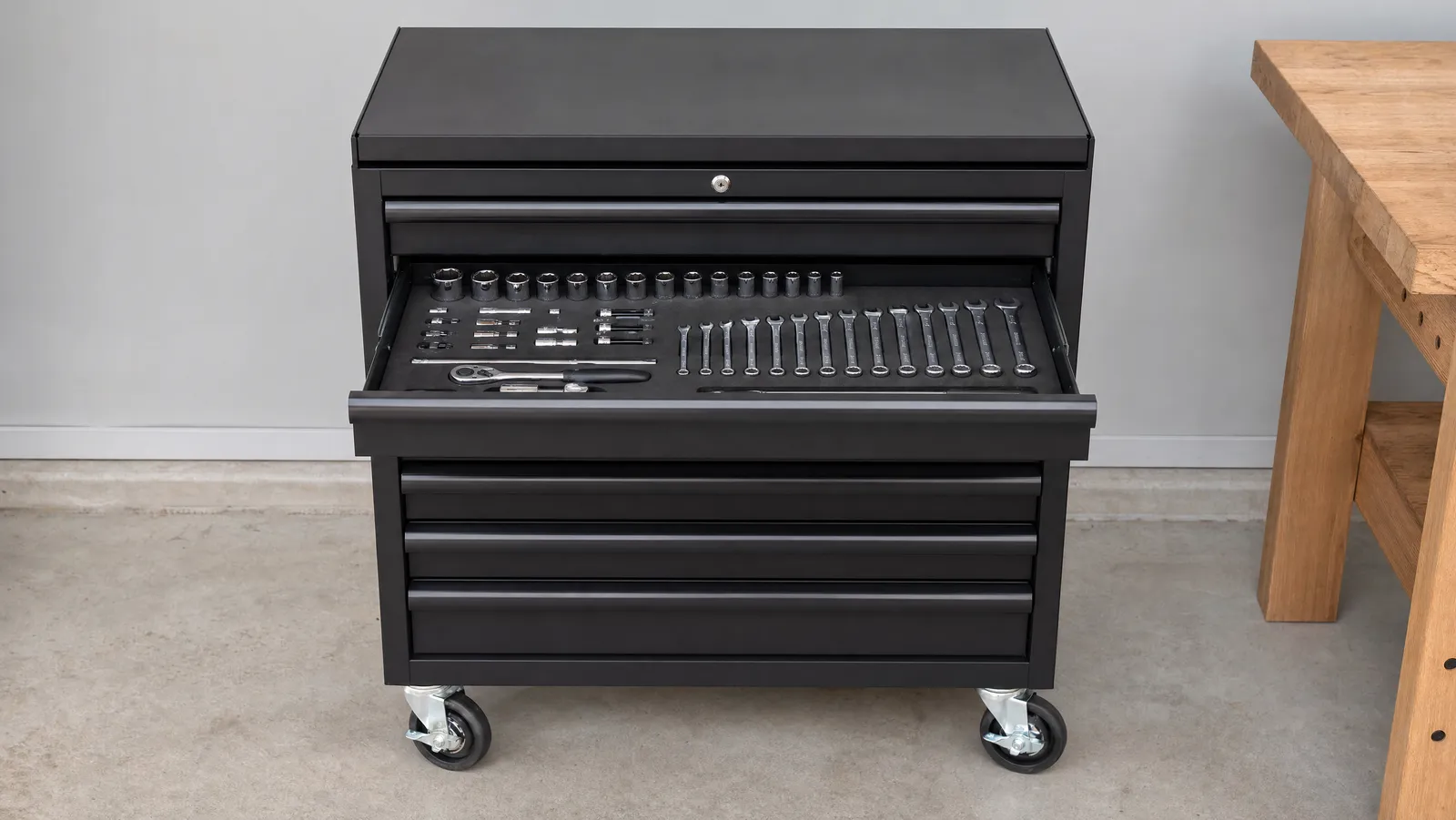
Sockets are the exception. A full set is dense and heavy, which argues for low, and it is the set you open most often. The compromise is the second drawer from the top: high enough to see into, low enough that it is not what levers the chest forward.
One job per drawer, and label the drawer
The layout fails the moment a drawer acquires a second job. "Electrical" becomes "electrical, plus whatever was in hand when the phone rang," and three weeks later it is a junk drawer with a label on it.
So: one job per drawer, and the drawer is full when the job is full. If the plumbing drawer overflows, do not annex half the electrical drawer — decide what in it is monthly-or-rarer and move that to the bottom.
Label the outside of the drawer, not the tray inside it. A label you can read with the drawer shut is the one that changes behavior: it tells you where a tool goes back without opening three drawers to find out. Masking tape and a marker works; a printed label survives oily hands better.
And be honest about capacity. A five-drawer chest holds five jobs, not six.
Method 1: modular interlocking trays

FLYVOLE 24-piece tray set
The modular route, for drawers whose contents are still changing. FLYVOLE lists 24 trays in five graduated sizes - 1 XL at 12.5 x 6.2 x 1.77 in., 2 L at 9.25 x 6.2 x 1.77 in., 4 M at 9.25 x 3 x 1.77 in., 5 S at 6.2 x 3 x 1.77 in. and 12 XS at 3 x 3 x 1.77 in. - moulded in ABS plastic with an interlocking design FLYVOLE says lets trays lock together or work independently. The published piece counts add up to 24. Every tray is the same 1.77 in. tall, and that single figure decides whether the set fits your chest.
Pros
- 24 trays in five sizes covers most of a chest in one purchase
- Interlocking layout can be rearranged when the tools change
- Every size shares one height, so trays sit flush against each other
- $14.99 as of September 2026 for the whole 24-piece set
Cons
- 1.77 in. tall throughout - too deep for a genuinely shallow top drawer
- Loose ABS trays slide in a drawer unless locked together or set on a liner
- Five fixed sizes will never match every tool you own
Modular trays are the right first move for any drawer whose contents are still changing — which, if you are still buying tools, is most of them.
FLYVOLE lists 24 ABS trays in five sizes: 1 XL at 12.5 x 6.2 x 1.77 in., 2 L at 9.25 x 6.2 x 1.77 in., 4 M at 9.25 x 3 x 1.77 in., 5 S at 6.2 x 3 x 1.77 in., and 12 XS at 3 x 3 x 1.77 in. Those counts add up to 24 exactly. FLYVOLE calls the design interlocking — trays lock together or work independently.
The buying gotcha is one number: every tray is 1.77 in. tall. There is no shallow option. If a drawer has less than about two inches of clear internal height, this set does not go in it. Measure the shallowest drawer you intend to use, not the deepest. At $14.99 as of September 2026 a wrong guess is annoying rather than expensive, but the height is the spec that decides it.
Method 2: fixed-compartment trays for shallow drawers

Ernst 10-compartment tray
The fixed-compartment answer for a shallow drawer. Ernst Manufacturing lists 10 compartments in a low-profile, stackable tray made of high-impact plastic, with rolled edges at the bottom so small bits and fasteners are easy to pick out, and says it is made in the USA. The rolled bottom edge is the detail worth paying for - square internal corners are where washers and grub screws hide. The Amazon listing does not give tray dimensions, but Ernst's own catalog puts every ten-compartment tray at 16 x 11 x 1.5 in., so measure the drawer against that before you order.
Pros
- Rolled bottom edges mean small fasteners come out on the first attempt
- Low profile fits the shallow top drawers deeper trays will not
- Stackable, so two can share one deeper drawer
- Made in the USA, per Ernst
Cons
- Ten fixed compartments - the layout is the layout, permanently
- The Amazon listing skips the size; Ernst's catalog figure of 16 x 11 x 1.5 in. is the one to measure against
- One tray covers one drawer; a full chest needs several
A fixed tray gives up flexibility and buys back two things: a lower profile and better corners.
Ernst Manufacturing lists 10 compartments in a low-profile, stackable tray of high-impact plastic, made in the USA, with rolled edges at the bottom so small bits and fasteners are easy to pick out. That rolled edge is the genuinely good detail. A square internal corner is a trap — washers, grub screws and 1/4 in. hex bits wedge into it and you end up tipping the compartment out. A radiused corner lets a fingertip sweep the part up the wall.
The Amazon listing does not give tray dimensions, but Ernst's own catalog puts every ten-compartment tray at 16 x 11 x 1.5 in. — measure your drawer against that figure, and note that 1.5 in. is genuinely lower than the 1.77 in. modular trays. At $13.63 as of September 2026 the tray costs less than the fasteners it holds. The trade is permanence: use fixed trays for categories that never change — fasteners, bits, blades — and modular trays for everything else.
Method 3: socket rails, the highest-value fix in the chest

HORUSDY 80-piece socket rails
The highest-value fix in the whole chest, because loose sockets are the worst thing in any drawer. HORUSDY lists 80 clips in total - 26 for 1/4 in. drive, 30 for 3/8 in. and 24 for 1/2 in. - moulded in ABS plastic, each with a spring-loaded ball bearing, on rails that take shallow or deep sockets. The published counts add up to 80. HORUSDY says the clips work with all brands of sockets, which is the brand's own claim rather than a checked fit.
Pros
- 80 clips across all three common drive sizes for $15.19 as of September 2026
- Spring-loaded ball bearings hold each socket rather than just resting it
- Rails take shallow or deep sockets, per HORUSDY
- Fixes the one drawer that wastes the most time in a working chest
Cons
- Works with all brands is HORUSDY's own claim, and socket wall thickness varies
- Rails need a drawer long enough for them to lie flat
- Clip counts are fixed, so a large 3/8 in. set can leave you short
- Plastic clips are a wear item, and the spring bearings are the part likeliest to wear out
If you do one thing from this article, do this one. Loose sockets are the worst offender in a tool chest. They look identical from above, they are marked on a face you cannot see when they lie down, and they roll to the back every time the drawer opens.
HORUSDY lists 80 clips: 26 for 1/4 in. drive, 30 for 3/8 in. and 24 for 1/2 in. Those add up to 80 exactly. The rails are moulded ABS, each clip has a spring-loaded ball bearing, and HORUSDY says they take shallow or deep sockets. It also says they work with all brands — treat that as the brand's own claim, because socket wall thickness varies and a clip that grips a thin-wall chrome socket may be loose on a deep impact one.
At $15.19 as of September 2026, list price $15.99, this is the cheapest hour you will buy back.
Method 4: foam, and the honest math on it
Shadow-boarding — cutting a tool-shaped pocket in two-tone foam so a missing tool shows as a bright silhouette — is the best-looking option and the one most people should skip. It is not expensive. It is slow. Shadow Foam, which sells the stuff, published its own timing for a drawer-insert project: 6 drawers in 2 hours and 28 minutes, of which roughly 30 minutes was planning before any cutting — about 25 minutes per drawer. That is the maker's own account of how quick its product is. Scale it and a ten-drawer chest is over four hours of a Saturday, where all three plastic fixes above come to $43.81 as of September 2026 and go in the same afternoon.
So when is foam worth four hours? When you must inventory a set at a glance. That is an aviation problem more than a DIY one. According to Flight Safety Australia, the Civil Aviation Safety Authority's magazine, the guiding principle of tool control is that all tools be returned at the end of the day or job, and — citing James Reason and Alan Hobbs — leaving tools or fasteners inside the component being serviced comprises about 10 per cent of maintenance error. It quotes Esso Australia aviation safety manager Mike Hutchinson saying a shadow board "works really well and is a low-cost investment", and adds in its own voice that discipline and commitment matter at least as much as the technology.
In a garage, foam earns its hours on a set where a missing piece is a real problem: a socket set you need complete before you drive to a job, router bits that are expensive to replace piecemeal, anything in a case that travels. It does not earn them on a general drawer whose contents will differ in six months, because every change means cutting new foam.
One number you will see quoted alongside foam: the tool-control supplier ComplianceSigns states on its 5S blog that workers spend nearly 25 per cent of their time searching for tools, information or equipment. The page cites no source and the company sells what the figure justifies, so treat it as a sales claim.
Line the drawer before you organize it
One step comes before any tray goes in. Line the drawers.
Craftsman's listing for its non-slip drawer liner roll (CMST82972) describes a rubber liner that keeps tools from sliding around in storage, can be cut to fit your drawers, and uses an open weave that pulls moisture away to help prevent rust. Craftsman quotes the roll at 22-1/8 in. by 85-1/2 in., enough to line up to 8 drawers depending on chest size. The part that matters to your layout is grip: a liner stops loose trays migrating every time a drawer is yanked open — the failure mode that turns a good layout into a bad one inside a month.
The habit: put it back before you walk away
Everything above is one afternoon. This part is the rest of your life with the chest, and it decides whether that afternoon was wasted.
The rule: the tool goes back before you walk away from the job. Not at the end of the day, not when you next tidy up. Aviation maintenance runs on a version of this, and the Flight Safety Australia piece is blunt that discipline and commitment matter at least as much as the technology, because there is still a human in the system.
The cost is asymmetric. Clipping a socket back while you stand at the chest takes two seconds. Finding it three days later, after a coat pocket and then a shelf, takes ten minutes. Systems rarely fail because the trays were wrong; they fail because the tool went down somewhere convenient and stayed there.
Common questions
What goes in the top drawer of a tool chest?
Small, light, high-frequency items you need to see from above: fasteners, driver bits, blades, punches. Husky's guide says to load a chest starting with the bottom drawers to help prevent tipping, so the top drawer is where added weight does most harm.
Should I use foam or plastic trays?
Plastic trays for anything that will change; foam only for a fixed set you must inventory at a glance. The deciding factor is time, not money — Shadow Foam's own published timing works out to roughly 25 minutes per drawer, and it has to be redone whenever the set changes.
Is it safe to open more than one drawer at a time?
No, and the makers say so directly. Husky's guide leads its safety section with "Do not open more than one drawer at a time", and Harbor Freight's manual repeats it under a heading about preventing serious injury and death from tipping.
Does the chest itself matter, or just the organizers?
Both, differently. Organizers decide how fast you find a tool; the chest decides how much weight a drawer carries and how stable it is loaded. If you are still choosing, the best tool chest for a home garage covers the per-drawer weight ratings that separate one chest from another. If your tools travel more than they sit still, the relevant question is modular tool box systems compared with a fixed chest, where the box is the organizing unit rather than the drawer.
The short version
Heavy and rarely used at the bottom, because the manuals say so and because a tall box with a loaded top drawer open wants to fall forward. Daily drivers at waist height. Small parts and sockets up top, in compartments you can see into.
Then pick a method honestly. Socket rails first at $15.19 as of September 2026. Modular trays at $14.99 for drawers still changing, if yours clear 1.77 in. A fixed low-profile tray at $13.63 for the shallow top drawer. Foam last, and only for a set you must inventory at a glance, because it costs hours rather than dollars.
None of it survives without the habit: one job per drawer, label the drawer, put the tool back before you walk away. If you are still deciding what the chest sits next to, that argument is in our complete garage storage guide — worth settling before you spend a Saturday cutting foam. For which tools deserve a drawer at all, start with the tools every DIYer actually needs.
About the Author
Cheryl Thompson
Cheryl Thompson is the tools editor at The DIY Tool Review. A lifelong fixer and self-confessed tool addict, she has spent years buying, borrowing and wearing out hand and power tools across home renovation, furniture building and everyday repairs. She writes hands-on, no-nonsense reviews to help fellow DIYers spend their money on the tools that actually last.